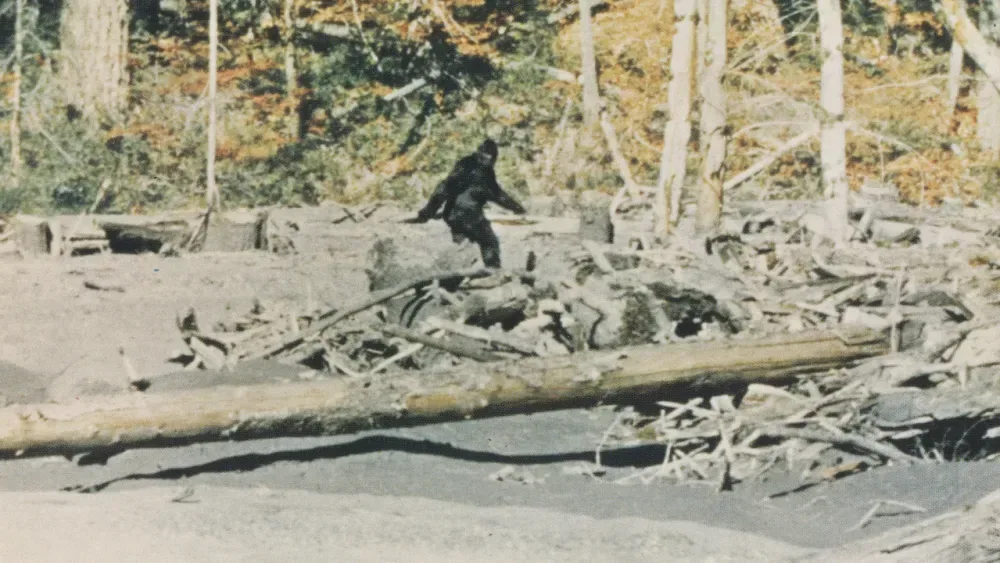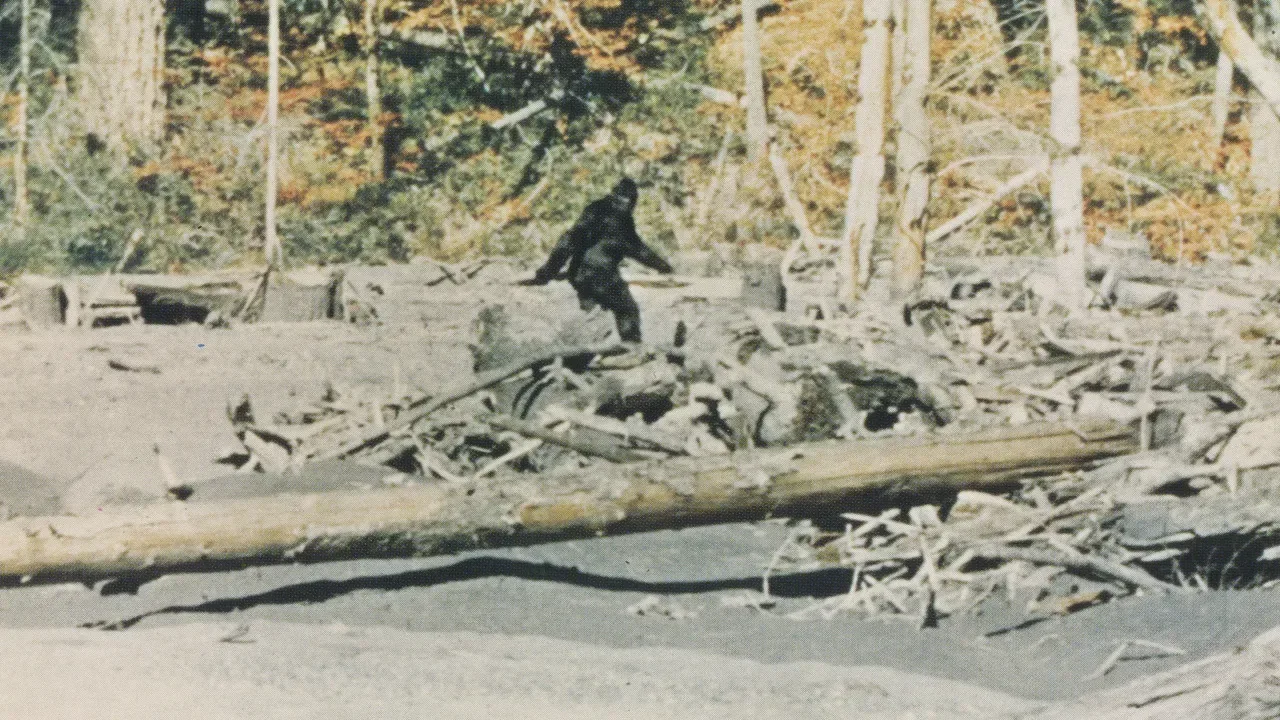
Capturing Bigfoot begins where the modern Bigfoot myth became impossible to ignore: with 59 seconds of shaky 16mm film. Shot in Northern California on Oct. 20, 1967, Roger Patterson’s footage appears to show an ape-like figure moving through a wooded clearing, briefly turning toward the camera before continuing into the foliage. The fragment is short, grainy and distant, yet it became an extraordinarily durable piece of alleged evidence—one that helped transform Bigfoot from regional folklore into a mass-media phenomenon.
Director Marq Evans approaches that history as a mystery with a promised answer. The 103-minute documentary is not framed as another open-ended paranormal tour, asking audiences to settle for a shrug and an ominous silhouette. It follows Patterson’s life, the people closest to the filming, the business built around the image, and a previously lost 16mm reel that the film presents as crucial evidence. Its central argument is clear: the famed Patterson footage was staged.
That makes Capturing Bigfoot more than a creature-feature investigation. It is a documentary about what happens when a piece of media feels authentic enough to become cultural fact—whether or not the event it depicts occurred.
The image that made Bigfoot mainstream
The Patterson clip has survived because it offers exactly enough information to invite interpretation. The figure is visible, but never close enough for certainty. Viewers can study its gait, apparent musculature and body shape, while the limitations of the image leave room for every possible counterargument. Evans foregrounds that ambiguity before moving backward into Patterson’s life and forward into the consequences of the footage.
Descriptions of the clip often emphasize its rough, amateur visual quality. That texture became part of its persuasive force. In film terms, cinéma vérité refers to a style associated with spontaneous, observational footage and an impression of unvarnished reality. A jittery handheld image is not proof on its own, of course, but audiences frequently read such imperfections as signs that an event was not carefully manufactured. The documentary’s larger story is that the look of evidence can sometimes matter as much as the evidence itself.
Patterson was not simply a man who happened to be holding a camera in the woods. The film portrays him as a Yakima, Washington, rodeo rider and ambitious self-made image-maker whose interest in outsized simian humanoids went back to the late 1950s. A 1959 magazine article about an American counterpart to the Abominable Snowman helped deepen that obsession. In 1966, a year before the famous film, Patterson published Do Abominable Snowmen of America Really Exist?, a Bigfoot book illustrated with his own elaborate drawings.
That background matters. The documentary does not depict the footage as an isolated accident that brought an unsuspecting man sudden fame. Instead, it places the film within a longer effort to imagine, illustrate and sell the possibility of Bigfoot.
From Yeti and Sasquatch to a media-era monster
The creature’s names carry a longer cultural lineage. The Himalayan Yeti supplied one branch of the legend, while Sasquatch became a familiar term in British Columbia. Patterson’s film gave the American version a definitive visual avatar: not a footprint, campfire story or eyewitness report, but a moving body on celluloid.
That distinction explains why the footage traveled so far. Stories can be doubted, but film arrives with an implicit challenge: if the camera saw it, what exactly are viewers looking at? Patterson leaned into that challenge. After the clip gained attention, he appeared on major talk shows and took the material on a theatrical road tour, charging $2 per ticket. The documentary describes the film as spreading with an intensity that resembles modern virality, long before that word became standard shorthand for an image ricocheting through public culture.
Its acceptance was helped by placement in scientific magazines and its presentation as a potential anthropological discovery. That did not settle the question of authenticity, but it gave the footage a setting in which audiences could treat it as a serious object of study rather than merely a novelty. Evans’ account is useful precisely because it tracks the machinery around the clip: publicity, touring, institutional attention and the financial rewards of having the only image that seemingly proved a legend.
The film’s earnings also created friction. Capturing Bigfoot describes substantial money flowing from the road-show success, while raising questions about how it was distributed among those connected to Patterson. His brother-in-law, Al DeAtly, is portrayed as benefiting significantly, while Bob Gimlin—Patterson’s close associate—reportedly did not receive a comparable share. Gimlin remains part of the Bigfoot convention circuit, an indication that the 1967 encounter has continued to shape lives and livelihoods long after Patterson’s death in 1972.
Why experts continued to disagree
One of the documentary’s strengths is that it does not pretend belief in the footage disappeared simply because counterevidence existed. Evans includes people who defend its authenticity. Dr. Jeffrey Meldrum, an anatomy professor at Idaho State University, argues that he can identify detailed muscle groups in the figure. He also maintains that the subject appears female, pointing to visible mammary glands.
Bill Munns, who began working as a make-up artist at Universal Studios in 1969, offers another version of the pro-authenticity argument. His position is that the figure could not have been a performer in a convincing suit because the effects technology available at the time would not have produced such a natural-looking result.
These perspectives are important not merely as dramatic opposition. They identify why the image maintained its power: a blurry recording does not eliminate analysis; it multiplies it. Anatomy, costume construction, camera limitations and body movement can all become fields of debate when the underlying image is brief enough to resist a final reading.
For viewers, this is also a practical media-literacy lesson. Technical language can clarify an image, but it can also make a conclusion sound more settled than the image allows. A claim about visible muscles, for example, is an interpretation of imperfect visual material, not a substitute for independently verifiable physical evidence. Likewise, a claim that a costume would have been difficult to make is different from proof that no costume was made. The distinction is not nitpicking; it is the gap between assessing plausibility and establishing fact.
The documentary’s case: rehearsal, costume material and a familiar walk
Evans eventually turns the investigation toward evidence that, in the documentary’s telling, shifts the discussion from how real the figure looks to how the image may have been prepared. Clint Patterson, Roger’s son and the film’s central on-camera figure, recalls entering his father’s usually locked shed as a child and finding a stack of second-hand fur coats. On its own, that memory does not explain the 1967 film. In the documentary’s structure, however, it becomes one element in a growing case about the practical materials behind a plausible-looking creature.
The more consequential piece is a lost 16mm movie from 1966, the year before Patterson filmed the celebrated Bigfoot sequence. Capturing Bigfoot presents this earlier reel as a rehearsal-like precursor to the later footage. The film also brings in Bob Heironimus, an associate of Patterson whose walk is positioned as especially significant to the investigation.
Those details are the basis for the documentary’s stated conclusion that Patterson’s Bigfoot was a hoax. Because this is a review of the film’s argument rather than a separate forensic inquiry, the most accurate framing is that Evans assembles the material as a decisive resolution, and the documentary itself treats the case as solved. Its achievement lies in how it connects the alleged fabrication to a wider network of planning, promotion, money and family loyalty rather than reducing the story to a single gotcha moment.
Clint Patterson and the cost of inheriting a legend
The personal stakes are concentrated in Clint Patterson. He is shown for much of the film as a believer in his father’s footage, which means the documentary’s investigation is never just an abstract correction to a famous piece of pop culture. It bears on a son’s understanding of his father and on the stories a family has been asked to preserve for decades.
That is where the film’s title gains a second meaning. “Capturing” does not only refer to capturing an alleged creature on film. It also suggests capturing a narrative before it changes shape again—getting at the hidden arrangements, unresolved resentments and financial incentives that can be buried beneath a beloved myth.
It is tempting to regard a revealed hoax as the end of the tale. Evans argues the opposite. If the Patterson footage was manufactured, that does not erase its cultural impact; it explains why studying its spread matters. The clip made Bigfoot more visible, more marketable and more easily reproduced in the public imagination. A fabricated document can have very real consequences when enough people build communities, careers or identities around it.
What the Bigfoot story says about belief
Capturing Bigfoot arrives in a culture accustomed to debating blurry footage, extraordinary claims and competing interpretations of what official or expert voices do—and do not—establish. The documentary draws a broad connection between Bigfoot belief, contemporary fascination with UAPs and wider conspiratorial thinking. That connection is an interpretive theme rather than proof that all such beliefs are identical. The useful point is narrower: uncertainty creates an opening, and compelling media can make that opening feel like confirmation.
The film also invites comparison with other mythic images later identified as constructed. It notes the 1934 Loch Ness Monster photograph, revealed in 1994 to have been made with wood putty attached to a toy submarine, and the crop-circle admissions from Doug Bower and Dave Chorley, who explained in 1991 that they had created a formation in 1978. Such revelations can feel oddly disappointing even to skeptics. The loss is not necessarily belief in a monster or extraterrestrial force; it is the loss of an alluring possibility.
That emotional complication is central to Capturing Bigfoot. The documentary’s apparent answer is not offered as a smug dismissal of anyone who ever found the 1967 footage intriguing. It instead asks why an image that was always limited, distant and contested became so persuasive. The answer involves Patterson’s resourcefulness, the period’s appetite for sensational stories, the authority lent by a camera, and the human preference for a tantalizing mystery over a mundane explanation.
For pop-culture viewers, the film is a reminder that an icon need not be true to be influential. The Patterson footage is still an iconic monster image because of the story people attached to it, the institutions that circulated it and the market that formed around it. Capturing Bigfoot makes the alleged deception the subject, but its more durable subject is the audience: what we want an image to prove, and how quickly a 59-second fragment can become a world.
For another look at how media, pop culture and technology shape the stories people attach to entertainment, see our coverage of the choices behind 007 First Light’s young Bond origin.
Key details
- Title: Capturing Bigfoot
- Director: Marq Evans
- Running time: 103 minutes
- Central subject: Roger Patterson’s Oct. 20, 1967, 16mm Bigfoot footage
- Featured participants: Clint Patterson, Bob Gimlin, Bob Heironimus, Greg Long, Jeffrey Meldrum, Bill Munns, Teresa Brooks and Larry Lund
- Documentary’s stated conclusion: The 1967 Bigfoot footage was a hoax