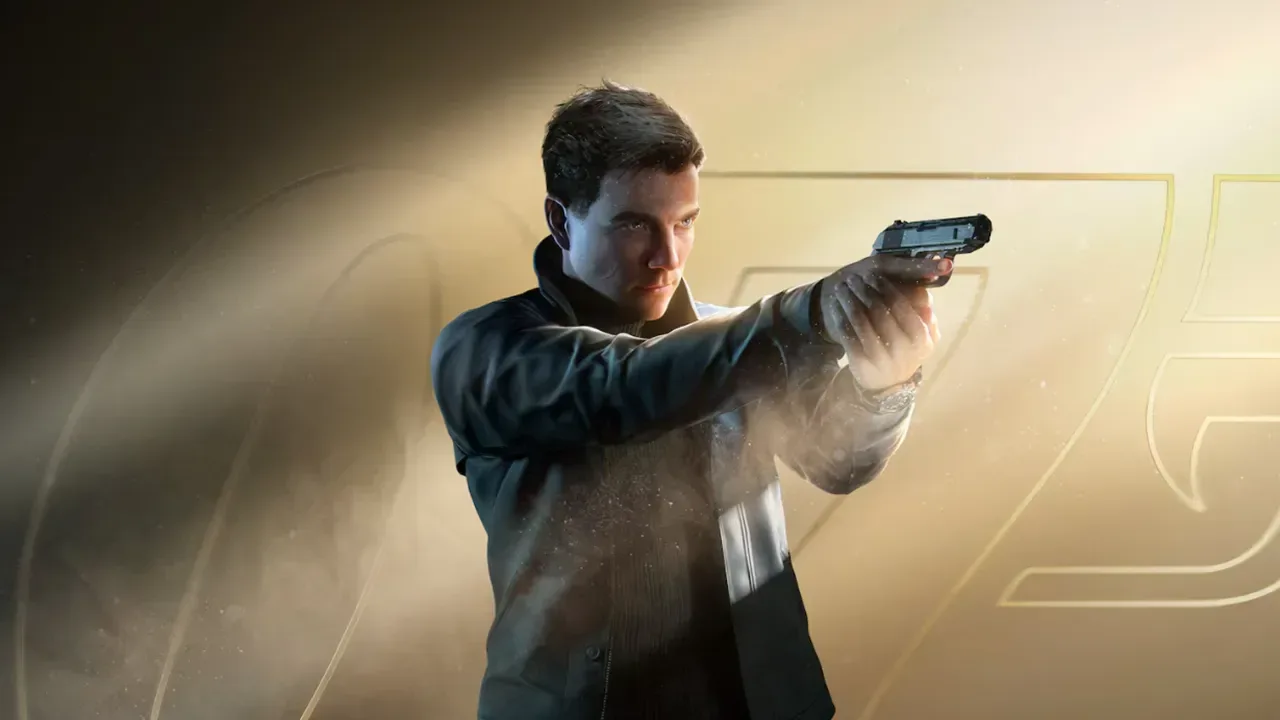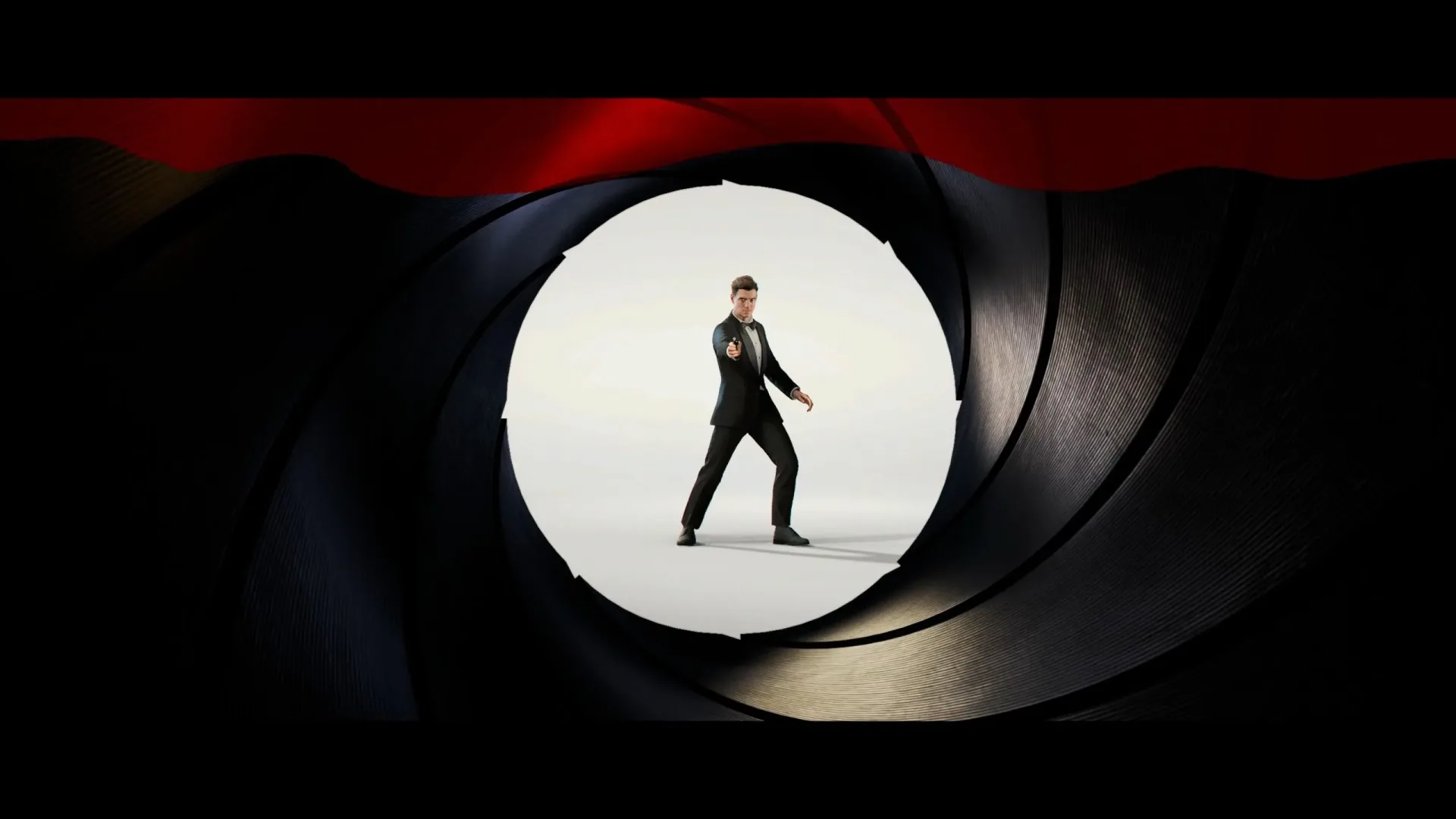
Researched feature, October 18, 2026: 007 First Light launched May 27, 2026. This is an analysis of its documented premise, design and post-launch update, not a hands-on review; we have not independently played or benchmarked it. The original illustrations below are not official game art or screenshots.
Bond before the myth
On October 18, 2026, 007 First Light is no longer a promise about what IO Interactive might do with James Bond. It launched on May 27 for PlayStation 5, Xbox Series X|S and PC, and its first major post-launch update arrived on October 1. That timing makes the game’s central gamble easier to examine: an origin story cannot simply hand players the finished Bond and ask them to admire the packaging. It has to make an incomplete Bond playable, while still giving him enough shape to feel like Bond at all.
That is a narrower and more difficult target than recreating a familiar film fantasy. This is an original, standalone reimagining of Bond at 26, before the character has hardened into the effortless professional audiences usually recognise. Patrick Gibson plays a young Royal Navy air crewman recruited into MI6 after an incident in Iceland. The premise places him at the point where training, instinct and institution begin pulling in different directions. His identity is not a costume waiting in a wardrobe; it is the thing the game must gradually turn into a method.
The playable problem of becoming Bond
Origin stories often confuse explanation with transformation. They list the experiences that supposedly produced a legend, then expect the audience to fill in the emotional arithmetic. A game has another burden: it must express that development through actions the player performs repeatedly. If early Bond is meant to be less polished, the design has to communicate that without making him frustrating or incompetent. If he is already too capable, the origin becomes decorative. The challenge is to let uncertainty exist inside a usable action-adventure hero.
First Light approaches that problem through a third-person blend of stealth, social manipulation, gadgetry, driving and direct action. Those ingredients are recognisably Bondian, but their significance changes when the protagonist is still learning what each one means. A disguise or conversation is not only a route past an obstacle; it can represent Bond discovering that charm is a tool, not merely a personality trait. A gadget is not just a reward for progression; it is a shortcut around the limits of experience. The distinction matters because an origin should show competence being assembled, not merely announced.
IO Interactive’s history with HITMAN makes the comparison unavoidable, but the useful contrast is not simply “Bond with guns” versus “Agent 47 with a licence to kill.” Agent 47 enters his situations as a finished instrument. His coolness is the premise, and the player experiments within it. A young Bond should generate a different rhythm: more improvisation, more social risk, and perhaps more tension between the plan a player imagines and the identity Bond is trying to project. The same studio can reuse expertise in infiltration while changing what infiltration says about its protagonist.
That also explains why calling First Light a HITMAN reskin would miss the more interesting design question. HITMAN is fundamentally about authored spaces behaving like systems around a known assassin. Bond’s fantasy includes systems, but it also depends on momentum, danger and performance. He is not only trying to solve a room; he is trying to become the sort of person who can walk into the next room with confidence. The game therefore has to balance systemic possibility against a directed origin narrative, without allowing either side to erase the other.
Between the films and the sandbox
The game’s Bond is not being inserted into film continuity, and that separation is important. It frees IO Interactive from reproducing a specific actor’s mannerisms, a familiar chronology or a canonised version of the character’s emotional history. It also removes an easy source of authority. The game cannot rely on the audience thinking, “This is Bond because I recognise that scene.” It has to establish its own version through setting, performance and the logic of play.
That independence creates room for a younger, less ceremonially defined figure. A 26-year-old Royal Navy air crewman carries a different physical and social history from the seasoned spy of most screen adventures. He can be disciplined without being worldly, brave without being controlled, and observant without always knowing which details matter. Those contradictions are more valuable than a simple before-and-after portrait. They give players something to interpret through approach, rather than merely something to watch in cutscenes.
IO Interactive has described player choice here as choice of approach, not as access to an unrestricted open world. That qualification is central to understanding the project. The fantasy is not that Bond can wander across a giant map inventing a private life. It is that a mission can accommodate different expressions of professional judgment: stealth, social manipulation, gadgets, driving or force. A bounded situation can still feel personal if the player decides what kind of agent Bond is becoming when pressure closes in.
Approach-based choice is also a way to avoid making young Bond’s uncertainty purely verbal. A player who favours observation and misdirection is rehearsing one version of his future trade; a player who leans on action is rehearsing another. Neither automatically defines the canon of this Bond, but each makes the player complicit in his formation. The tradeoff is obvious: authored characterisation may need to remain stable even while player behaviour varies. The strongest version of the idea would make those choices feel like facets of an emerging professional, not morality sliders attached to a famous name.
The same tension applies to spectacle. Bond games are expected to deliver cars, gadgets and danger, yet an origin should resist turning every early success into proof that the hero was always perfect. Driving can be pursuit, escape or cover for improvisation. Gadgets can extend possibility while exposing dependence on equipment. Social manipulation can succeed because Bond is perceptive, or fail because confidence is not the same as control. These are design opportunities rather than guaranteed outcomes, but they show why the origin premise matters mechanically instead of merely cosmetically.
This is where the distinction from film adaptations becomes most useful. A film can imply that a gesture carries years of experience because an actor supplies the weight between cuts. A game must let the player repeat, test and sometimes misunderstand that gesture. It can use performance and staging to establish a young man under pressure, but interactivity decides whether that youth is felt as a meaningful condition or simply mentioned in biography. The origin succeeds only if the player’s verbs and the character’s situation are telling the same story.
There is no need to pretend that every choice can transform Bond into an entirely different person. A recognisable protagonist requires boundaries, especially in a licensed character adventure. The more practical aim is subtler: let players vary the route by which Bond arrives at a stable idea of himself. That makes the game distinct from both the fixed spectacle of a film and the near-limitless experimentation associated with HITMAN. It is a story about formation expressed through controlled freedom.
Seen from this October vantage, 007 First Light is most interesting not as a catalogue of Bond references, but as an attempt to solve a problem the franchise rarely has to face. How do you make a legend playable before he has earned the legend? IO Interactive’s answer combines a young protagonist, mission-based choices and a toolkit broad enough to support several kinds of spycraft. Whether every part of that balance lands is a question for sustained criticism, not a fact to assume. The design ambition, however, is clear: Bond begins here not as a myth in waiting, but as a player-shaped professional learning what the myth will demand.
The long gap in big Bond games
From split-screen sensation to a difficult legacy
For many players, Bond videogame history still begins with GoldenEye 007. Rare’s 1997 Nintendo 64 adaptation did more than translate a film into corridors, objectives and gunfights. It made a console shooter feel like a social occasion, with four-player split-screen turning a cinematic fantasy into a competitive ritual. Its campaign also gave players room to think about difficulty, timing and mission objectives rather than simply advancing through a sequence of targets. That combination became the standard against which later Bond games were measured, whether or not they were trying to reproduce it.
The achievement is easy to misread in retrospect. GoldenEye was not simply “a Bond game with multiplayer,” nor was it a complete template for the character. Its stealth was limited by the technology and conventions of its era, its shooting had a particular, sometimes awkward rhythm, and its levels were shaped by the needs of a first-person console game. Yet it captured something essential: Bond could be both a precise professional and a player-controlled problem solver. The fantasy was not only possessing better weapons. It was entering a space, reading its security, and deciding how much noise the mission could tolerate.
The games that followed explored different answers. Some leaned harder into first-person shooting, while others pursued a more overtly cinematic third-person action style. Tomorrow Never Dies and The World Is Not Enough extended the film-licensed shooter approach; Agent Under Fire and Nightfire built original adventures around familiar Bond ingredients; Everything or Nothing made a conspicuous push toward set-piece spectacle; and later releases such as From Russia with Love and 007 Legends revisited established screen eras in different ways. None of these games needs to be reduced to a failed attempt at being GoldenEye. They show a licence repeatedly being pulled between adaptation, original fiction and whatever action-game form was fashionable at the time.
That tug of war explains why Bond has never settled into one obvious videogame genre. The films make him a spy, but also a driver, infiltrator, improviser, gambler, investigator and action hero. A game that prioritises shooting can satisfy the blockbuster side while neglecting the professional tradecraft. A game that insists on stealth can make Bond feel less like a daring adventurer and more like a patient systems operator. Driving, gadgets and social deception each suggest a different control language. The licence promises all of them, while a coherent game usually has to decide which ones are foundational.
Meanwhile, the wider shooter has changed around Bond. Modern first-person campaigns have trained players to expect responsive weapons, cinematic pacing and elaborate spectacle, while immersive sims and stealth games have made systemic spaces, guard awareness and multiple solutions part of the conversation. Third-person action adventures add their own expectations: expressive movement, cover, traversal and a camera that keeps the hero visibly central. A new Bond game cannot merely revive the surface details of an older formula. It has to explain why this particular mixture of shooting, sneaking, gadgets and style belongs to Bond rather than to any competent action protagonist.
Why a licence this complicated is hard to carry
Licensed games face a problem that original games can often postpone: the audience arrives with a pre-existing Bond in its head. Some players want the cool restraint of the earlier films; others expect modern spectacle, familiar music, iconic cars or the wry confidence associated with the long-running screen tradition. The developer must satisfy recognition without making the game feel like a museum display. It must also tell a story that can stand on its own, despite being attached to a character whose image is already heavily managed.
There is a practical difficulty, too. A Bond game needs to justify expensive-feeling variety without becoming a catalogue of disconnected attractions. A driving sequence, a casino encounter, a stealth compound and a large firefight may all be individually plausible, but they can feel like separate demonstrations if the underlying verbs do not connect. The most convincing Bond design would let information gathering lead naturally into infiltration, social access create an advantage during action, and gadgets change the shape of a pursuit rather than merely decorate an equipment wheel. That is a demanding structure for any studio, particularly under the constraints of a major entertainment licence.
This is why the long gap between substantial Bond games matters more than a simple count of releases. The absence is not just a missing brand on a release calendar; it is time in which player expectations have moved on. A contemporary Bond game has to answer the memory of GoldenEye without being trapped by it, compete with polished action-adventure design without imitating a specific rival, and establish a new interpretation without pretending the character has no history. The challenge is less “make Bond popular again” than “decide what playing Bond should mean now.”
IO Interactive is an unusually relevant studio for that question. Its work on Hitman has made it closely associated with stealth, disguise, observation and the pleasure of arranging an approach before committing to it. That does not automatically make a Bond game a larger Hitman, and treating it that way would miss the distinction between a repeatable assassination sandbox and a directed spy adventure. But IOI understands the dramatic value of a room full of people who do not know the player’s intentions, and it understands that information can be as useful as ammunition.
The announced shape of 007 First Light reflects that opportunity. It is a third-person action-adventure combining stealth, social manipulation, gadgetry, driving and direct action, with player choice framed around approaches rather than an unrestricted open world. That qualification is important. Bond does not need a map filled with unrelated activities to feel free; he needs missions in which preparation and judgement affect the route through a dangerous situation. IOI’s experience gives the project a credible design vocabulary for that kind of choice, even though the final balance between authored drama and player expression must be judged on the game itself, not inferred from the studio’s reputation.
A new starting point, not a return to the old one
First Light also makes a consequential choice by presenting an original, standalone origin for a 26-year-old James Bond. Patrick Gibson plays Bond as a Royal Navy air crewman recruited into MI6 after an incident in Iceland. That premise gives the designers permission to show a Bond who is not yet the fully formed cultural icon. It can make mistakes, learn institutional habits and discover how charm, nerve and violence operate inside a professional intelligence service. Just as importantly, it avoids asking the game to continue a particular film continuity.
An origin story can therefore solve one of the licence’s oldest problems while creating another. It offers a clean entry point for people who know Bond mainly as a screen legend, but it risks turning the character into a generic trainee if his defining qualities are postponed too long. The interesting question is not whether young Bond can already win every encounter. It is whether the game can show competence developing without confusing inexperience with helplessness. A player should feel that this is Bond becoming Bond, not simply an ordinary agent wearing a famous name.
The significance of IOI’s project, then, is not that it guarantees a definitive Bond game or erases the shadow of GoldenEye. It is that the studio is approaching the licence through the relationship between identity and method. Bond is compelling when the player’s route through a situation says something about the agent: discreet, theatrical, reckless, patient or ruthlessly direct. A game built around that idea can acknowledge the history of shooters without becoming another corridor of targets, and can use the licence’s many ingredients as connected choices rather than mandatory stops on a theme-park ride.
That is a high bar, especially after years in which Bond’s videogame presence felt intermittent rather than central. The useful comparison is not whether First Light recreates a cherished multiplayer memory, nor whether it contains every expected Bond flourish. It is whether its young protagonist gives modern action-adventure design a convincing reason to slow down, observe, deceive and improvise before the shooting starts. The old lineage supplies the pressure. IOI’s value lies in having a plausible answer to what should replace simple nostalgia.
Who this Bond is—and is not
A beginning, not a missing chapter
007 First Light starts with a useful act of separation. This is not a continuation of the Bond films, nor a game attempting to squeeze itself between established cinematic adventures. IO Interactive’s version is a standalone reimagined origin for James Bond at 26: young enough to be unfinished, old enough to have already made consequential choices. That distinction matters because “origin story” can mean either a fresh foundation or an overfamiliar explanation for a character who never needed one.
Here, Bond begins as a Royal Navy air crewman rather than as the fully formed international superspy that popular culture usually delivers. An incident in Iceland becomes the point at which his capabilities, temperament and appetite for danger attract MI6’s attention. Recruitment is therefore not a ceremonial prologue before the real game begins. It is the premise: what does an institution see in this particular young man, and what might it fail to see?
The answer is not simply that Bond is talented. Talent is the least interesting part of an origin. The more revealing question is how his strengths arrive tangled with liabilities. A 26-year-old who can improvise under pressure may also confuse nerve with judgment. Someone comfortable in the air, at sea or in a crisis may be less prepared for the slow social calculations of espionage. First Light has room to present those contradictions without pretending that the finished 007 was hiding inside him all along.
That is where Patrick Gibson’s casting becomes especially important. A younger Bond should not be played as a miniature version of the most familiar screen interpretations, with the same polished pauses and effortless authority merely reduced in age. Gibson’s presence allows the character to read as capable but not settled, attractive without being invulnerable, and quick to act before he has fully considered what an action will cost. The performance, as framed by this reimagining, is less about impersonating a legacy than establishing a new baseline for it.
Recklessness as character, not decoration
Youthful recklessness can easily become a shorthand for “Bond before the tuxedo.” That would be a thin use of the idea. The stronger version treats recklessness as a design problem: a player is given a hero whose instincts can create opportunities and complications at the same time. Stealth, social manipulation, gadgetry, driving and direct action are not just a catalogue of Bond activities; together, they describe different ways of making a decision when certainty is unavailable.
IO Interactive has described choice in terms of approach rather than an unrestricted open world. That qualification helps define the game’s ambition. This is not a promise that every action permanently rewrites a vast simulation, or that Bond can wander through a consequence machine with no authored direction. Instead, the player is invited to decide how this inexperienced operative handles a problem within carefully shaped situations. That is a more credible fit for an origin: freedom expressed through temperament, not infinite geography.
A stealth route can suggest patience, but it does not automatically make Bond patient. Social manipulation can demonstrate charm while also exposing arrogance or misjudgment. A gadget may solve an immediate obstacle while encouraging the player to take a risk that a more cautious agent would avoid. Even driving and action sequences can contribute to the portrait when they feel like expressions of a young man testing the limits of what he can get away with, rather than obligatory attractions in a spy-themed amusement park.
The Iceland incident, kept here at the level of premise rather than plot detail, is consequently more valuable as a pressure point than as a mystery box. It places Bond in circumstances that make his recruitment plausible, but it should not function as a single traumatic explanation for every later behavior. Origins become dramatically smaller when one event is asked to explain a whole personality. The better possibility is that Iceland reveals a pattern already present: initiative, courage, impatience and a dangerous confidence that consequences can be managed afterward.
That pattern also gives MI6 a credible reason to recruit him without making the service look omniscient. Institutions often identify useful people for mixed reasons. Bond may be promising, available, politically convenient or simply impossible to ignore after what happens in Iceland. Recruitment can be opportunity as much as destiny. Presenting it that way preserves the tension between Bond’s self-image and the organization’s assessment of him: he may believe he has been recognized, while MI6 may mainly believe he can be deployed.
Earning the symbols
The number 007 carries enormous visual and cultural weight. So do the tailored clothes, the gadgets, the cars, the dry confidence and the elegant violence. An origin has to decide whether to withhold those symbols until they feel earned or introduce them early and ask the player to understand them differently. First Light can use the iconography without claiming that the young man already possesses the finished meaning of it. A symbol can be present before its owner fully grows into it.
That distinction keeps the game from treating film continuity as a rulebook. The cinematic Bonds are a collection of interpretations, eras and tonal agreements, not a single biography that every new work must obey. This Bond does not need to explain why he has not appeared in a particular film, or account for every established relationship, scar, vehicle or line of dialogue. He belongs to this game’s continuity. Familiarity is a creative ingredient here, not proof that the game is secretly canonical to the movies.
For a general audience, the payoff is that newcomers need not approach First Light as homework. The character’s reputation arrives before he does, but the game’s central task is to make that reputation provisional. The player knows what Bond is supposed to become; the drama lies in watching a young operative repeatedly approach that image, diverge from it and occasionally mistake performance for identity. An origin works when the destination is recognizable without making the journey feel predetermined.
The danger, naturally, is that player choice can pull against that authored development. If an origin promises a specific emotional and professional transformation, too much flexibility may make Bond feel like a costume worn by the player rather than a person being shaped by events. Yet too little flexibility would turn the player into a spectator of someone else’s apprenticeship. The useful compromise is not to make every choice canonically equal, but to let different approaches reveal competing facets of the same unsettled character.
What finally makes this Bond interesting is the gap between icon and recruit. He is already James Bond in name, but not yet in certainty, discipline or cultural meaning. The Iceland incident gets him noticed; MI6 gives him a direction; Gibson’s youthful performance gives the role room to remain volatile. 007 First Light earns the right to use the familiar signals when it treats them as milestones in a becoming, rather than certificates proving that the legend was complete from the opening scene.
IO Interactive’s design inheritance
The lesson of the sandbox
IO Interactive arrives at James Bond with a design language already legible to players: the dense, watchful spaces of HITMAN. Those games made a level feel less like a corridor and more like a machine whose parts could be studied, accessed and redirected. A target’s route, a guard’s attention, a locked door and an apparently trivial object all became pieces of a readable system. That history matters to 007 First Light, but it should be treated as inheritance rather than identity.
The confirmed shape of First Light is a third-person action-adventure combining stealth, social manipulation, gadgetry, driving and more direct action. IO Interactive has also described it as a game in which players can choose their approach, while explicitly stopping short of presenting an unrestricted open world. That distinction is important. It suggests authored missions with room for interpretation, not a Bond-flavoured life simulator or a map designed to absorb every possible activity.
In HITMAN, systemic space is often the star. A location is built to expose relationships: who can enter, who can overhear, who is trusted, and which routine creates an opening. The player learns by watching, then acts on that knowledge. For Bond, this same principle has obvious dramatic value. Espionage is not merely sneaking past a camera; it is understanding a room quickly enough to know which person, role or piece of information can move it in your favour.
That does not mean every Bond scene must become a puzzle box with a dozen solutions. A young agent’s story needs momentum, danger and the feeling of being pulled through an operation that has a shape of its own. The design challenge is therefore narrower and more interesting: how much freedom can a directed thriller offer before its tension dissolves into a set of optional chores? IOI’s previous work gives it experience with that balance, but First Light has to apply the lesson to a different kind of fantasy.
From disguises to access
Disguise is the most obvious bridge between the two series. In HITMAN, changing clothes is never just cosmetic. It is a temporary permission slip, allowing the player to cross a threshold or stand near someone who would otherwise be unreachable. The interesting question is not “Can the protagonist look like this person?” but “What does this identity allow, and where will it stop working?” That logic suits Bond because espionage depends on controlled performances rather than simple invisibility.
Still, Bond’s social manipulation cannot be reduced to Agent 47’s wardrobe economy. A tuxedo is a symbol, not a universal access card. The Bond fantasy involves reading motives, projecting confidence, using gadgets to tilt a conversation and deciding when charm has become a liability. If First Light inherits anything from HITMAN here, it is the idea that social space can be navigated as deliberately as physical space—not the assumption that every problem should be solved by borrowing somebody else’s uniform.
IOI has confirmed the broad ingredients, including stealth, social manipulation and player choice in approach. The more specific interpretation—that particular conversations, disguises or gadgets will reliably open distinct routes—is an inference about how the studio’s established design habits may express themselves, not a feature list we should quietly turn into fact. That distinction matters in a game whose appeal can be overstated by describing imagined possibilities as though they were demonstrated systems.
The same caution applies to improvisation. HITMAN encourages players to recover from mistakes, exploit an unexpected opportunity or turn a compromised plan into a new one. Such improvisation is a natural fit for a novice Bond, especially one portrayed as a 26-year-old Royal Navy air crewman recruited into MI6 after an incident in Iceland. Yet the confirmed premise does not, by itself, prove that every mission is an open-ended experiment. It tells us the character is at the beginning of his career; it does not guarantee unlimited player-authored outcomes.
An authored Bond, not a tuxedoed Hitman
The most useful comparison with HITMAN may therefore be structural rather than superficial. Both can make preparation, observation and access feel meaningful. But First Light is a standalone reimagined origin adventure with its own protagonist, tone and dramatic obligations. It is not simply HITMAN with a tuxedo, and treating it that way would flatten what the Bond licence brings to the design: propulsion, glamour, danger, gadgets, vehicles and the pressure of becoming a particular kind of spy.
That authored quality also separates it from the fantasy of being an anonymous operator. Agent 47 is defined by professional certainty; this Bond begins before the legend has hardened. A mission can ask the player to choose an approach while still framing the experience around his recruitment, his changing relationship to authority and the risks of learning in public. The choices may alter how a situation is handled without turning the protagonist into a blank avatar whose personality is assembled entirely from player preference.
Driving and action are especially significant in that distinction. IOI’s earlier reputation is tied to controlled spaces and patient observation, whereas Bond has always moved between infiltration and spectacle. The confirmed mixture of driving, action, gadgetry and stealth implies a broader rhythm than a pure social stealth game. Whether those elements combine seamlessly is a question for the finished experience and for play, not something to declare in advance. What can be said now is that the design brief is wider than the studio’s most familiar template.
That qualification is essential when considering New Game+ or extra operations. They may encourage players to revisit spaces with greater confidence, test different approaches or notice details missed during a first run. Those are reasonable design implications, but they remain implications. The update tells us what was added; it does not automatically establish how much freedom each scenario contains, how widely choices propagate or whether the replay structure mirrors HITMAN’s mastery loop.
IO Interactive’s real inheritance is a habit of making environments speak. A guard’s patrol, a restricted room, a social expectation or a useful gadget can become information rather than decoration. In a Bond game, that habit can make glamour functional: the casino floor, diplomatic gathering or hostile facility is not merely a backdrop, but a network of permissions and risks. The danger is over-systematizing the fantasy until every human exchange feels like a menu and every elegant entrance conceals the same mechanical trick.
007 First Light will be most convincing when it lets those systems support authored moments instead of competing with them. The player should feel clever for finding a way through, but also feel the pressure of a story that knows where this young Bond is headed. IOI’s HITMAN history gives the studio a rare vocabulary for observation, disguise, social access and improvisation. The new game’s task is to speak that vocabulary in a different voice: not the voice of an endlessly replayable assassination sandbox, but that of an origin adventure teaching its hero—and its player—how to become Bond.
Reconnaissance, discretion and social play
October 18, 2026
The room is part of the weapon
James Bond’s most recognisable talent is not marksmanship. It is appraisal. He notices who is nervous, who is performing confidence, which door is being watched and when a conversation has quietly become a contest. In 007 First Light, IO Interactive’s description of stealth, social manipulation, gadgets and action points toward an origin story interested in that broader fantasy: Bond as someone learning to read a room before he decides whether to cross it.
That matters because a third-person action-adventure can reduce espionage to a parade of targets and cover positions remarkably quickly. IOI has instead presented the game around player choice in approach, rather than an unrestricted open world. The distinction is important. It suggests authored spaces with room for judgement: situations designed to support different attitudes to risk, timing and attention, without promising that every building is a miniature simulation or that every problem has limitless solutions.
The result, at least as a design proposition, is more interesting than simply making the young Bond stealthier. A spy does not merely avoid detection; he manages other people’s expectations. The fantasy lives in the gap between what Bond knows and what the room thinks he knows. A guard looking the wrong way, a host trying to impress him, or an ally waiting for a signal can all be as significant as an enemy behind a rifle. Social play gives those relationships mechanical weight without pretending that charm is a magic spell.
Conversation as controlled pressure
“Social manipulation” is a loaded phrase, and it is worth being precise about what it can mean here. Developer-described choice does not automatically amount to a fully reactive role-playing system in which every line rewrites the world. It can instead mean choosing when to conceal intent, when to apply pressure, and when to let another character believe they are in control. That narrower interpretation may be more appropriate for Bond, whose conversations are often acts of positioning rather than heartfelt self-expression.
There is a useful contrast with conventional dialogue-heavy games. In many role-playing adventures, conversation is a pause from danger: select a response, receive information, continue. A spy thriller can make the exchange itself feel like reconnaissance. The player is weighing timing, audience and consequence while remaining aware that attention is a resource. Speaking too boldly may be as conspicuous as firing a weapon; waiting may create a better opening, but it may also allow a situation to harden against Bond.
That makes discretion an active choice rather than the absence of action. The quiet approach is not necessarily the morally superior or mechanically easiest one. It may require patience, a willingness to leave useful information undiscovered, or acceptance that an imperfect opportunity is safer than a perfect one that demands exposure. Conversely, an aggressive approach can be rational when secrecy has already been compromised. The value is in asking why Bond acts, not merely rewarding the player for never being seen.
IO Interactive’s experience with stealth-oriented design gives this idea a useful lineage, but First Light is not simply another version of a familiar assassination sandbox. The studio has described a linear or authored action-adventure framework rather than an open-ended world of endlessly emergent contracts. That should temper expectations. The promise is not infinite improvisation; it is a curated Bond scenario in which the player can decide how much of Bond’s emerging identity is expressed through caution, manipulation, gadgets or direct force.
Timing, tools and the cost of certainty
Timing is the connective tissue between those approaches. A gadget is rarely interesting because it exists; it becomes interesting when its use changes the moment. The choice may be whether to spend a tool now, preserve it for a more uncertain situation, or accept a slower and more exposed route. Without inventing specific devices or mission rules, the broader design question is clear: does equipment expand the player’s reading of a space, or merely provide a button for bypassing it?
The best spy gadgets do not erase problems. They rearrange them. A device can create an opening, but the player still has to recognise what that opening means and decide how much risk to attach to it. This is where gadgetry belongs alongside conversation rather than above it. Both are forms of leverage. One alters the physical conditions of a scene; the other alters what people believe those conditions to be.
That emphasis also protects the young Bond premise from becoming a contradiction. A 26-year-old Royal Navy air crewman recruited into MI6 after an incident in Iceland should not feel like a fully formed legend simply because the player has a familiar name on screen. Patrick Gibson’s Bond can be capable without being omniscient. A system built around observation and timing has room for competence that must be exercised, not assumed: the player is not only choosing what Bond does, but helping define how he learns to operate under pressure.
The danger, naturally, is that social stealth can become decorative. If every conversation exists only to funnel the player toward the same encounter, then “manipulation” is flavour text attached to a shooting game. The same is true if every gadget has one obvious use or if waiting produces no meaningful advantage. IOI’s public framing establishes the intended ingredients, but it does not by itself prove how deeply they interlock. That is a distinction worth preserving when discussing a game we are not presenting as personally tested here.
Nor should discretion be confused with passivity. Bond’s appeal has always included decisiveness, and an origin story needs to show why this particular recruit can survive rooms populated by people with more experience, money or authority. Social play should therefore create tension between maintaining cover and asserting control. A player may want to stay invisible, but Bond may also need to take command of a conversation before someone else does. The drama comes from choosing the moment when restraint stops being an advantage.
Even the presence of a higher difficulty can be read in two ways. It may make detection and combat more punishing, but difficulty only serves the espionage fantasy when it sharpens decisions rather than merely enlarging penalties. The meaningful question is whether players are pushed to observe more carefully, manage timing more deliberately and treat force as a choice with consequences. A tougher firefight is not automatically a more intelligent spy game.
Ultimately, 007 First Light has a chance to make Bond feel like a profession before it makes him feel like a myth. Its stealth and social systems need to support the same basic act: looking at a situation and understanding its pressure points. Shooting should remain available because Bond is an action hero, but it should not be the only language the game takes seriously. The more clearly a player can distinguish between a room to infiltrate, a person to persuade and a crisis to confront, the more convincing this new origin becomes.
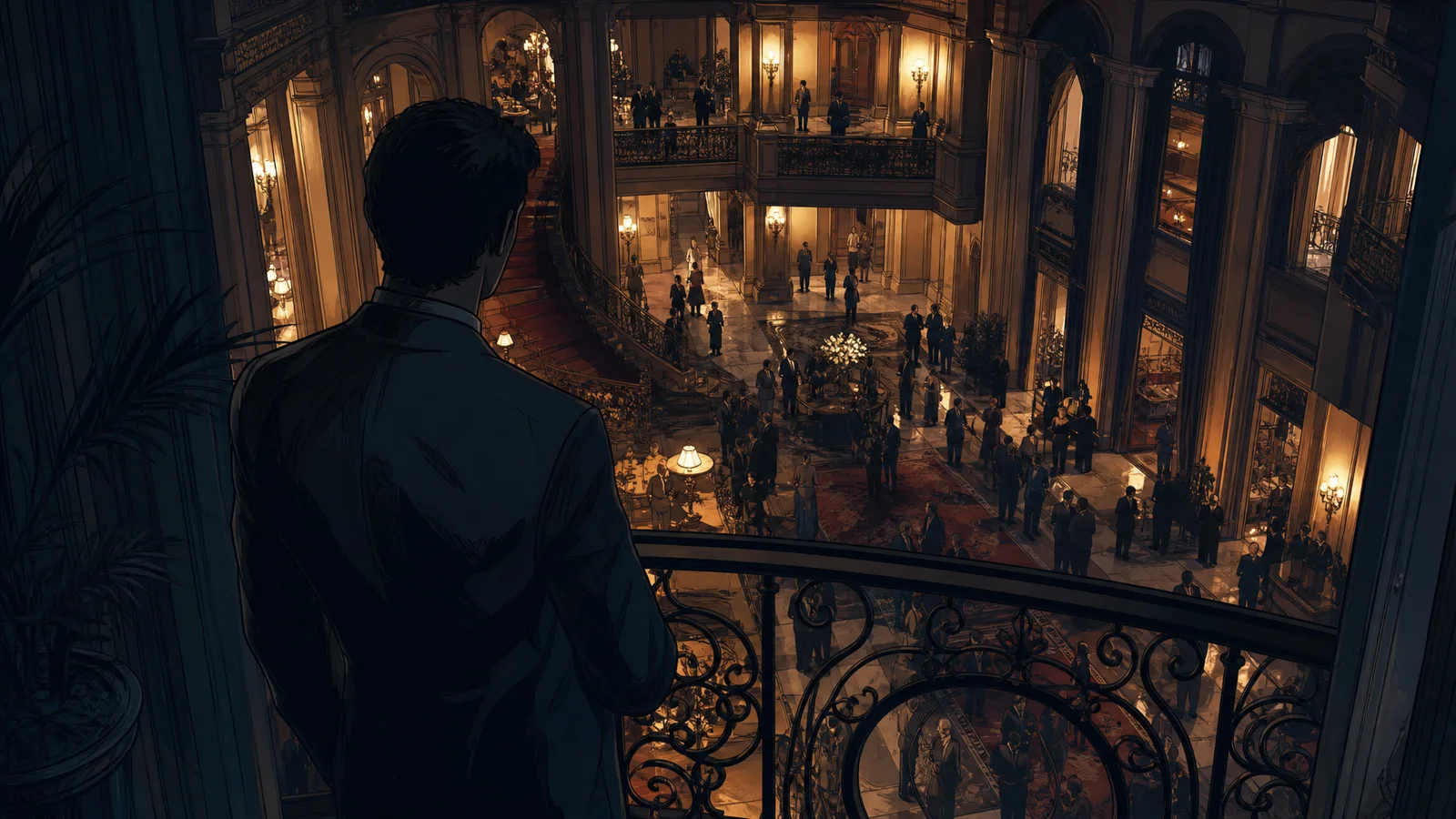
When subtlety gives way to spectacle
Action built to escalate
Published gameplay for 007 First Light presents action as a pressure valve on its quieter systems. The game is a third-person action-adventure about stealth, social manipulation, gadgetry, driving and direct combat, so a mission can move between reading a room and surviving its consequences. That mixture is important to its identity as a young Bond story. This is not an established agent gliding through every situation with effortless authority; it is a 26-year-old Royal Navy air crewman being pushed into a profession where improvisation has to become instinct.
The footage also makes clear that the game is comfortable with escalation. Suspicion can become pursuit, pursuit can become a firefight, and a carefully managed approach can give way to the kind of broad, kinetic danger expected from a Bond production. That progression is more than a parade of louder encounters. It is a design argument: subtlety matters partly because it creates a contrast with spectacle. If every situation were already a shooting gallery, social manipulation and stealth would be decorative options rather than meaningful ways to control risk.
IO Interactive has described choice here as flexibility in approach, not as an unrestricted open world. That distinction helps explain the shape suggested by the published material. First Light appears to offer authored spaces with room for different solutions, rather than a giant map in which Bond can freely manufacture missions. The benefit is dramatic focus. A chase can have a deliberate beginning, middle and end; a driving sequence can be staged around a specific turn in the story; an infiltration can be arranged to support both observation and interruption.
The cost is that agency exists inside a corridor, however wide that corridor may be. Players may decide whether to stay quiet, manipulate a social situation, use a gadget or draw a weapon, yet the broader escalation remains authored. That is not a flaw by itself. Most action games rely on such boundaries. The interesting question is whether the available choices alter the texture and danger of a sequence, or merely select one animation set before the same cinematic beat arrives.
Published gameplay suggests an effort to make those choices legible through the character rather than through abstract branching alone. A less experienced Bond should plausibly be learning how to survive uncertainty, not simply selecting dialogue from a menu and then reverting to perfect competence. Gadgets, weapons and movement therefore carry dramatic weight. They are tools in a developing professional vocabulary: solutions that can look elegant when prepared and desperate when used under pressure.
Driving between control and display
Driving is where the tension between player control and Bond spectacle becomes especially visible. A car chase asks the player to steer, brake and react, but it also asks the game to preserve cinematic rhythm. Designers need room for an authored camera, readable traffic patterns and moments of danger that arrive on cue. Too much control can make the sequence feel like an ordinary driving game; too little turns the player into a passenger holding a controller.
The published material positions vehicles as part of the broader action-adventure blend rather than as a separate racing system. That is a sensible choice for a Bond origin. The fantasy is not simply winning a lap; it is keeping composure while a plan collapses around you. Driving can function as a bridge between stealth and spectacle, carrying the player out of a controlled situation and into a more exposed one without requiring the game to abandon its authored structure.
That bridge also creates a useful measure of escalation. A stealth section narrows attention toward sight lines, timing and information. A chase widens it toward speed, obstacles and immediate survival. Direct combat then sharpens the question of whether the player is still choosing a response or merely enduring a prewritten crisis. Moving across these modes can make an operation feel like one unfolding problem rather than a stack of unrelated minigames, provided the transitions respect what the player was doing before the spectacle began.
There is a familiar danger in cinematic action: the player may perform the least interesting part of the event while the game performs the memorable part. Explosions, sudden reversals and dramatic escapes are easy to recognize in a trailer, but recognition is not the same as participation. The stronger version of this design lets authored drama establish the stakes while leaving the player responsible for positioning, timing and recovery. The spectacle should complicate agency, not replace it.
That principle matters even more for a young Bond than it would for a veteran one. An origin story has an opportunity to show competence being assembled under stress. If every spectacular beat is protected by invisible scripting, the character’s growth can feel cosmetic. If the game allows mistakes, improvised tools and changing levels of exposure to matter within its designed limits, escalation can communicate learning. Bond is not merely being introduced to danger; he is learning how to turn danger into an advantage.
The authored thrill
IO Interactive’s background in systemic stealth gives this problem an unusually relevant context. The studio’s best-known design language is associated with spaces that support observation, disguise and multiple routes through a situation. First Light is not simply another entry in that earlier format, and it is not being presented as one. Its action and driving ambitions require a more forceful cadence, but the same underlying interest in player-directed problem solving can still shape how a set piece begins and how much room remains inside it.
The result, at least in the published presentation, is a game negotiating two kinds of authorship. Film-style authorship dictates the reveal, the tempo and the emotional punctuation. Game-style authorship gives the player responsibility for approach and response. Neither side should completely win. Remove the first and Bond’s world can lose its tailored, larger-than-life momentum; remove the second and the player is left watching a Bond story with occasional steering and shooting duties.
Those additions should not be mistaken for proof that every tension has been solved. A higher difficulty can make decisions more consequential, but it does not automatically make a scripted transition more interactive. New Game+ can encourage experimentation, but replay value depends on whether the underlying spaces reward new approaches rather than simply permitting stronger equipment. The significance of the update is instead that it gives the game more opportunities to test its central proposition: that Bond’s spectacle is most satisfying when the player helps determine how he reaches it.
There is also a historical reason to be cautious about judging this balance by trailers alone. Bond action has always depended on editing, music, timing and impossible-looking escapes, while games must translate those effects into systems that can tolerate hesitation and error. A polished clip shows the intended line through a moment; it does not reveal every alternative line, nor how generously the game accommodates a player who refuses the obvious one. Published gameplay can establish ambition and structure, but not settle the final question of agency by itself.
What can be said is that First Light is making a deliberate bet on controlled escalation. Released on May 27, 2026 for PlayStation 5, Xbox Series X|S and PC, it frames action as part of a broader origin rather than as the whole assignment. Its chases, driving and combat need to feel like consequences of choices, even when their major beats are scripted. The most persuasive version of that design will not make spectacle smaller. It will make the player feel responsible for arriving at it—and for surviving what comes after.
Gadgets, technology and the modern spy fantasy
Less magic toolbox, more pressure valve
In Bond fiction, a gadget is rarely just a gadget. It is a promise that an impossible situation might still contain an elegant exit. The famous device matters because it changes the meaning of a locked door, a guarded room or a rapidly worsening plan. In 007 First Light, that tradition has to serve a younger Bond: a 26-year-old Royal Navy air crewman recruited into MI6 after an incident in Iceland, rather than the already polished operator familiar from many screen adventures. Technology therefore carries a useful dramatic burden. It can make him resourceful without pretending he is fully formed.
That distinction matters in a third-person action-adventure built around stealth, social manipulation, driving and action. The modern spy fantasy is not simply about collecting a better weapon or pressing a button marked “Q.” It is about reading a situation, identifying what information is missing and deciding which tool might compensate for that ignorance. A gadget can distract, conceal, observe or create an opening, but the player still has to judge timing and risk. The interesting question is not whether Bond owns a miraculous device; it is what kind of problem the device allows him to reinterpret.
This is where information becomes a gadget in its own right. A scrap of knowledge can be more valuable than an explosive, particularly in a social environment where the correct name, affiliation or vulnerability changes the available route through a scene. IO Interactive has described First Light as offering choice in approach, while stopping short of presenting an unrestricted open world. That qualification is important. It suggests authored spaces with room for improvisation, not a boundless simulation in which every object must support every conceivable scheme. The pleasure comes from finding leverage inside a designed situation.
That model also feels closer to espionage than the fantasy of endless equipment. Real intelligence work is built around uncertainty, preparation and interpretation: who knows what, who is pretending not to know it and what can safely be inferred from a small inconsistency. A game cannot reproduce that entire mess, nor should it try. It can, however, turn information into a form of navigational currency. The player who notices a social opening or understands a security pattern is not merely being rewarded with lore; they are being given a different way to spend attention.
Q Branch, updated for players who expect agency
Historically, Bond gadgets often arrived as compact jokes with serious consequences. The briefing room established the ritual: an expert handed Bond an improbable object, Bond questioned its usefulness, and the story later proved that its absurdity had been carefully engineered. Fleming’s novels tended to frame equipment as part of professional preparation, while the films made the handoff a recurring comic set piece. Either way, the gadget expressed Bond’s relationship with institutions. He was an individual agent, but he was never entirely self-sufficient.
A contemporary game has to translate that relationship without reducing the player to a passenger. If every solution is prescribed by a preselected device, the fantasy becomes a guided tour of Bond memorabilia. If every tool is so flexible that it erases consequences, espionage becomes a catalogue of convenient superpowers. The better balance is to make technology expand the menu of plausible decisions while leaving the player responsible for choosing among them. That preserves the old Bond pleasure—the clever object arriving at the right moment—without surrendering the newer pleasure of authorship.
This is also why restraint can be more exciting than escalation. A modern spy story does not need to out-invent every previous film with a louder, stranger machine. A device that improves awareness, creates a temporary distraction or clarifies a relationship may produce richer play than a weapon capable of solving an entire encounter. The fantasy is strongest when the tool changes the player’s interpretation of a problem. A guarded venue is no longer only a combat space; it might be a conversation, a surveillance puzzle or a driving problem depending on what the player knows and what they are willing to risk.
The danger, naturally, is gadget clutter. Contemporary games often teach players to treat equipment as a checklist: acquire, upgrade, activate, repeat. That can flatten the personality out of spy technology. Bond’s best tools historically had a sense of occasion because they were legible ideas, not just statistics. They made a memorable situation possible. For First Light, the challenge is to make technology feel like part of a young agent’s developing tradecraft rather than a parade of branded rewards. The less a gadget announces itself as a solution, the more room there is for the player’s judgment to matter.
IO Interactive’s wider format supports that ambition because its Bond game is not confined to one rhythm. Stealth, social manipulation, driving and action imply different kinds of information and different costs for being wrong. A social approach depends on reading people; stealth depends on reading space; driving depends on reading momentum and escape routes. Gadgets can connect those modes, but they should not make them interchangeable. A tool that helps in one context may be awkward or dangerous in another, preserving the friction that makes improvisation feel earned.
The contemporary spy fantasy is informational
Players now arrive with expectations shaped by immersive simulations, systemic stealth games and blockbuster action adventures. They want cinematic Bond spectacle, but they also want to understand why an alternative approach worked. They are alert to invisible walls, arbitrary fail states and interactions that exist only because a designer placed a glowing prompt beside them. That does not require First Light to become a laboratory where everything is possible. It does require its selected possibilities to communicate clearly enough that experimentation feels like intelligence rather than guesswork.
Difficulty is especially tied to information. A more demanding setting can make a player value observation, timing and contingency planning rather than treating direct action as the universal answer. New Game+ can likewise encourage a second reading of familiar spaces, although its exact effect should not be overstated without treating it as an invitation rather than a guaranteed transformation. The important design principle is that replay should make knowledge feel useful. A player who understands a location should be able to act more confidently, not merely endure tougher numbers.
There is a contemporary irony here: spy fiction has become saturated with information, yet information is often made dramatically weightless. Characters can identify faces, trace devices and retrieve secrets instantly, so the story moves on before knowledge has changed anyone’s options. Games have an opportunity to make data consequential by asking players to decide when to use it, whom to trust and which uncertainty to leave unresolved. The strongest gadget design does not remove doubt. It gives the player a sharper way to manage doubt.
That approach also protects Bond from becoming an empty avatar for equipment. A young agent should not feel impressive merely because the interface supplies an answer. He should feel capable when he turns incomplete knowledge into a workable plan, then adapts when the plan starts to fail. The fantasy is not technological omniscience. It is composure under pressure, supported by tools that reward curiosity and punished by tools used carelessly. In that sense, improvisation is not chaos; it is disciplined flexibility.
007 First Light consequently has a delicate historical conversation to manage. It must acknowledge the Q Branch lineage, the seductive absurdity of Bond technology and the cinematic pleasure of a perfectly timed reveal. At the same time, it has to meet players who expect choices to express intention, not simply trigger prewritten tricks. The most convincing modern spy gadget is therefore one that creates a question: can this help, what will it expose and what new problem will it create? That is a more durable fantasy than possessing a solution to everything.
For a game about Bond before the legend is complete, technology works best as a measure of growth. Equipment may open doors, but information teaches him which doors deserve opening. Gadgets may rescue a plan, but improvisation reveals whether he understood the plan in the first place. By placing those judgments inside authored missions rather than an unrestricted open world, First Light can make spycraft feel deliberate without making it rigid. The modern Bond fantasy is not that every contingency has been prepared. It is that, when preparation ends, intelligence still has somewhere to go.
Story, cast and world without spoilers
An origin built around relationships
007 First Light has the rare freedom of a Bond story that is not required to explain itself through an existing film continuity. IO Interactive describes it as an original, standalone reimagined origin, with a 26-year-old James Bond portrayed by Patrick Gibson. That distinction matters: this is not simply a younger version of a familiar screen performance, nor a missing chapter between established adventures. It is a chance to decide what Bond looks like before the legend has hardened around him.
The public premise gives that younger Bond a clear point of departure. He is a Royal Navy air crewman who is recruited into MI6 after an incident in Iceland. That background places him between institutions rather than fully inside either one. He has military training, but not yet the complete vocabulary of espionage; he can be capable without being finished. For a game about becoming Bond, that gap is more interesting than treating him as an already polished super-agent in a slightly younger body.
Mentorship is therefore one of the most promising tools available to this version of the character. A mentor can teach Bond how to read a room, when to conceal his intentions and how to turn apparent weakness into leverage. More importantly, a mentor can embody a philosophy that Bond may eventually accept, reject or revise. The useful dramatic question is not merely whether Bond can perform a task, but which parts of his identity are being trained into him and which parts resist instruction.
A rival can sharpen that question from the opposite direction. Rivalry need not mean a simple contest between a noble recruit and a jealous colleague. A peer who is more disciplined, more socially fluent or more willing to obey could expose the costs of Bond’s instincts. Conversely, Bond might possess the adaptability his rival lacks. In a third-person action-adventure that combines stealth, social manipulation, gadgetry, driving and action, relationships can give those approaches emotional meaning instead of presenting them as interchangeable buttons on a mission screen.
That is an editorial possibility, not a claim about unseen story beats. Public information does not establish the full shape of Bond’s mentor or rival relationships, nor does it confirm how far they develop. The sensible standard is to judge the premise by the opportunities it creates. An original universe can make a trusted instructor feel like more than an exposition device and make a rival more than a recurring obstacle, provided both relationships test Bond’s judgment rather than merely decorate his rise.
A world tour with a point of view
Global scale is another defining promise of Bond fiction, but travel alone does not create a convincing espionage world. The settings need to reflect the pressures placed on a young agent. Iceland, already part of the public setup, suggests a colder and more exposed starting point than the glamorous confidence traditionally associated with Bond. The announced TacSim additions also point to a broad geographical canvas: Jungle Heist takes place at The Pearl in Vietnam, while Valhalla Protocol features the Aston Martin Valhalla. These details establish variety without revealing a campaign’s story.
Those locations can do more than provide attractive backdrops. A place should alter the social rules Bond must navigate. A formal venue rewards composure and observation; a tropical environment may make concealment, logistics and visibility feel different; a military or industrial space can turn access itself into the central problem. The strongest globe-spanning adventures use location as a character. They ask what kind of performance Bond must give in each culture, institution or class setting, and what that performance costs him.
IO Interactive has described First Light as offering choice in approach rather than as an unrestricted open-world game. That qualification is important. A structured mission can concentrate attention on the design of a specific place: its entrances, routines, witnesses and social hierarchies. It can also make a choice legible. When a player decides whether to move quietly, manipulate a social situation, use a gadget, drive through danger or fight, the setting can clarify why one solution is elegant and another is reckless.
The risk is that international variety becomes a checklist: snow, jungle, luxury, cars, weapons, repeat. A young-agent origin benefits from a more coherent idea of movement. Bond should not simply visit the world because the genre expects postcards. He should encounter different versions of authority and vulnerability. The farther he travels, the more the game can show that espionage is not only about crossing borders; it is about learning which assumptions travel badly across them.
Becoming Bond without becoming a blank slate
Moral development is especially delicate with a protagonist whose destination is already culturally familiar. Players know the outline of the myth: Bond will become an elite operative associated with confidence, danger and controlled charm. The game cannot create suspense by asking whether he will become Bond at all. It can create suspense by asking what he will sacrifice, preserve or misunderstand on the way there.
That does not require an unrestricted morality system or a branching biography. In fact, the public premise only promises choice in how players approach situations, not a fully reactive life simulator. The more interesting possibility is that approach becomes a form of characterization. Stealth can suggest patience, social manipulation can reveal comfort with deception, direct action can expose urgency or calculation. None of those methods is automatically virtuous or corrupt, but each can frame the young Bond differently.
The design challenge is to avoid turning moral growth into a scoreboard. A game should not imply that quiet play is always ethical or that violence always represents failure. Espionage is built from compromised choices, and a credible young agent may make the wrong call for understandable reasons. The meaningful distinction is whether the game lets context matter: who is endangered, what information is missing, which authority is being obeyed and whether success leaves a consequence that cannot be erased by the next objective.
Gibson’s role is central to that balance. A younger Bond needs enough charisma to make his future recognizable, but enough uncertainty to keep the origin alive. If every conversation lands with effortless control, the age in the premise becomes cosmetic. If he is portrayed as merely naïve, the character loses the competence that makes his recruitment plausible. The most productive middle ground is an agent who can improvise convincingly while still learning what his improvisations mean to other people.
As of October 18, 2026, 007 First Light is a released game on PlayStation 5, Xbox Series X|S and PC, not an announced prospect waiting to define itself. Yet avoiding spoilers also means resisting the temptation to declare that its unseen narrative has solved every challenge outlined by its premise. What can be said with confidence is that IO Interactive has chosen a fertile starting point: a recruit with military experience but no finished legend, a world large enough to challenge his assumptions, and a familiar hero whose most important equipment may be the judgment he has not learned to trust yet.>

Platforms and presentation
By October 18, 2026, 007 First Light is no longer a forthcoming promise on a release calendar. IO Interactive’s young-Bond adventure launched on May 27 for PlayStation 5, Xbox Series X|S and PC, establishing a deliberately current-generation platform base. That choice matters to a game built around dense interiors, cinematic staging, stealth encounters, driving sequences and the visual polish expected from a modern spy thriller. It also gives the game a clear technical target, even if “current generation” does not mean identical results on every machine.
The console version is therefore a three-platform conversation rather than one universal presentation. PlayStation 5, Xbox Series X, and Xbox Series S share the same broad design ambitions, but they do not offer the same hardware resources. The Series S occupies a different performance class from its larger sibling, while storage systems, memory bandwidth, processor allocation and platform-level reconstruction tools can all influence what a developer prioritises. A game may preserve the same missions and systems across those machines while making different compromises in resolution, effects, density or loading behaviour.
That is why platform-specific performance requires independent testing, not assumptions borrowed from a trailer or a neighbouring version. A polished launch video can establish art direction, but it cannot tell us whether a particular mode holds its intended frame rate during a crowded action scene, whether image reconstruction remains stable in motion, or how consistently a console manages transitions between exploration and spectacle. Those questions belong to measured comparisons conducted on each platform, under repeatable conditions, rather than to general impressions about the hardware generation.
The distinction is especially important for a third-person game whose appeal depends on readable spaces. Stealth, social manipulation and gunplay all ask the player to interpret animation, lighting, silhouettes and environmental detail quickly. A small change in image clarity may affect how confidently a player reads a distant guard or spots a useful route. That is not an argument that one platform automatically offers the “real” version. It is a reminder that presentation is part of interaction, and that the same artistic intention can arrive through different technical compromises.
PC as a showcase, not a guarantee
On PC, IO Interactive announced optional path tracing and DLSS 4.5 features. Those additions position the computer version as the most technically configurable release, allowing suitable hardware to pursue more elaborate lighting and Nvidia’s latest image-generation and reconstruction tools. Path tracing can make reflections, indirect light and shadow relationships behave in a more unified way, while DLSS 4.5 is intended to help compatible systems balance image quality and performance. Both are options, not requirements for experiencing the game.
That qualification is crucial. “Supports path tracing” does not mean every PC can run it comfortably, just as “supports DLSS 4.5” does not describe a single result across all graphics cards, processors and display resolutions. The benefit of an advanced rendering mode depends on the rest of the machine, the selected settings and the player’s tolerance for latency or visual artefacts. A high-end desktop, a modest gaming laptop and a living-room PC may all display the same advertised feature while delivering very different practical experiences.
DLSS also makes simplistic resolution comparisons less useful. A reconstructed image can look excellent while being generated from a lower internal workload, but its stability depends on movement, foliage, particles, reflections and the quality of the underlying implementation. Frame generation adds another layer: it can increase apparent smoothness while introducing its own requirements and tradeoffs. None of that makes the technology suspect. It simply means that technical labels need to be paired with captured evidence and clear test conditions.
For a fair PC assessment, reviewers should identify the graphics card, processor, memory, driver version, display resolution, upscaling mode, frame-generation setting and ray-tracing configuration. They should test more than a quiet corridor or a repeatable benchmark, too. A Bond game moves between conversation-heavy social spaces, covert navigation, vehicles and sudden combat, so performance may vary with the type of scene. Until those comparisons are independently made, the responsible conclusion is that First Light offers ambitious optional PC technology—not that every player will see the same advantage.
The PC edition also illustrates a broader presentation tradeoff. More visual complexity can reinforce the fantasy of being a resourceful spy operating in tactile, convincing places, but it can compete with clarity and responsiveness. Path-traced reflections may enrich a hotel lobby or wet street; they may also consume resources that a player would rather spend on a steadier frame rate. The correct setting is therefore not automatically the most expensive one. The best configuration depends on whether a player values cinematic lighting, responsiveness, resolution or a balanced combination.
The missing fourth destination
Switch 2 deserves careful wording because its status changed after the main release. It was not part of the May 27 launch on PlayStation 5, Xbox Series X|S and PC. IO Interactive confirmed on October 14 that the later Switch 2 edition is scheduled for March 18, 2027. As of this feature’s October 18 date, that is the current announced date; it should not be presented as a launch platform or as a version already available for comparison.
A delayed Switch 2 release would also demand its own technical examination rather than a simple expectation that it will reproduce the other versions unchanged. Portable hardware introduces different questions around resolution, battery use, heat, display size, docked versus handheld output and how aggressively effects must be scaled. Those constraints do not make a conversion lesser by definition. They make the conversion a separate engineering achievement whose strengths and compromises need to be documented on its own terms.
It would be equally premature to treat the delay as evidence of failure. Additional development time might support optimisation, certification, control adjustments or a more stable compromise between handheld practicality and visual ambition. It might also leave the port facing difficult cuts. Until the edition is released and independently tested, neither the optimistic nor pessimistic version of that story is an observed result. The only solid editorial point is that Switch 2 belongs to the game’s later platform history, not its confirmed launch-day lineup.
Photo Mode, in particular, makes the relationship between technical craft and player attention unusually visible. It invites players to stop treating lighting, composition and character animation as background support and start examining them as subjects. New Game+ and 00 difficulty similarly encourage repeat visits, where small presentation issues can become more noticeable because players spend longer in the same spaces. That is not a verdict on quality; it is a reason updates and platform testing should be considered together.
The sensible conclusion is neither that 007 First Light has one definitive visual identity nor that platform differences are merely pixel-count trivia. It is a game released across three major targets, with a configurable PC edition and a later Switch 2 version whose announced March 18, 2027 date must be kept separate. IO Interactive has announced ambitious optional tools, but independent testing remains necessary to establish how those tools, modes and updates behave in practice. For a spy thriller about adapting to changing circumstances, its presentation is fittingly a matter of context.
What changed after launch
One game, several reasons to return
By October 1, 007 First Light had moved beyond its May 27 launch on PlayStation 5, Xbox Series X|S and PC with Extended Operations, the free 1.3.0 update. Its additions are less about rewriting the young Bond’s origin than about changing how players revisit it. New Game+, Photo Mode and 00 difficulty address three different appetites: continuity, observation and pressure. Together with new TacSim missions, they suggest IO Interactive sees First Light as a game meant to be returned to, not simply completed and shelved.
That distinction matters for a title built around a 26-year-old James Bond finding his place between military discipline and espionage. The campaign’s appeal is not only its sequence of locations or set pieces, but the possibility of approaching situations through stealth, social manipulation, gadgets, driving and direct action. A second run can therefore be more than a faster repeat. It can be a chance to test whether a player’s first instinct was genuinely a choice, or merely the safest answer available at the time.
New Game+ is the most direct invitation to conduct that experiment. IO Interactive has presented it as a way to take a finished experience back into the campaign, though the update’s existence should not be inflated into assumptions about every detail of progression or balance. What is clear is the design implication: the campaign now has a formal replay lane. Players who already understand its spaces and rhythms can spend less time learning the basics and more time comparing approaches, refining routes or deliberately choosing a riskier solution.
That can make First Light’s choice-driven structure easier to appreciate. On a first attempt, uncertainty is part of the tension: a conversation may be useful, a disguise may open a door, and a gadget may solve a problem without announcing the consequences in advance. On a replay, knowledge becomes another tool. New Game+ turns familiarity into a resource, allowing the player to revisit decisions with intent rather than simply hoping to discover a different result. It does not make the game an unrestricted open world; it gives a structured adventure more room to breathe after its first pass.
Photo Mode serves a quieter purpose. Bond games traditionally sell a fantasy of controlled glamour, but an action-adventure’s momentum can make its visual detail easy to miss. A dedicated camera lets players pause over locations, costumes, vehicles and the carefully staged posture of a spy who is still learning the job. That is not a new mission system, yet it changes the relationship with the existing one. Spaces designed to be crossed quickly become places to inspect, frame and remember.
Photo Mode also acknowledges a modern replay habit: not every return is about mastery. Some players replay a mission to find a better angle, preserve a striking composition or look more closely at an environment they passed through under pressure. For First Light, that matters because its identity sits between Bond spectacle and the granular observation associated with IO Interactive’s earlier work. The camera becomes a small but meaningful bridge between those traditions.
Then there is 00 difficulty, the update’s clearest escalation. Its value is not simply that it makes the game harder. A top difficulty can give experienced players a reason to rethink habits that lower settings allow them to rely on: rushing a guarded space, improvising after detection or treating combat as a universal escape hatch. The announced addition creates a sharper upper boundary for the same systems, without requiring the entire campaign to be redesigned around expert play.
More places to practice the fantasy
The accessibility question here is about access to challenge rather than a claim that 00 is an accessibility feature in the conventional sense. A selectable difficulty can make demanding play more approachable because players choose when to enter it, instead of having one severe standard imposed on everyone. Conversely, its presence preserves easier routes for people more interested in Bond’s story, travel and improvisation than in repeated punishment. The important trade-off is choice: challenge becomes a setting, not a gatekeeping identity.
Extended Operations also adds TacSim material, including Jungle Heist at The Pearl in Vietnam and Valhalla Protocol featuring the Aston Martin Valhalla. These scenarios expand the game’s repeatable playground without pretending to be another chapter of Bond’s origin. Their function is closer to a training ground or a set of encore performances: compact opportunities to apply the campaign’s vocabulary of infiltration, gadgets, driving and action under conditions that can be revisited.
The named locations and vehicle matter because they diversify the fantasy. Jungle Heist suggests a different visual and tactical texture from the campaign’s established route, while Valhalla Protocol puts a contemporary Aston Martin at the centre of the exercise. That does not automatically make either scenario deeper or better; no such conclusion follows from the announcement alone. It does mean the update gives returning players fresh contexts in which to examine the game’s central promise: that being Bond is a matter of choosing how to enter a problem, not merely surviving its loudest moment.
TacSim content can also make experimentation less costly. A player who is reluctant to disrupt a carefully paced story mission may be more willing to test a gadget, provoke a pursuit or attempt an unconventional route in a standalone operation. In that sense, the new material supports learning by repetition. It separates the pleasure of mastery from the pressure of narrative progress, while still using the same broad action-adventure toolkit.
The less glamorous part of 1.3.0 is equally important: IO Interactive reported more than 700 fixes and improvements. That is the developer’s count, not an invitation to convert a patch number into a verdict on quality or performance. A fix total can include tiny corrections, systemic adjustments and presentation work, and it does not tell us which changes matter most to every player. Still, the scale of the stated maintenance effort shows that post-launch development was not limited to headline modes.
Among the specifically identified refinements are improved weapon-handling animations. This is a modest phrase with outsized significance in a third-person action game. Weapons sit at the centre of the transition between stealth and open conflict, so their handling helps determine whether Bond feels like a trained operative, an ordinary action hero or an avatar moving through preset poses. Animation refinement is not a promise of transformed combat, but it can make the physical language of aiming, carrying and firing more coherent.
The update’s combination of polish and new content is therefore more interesting than either category alone. New modes can expose old friction, while fixes can make existing missions more inviting without giving players a reason to return. Extended Operations pairs the invitation with maintenance: look closer, try again, raise the stakes, then take those experiments into new TacSim situations. That is a sensible post-launch shape for a game whose appeal depends on the relationship between systems and player judgment.
It is also worth keeping the limits clear. The October 1 update does not turn First Light into a live-service sandbox, erase the authored structure of its campaign or establish that every new feature will produce the same value for every player. Nor can a developer-reported fix count, before independent testing, prove that every rough edge has disappeared. What can be said is narrower and more useful: IO Interactive has made replay a more explicit part of the game’s design.
That change gives the young Bond a longer afterlife than the launch campaign alone could provide. New Game+ rewards curiosity about familiar missions; 00 offers a higher ceiling for players who want pressure; Photo Mode rewards attention without demanding mastery; and TacSim supplies additional spaces for practice and performance. None replaces the original origin story. They change what completion means, turning it from a finish line into an invitation to ask how differently the same spy can move through the world.
The Bond game audiences actually want
Three audiences, one difficult brief
By October 18, 2026, 007 First Light is no longer a promise about what a Bond game might become. IO Interactive’s origin story launched on May 27 for PlayStation 5, Xbox Series X|S and PC, presenting a 26-year-old James Bond portrayed by Patrick Gibson. Its Bond is a Royal Navy air crewman recruited into MI6 after an incident in Iceland, and the game’s identity depends on what happens when that inexperienced operative enters situations that demand more than a well-timed gunshot.
That premise creates three overlapping audiences with slightly different ideas of authenticity. Stealth fans want readable spaces, patient infiltration and consequences for careless improvisation. Cinematic-action fans want momentum, danger and the feeling that a mission can erupt into a spectacular escape without becoming a shooting gallery. Bond fans want the fantasy of competence, charm, gadgets, vehicles and international intrigue, while also accepting that this particular Bond is still learning how to inhabit the role. The difficult achievement is not satisfying one group in isolation. It is making their demands reinforce rather than cancel one another.
For stealth players, the most credible expectation is not an enormous sandbox filled with busywork. IO has described an action-adventure built around choices of approach, not an unrestricted open world. That distinction matters. A carefully shaped mission can offer multiple ways through a security problem—social manipulation, gadgetry, quiet movement or direct action—without pretending that every street and building is a fully simulated playground. The useful question is whether those routes feel like meaningful decisions, rather than different animations leading to the same corridor.
Stealth also needs room for recovery. Bond is not compelling because every plan proceeds flawlessly; he is compelling because he can read a changing situation and turn disadvantage into leverage. A guard noticing something, a disguise becoming suspect or a covert entry collapsing into pursuit should create new problems rather than simply trigger a reload. Yet friction has to be legible. If the player cannot understand why suspicion rose or why a social gambit failed, agency becomes guesswork. The best version of First Light would make failure a complication with texture, not a punishment for failing to memorize an invisible script.
Action needs consequences, not just volume
Cinematic-action fans ask for a different rhythm. They expect the camera to sell danger, the controls to support a quick change of plan and the world to provide memorable transitions from conversation to confrontation. A Bond adventure that makes players spend every minute crouched behind furniture would misunderstand the character as thoroughly as one that turns every mission into a corridor of targets. The action needs to feel like the costly consequence of a decision, or the desperate solution to a problem, rather than the game’s default punctuation.
That balance becomes especially important with weapons and driving. Firearms, vehicles and gadgets are part of Bond’s vocabulary, but their presence should not erase the value of preparation. A silenced weapon might solve an immediate obstacle while increasing the danger later; a gadget might open a route while sacrificing another advantage; a vehicle sequence might reward nerve without making every previous choice irrelevant. IO’s October 1 free Extended Operations 1.3.0 update added improved weapon-handling animations, among many other changes. That is a developer-stated addition, not evidence of a particular player experience, but it points toward the tactile clarity action audiences reasonably demand.
The same principle applies to spectacle. Bond set pieces work when they express character: confidence curdling into improvisation, elegance giving way to blunt survival, or a clever plan surviving one impossible interruption. Spectacle that arrives regardless of what the player did can still be entertaining, but it weakens the fantasy of being Bond. Spectacle that responds to the player’s approach is harder to build and harder to communicate, yet it makes the difference between watching an interactive spy film and participating in one.
Bond fans, meanwhile, are not asking only for familiar nouns. Aston Martin, tailored confidence, exotic locations and high-stakes espionage matter, but they need context. A young Bond should not be treated as a blank action hero with the franchise decals applied afterward. His inexperience can give conversations tension, make gadgets feel earned and turn social manipulation into a skill he is acquiring rather than a superpower he always possessed. The game does not need to imitate film continuity to feel recognisably Bond; it needs to understand why discretion, performance and nerve are as important as violence.
Replayability should reveal possibility
Replayability is where these expectations can converge. A second run should not merely ask players to repeat a sequence faster. It should invite them to test a different Bond: quieter, more sociable, more gadget-dependent, or more willing to improvise when concealment fails. IO’s October update added New Game+, 00 difficulty, Photo Mode and further TacSim content, including Jungle Heist at The Pearl in Vietnam and Valhalla Protocol with the Aston Martin Valhalla. Those are announced or developer-stated additions and broaden the available reasons to return, though their ultimate value depends on how substantially they change decision-making rather than simply raising resistance.
New Game+ and a tougher 00 setting are most useful when they sharpen the game’s existing language. A more severe challenge should reward understanding of patrols, social spaces and equipment, not just demand that enemies absorb more punishment. Likewise, optional operations can become a laboratory for the central fantasy: enter cleanly, manipulate the room, exploit a tool, then escape when the plan inevitably develops a crack. Replayability becomes meaningful when it exposes a mission’s structure and invites experimentation, rather than revealing that the optimal route was the only route all along.
Agency does not require dozens of endings or a moral-choice wheel. It can live in smaller, more immediate consequences: which person trusts Bond, which alarm remains active, which route is available during an escape, or whether an objective is achieved discreetly enough to preserve the next advantage. The player should feel that choices alter the texture and pressure of a mission even when the broader story must eventually reach its authored destination. Espionage is full of constrained decisions; being given a limited hand and choosing how to play it can feel more authentic than being offered an implausibly consequence-free world.
There is a danger on both sides of that equation. Too much authored spectacle can make agency decorative, reducing alternative approaches to optional entrances before a fixed action scene. Too much systemic freedom can make Bond feel anonymous, because a carefully written spy thriller gives way to a generic problem-solving simulator. The strongest compromise would preserve IO’s authored pacing while allowing the player’s methods to change the emotional temperature: a clean operation should feel different from a compromised one, even if both eventually deliver Bond to the next chapter.
That is also why social manipulation deserves equal status with stealth and combat. A conversation can be an infiltration tool, a way to manufacture permission or a means of identifying who controls a situation. It should not function as a decorative dialogue break before the “real” mission begins. Nor should every exchange become a test of selecting the obviously flirtatious or intimidating line. Bond’s charm is performance under pressure, and the player’s agency is strongest when reading a room matters as much as selecting an answer.
No single audience gets everything it wants from 007 First Light, and that is the honest design challenge rather than a flaw that can be solved with more content. Stealth fans need clarity and consequence; action fans need responsive escalation; Bond fans need style with a point of view. A useful Bond game lets one audience’s pleasure become another audience’s opportunity: a social maneuver creates a stealth opening, stealth preserves resources for a chase, and the chase becomes personal because earlier choices made it necessary.
As of this date, the fair standard is therefore not whether First Light delivers an immaculate fantasy of Bond, nor whether it can be reduced to one preferred genre. It is whether its systems make the player feel responsible for the shape of an operation while its authored scenes retain the glamour and danger of a spy adventure. The Bond game audiences actually want is not the loudest, largest or most permissive one. It is the one that makes discretion, improvisation and spectacle feel like different expressions of the same decision: what kind of agent will James Bond become when the plan stops behaving?
A careful October 2026 verdict on the idea
What can now be said with confidence
By October 18, 2026, 007 First Light is no longer a speculative pitch about what IO Interactive might do with Bond. It launched on May 27 for PlayStation 5, Xbox Series X|S and PC, and its design can now be discussed as a released work rather than a trailer assembled from promises. That distinction matters. The central idea has survived into a finished game: an original, standalone reimagining of James Bond at 26, before the familiar legend has hardened around him.
The premise is deliberately separate from film continuity. Patrick Gibson portrays Bond as a Royal Navy air crewman drawn into MI6 after an incident in Iceland, not as a younger version of any established screen performance. That gives IO Interactive room to ask a useful question: what would turn a capable serviceman into the particular kind of agent who can move between a casino floor, a guarded compound and a high-speed escape without treating each skill as a separate costume change?
What is known about the answer is broad rather than exhaustively measurable. First Light is a third-person action-adventure built from stealth, social manipulation, gadgets, driving and direct action. IO Interactive has described choice in approach, not an unrestricted open world. That is an important boundary. This is closer to a sequence of authored Bond operations with room for improvisation than to a giant sandbox where every problem can be solved in any imaginable way.
That structure is also the idea's clearest design gamble. A Bond game needs spectacle, but spectacle alone can flatten the character into a walking set piece. A tightly shaped operation can deliver pacing, escalation and visual control, while choice of approach can let players feel like they are operating rather than merely following instructions. The tradeoff is that freedom is likely to be meaningful within designed spaces, not limitless beyond them. Players looking for a spy-themed immersive sim may find that distinction more important than the license itself.
What remains subjective, and what we have not tested
Joking Joystick has not independently played or tested 007 First Light for this verdict. We therefore cannot responsibly turn developer descriptions into claims about handling, stealth readability, artificial intelligence, loading behaviour, accessibility, image quality, controller feel or the success of the new content. Nor can we say whether Bond's social tools feel as expressive as the premise suggests, whether the third-person perspective preserves tension during infiltration, or whether the action and driving maintain a consistent cinematic tempo.
That limitation is not a footnote to hide at the end; it changes the kind of conclusion available here. We can assess the coherence of the proposal and the information confirmed after launch, but not substitute expectation for independent experience. A feature can sound ideal on paper and still feel ornamental in play. Conversely, a system described in modest terms can become memorable through timing, level design and performance. Those are precisely the qualities this editorial cannot certify without hands-on testing.
The same caution applies to Bond himself. A young origin story can make familiar traits feel earned, but it can also over-explain a character whose power has always included mystery. Making Bond 26 creates useful dramatic pressure: he can be highly trained without being fully formed, brave without being invulnerable, and persuasive without possessing effortless command of every room. Whether Gibson's performance gives that transition emotional weight is subjective and remains untested by us, just as surely as the question of whether the game finds a convincing balance between vulnerability and competence.
There is a further risk in translating espionage into game language. Stealth, disguise, gadgets and gunplay are easy to advertise as a toolkit; the harder task is making choices feel like judgments with consequences rather than buttons on a menu. IOI's stated emphasis on approach suggests an effort to preserve player authorship inside authored missions. It does not establish how often the game meaningfully acknowledges those decisions, or whether social manipulation is as central in practice as combat and pursuit. Those answers belong to play, not marketing copy.
The expanded post-launch package makes a fairer verdict possible, but not a universal one. A player arriving after October 1 receives a larger feature set than the May audience, including replay-focused additions and new scenarios. That is relevant to the game's current status and should be included in any contemporary recommendation. It still does not make every mode equally valuable to every player. A photo mode may matter greatly to someone drawn to Bond's visual staging and not at all to someone seeking systemic depth; 00 difficulty may sharpen the fantasy for one player and merely add friction for another.
Platform scope also deserves plain wording. The May launch covered PlayStation 5, Xbox Series X|S and PC. The Switch 2 edition is not part of that launch assessment; IO Interactive now schedules it for March 18, 2027, so prospective buyers on Nintendo's newer hardware should check the latest release information rather than assume parity today. Nothing in this conclusion should be read as a performance judgment across platforms, because we have not conducted those comparisons.
Who should take the idea seriously?
The strongest audience is the player who wants a directed spy adventure with room for personal method: someone who enjoys entering a mission with a plan, adapting when it breaks, and appreciating the contrast between quiet infiltration, social theatre, gadgets, driving and sudden violence. Fans of IO Interactive's interest in authored spaces and player-led problem solving have a clear reason to pay attention, even if they should not expect an unrestricted open world or a perfect simulation of espionage.
It is a less certain recommendation for players who want Bond primarily as a power fantasy, a competitive shooter or a huge open-world travelogue. The origin premise points toward a more formative version of the character, and the mission-based structure points toward crafted scenarios rather than endless geographic freedom. Those are not defects; they are commitments. But anyone hoping for a game that behaves like a sprawling sandbox, a purely stealth-focused classic or an all-action blockbuster should weigh those expectations before buying.
The careful October 2026 verdict, then, is that 007 First Light is a credible and unusually purposeful Bond idea now backed by a live, post-launch product. Its known ingredients fit together: a standalone young Bond, a third-person mission structure, multiple approaches, and continued support that has already added substantial features and content. What remains unresolved for us is the part only play can settle: the feel of those systems, the strength of the writing and performance, the value of repetition, and the consistency of the fantasy from one operation to the next.
That is not a refusal to judge; it is the responsible shape of the judgment. IO Interactive has made claims about the game's scope and updates, and those claims can be recorded. Independent experience must decide whether the ambition becomes elegant design or merely attractive packaging. For now, choose First Light if the idea of helping a not-yet-finished Bond discover his methods is more appealing than revisiting a fixed legend. Approach it with that expectation, and with platform and hands-on evidence still in mind, rather than treating the logo as a guarantee.