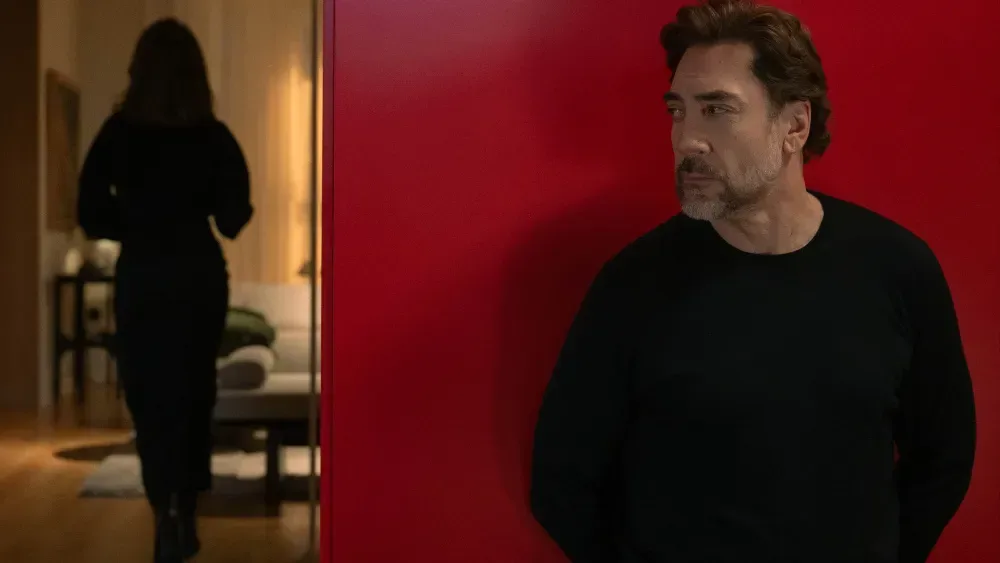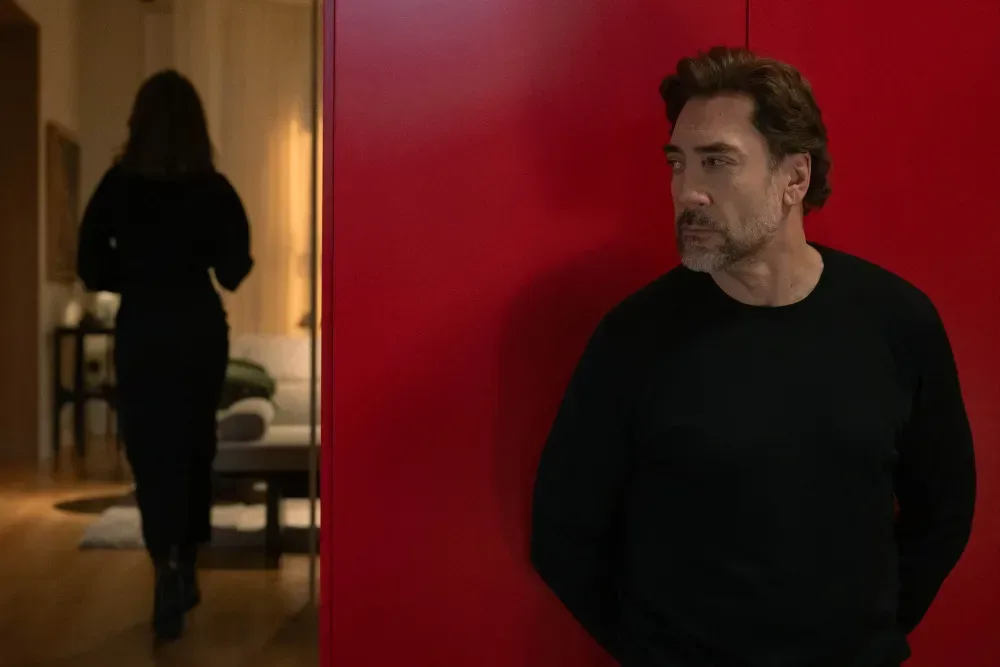
Florian Zeller’s Bunker turns a beautiful London home into a pressure chamber. The 126-minute France-Spain production stars Javier Bardem and Penélope Cruz as Miguel and Sofia Moreno, a successful Spanish expatriate couple whose apparently enviable East End life is built around order, taste and separation from the rest of the world. Then a hole opens in their garden wall, and the carefully controlled household begins to feel considerably less secure.
Screening in Competition at the Venice Film Festival on September 8, 2026, before a Gala Presentations slot at the Toronto Film Festival, Bunker is directed and written by Zeller. It uses domestic conflict, brittle comedy and psychological-thriller tension to examine an uncomfortable question: when does the wish for privacy become a desire to barricade oneself against other people?
An immaculate home with cracks already in it
The Morenos’ home is fundamental to the film’s uneasy atmosphere. It presents an old Victorian street-facing exterior while opening up behind it into a much larger modern structure of concrete, wood and glass, arranged over several split levels. There is also a compact, sharply designed walled garden, though the family largely leaves it to Blue, their gray Abyssinian cat.
That contrast is more than a piece of striking production design. The house gives Bunker its central image: an outwardly modest building that conceals a controlled, insulated private world. Miguel is an acclaimed architect, while Sofia works as a literary editor. Their teenage daughter Lucia, played by Chloe Conh, is remote behind her headphones; younger daughter Rosa, played by Leah Conh, still noticeably feels her parents’ absences. Everyone is physically close, yet the family is emotionally dispersed.
Sofia articulates the film’s relationship philosophy in a memorable thought about treating lasting things as fragile rather than indestructible. It is an idea that carries obvious relevance to her 17-year marriage with Miguel. The couple’s professional lives and routines have seemingly left them with little space to listen to one another. Their exchanges do not necessarily explode immediately; instead, they miss, deflect and pass by each other. That quiet distance supplies much of the movie’s most affecting tension.
Production designer Alain Bainée creates a house that looks composed enough for a glossy architecture feature, but Zeller’s story makes the space increasingly porous. The break in the garden wall is literal evidence that an enclosure is only as reliable as its boundaries. It also exposes just how much the Morenos have invested emotionally in keeping the outside at a comfortable distance.
A window becomes a class conflict
The breach comes from next door. Toby, played by Stephen Graham, wants to convert his garage into a studio apartment and intends to put in a window looking toward the Morenos’ garden. Miguel objects. From the perspective of property rights and domestic privacy, his concern has a clear practical basis. But Toby sees the disagreement through the changing neighborhood around him, where increasingly wealthy arrivals have reshaped the area he has long called home.
Bunker finds dark comedy in the neighbor dispute without making its social stakes simple. Miguel may be legally justified, but the conflict cannot be separated from the larger imbalance between a prosperous architect in a designer home and a working-class neighbor watching gentrification move through his community. Zeller positions the wall and window as blunt but effective symbols: people who say they want peace can still be making decisions that shut others out.
That emphasis on division gives the film a timely companion piece in its broader interest in anxiety around status, isolation and billionaire influence. The topic has also appeared in pop culture through stories focused on wealth and social unrest, including a recent look at a project connecting class rebellion with a Fortnite tie-in. Bunker reaches the same territory through an intimate household drama rather than a historical-game framework.
The billionaire commission at the center of Bunker
Miguel’s private unease intensifies when an unnamed technology billionaire approaches him to design a huge underground refuge on a Hawaiian island. Paul Dano plays the mogul, appearing through the eerily impersonal space of a Zoom call. The proposed bunker is intended to keep the client’s family alive through an undefined catastrophe, framed as protection against a possible systemic collapse.
The offer is lucrative, but it forces Miguel to confront what his own work might enable. The billionaire presents private survival infrastructure as the sensible answer to looming instability. Sofia sees the commission as morally repellent: an extravagantly expensive method for someone already protected by wealth to retreat even further from the society around him. Miguel, meanwhile, cannot entirely dismiss the logic of fear behind the request. He begins wondering whether his own family has enough security, a response that both complicates and exposes him.
From there, the film moves between social satire and nervous domestic suspense. Miguel’s pursuit of security includes an overbuilt system that is as absurd as it is unreliable. The impulse is funny until it is not. Zeller’s point is not simply that elaborate technology fails; it is that no device can resolve the fears created by a person’s fractured relationships, economic insulation or inability to accept uncertainty.
Bardem and Cruz make the marriage matter
The conceptual machinery in Bunker is deliberately conspicuous. The home is a bunker before anyone has constructed the island bunker. The damaged wall represents an invasion of the protected life within. The architect who values silence is confronted by a world he cannot fully keep quiet. Some viewers may find Zeller’s symbolism almost too precisely arranged, particularly when dialogue returns to explain ideas the images have already made clear.
Yet Bardem and Cruz give the design an essential human unpredictability. Bardem plays Miguel with a mixture of polished authority, defensiveness and gathering loss of control. His performance finds comedy in a man trying to preserve the image of total competence while ordinary complications, neighbors and his own apprehensions keep refusing to cooperate.
Cruz brings a different kind of intensity to Sofia. She is poised and watchful, but the character’s composure carries strain rather than serenity. Sofia’s objection to the billionaire project is not presented as a casual political disagreement; it becomes part of a larger realization that Miguel may be turning inward at precisely the moment their family needs openness. Cruz makes that conflict feel active even in pauses and glances.
The actors’ scenes together are the film’s strongest asset. They can communicate a long shared history without turning every moment into an argument. A look that lingers too briefly, an interrupted answer or a conversation that lands nowhere reveals what their characters cannot say directly. Their on-screen dynamic makes the Morenos’ wealth and surroundings feel less like an abstract target than the environment in which two people have become increasingly unable to reach one another.
Craft that favors icy precision
Ben Smithard’s cinematography complements the story’s controlled unease, treating the Moreno home with cool, hushed stillness. Its architectural lines do not merely look expensive; they impose a visual order that becomes more ominous as the film proceeds. Yorgos Lamprinos edits the 126-minute drama, while Volker Bertelmann provides the music.
The supporting cast includes Patrick Schwarzenegger, Mark Gatiss, Karen Ascoe and Eileen Atkins, alongside Graham, Dano and the two Conh sisters. Dialogue is in English and Spanish. The film is produced by Blue Morning Pictures, MOD Producciones, Pathé and Entourage Pictures/Mediawan, with Federica Sainte-Rose, Zeller, Fernando Bovaira, Simón de Santiago and Alice Dawson among its producers.
Bunker does not hide its interest in the architecture of privilege, whether that means a walled London garden, a highly engineered alarm system or an apocalypse shelter for the ultra-rich. Its ideas can be emphatic, and its metaphors are built with the precision of Miguel’s own preferred designs. But its emotional force comes from watching Bardem and Cruz locate instability beneath a spotless surface. The most dangerous breach in this household is not necessarily the new window next door. It is the recognition that the people inside may have been living apart for some time.