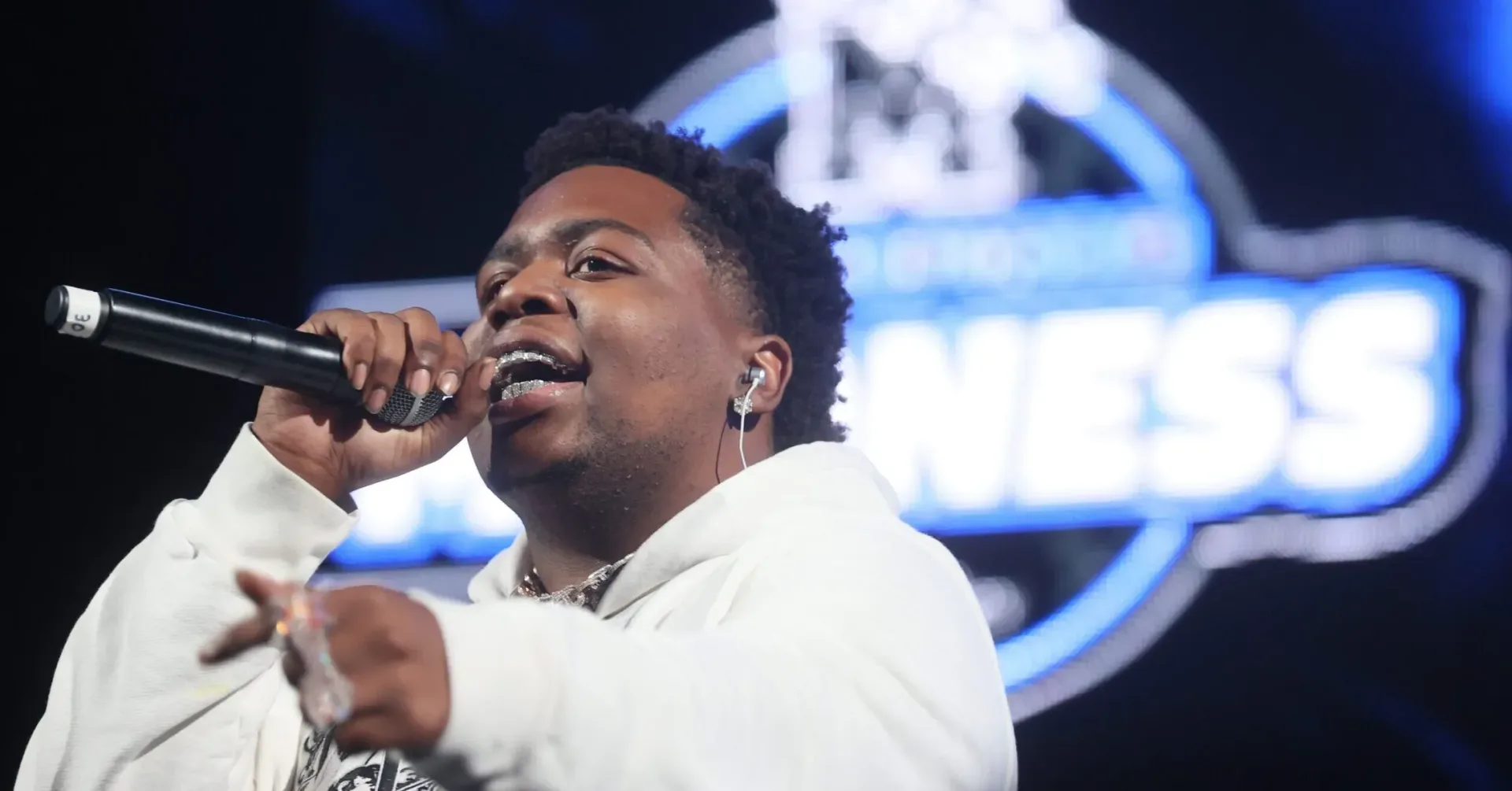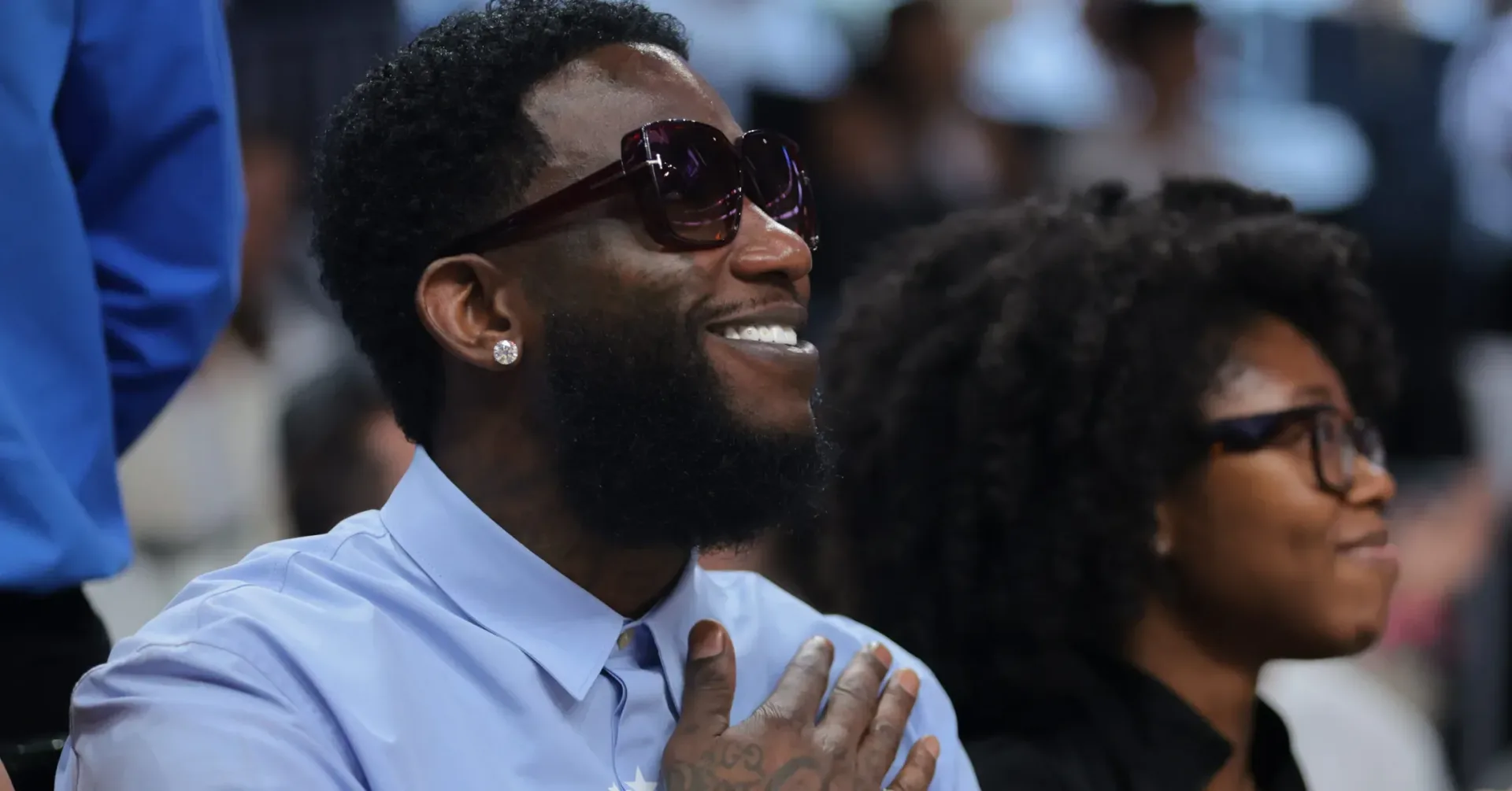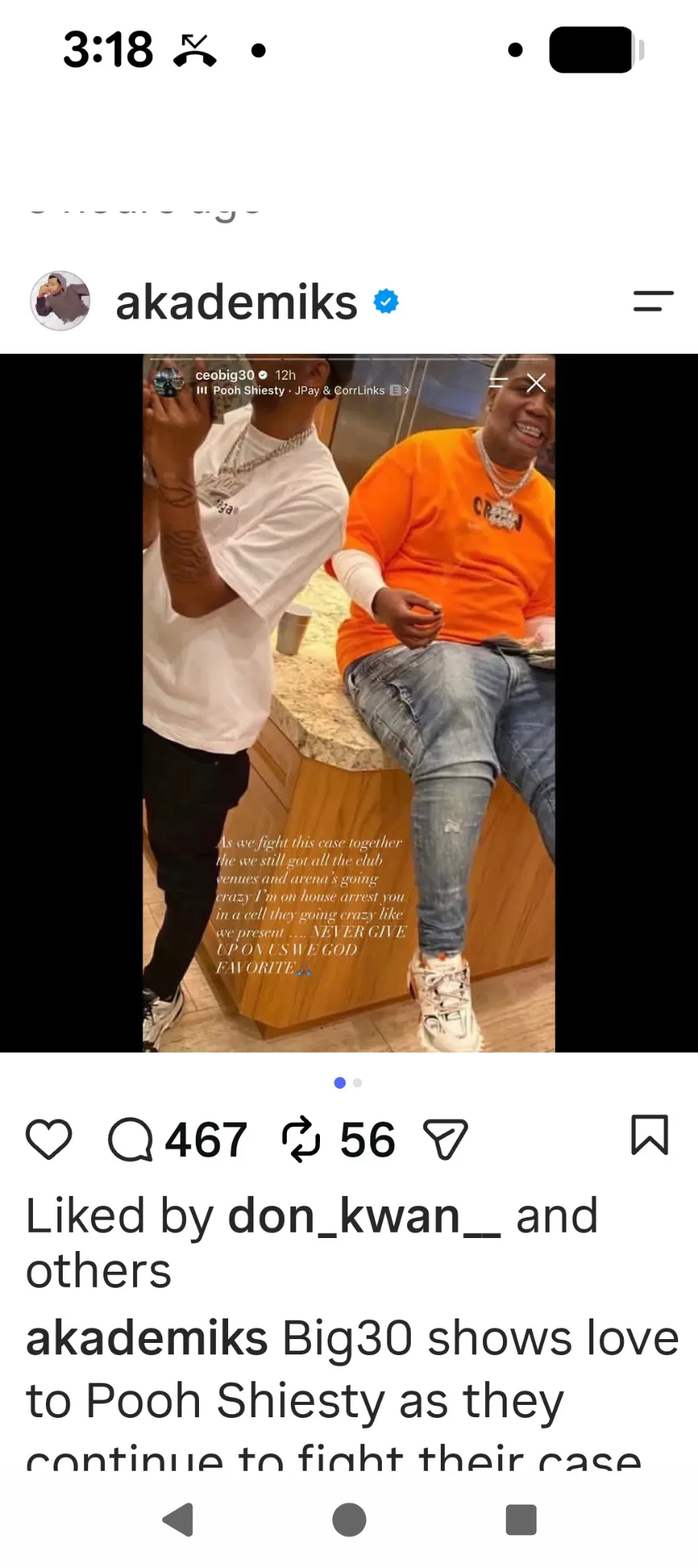
Big30 has offered a public show of support for Pooh Shiesty while both rappers face a federal kidnapping and extortion case tied to Gucci Mane. In an Instagram Story, Big30 acknowledged the different restrictions facing the two men—house arrest for him and jail for Pooh Shiesty—while telling followers not to lose faith in them.
“I’m on house arrest you in a cell,” Big30 wrote, adding: “NEVER GIVE UP ON US WE GOD FAVORITE.”
The message arrived days after Gucci Mane released Against All Odds on October 16. Its closing song, “1017,” contains grievances aimed at unnamed artists whom Gucci Mane says he helped financially and turned into stars, only for them to later present themselves as self-made. The lyrics are not a direct naming of Big30 or Pooh Shiesty, and Big30 likewise did not name Gucci Mane or say that his post answered the song.
That distinction matters. A social-media statement of support can be personal, legal and motivational at the same time without being a diss-track response. The timing may invite listeners to read the two events together, but the available facts do not establish that Big30 intended his words as a reply to “1017.”
Three connected careers, but different routes
The situation has drawn attention partly because Big30 and Pooh Shiesty have different professional relationships with Gucci Mane. Pooh Shiesty, born Lontrell Williams Jr., joined Gucci Mane’s 1017 roster and became one of the label’s most recognizable artists. Big30, born Rodney Wright Jr., built his career through Moneybagg Yo’s Bread Gang and N-Less Entertainment, while some of his earlier releases also carried the Interscope name.
Those differing paths do not mean Big30 and Gucci Mane were strangers creatively. They collaborated on “Shit Crazy.” Big30 and Pooh Shiesty, meanwhile, were close from childhood and had made music together well before the current criminal case. That history gives Big30’s message a clear personal basis even without treating it as commentary on Gucci Mane’s record.
For fans, the overlap can seem unusually tangled: a label figure, an artist associated with that label, a longtime friend from another camp, and a song about respect all exist beside a case centered on a disputed contract release. But artist affiliation is not the same thing as a legal finding, and musical alliances can be broader and more complicated than a roster listing. It is also worth separating a lyric’s emotional claim from any allegation in a courtroom. The former is an artist’s expression; the latter must be tested through legal procedure.
What prosecutors allege in the Dallas studio case
Nine men were charged in the federal case. Prosecutors allege that a January 10 meeting at a Dallas recording studio, initially concerning Pooh Shiesty’s contract, became an armed takeover. The government’s account alleges that Pooh Shiesty had an AK-style pistol and forced Gucci Mane to sign documents releasing him from his deal.
Related coverage includes Big30 Stands With Pooh Shiesty as Federal Case Moves Toward 2027 Trial.
At the time of the alleged incident, Pooh Shiesty was on home confinement in connection with an earlier federal gun case, according to the Justice Department. Prosecutors further allege that three victims had cash and jewelry taken from them.
The allegation involving Big30 is specific but remains an allegation: prosecutors accuse him of blocking the studio door, preventing people inside from leaving. Big30 has pleaded not guilty. His attorneys have argued that the government exaggerated his part in what occurred.
Pooh Shiesty has also pleaded not guilty. His father, Lontrell Williams Sr., was charged as well. An FBI affidavit alleged that Williams Sr. booked the studio and told his son that a signed release required a date. His defense has disputed the claim that he participated in a kidnapping plot. He pleaded not guilty and was granted pretrial release by U.S. District Judge David Godbey in May.
Why the wording around the case is important
A federal charge is an accusation, not a conviction. Terms including kidnapping, extortion and armed takeover describe the government’s theory of what occurred in this case; they are not established facts simply because they appear in charging materials. A not-guilty plea is the formal response through which a defendant contests the charges and requires the government to prove them in court.
Likewise, a defense argument that prosecutors overstated someone’s role is not a ruling in that defendant’s favor. It is a competing account that may be explored through evidence, motions and trial proceedings. This is especially important when a story moves quickly through fan pages, lyrics and social feeds: all can circulate intense interpretations long before a jury evaluates the underlying claims.
The difference also has practical consequences for public discussion. Fans can recognize the seriousness of the allegations and the gravity of the claimed harm without assuming guilt. They can also understand why Big30’s post focuses on endurance and faith rather than legal specifics. A message to a friend in custody may be emotionally direct while revealing little about the issues a court will ultimately decide.
Pooh Shiesty remains in custody as trial approaches
Pooh Shiesty remained jailed after Judge Godbey denied his second request for release in July. In an October 15 motion, his lawyers raised concerns about his detention conditions, saying he spent 23 hours a day alone in his cell and had limited family visitation.
Those claims concern the conditions of confinement rather than guilt or innocence on the charges. They are nevertheless significant because pretrial detention can shape a defendant’s day-to-day ability to maintain contact with family and work with counsel. The court’s eventual assessment of the criminal accusations is a separate question from arguments about how a person is housed while awaiting trial.
Trial is scheduled for February 22, 2027. Until then, the case will remain a major backdrop to any public exchange involving the artists, whether it appears in a song, a post or a fan interpretation. The schedule also means there is a substantial period during which social-media narratives may develop without a final courtroom outcome.
“1017” and the risk of reading every lyric as a legal statement
Gucci Mane’s complaint on “1017” is framed around respect, support and perceived ingratitude. He says unnamed artists received help from him and later behaved as though they had reached success alone. That is a familiar subject in music, particularly where label relationships and career-making support carry personal as well as business weight.
Yet the track’s lack of named targets is crucial. Listeners may connect its subject matter to current headlines, longstanding affiliations or public relationships, but none of that turns inference into confirmation. Big30’s statement did not identify “1017,” did not criticize Gucci Mane, and did not say that Gucci Mane’s lyrics prompted it.
There is an added reason to avoid collapsing the song and case into one narrative. The alleged studio incident itself concerns a purported contract release, while Gucci Mane’s song discusses artists owing respect for prior assistance. The subjects can look adjacent, but being adjacent is not proof that the lyric documents, comments on or resolves anything about the criminal allegations.
For readers tracking entertainment news, this is where precision is more useful than speculation. The known record is that Big30 publicly encouraged Pooh Shiesty, Gucci Mane released a song criticizing unnamed artists, and the two men remain connected by a pending federal case in which both have pleaded not guilty. The known record is not a confirmed lyrical feud between the pair.
That caution applies across music and screen culture alike, where public figures’ creative work is frequently treated as a coded statement on every current controversy. A separate example of how entertainment projects can spur intense audience interpretation can be found in coverage of Hideo Kojima’s return to Night City in Cyberpunk: Edgerunners 2, though the facts surrounding a fictional production are plainly different from a pending criminal proceeding.
What can be said now
Big30’s post is best understood on its own terms: a message of loyalty and resilience toward a childhood friend facing incarceration. It also speaks to the contrast he described between continuing public interest in their music and the limitations imposed on their freedom.
Gucci Mane’s “1017,” meanwhile, provides a separate public expression of frustration directed at artists he believes failed to show appropriate respect. The song’s unnamed targets leave room for debate, but not for a definitive identification based on the information available.
As the February 2027 trial date nears, the legal case—not online interpretation—will determine whether the government can prove its allegations. Until then, the clearest account is also the most restrained: the defendants deny the charges, Big30 is on house arrest, Pooh Shiesty remains in jail, and a supportive post has intensified attention around relationships that were already complicated by music, business and friendship.