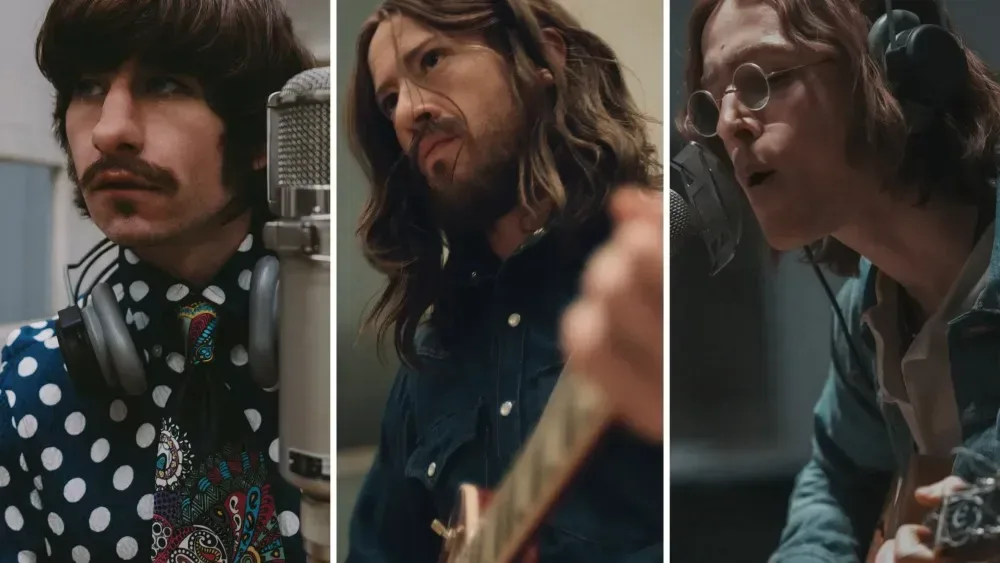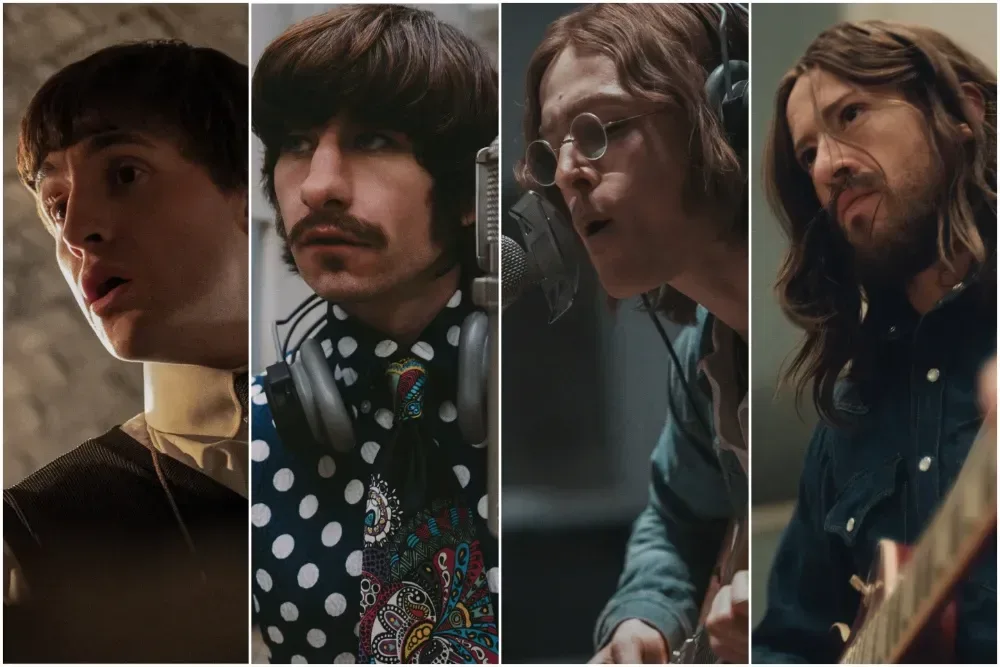
The forthcoming Beatles screen project has moved from familiar album-cover imagery to one of the group’s most recognisable movie moments. Barry Keoghan, Joseph Quinn and Harris Dickinson have been seen filming a sequence that recalls the opening of A Hard Day’s Night, with three band members running from a crowd of enthusiastic fans.
The scene is a particularly legible signal of what the four-film project is trying to evoke: not only the music, but the overwhelming public phenomenon around the band. Images from the set point to a recreation of the brisk, fan-pursuit energy associated with the 1964 film. Paul Mescal, who plays Paul McCartney, was not identified among the three performers seen in that reported shoot.
The casting assigns Dickinson to John Lennon, Quinn to George Harrison, Keoghan to Ringo Starr and Mescal to McCartney. All four films are planned for theatrical release in April 2028, and each is designed to focus on a different member of the Beatles.
Why the A Hard Day’s Night reference matters
Richard Lester directed A Hard Day’s Night, released in 1964. Its story follows the Beatles across two days as they attempt to make it to a live television performance, contending with the pressures around them and Paul’s disruptive grandfather. The running shots at the beginning became a concise visual expression of Beatlemania: the performers are not simply travelling to work; they are being swept through a public frenzy that has become impossible to ignore.
That makes the footage more meaningful than a straightforward costume recreation. A biographical film has to decide whether an iconic moment is included as a landmark to tick off or as a way to explain its subject. Here, the reported sequence could serve either purpose, and it is too early to know how it will function in the final films. Still, the choice of material points toward the project engaging with the Beatles’ own screen image as part of their story.
That distinction is important. The planned project is not described as one single, conventional cradle-to-breakup biopic. It is a four-film event, with each chapter centered on a different band member. The official premise frames the approach around four individual stories that form a shared legend. Revisiting a moment from the group’s 1964 movie therefore offers an obvious shared point of view: the same crowd, career and band can have a different emotional meaning depending on whose film the audience is watching.
A film-within-a-biopic challenge
Recreating an earlier Beatles movie inside a Beatles biographical drama creates a technical and storytelling problem. The production is not merely staging a chase scene from the 1960s. It is depicting actors who portray the Beatles working within the world of an earlier fictional feature. Costuming, movement, camera placement and the scale of the crowd can all help establish the reference, but none alone explains what the performers themselves were experiencing.
In this context, the chase can do several jobs at once. On the surface, it is a rapid piece of crowd spectacle. Dramatically, it can communicate exhaustion, exhilaration, routine, pressure or a mix of all four. The four-film structure gives the filmmakers room to return to the same era from different personal angles, though there is no confirmation that this exact sequence will appear in more than one film.
There is also a useful difference between an homage and a recreation. An homage borrows the audience’s memory of an earlier work. A recreation aims to put that work back on screen in a recognisable form. The reported set images suggest the latter, but set photography cannot establish how closely the finished scene will match the original film, how long it will run, or whether it will be shown as part of the characters making A Hard Day’s Night versus a stylised passage in the biopic itself.
Two high-profile visual markers already on set
The A Hard Day’s Night material follows another immediately recognisable Beatles image. Last month, Mescal, Quinn, Keoghan and Dickinson were seen recreating the crossing pose associated with the Abbey Road album cover. Taken together, the two reported set pieces move between separate eras and media: one refers to the Beatles as movie stars in 1964, the other to an album image from later in their career.
That does not reveal the films’ chronology. Productions often shoot scenes out of order, and photographs taken during filming are not a roadmap to the final edit. But the choice of these images illustrates the unusually demanding visual task ahead. Beatles history is packed with moments audiences can recognize in seconds. That recognition can be an advantage, creating instant context, but it can also raise expectations for the surrounding dramatic material to give the familiar image a reason to be there.
The project’s format may be its most consequential creative decision. Rather than making one performer carry an ensemble story while the others orbit around him, the four-film concept promises space for each of the four. It could also make the supporting cast especially important, because the same relationships may take on different weight in the individual chapters.
The wider cast and the people around the band
The announced supporting lineup reaches beyond the four musicians and includes partners, family, management and key collaborators. Saoirse Ronan plays Linda McCartney, while James Norton portrays Brian Epstein. Mia McKenna-Bruce plays Maureen Starkey, Anna Sawai plays Yoko Ono and Aimee Lou Wood is Pattie Boyd.
Harry Lloyd has been cast as producer George Martin. David Morrissey plays Jim McCartney, and Leanne Best plays Mimi Smith. Bobby Schofield will portray Neil Aspinall, while Daniel Hoffmann-Gill plays Mal Evans. Arthur Darvill is Derek Taylor, and Adam Pally plays Allen Klein.
Those names indicate that the films will have access to characters connected to multiple phases of the Beatles’ lives and work. However, the cast list should not be mistaken for a scene-by-scene outline. No role sizes, film-specific appearances or plot details have been established here. A four-film plan can distribute those relationships in many ways, and a character’s inclusion does not confirm which milestones will be dramatized.
What can be said is that the project has assembled actors for people associated with creative work, business, family life and the group’s inner circle. That is relevant to a Beatles story because the band’s public identity was never constructed by four people in isolation. The reported A Hard Day’s Night sequence foregrounds fans and celebrity; the announced supporting players suggest the films also have the personnel to address the private and professional networks around the group.
What viewers should and should not infer from set photos
Set photographs are useful clues, not finished evidence. They can confirm that a production has staged a location, a costume arrangement or a specific visual reference. They cannot confirm the final dialogue, musical treatment, scene order, point of view, editing or tone. This is especially true for a project whose central hook is four linked films: a single day of filming may eventually be divided between chapters, altered substantially, or used in a context that images alone do not explain.
The reported fan-chase footage does establish one reasonable expectation: the movies are willing to engage directly with famous existing Beatles imagery rather than avoid it. Whether that choice produces a vivid dramatization or a chain of references will depend on material that has not been revealed.
For now, the best read is a cautious one. Dickinson, Quinn and Keoghan appear to be participating in a recreation connected to the opening of A Hard Day’s Night. Mescal is playing McCartney, and the quartet has also been seen in imagery recalling Abbey Road. The larger undertaking remains a four-film theatrical event built around individual perspectives on Lennon, McCartney, Harrison and Starr, targeted for April 2028.
As more entertainment productions revisit defining pop-cultural images, the challenge remains the same: recognisability gets people’s attention, but perspective is what gives the image a new purpose. For another recent film-focused item, see this look at Angh.