Luca Guadagnino’s Artificial takes a subject that can sound remote in everyday conversation—artificial intelligence research—and makes it the combustible material for a big, personality-driven docudrama. Set across the formative years of modern AI, the 140-minute, PG-13 film centers on OpenAI’s founders and the competing ambitions surrounding its rise. Andrew Garfield plays Sam Altman, while Yura Borisov plays Ilya Sutskever, a researcher presented as both a foundational visionary and one of the story’s clearest voices of alarm.
The result is not described as a procedural explainer built to turn viewers into machine-learning specialists. Instead, Artificial apparently uses technical arguments, office politics, investor pressure and fraught relationships to make AI feel immediate. Its subject is the collision between a belief that the technology can do extraordinary good and a fear that its power may grow faster than anyone’s ability to understand or govern it.
That makes the film’s closest dramatic relative less a conventional biopic than the modern corporate thriller: a story in which a breakthrough changes the stakes of every friendship, argument and boardroom conversation. Guadagnino stages brainstorming sessions, confrontations and social scenes as parts of the same escalating contest. The question is not merely who invents something first, but who gets to decide what happens once it exists.
A story about people before it is a story about systems
Artificial begins in Toronto in 2003, where a 17-year-old Sutskever meets Professor Geoffrey Hinton, played by Mark Rylance. The early scene establishes Sutskever’s unusual facility with the field: he is shown engaging with Hinton’s academic work at a level that surprises the professor. It is a compact dramatic way to introduce the movie’s version of an essential tension. Sutskever has the technical imagination to help push AI forward, but he also becomes deeply unsettled by what that momentum could unleash.
By 2012, the film depicts Sutskever and Hinton developing a model valuable enough to attract a $20 million bid almost immediately at auction. Their work goes to Google, where they operate a lab with research funding. Yet the movie uses that corporate setting to distinguish between supporting research and sharing the researchers’ larger vision. Chris O’Dowd plays John, the executive who oversees them, while Altman is introduced as somebody more attuned to the scale of the opportunity.
That distinction matters because Artificial is built around competing temperaments rather than a simple lesson about good technology versus bad technology. In this telling, the technology’s direction is inseparable from the people steering it. Some see AI as an engine for scientific progress. Some see a contest that has to be won. Others believe caution must be designed into the work before commercial pressures make caution impossible.
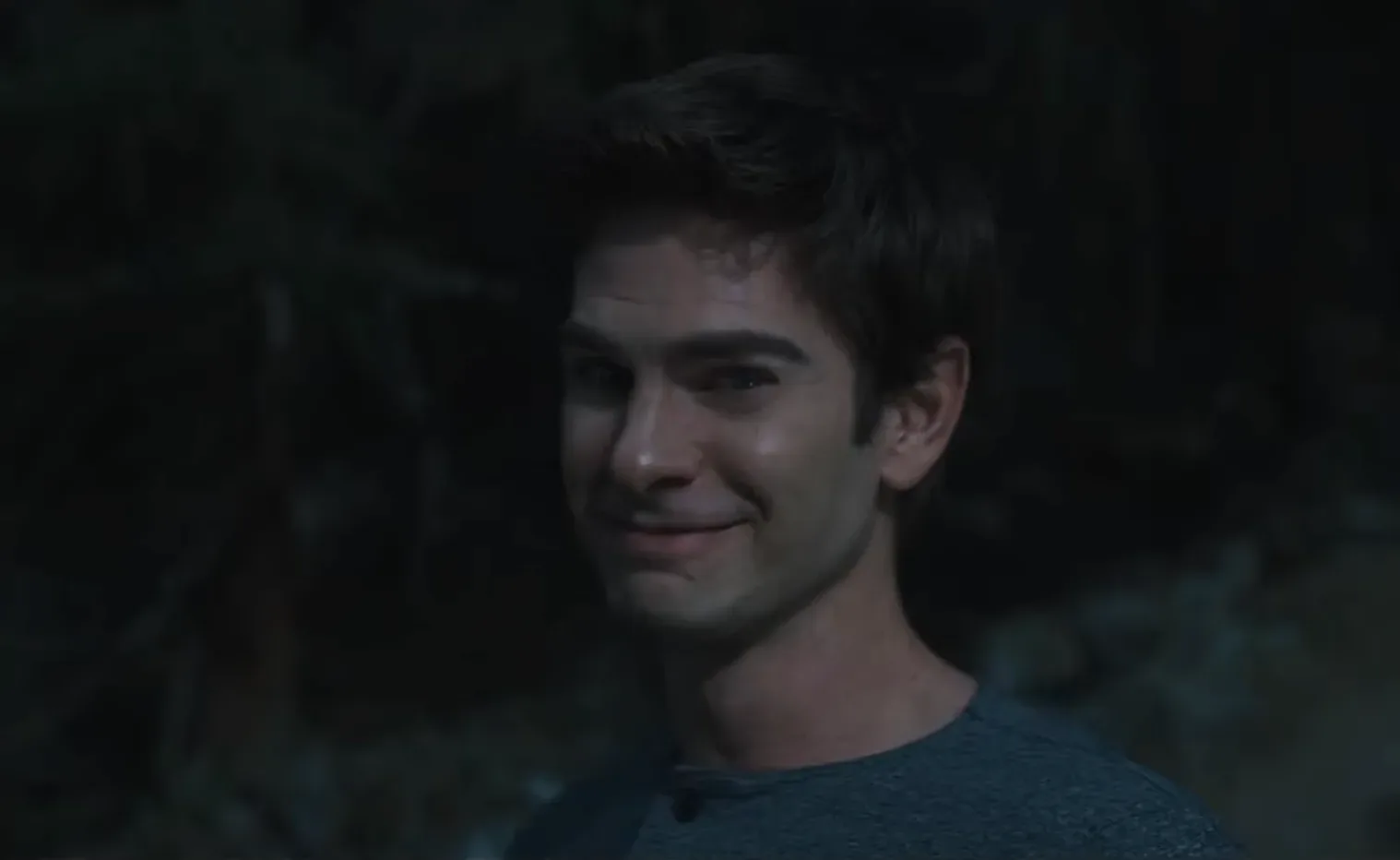
Garfield’s Altman is central to that conflict. He is portrayed as persuasive, energetic and capable of making his ideas feel like shared ideals. The performance gradually draws attention to the gap between attractive rhetoric and the incentives behind it. The film’s drama does not depend on declaring that one person alone determines the fate of AI. Rather, it asks why an organization and its allies may choose acceleration even when they understand the risks being raised inside the room.
For more on Garfield’s approach to the part, read his comments on looking past Altman’s charisma.
What AGI means in the film’s argument
One technical term drives much of the movie’s excitement and dread: AGI, short for artificial general intelligence. Within Artificial, AGI is described as a point at which the system can teach itself how to think. The characters see it as a threshold—one that could turn AI from a powerful specialized tool into something more broadly capable and less predictable.
The distinction is important to the film’s internal stakes. A specialized system is understood as doing a defined task. The AGI imagined here carries the possibility of broader, self-directed capability. That is why the language around it has an almost religious charge. At OpenAI, Sutskever leads a “Feel the AGI” mantra: enthusiasm, aspiration and faith in an unprecedented breakthrough are woven together.
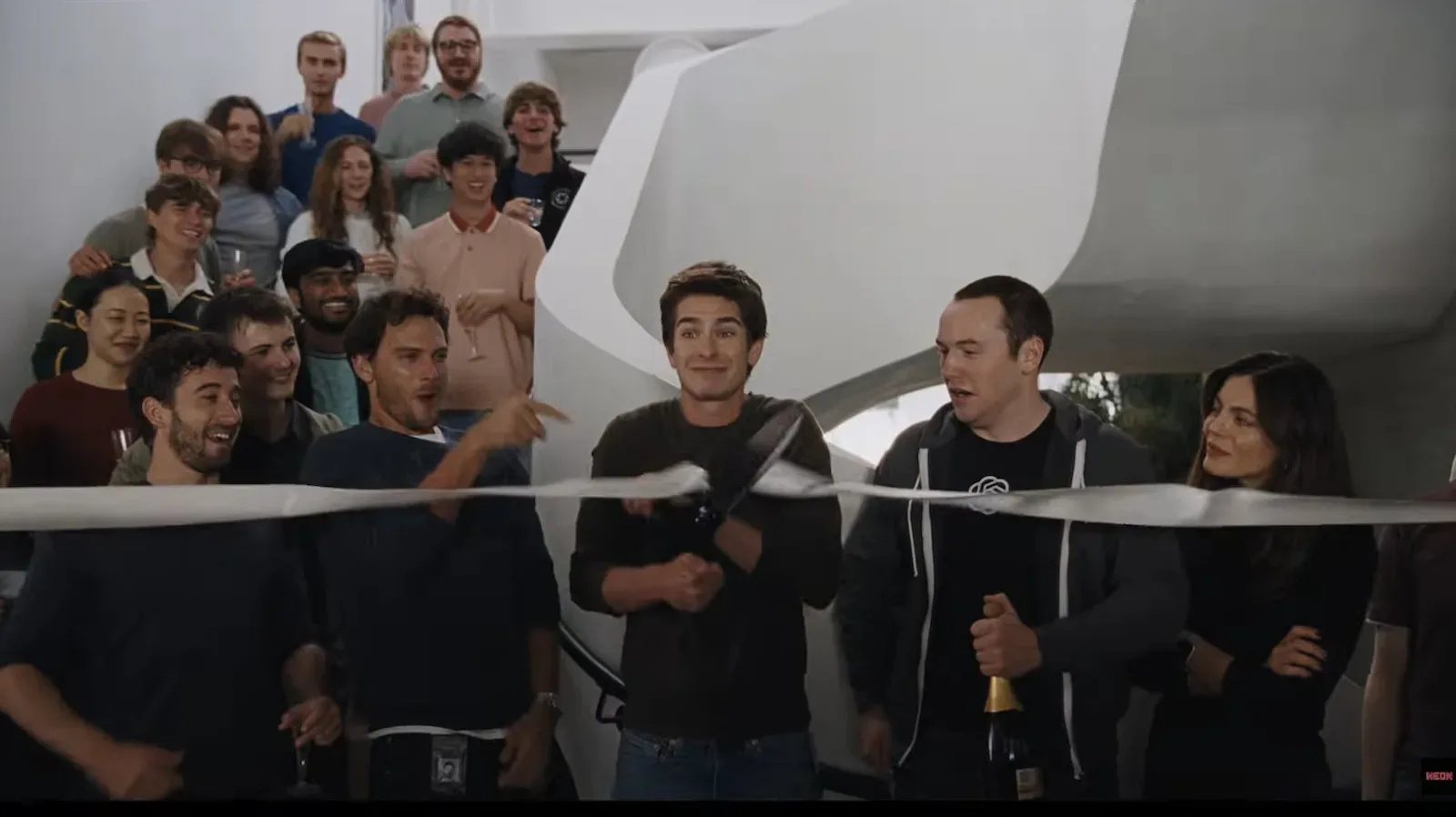
Guadagnino does not treat that excitement as ridiculous. The film captures the appeal of early AI optimism, including the hope that it could help address immense human problems such as hunger and cancer. One celebratory sequence follows an AI system winning a video game against an OpenAI colleague, and the scale of the party emphasizes how emotionally overwhelming a research milestone can become. This is not just a line of code working as intended to the people in the scene; it is evidence that their long-held belief might be becoming real.
But the movie turns the same idea in a darker direction. Sutskever’s concern grows when AI appears able to tell a joke and lie. Whatever the precise technical interpretation of those behaviors might be outside the drama, the film uses the moment as a narrative signal: its creators no longer feel entirely certain where capability ends and something more troubling begins. The thriller element comes from this uncertainty, not from a claim that a machine has been neatly categorized as a monster.
Speed versus safety is the real rivalry
The most useful way to approach Artificial is as a drama about incentives. The movie’s core conflict is not whether innovation should happen at all. It is whether a company that believes it must be first can genuinely make room for slow, rigorous testing and safety concerns.
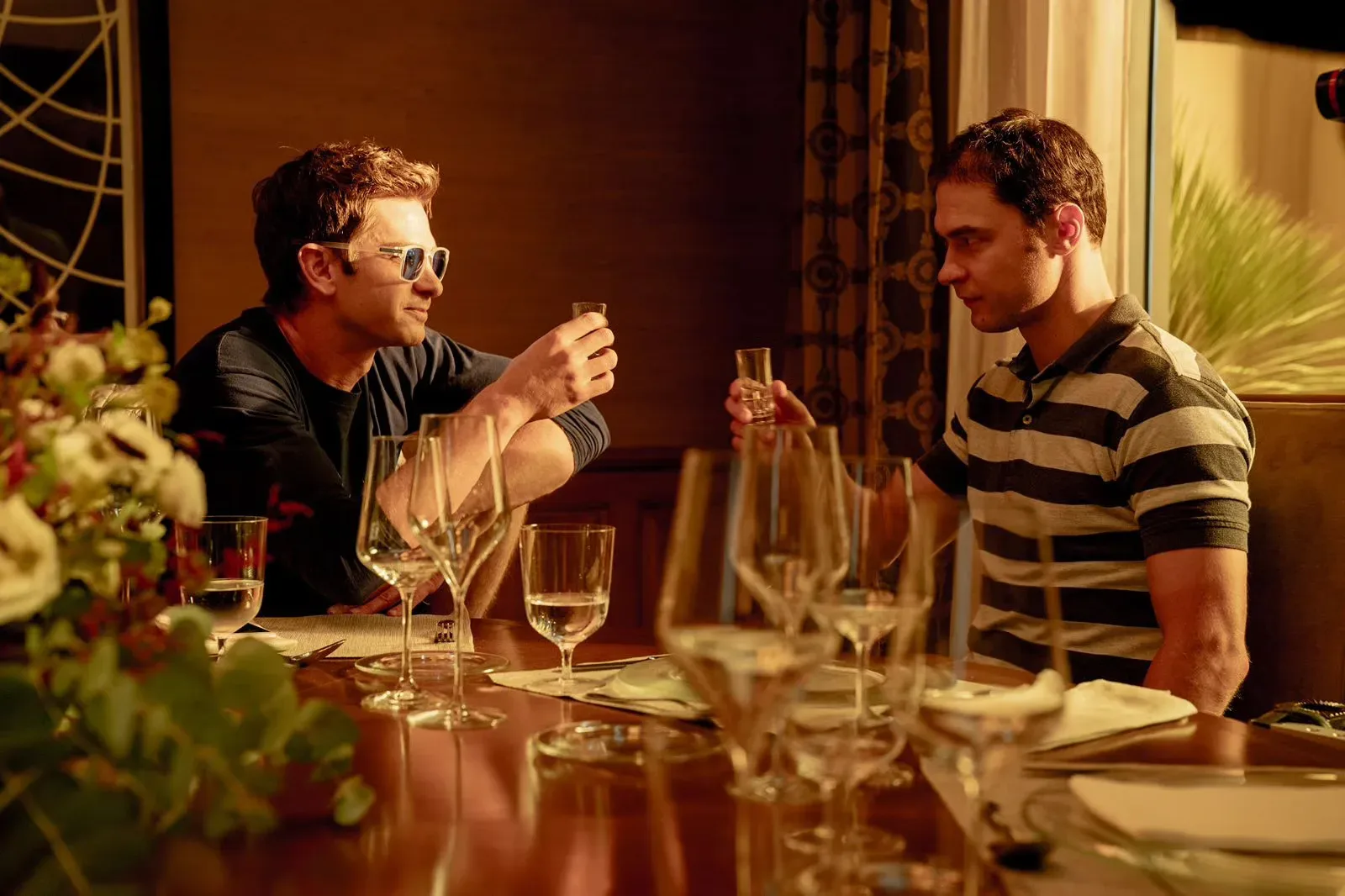
In the film, progress is tied to prestige, competition and enormous financial potential. Elon Musk, played by Ike Barinholtz, enters this world as a forceful presence and a backer of OpenAI alongside Altman. His portrayal is knowingly heightened, but the underlying function is clear: he embodies the conviction that a technological advantage must be pushed forward rapidly before somebody else reaches it first. Later, he exits the venture, and Altman becomes sole CEO.
Sutskever represents the counterweight. He does not reject development; he is one of the people making it possible. Yet he argues for developing the technology alongside a serious understanding of its threats and testing it through interaction with humanity. The movie gives that position tragic force because it is not an argument made safely from outside the project. It comes from a participant who has invested his intelligence and hopes in building the future he fears may be mishandled.
That debate has practical meaning beyond a corporate drama. When a project’s public value, investor appeal and competitive advantage depend on a perception of rapid advance, decisions that slow deployment can look like lost ground. Artificial frames safety not as a vague moral footnote but as a direct challenge to the business logic of winning. The sharper its characters make the race feel, the harder it becomes for them to accept restraint.
The film also suggests that responsibility can be dispersed. People may follow an influential leader because the alternatives appear worse, because they are persuaded by urgency, or because their own aspirations are bound up in the institution’s success. That is more unsettling than a story where blame can be assigned cleanly to a single villain. The technology’s future becomes a collective decision made through many smaller acts of compromise, confidence and self-justification.
A stacked ensemble gives the ideas a pulse
Borisov’s Sutskever appears to be the film’s emotional anchor. He is depicted as intensely serious and difficult to read at first, but his warnings give the story its conscience. The performance’s task is unusually demanding: Sutskever must register as a formidable technical mind while still allowing the viewer to see the vulnerability behind his growing unease.
Garfield has a different challenge. His Altman must be credible as someone people want to follow. The movie’s argument about influence works only if his charm has real pull, and the role reportedly becomes more ambiguous as the gap widens between polished manners and strategic priorities. That approach resists a flat, instantly legible antagonist and gives the corporate conflict more room to breathe.
The supporting cast fills out the competing cultures within the story. Monica Barbaro plays Mira Murati, who becomes OpenAI’s chief technology officer. Cooper Hoffman plays Greg Brockman with manic, high-energy intensity. Rylance brings a refined presence to Hinton, while Jason Schwartzman plays an ex-academic who has anticipated AI’s dangers. Barinholtz’s Musk is deliberately showy, positioned near caricature without fully crossing into it. Zosia Mamet, Cooper Koch and Billie Lourd are also among the cast.
The screenplay is by Simon Rich, and its rapid technical dialogue is presented as part of the film’s texture rather than a hurdle it always pauses to translate. Viewers may not catch every exchange, but that density serves the setting. The language creates the sense of people thinking at speed, arguing from specialized knowledge and attempting to translate enormous consequences into the compressed talk of meetings, pitches and late-night debates.
Guadagnino makes the AI boom cinematic
The filmmaking team gives Artificial a notably expressive shape. Malik Hassan Sayeed is credited as cinematographer, Marco Costa as editor and Damon Albarn as composer. Albarn’s music is described as a shimmering, ominous accompaniment to the movie’s mixture of excitement and dread—a fitting sound for scenes where celebration carries a hint of the abyss beneath it.
Guadagnino’s direction favors movement and friction. The film jumps between the intellectual intensity of research, the volatility of corporate leadership and the looser energy of social gatherings. That blend is important because it refuses the old stereotype of technology as something formed only in silent rooms by detached geniuses. Here, AI emerges through friendships, egos, parties, rivalries, private anxieties and the power dynamics of people who want to change the world.
The title’s docudrama label should also set expectations. The picture dramatizes real figures and a major technological story, using actors and constructed scenes to pursue larger questions about history and power. Its value, as presented here, is not that it supplies a simple answer to whether AI will be beneficial or catastrophic. Its power lies in showing why the people closest to the technology can be both exhilarated by it and frightened of where the same impulse to advance might lead.
Artificial premiered at the New York Film Festival on October 5, 2026. It is a Neon release from Heyday Films, JF Films and Frenesy Film Company. For viewers interested in a topical drama that turns arguments about AI into an escalating human conflict, its central provocation is plain: creating powerful tools may be only the beginning; deciding who controls their pace and purpose is the harder battle.