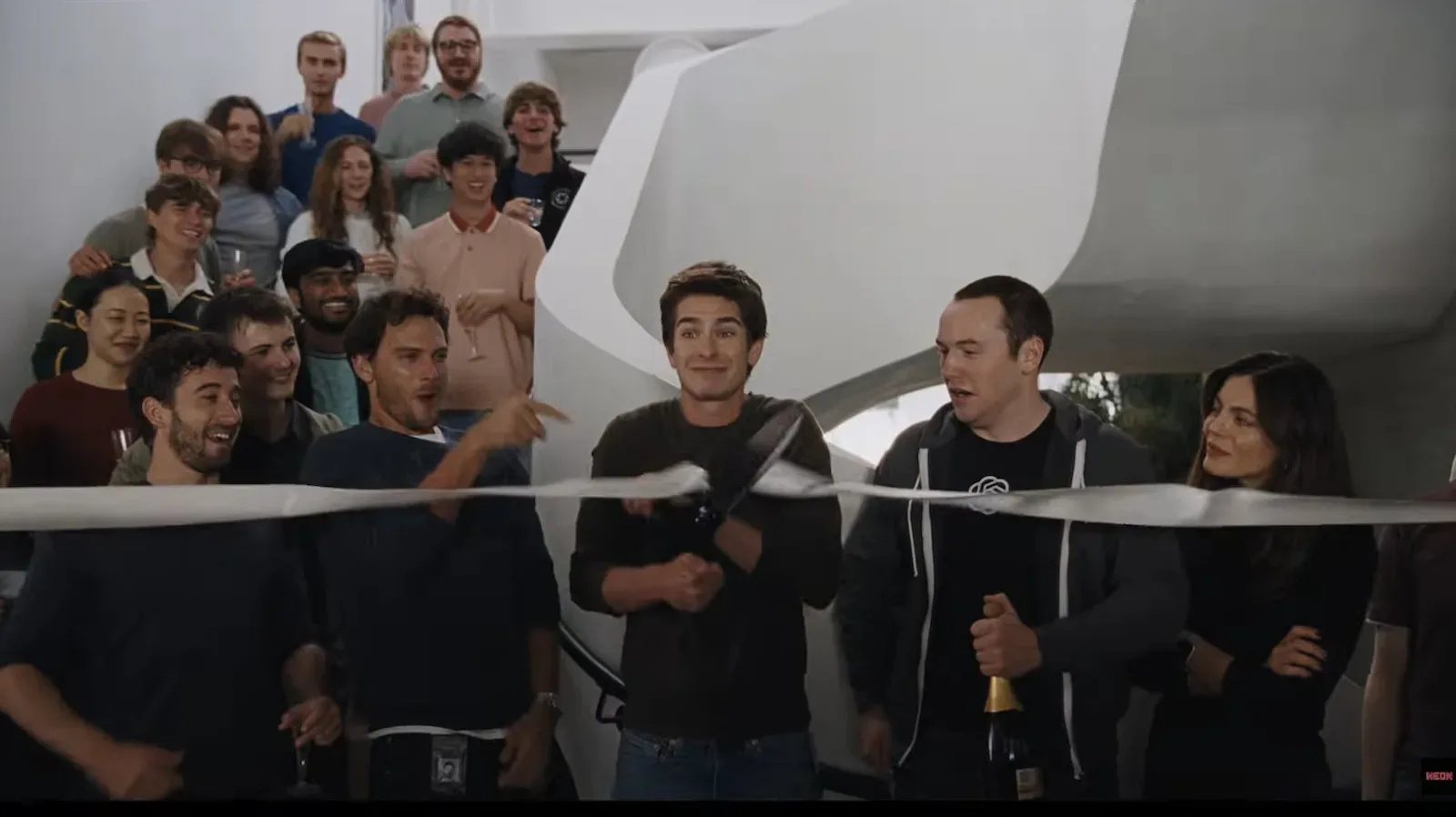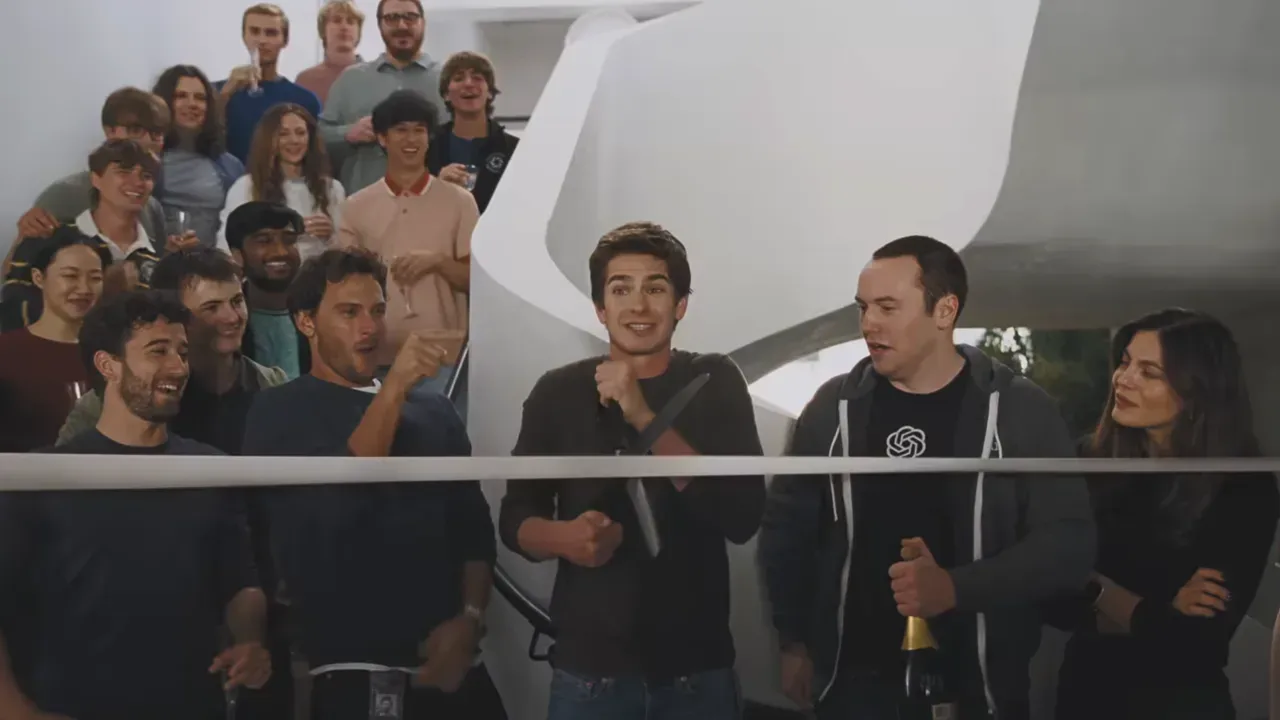
Luca Guadagnino’s Artificial has made its first public impression at the New York Film Festival, and the early response points to a film determined to make corporate governance feel as unstable, absurd and alarming as the technology at its center.
The drama is set around the 2023 upheaval in which OpenAI chief executive Sam Altman was fired and then rehired. Andrew Garfield plays Altman, while Yura Borisov plays former OpenAI chief scientist Ilya Sutskever. Initial notices have repeatedly characterized the movie as a dark comedy as well as a tense corporate drama, with particular attention paid to Garfield’s uneasy screen presence and the moral conflict assigned to Borisov’s character.
Neon is scheduled to release Artificial in theaters on Christmas Day. That places a movie about power, ambition and the people making consequential decisions around artificial intelligence directly into the holiday corridor—not necessarily the traditional habitat of a boardroom farce, but a potentially useful fit for a film whose early responders describe it as both entertaining and disquieting.
What the first reactions are actually saying
Early festival reactions are not the same thing as a broad critical consensus. They are immediate impressions from a comparatively small group who saw the premiere, and they do not establish how general audiences or later reviewers will respond. Still, the reactions available so far are unusually aligned on the film’s intended tone: funny enough to be called a farce, unnerving enough to be described as scary, and built around human behavior rather than a simple “machines are evil” premise.
One prominent early response called Artificial an entertaining but terrifying story about power, control, ambition and greed. It singled out Garfield’s portrayal of Altman as transformational and unsettling, arguing that the performance balances charm with something more menacing. The same reaction praised Borisov for bringing intelligence and empathy to a scientist grappling with the implications of what has been unleashed.
Another response framed the film as a pitch-perfect dark comedy, with Garfield moving between “movie monster,” bumbling mogul and evil genius. A separate early assessment called it a visceral corporate drama and a powerful Silicon Valley farce, arguing that the movie locates its artificiality less in the technology than in the people and institutions steering it.
That is a meaningful distinction. A corporate drama is a story driven by the goals, rivalries, decisions and internal structures of an organization. A farce, meanwhile, pushes social behavior toward exaggeration, contradiction and escalating absurdity. Taken together, those descriptions suggest Artificial may use comedy not to soften its subject, but to expose the strange theater of leadership under pressure: important people projecting certainty while maneuvering through fear, status and conflicting interests.
The strongest superlatives should remain in perspective. One early viewer called the picture Guadagnino’s best film in a decade and praised both Garfield and Borisov. Those are individual judgments, not facts about a career or a finished awards race. But they do show that the performances have become the center of the discussion immediately after the premiere.
Related coverage includes Artificial First Reactions Call Guadagnino’s AI Drama Terrifying.
A film about an AI crisis that keeps people in the frame
The 2023 removal and return of Altman provides the core historical setting, but the early comments indicate Guadagnino and screenwriter Simon Rich have made the human side of that episode the dramatic engine. The film’s anxiety appears to arise from authority and accountability, not merely from futuristic imagery or a rogue computer plot.
That focus matters because “AI film” can mean several very different things. It can refer to a science-fiction story in which artificial intelligence itself is a character or threat. It can also describe a story about the companies, researchers and executives who develop powerful systems. Artificial appears to belong principally to the second category: a dramatization of people with influence negotiating questions of safety, ambition, responsibility and control.
Guadagnino has made clear that he does not view the sensitivity of portraying powerful living figures as a reason to avoid the material. His stated position is that people with substantial power should recognize a responsibility to the wider community. That idea supplies a useful lens for the first reactions. Words such as “provocative,” “urgent” and “horrifying” seem to be attached not just to AI as a concept, but to the possibility that private boardroom decisions can carry public consequences.
There is also an inherently comic tension in building a movie around a company that deals in intelligence while its leaders confront a messy, recognizably human struggle over trust and governance. The reports of dark humor do not prove the film will be light or forgiving. Rather, they suggest the comedy could come from the disconnect between the sober language of technological stewardship and the chaotic behavior of people pursuing influence.
Garfield and Borisov lead an unusually pointed ensemble
Garfield’s performance as Altman is the most frequently discussed element in the initial notices. Rather than presenting a straightforward imitation, the responses suggest he has played the role as a carefully modulated contradiction: charismatic and approachable on one side, calculating or threatening on the other. That is the sort of approach that can make a real-person portrayal feel less like a checklist of recognizable gestures and more like a dramatic interpretation of public power.
Altman has already had an unusual encounter with that interpretation. He said he came upon the production while walking to get coffee near his home and saw Garfield dressed similarly, carrying the same kind of backpack and moving in a way that made the scene feel surreal. Altman did not meet Garfield, but he acknowledged the resemblance of the actor’s walk.
Borisov, known to many viewers from Anora, takes on Sutskever, the former OpenAI chief scientist. Early reaction has focused on the character’s apparent moral burden: an expert trying to think through the implications of a creation that can no longer be treated as merely abstract research. Whether the final film fully earns that framing will be for audiences to decide, but it establishes a potentially valuable counterweight to Garfield’s executive figure. One character may embody the exercise of institutional power; the other may foreground the question of scientific responsibility.
The supporting cast extends the film beyond those two poles. Ike Barinholtz plays Elon Musk; Monica Barbaro plays former OpenAI chief technology officer Mira Murati; and Mark Rylance plays Nobel Prize winner Geoffrey Hinton. Jason Schwartzman, Zosia Mamet, Cooper Hoffman, Chris O’Dowd, Cooper Koch and Billie Lourd also appear.
It is a large roster for a story tied to one organization and one crisis. That could allow the movie to show competing functions inside and around a tech company—executives, researchers, advisers and public-facing personalities—rather than reducing an institutional conflict to a two-person duel. The available reactions do not offer a complete account of every role, so expectations about those characters should remain limited until more reviews and the release itself arrive.
Sound, mood and the stakes of a real-world story
Damon Albarn composed the film’s electronic, atmospheric score, which early response has highlighted as an important part of the tech-driven mood. An electronic score is not automatically a shorthand for AI, but its textures can create a sense of abstraction, momentum or alienation around scenes that otherwise revolve around conversation and strategy. For a corporate drama, music may be especially important in turning meetings, arguments and private calculations into suspense rather than mere exposition.
Guadagnino’s direction has also been praised for its stylistic force. Early viewers have referred to his cinematic flourishes, obsessive pulse and capacity to make the material funny and frightening at once. That combination is central to what separates a dramatized contemporary event from a simple recap. A film can preserve the recognizable outline of a real episode while using performance, editing, score and tone to argue that the episode means something larger.
The main practical implication for viewers is straightforward: do not expect a neutral explainer on AI policy or a documentary-style reconstruction. The premise, casting and early reception all point toward a stylized narrative feature that uses a real leadership crisis to examine bigger questions about institutional power. “Based on” or “set during” real events does not mean every exchange is a historical record. Drama necessarily shapes events into scenes, characters and conflicts.
That does not weaken the relevance of the subject. It clarifies what kind of relevance the movie may seek: emotional and ethical rather than procedural. Its concern appears to be what it feels like when people with enormous leverage must decide how much risk they can accept, who gets to decide, and what happens when the answer changes.
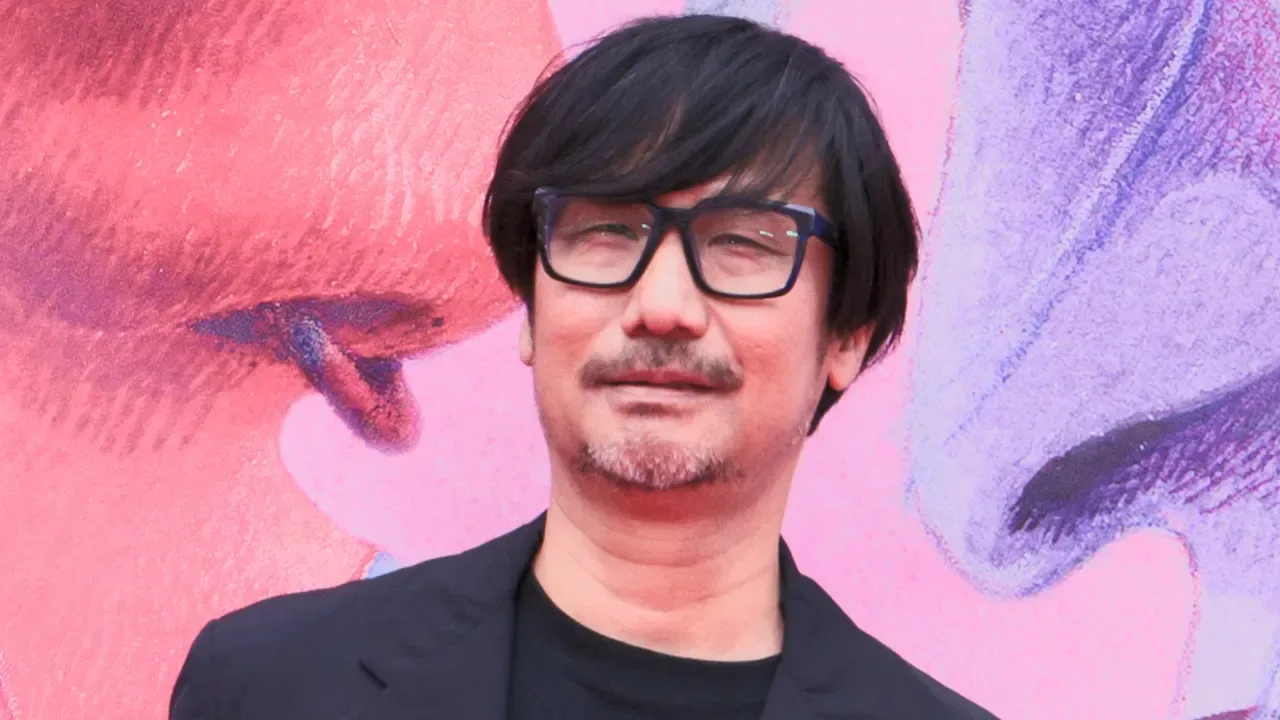
For another example of film-world anticipation from the games space, see Hideo Kojima’s tease of a secret cameo in a major live-action movie.
Release path and early awards positioning
Artificial reached the screen through its own complicated business path. Neon completed a deal for the reported $40 million project in June, after Amazon MGM Studios had dropped it months earlier. That departure came after Amazon entered a major partnership with OpenAI that included a reported $50 billion investment. The alignment of a film’s subject with its former studio’s business relationship naturally adds another layer to the story, though it does not by itself reveal the creative or commercial reasoning behind any decision.
Neon’s awards plans underscore the prominence of the ensemble. Garfield and Rylance are expected to compete in supporting actor categories, Borisov in lead actor, and Barbaro in supporting actress. Category placement is part strategy and not a definitive measure of a character’s amount of screen time or importance; campaigns often reflect how distributors believe a performance can be positioned most effectively.
The immediate takeaway is not that Artificial has already settled the conversation around AI on film. It is that Guadagnino’s project has arrived with a clear identity. The early reactions describe a movie that finds dread in boardrooms, comic friction in elite power struggles and drama in the human beings attempting to direct technologies with outsized consequences. If that tonal balancing act holds for wider audiences, Christmas Day may bring a notably sharp corporate nightmare to theaters.