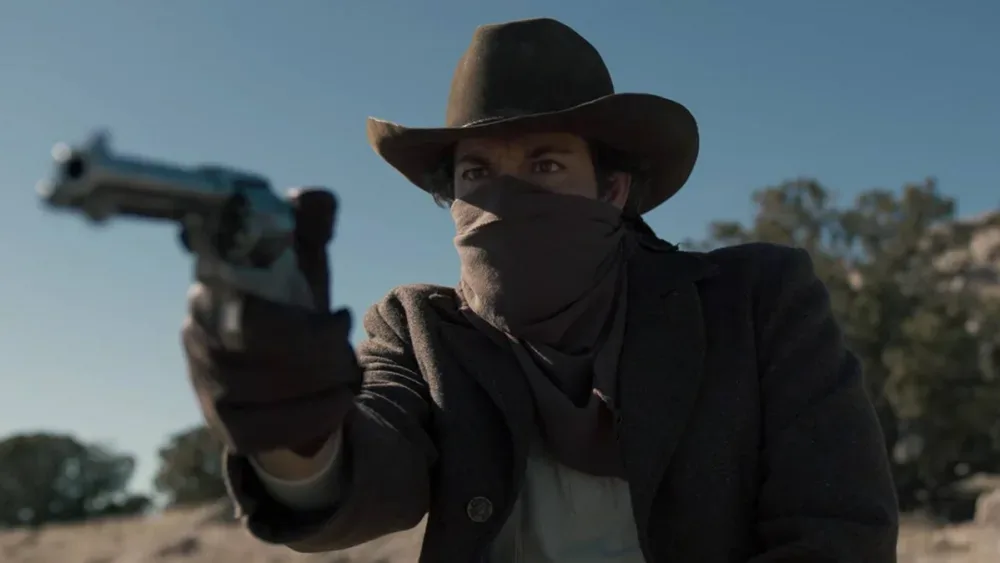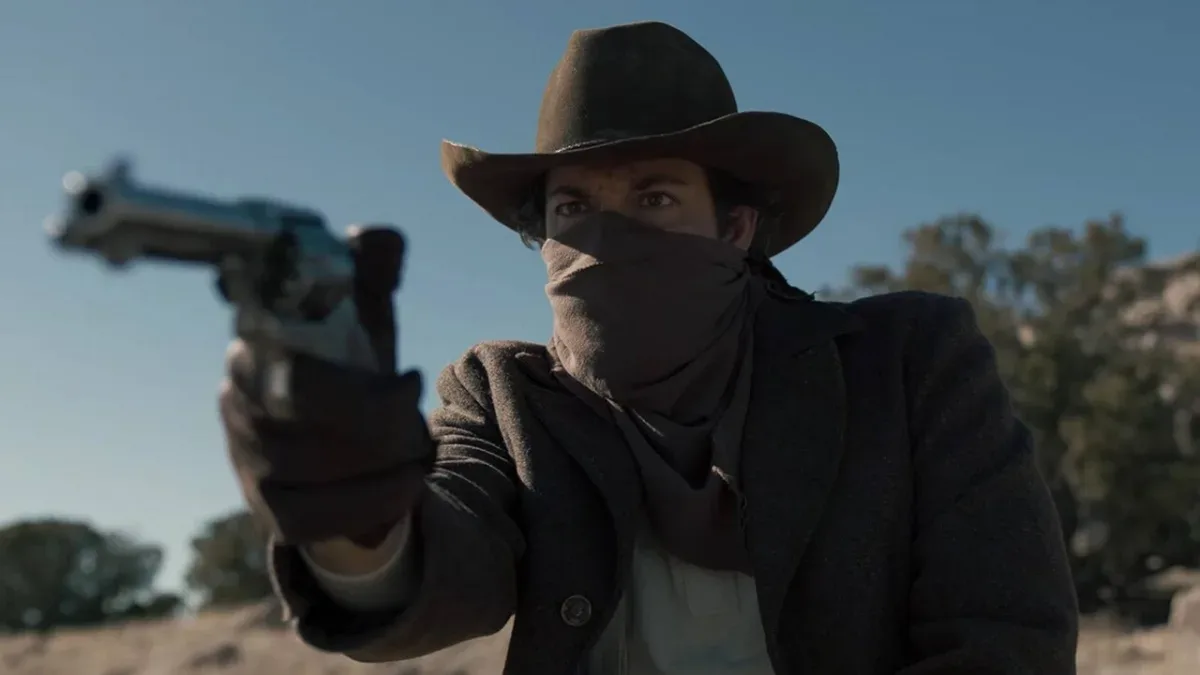
Angel and the Badman, director Julio Quintana’s new remake of the 1947 Western, puts Zachary Levi in the role of Quirt Evans: a gunman and cattle rustler attempting to leave violence behind after a frontier family takes him in. It is a familiar redemption premise, and one with a substantial cinematic shadow. The original starred John Wayne, marked his debut as a producer as well as its star, and has already received one prior remake, a 2009 television adaptation featuring Lou Diamond Phillips and Deborah Kara Unger.
This new version has a clear central proposition: a man defined by brutality encounters a community organized around belief, mercy and a different vision of life. But its uneven mix of broad modern-sounding humor, romance, moral seriousness and shootout-era danger appears to leave the film pulling in more than one direction. The strongest reason to check it out may be Tommy Lee Jones, whose supporting turn as a watchful U.S. marshal reportedly gives the film an energy and personality that its central romance does not always match.
A Western about a bad man offered another way
Quirt Evans arrives at the Worth family’s door after an opening confrontation with the Laredo gang, the criminal group with which he has been involved. He is injured, hunted and looking for an exit from the life that has shaped him. The Worths nurse him back to health, and Penny Worth, played in the new film by Meg Fraser, becomes the emotional center of his potential transformation.
That setup explains the title’s deliberately opposing terms. Quirt is the “badman,” though the story does not treat him simply as an irredeemable outlaw. Penny is one of the story’s “angels”; the title has historically referred to two angels rather than just one. The drama rests on whether Quirt can abandon the violence inherited from his father and reinforced by his own recent choices.
The 1947 film made that conflict unusually specific through the Worth family’s Quaker faith. Quakers are a Christian religious group historically associated with peace testimony, meaning a conviction against war and violence. Placing an armed fugitive in a Quaker household creates an immediate ethical collision: the people offering care do not share his assumptions about force, revenge or survival.
In Quintana’s remake, that specific Quaker identity has been exchanged for a broader Christian framework shared by the Worths and the wider town. That change can make the film’s values easier to state outright, but it also alters the particular pressure surrounding Quirt. A story built around pacifism has an inherent tension whenever guns, gangs and lawmen enter the frame; a more general spiritual message can place greater emphasis on stated belief and personal repentance.
The challenge of remaking a John Wayne vehicle
The original Angel and the Badman was a notable project in Wayne’s career. Released by Republic Pictures, it was written by James Edward Grant, who later wrote 11 more Wayne films. Wayne also took a risk by making Grant, an experienced screenwriter but first-time director, the filmmaker behind the camera.
Its genre mixture is a key part of why the earlier film remains difficult to recreate. It was not only a gunfighter drama. It shifted between romantic comedy, a leisurely tale of moral recovery and classic Western danger, allowing Wayne’s Quirt to be both a figure of threat and an object of attraction. Gail Russell played Penny opposite him.
Related coverage includes Angel and the Badman Review: Zachary Levi Remake Struggles to Match Its Western Roots.
The original was also part of a wider but relatively distinctive tradition: the Western that tests frontier violence against religious principle. Other films named in that conversation include The Lady from Cheyenne, High Noon and Cheyenne Autumn, along with the non-Western Friendly Persuasion. Yet the earlier Angel and the Badman is regarded as especially character-focused within that group.
A remake, then, needs more than horses, wide-open country and a man with a troublesome past. It needs to make the hero’s moral contradiction vivid, give the romantic pairing a real charge, and ensure the faith at the heart of the story generates drama rather than simply supplying instruction. On the available assessment, the 2026 version does not consistently find that balance.
Zachary Levi’s Quirt faces a tonal split
Levi’s performance is described as proficient, but the material reportedly gives him competing registers that do not fully join together. On one side, Quirt is written with jokey, conspicuously contemporary-style wisecracks. On the other, he must confront an inheritance of abuse and violence while trying to become someone capable of a better life.
That is not an impossible pairing. A charismatic outlaw can use humor as armor, particularly when he is frightened, guilty or unwilling to admit vulnerability. But the jokes have to reveal something about the character or sharpen the tension around him. If they feel imported from another kind of movie, they can dilute the danger and make a character’s darkest reckoning less persuasive.
The assessment here is that Levi has difficulty reconciling the light, wisecracking version of Quirt with the more textured “dark angel” the story requires. It compares his lighter mode to the affable energy associated with Jason Sudeikis in Ted Lasso, an observation that pinpoints the issue without questioning Levi’s screen presence. A redemption Western needs the audience to believe that its protagonist has genuinely been close to ruin. Charm is valuable, but it cannot entirely replace gravity.
Fraser’s Penny is characterized as scrappy and yearning, qualities that fit a woman who sees possibility in an injured man while still needing to preserve her own agency. The reported weakness is less about the individual conception of Penny than the limited spark between the romantic leads. For a story in which love is part of the route out of violence, that missing chemistry has larger consequences.
Tommy Lee Jones gives the marshal some bite
Jones plays the U.S. marshal who tracks Quirt and keeps an eye on the Laredo gang, taking over the role played by Harry Carey in the 1947 film. At 80, Jones is said to bring a dry, wily intelligence to even the plainest dialogue. His voice is higher than it once was, but that quality apparently becomes part of the performance’s distinctive rhythm rather than a distraction.
The marshal is a potentially valuable counterweight in this kind of Western. He is neither the fleeing outlaw nor the family attempting to reform him. He represents the law, but also experience: a man who understands criminals, recognizes evasions and may see possibilities in Quirt that Quirt himself cannot yet acknowledge. Jones’s handling of that role seems to add the small verbal payoffs and idiosyncratic character detail the rest of the film could use more often.
There is a backhanded compliment embedded in that strength. The marshal is said to be compelling enough that the film occasionally makes a viewer want to follow him instead. A magnetic supporting character can enrich a Western, but when he pulls focus from the protagonist’s inner transformation, it underscores how difficult the leading role’s tonal assignment has become.
New Mexico beauty, but limited frontier texture
The film was shot amid New Mexico scenery, which supplies a calming visual backdrop. Its opening image is singled out as the best example of the movie’s visual confidence: gunshots are heard before a distant rider appears on the horizon, soon pursued by other horsemen. It is a recognizable Western grammar, but one reportedly composed with enough care to avoid feeling like a mere reenactment of genre imagery.
“Shot design” is the useful term here. It refers to how a movie arranges the camera’s position, framing, movement and relation to performers or landscape in order to direct attention and establish feeling. A long-distance image of one rider against an expansive horizon can suggest isolation, danger and the vastness of the frontier before anyone speaks.
Alex Quintana served as both cinematographer and editor. Cinematography encompasses the image-making choices of lighting, framing and camera work; editing is the selection and arrangement of shots into scenes and sequences. The critique is that the lighting, cutting and compositions are functional without becoming especially surprising or distinctive after that opening.
The larger production-design concern is that the town does not feel sufficiently lived in. Belt buckles appear new, signage looks freshly painted, and the film offers comparatively little sense of the material texture of 19th-century Western life. This is not merely a matter of dirty costumes for their own sake. Wear, clutter, labor and the physical traces of ordinary living can make a setting feel inhabited. When those details are absent, the moral stakes can feel detached from a credible world.
What to know before watching
- Rating and length: The film is rated PG-13 and runs 105 minutes.
- Director: Julio Quintana.
- Screenwriters: Kevin Townsend, Christopher Tuffin and Jaime Hernandez.
- Key cast: Zachary Levi, Meg Fraser, Tommy Lee Jones, Neal McDonough, Jean Louisa Kelly, Barrett Klepac, Melissa Chambers, Maurice Greene, Jesus Carus and Sean Bridgers.
- Music: Hanan Townshend.
The result sounds like a fitfully engaging remake rather than a definitive revival of its source material: one sustained by attractive New Mexico locations, a strong first image and a scene-stealing Jones, but undermined by an uncertain tonal approach, an overly polished Western environment and a romance that does not generate enough heat. The earlier film’s combination of danger, romance and restraint remains the sturdier version of this particular redemption ride.
For another recent example of film culture intersecting with game-world conversation, Ben Affleck has discussed how Fortnite voice-chat arguments informed an element of Animals.