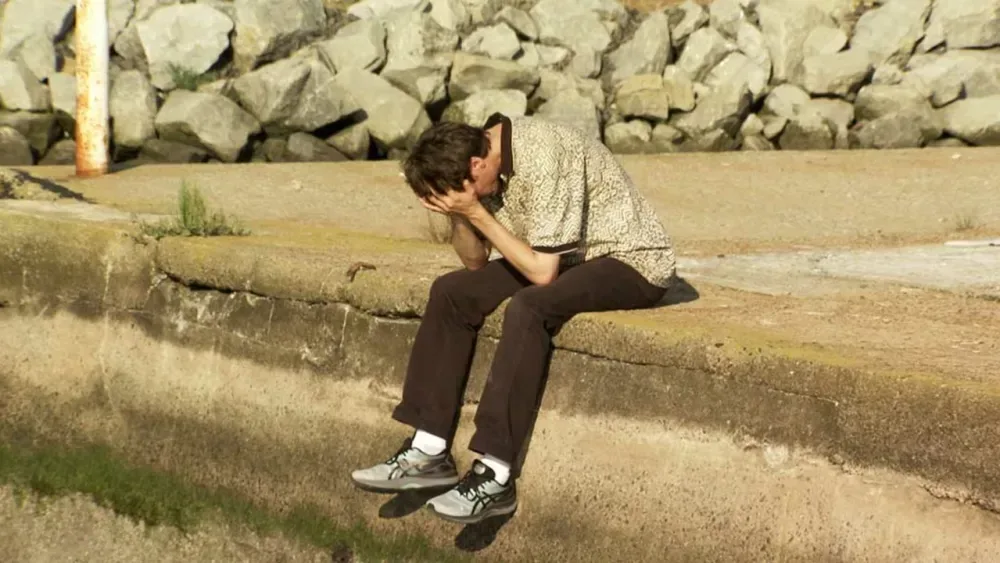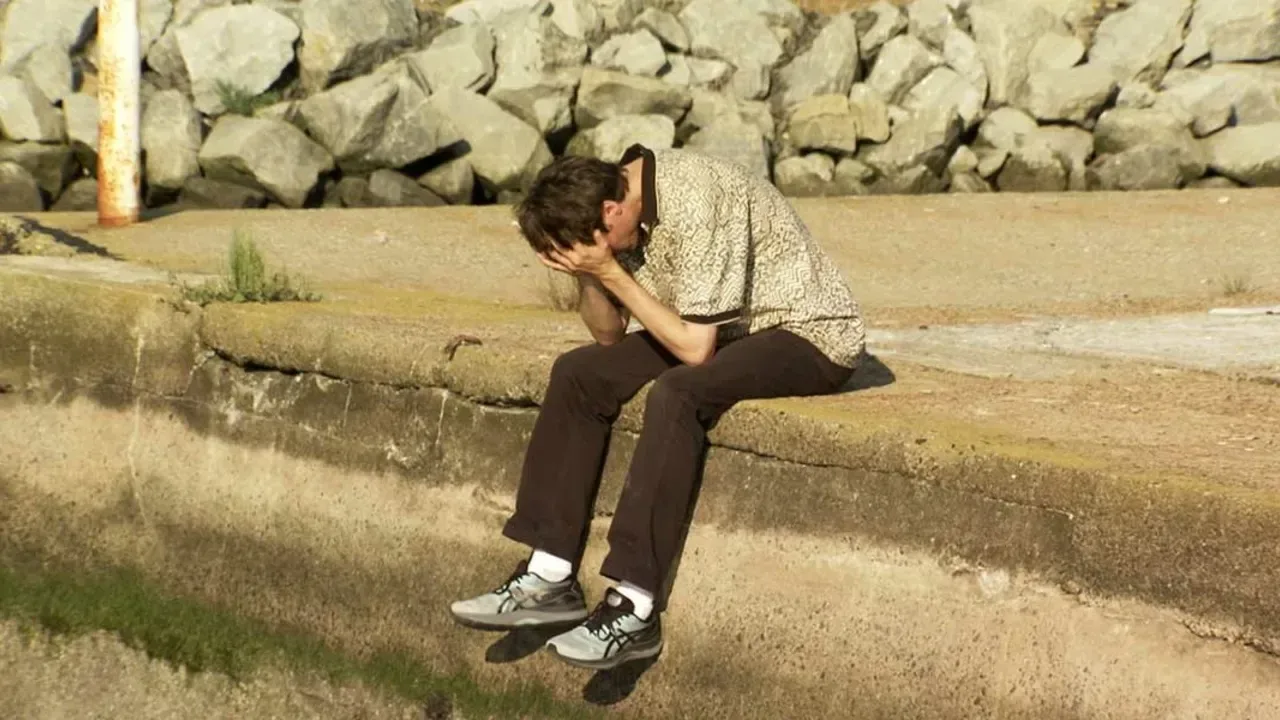
Matt Barats’ Anchors Aweigh starts from an intentionally uncomfortable premise: a comedian in his late thirties proposes to Megan, a 25-year-old heiress with Broadway ambitions, and her uneasy response leaves him emotionally and creatively unmoored. Barats plays the unnamed comedian as a version of himself, then builds the film around the aftermath—old recordings, aborted sketches, awkward encounters and a running stream of sardonic commentary.
The premise gives the film a clear subject: arrested development. Its central character is old enough to recognize his limitations but too committed to his defensive comic persona to move beyond them. That tension is both the movie’s most promising idea and the reason its loose, self-conscious style can feel frustrating. Anchors Aweigh finds texture in a comedian’s grimly funny self-examination, but its 71-minute running time still reportedly feels stretched by material that does not always develop past the outline of a sketch.
A breakup spiral filmed through obsolete technology
Barats wrote and directed the film as well as taking the leading role. The character’s failed proposal to Megan, played by Serena Profaci, prompts him to look backward at MiniDV footage from his younger years while using what appears to be that same kind of camera for fresh recordings. The result is not simply a story about romantic embarrassment. It is a story about somebody treating the machinery of recording as a substitute for progress.
MiniDV refers to a small digital videotape format associated with consumer and prosumer camcorders. In this case, the format matters aesthetically: its image noise and dated texture make the recordings feel inseparable from the protagonist’s past. The camera is more than a period detail. It becomes a visual expression of someone who still processes adulthood through an old set of reflexes—particularly a style of sarcasm shaped by the political and cultural atmosphere of the Bush years.
That is a potent visual idea because the technology does not merely preserve memories. It makes present-tense footage look like memory too. When the protagonist records new solo material on the old camera, the film suggests that his current creative life has become difficult to distinguish from replaying his younger self. He is documenting a breakdown, but he may also be repeating it.
Mockumentary rules, then deliberate rule-breaking
Anchors Aweigh sometimes adopts the guise of a documentary made by its protagonist, though it periodically abandons that framework for more conventionally staged scenes. A mockumentary is a fictional work that borrows the visual language, structure or apparent directness of documentary filmmaking. It can create comedy through awkward interviews, amateur-looking footage, conspicuous cameras and the tension between a subject’s self-image and what viewers can plainly see.
Barats’ film does not appear interested in following those rules rigidly. Its transitions between self-shot material and more traditional scenes are part of its unstable design. That instability fits the lead character’s ennui: he is neither making a clean documentary nor telling a cleanly shaped fictional story because he does not seem able to give his own experience a satisfying form.
There is an appeal to that formal messiness. A person in a creative and romantic tailspin is unlikely to produce a neat record of events. But looseness needs a counterweight—either escalating comic situations, people with enough presence to alter the story, or a more sustained emotional reckoning. The film’s approach reportedly supplies intriguing moments rather than a consistently accumulating arc.
Related coverage includes ‘Anchors Aweigh’ Drifts Through Comedy, Regret and MiniDV Nostalgia.
The marina detour and a movie that keeps drifting back inward
One of the movie’s notable diversions takes place after the protagonist rents a boat at a marina near a New York airport. The setting opens the door to a different kind of comic documentary: lingering waterfront imagery, unusual local figures and a potentially wider social canvas. The material gestures toward observational mockumentary, with the lead’s caustic personality placed against people who may not share his worldview or perform for his camera in the way he expects.
Yet the supporting figures at the marina do not remain in focus long enough to become a strong counterforce to Barats’ character. The film returns to the strained romance and the protagonist’s inward spiral. That choice is understandable—the failed proposal is the emotional engine—but it limits what could have been a richer collision between his monologue-heavy persona and a world not built around him.
The waterfront also supplies an apt recurring visual motif. Water, boats and shoreline imagery naturally evoke aimlessness, transit and the possibility of escape. Here, those images appear to sit beside a man who is physically mobile but psychologically stalled. The title’s maritime phrasing gains some irony in that context: the character is not confidently setting a course so much as failing to find one.
Irony as both the joke and the barrier
Barats’ protagonist has a sardonic cadence that turns nearly every observation into a possible punchline. That is an essential part of the characterization. He is not just funny or cynical; he is someone for whom cynicism seems to be an all-purpose way of avoiding sincerity. Even when he recognizes his own naïveté or immaturity, he can package that realization in a knowing aside before it becomes genuinely vulnerable.
This creates a difficult but interesting comic problem. Self-awareness is not the same as change. A character can correctly diagnose his flaws while continuing to use the diagnosis as another performance. Anchors Aweigh understands that distinction, and its gentler moments of sentimentality reportedly peek through the coating of irony. But the film’s insistence on winking at its own construction can keep those moments at a distance.
In practical terms, that means audiences drawn to cringe comedy, fragmentary comic essays or films about artistic self-sabotage may find much to engage with in its premise and texture. Viewers hoping for a steadily expanding romance, a sharply structured mockumentary or a full emotional payoff may find the film’s wandering form less persuasive. The strongest case for the movie is not that it resolves its protagonist’s problems, but that it makes his inability to resolve them visible in the footage itself.
Dreamlike sound, half-formed sketches and an uneven scale
Simon Hanes’ score is a major contributor to the movie’s occasional movement into surreal territory. The music helps complicate what might otherwise be a very literal tale of humiliation and nostalgia, nudging the film toward an atmosphere where memory, invention and self-mythologizing can blur together.
That slightly dreamlike quality is important because the protagonist is shooting new sketches and anecdotes alongside revisiting old material. He is not presenting a stable archive. He is building an edited version of himself while openly failing to escape the previous one. The sketches’ half-formed nature becomes part of the portrait: creative work here is not a triumphant outlet but another sign of a person stuck in preparation mode.
The film’s limitations seem tied to scale rather than a lack of a starting point. There is enough material for an effective short-form comic piece: a failed proposal, a noisy old camera, a self-lacerating performer and the uneasy realization that aging does not automatically make someone wiser. Stretching that idea into a feature asks for more variation and deeper consequences. Anchors Aweigh reportedly reaches toward both, but does not always get there.
Still, Barats’ willingness to make his self-insert character callow, awkward and routinely unflattering is notable. The movie does not seem to mistake the comedian’s observations for wisdom simply because they are pointed. Its most compelling notion is that intelligence and irony can become their own kind of inertia.
Cast and production details
Alongside Barats and Profaci, the cast includes Mike Holt, Felipe Di Poi, Elizabeth Cappucino and Ana Fabrega. Alex Bliss served as camera operator, Whit Conway edited the film, and Hanes composed the music. The production credits include AbsoLutely Productions, Cartuna, Mongoose Picture House and Bronxburgh.
Anchors Aweigh was screened in the Midnight Madness program at the Toronto Film Festival on September 17, 2026. Its 71-minute length makes its central creative question especially pointed: can a deliberately rambling portrait of immaturity transform repetition into revelation? The film’s answer appears deliberately unsettled, which may be the point—even if its sharpest joke is that its protagonist never quite finds a way to move forward.
For another recent film story built around a performer caught in a highly mediated personal spiral, see our look at Vintage Violence.