Vintage Violence is built to move at the speed of a feed: vertical video, flying chat comments, a social-media personality who cannot escape an audience, and a plot that turns a bag of vintage denim into the kind of object everyone is ready to hurt everyone else over. Yet its defining tension appears to be that all this aggressively current visual and technological noise does not always produce corresponding momentum.
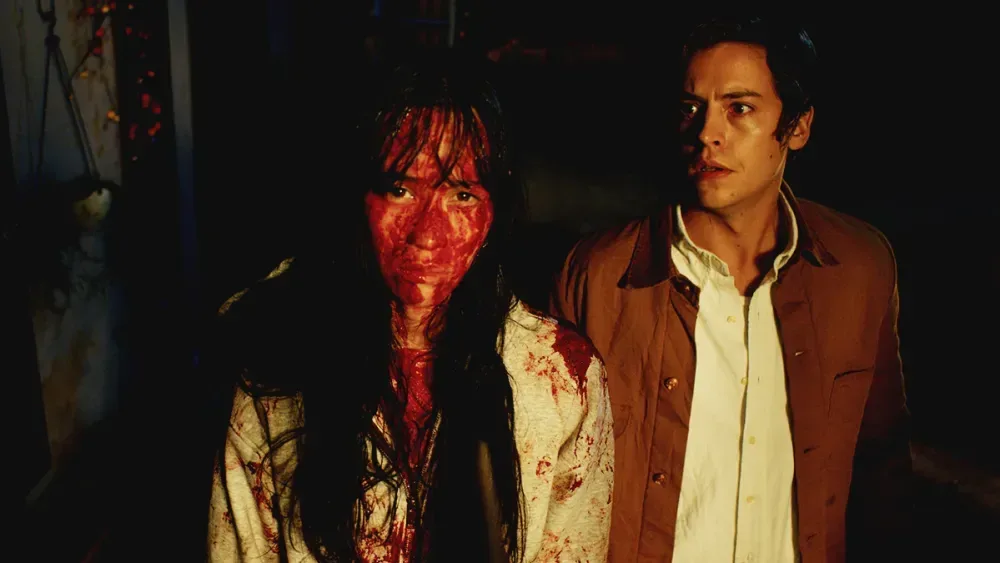
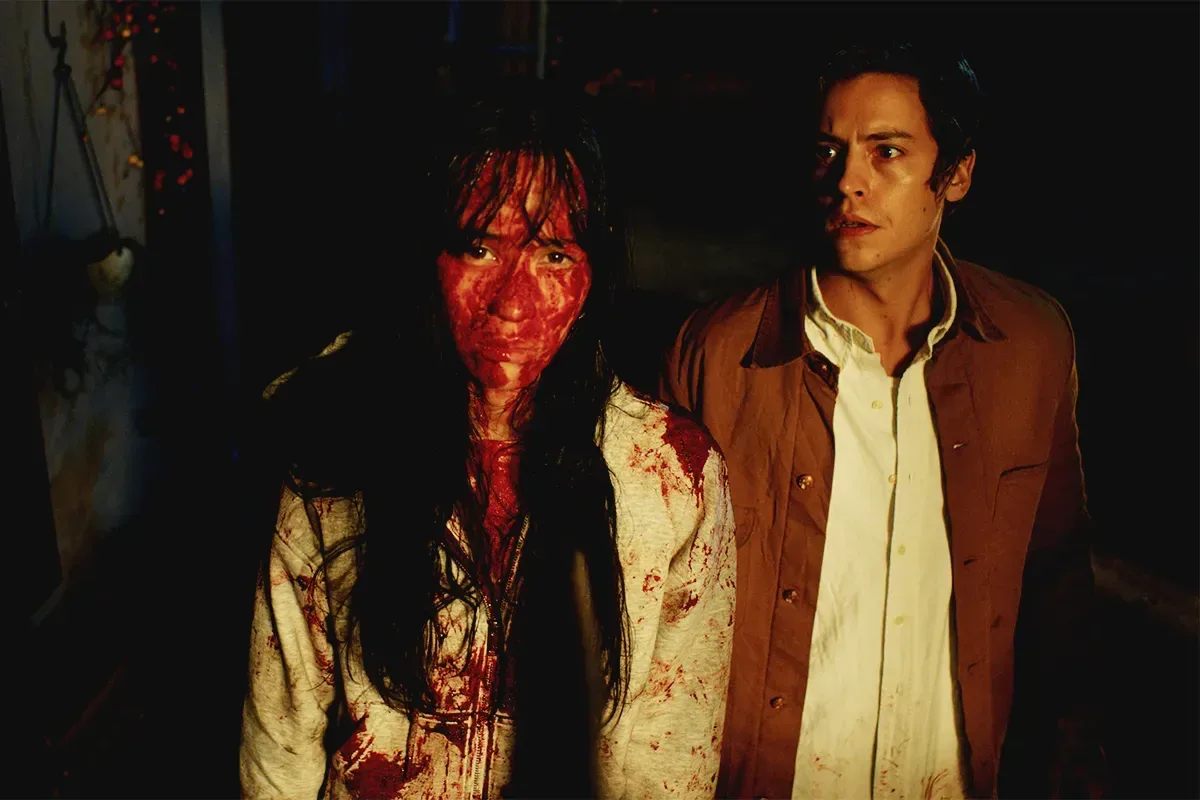
Written and directed by Eugene Kotlyarenko, the 105-minute Canada-Ireland production stars Cole Sprouse as Carter, an obnoxious online celebrity introduced while broadcasting live. He is soon pulled into a Tokyo-set gangsters-versus-everybody scramble after Izumi Adachi, played by Kiko Mizuhara, offers the prospect of enormous money for denim Carter has found during a stream.
The result is a film described through extremes: hyper-online, bloody, packed with references, filled with bizarre underworld figures and designed around pieces of contemporary technology. It played in the Toronto Film Festival’s Midnight Madness program on September 14, 2026. For a compact rundown of the same premise, see this overview of Carter’s Tokyo live-stream mayhem.
A protagonist introduced by the interface
Carter’s opening matters because it establishes that the screen is not simply recording his life. It is part of the story’s pressure system. He appears in vertical framing, the visual orientation closely associated with phone-first social platforms, while chat messages fire insults and exposition at him in quantities too dense to comfortably absorb.
For more context, explore Bad Idea’s December 2026 Comics Lineup Sends Hank Howard to Tokyo, Collects Odinn’s Eye.
That choice turns interface clutter into characterization. Carter is not introduced through a calm conversation that explains his history; information is dispersed amid a noisy audience response. Viewers are asked to process the same barrage of attention, abuse and context that surrounds an internet-facing celebrity. The film’s early density is one of its clearest ideas: digital platforms can compress an extraordinary amount of information, but compression is not the same thing as clarity.
It also fits Kotlyarenko’s established interest in stories about love and cultural madness under social media’s influence. Live-streaming was central to his 2020 film Spree, and Vintage Violence again uses being watched as an active dramatic condition rather than an incidental detail. Carter begins as someone already performing for a crowd, which makes his plunge into a criminal chase feel less like an escape from spectacle than a more dangerous extension of it.
The denim is a MacGuffin, not a nostalgia trip
The vintage denim is the film’s MacGuffin: a sought-after object whose chief narrative job is to make characters act. Here it arrives in duffel-bag scale and keeps Carter and the people chasing him in motion. Izumi’s promise of major profits provides the reason for him to head to Japan, while the denim supplies a portable stake that can circulate through a violent, shifting set of alliances.
Calling it a MacGuffin does not mean it is meaningless. The choice of vintage clothing aligns with one of the film’s sharper thematic contradictions. The title suggests an encounter between oldness and brutality, but the past seems to exist chiefly as a thing to buy, sell, display and fetishize. “Vintage” is less a doorway into memory than an item with exchange value. The story is otherwise fixed in the relentless present: live reactions, phone tracking, clip-ready outbursts and constant motion.
The end credits say the production received support from Levi’s and Levi’s Japan, a detail that makes the denim’s centrality especially notable. Still, the supplied information does not establish exactly how that support affected the plot or props, so it is best read simply as a disclosed production connection rather than evidence of a particular creative decision.
Tokyo, outsider status and the limits of Carter’s viewpoint
Vintage Violence does not ignore the potentially uneasy position of an American-led story racing through Tokyo. Carter is repeatedly branded a gaijin, a Japanese term commonly used for a foreigner or outsider. In this context, the insults make his lack of belonging explicit. The film turns that discomfort into part of its action-comedy machinery rather than pretending Carter naturally understands the world into which he has arrived.
That self-awareness does not automatically settle larger questions about a foreign director presenting Japanese characters and spaces, but it does identify the problem inside the movie. Carter is an interloper, not a neutral guide. His outsider status shapes both the hostility directed at him and the story’s premise of someone chasing quick money in a setting he cannot control.
Sprouse is presented as a workable center for the escalating mayhem. Carter adapts to each new threat and moves toward a measure of moral rehabilitation, a process that is paired with a romantic development. That arc gives the film a comparatively familiar dramatic spine beneath its chaotic wrapping. The wider cast includes Pierre Taki, Hio Miyazawa and Nijiro Murakami, with dialogue in English and Japanese.
Technology becomes the chase choreography
The strongest described setpiece turns a small wireless convenience into a tracking device. After Carter’s phone is stolen, he pursues the thief by listening to the changing interference in his Bluetooth earbuds. As he gets nearer to the phone, the crackle becomes more continuous.
It is an effective example of a film using a current technology for more than a topical reference. Bluetooth is a short-range wireless connection standard; its limited range lets the audio disruption function as a rough proximity signal. Rather than relying on a conventional map dot or a shouted clue, the sequence converts unstable connectivity into suspense. Carter is literally listening for his relation to the missing device.
That is the sort of technical detail that can give an action sequence a present-day texture. The device does not have to be explained at length for the audience to understand the rule: broken audio means distance, steadier audio means he is closing in. It is also a useful reflection of the film’s larger interest in life mediated through hardware. Carter’s phone is both personal possession and a vital extension of his public self, so losing it produces a chase that is practical, professional and psychological at once.
Maximal style meets a familiar action framework
Cinematographer Sean Price Williams supplies a restless look through frequent tilts and zooms. Those movements can make the image feel unstable or reactive, matching a narrative in which Carter is continually knocked into another violent situation. Eli Keszler composed the music, while Kotlyarenko edited with Tucker Bennett and Sabrina Greco.
The film’s references and genre signals are expansive. It invokes Japanese filmmaking and takes cues from works as different as North by Northwest and Wanderlust. Its yakuza violence is described as bloodier than a typical mid-2000s Takashi Miike outing. The title itself comes from a John Cale album, and the movie reportedly earns it through conspicuous bloodletting.
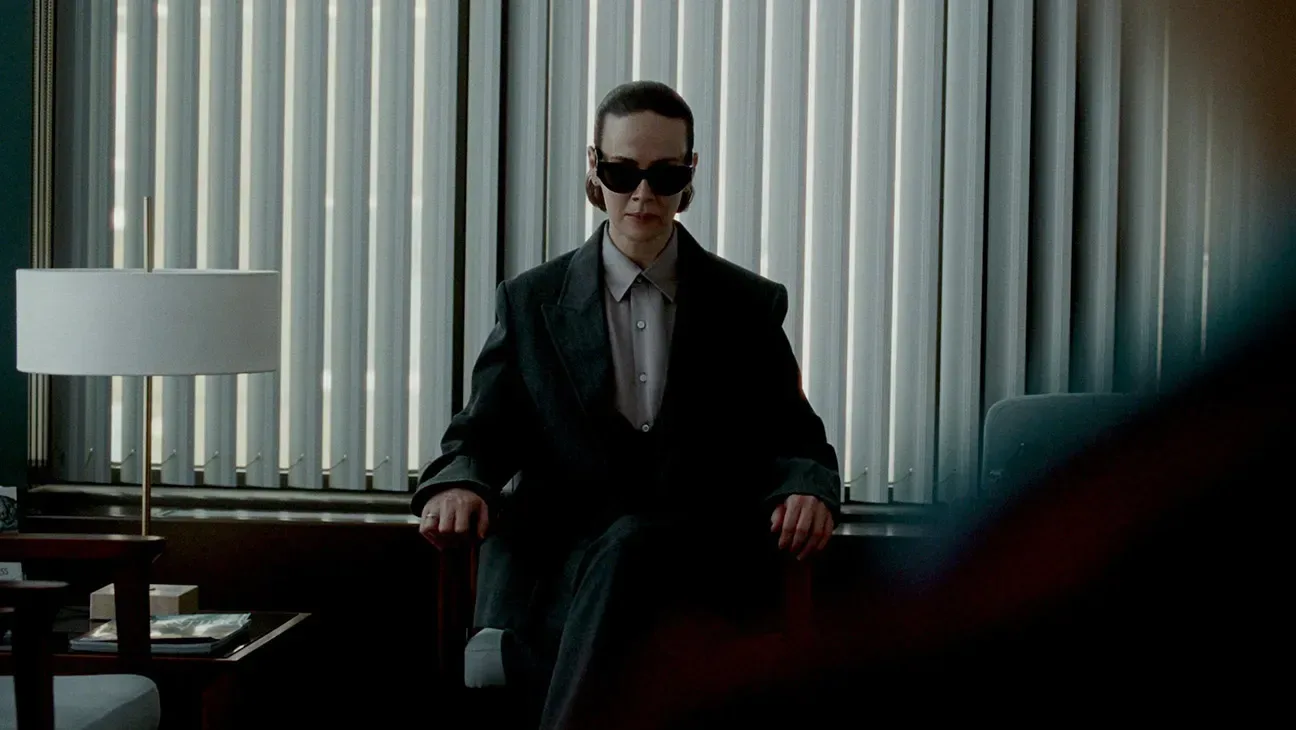
There are also deliberately outrageous inventions: a hotel with an unnerving media-programming sensibility, and a gangster whose missing finger has been replaced by a poisonous-mist spray bottle. These are not restrained touches. They are cult-film images built to be instantly legible, shocking and easily extracted into a short online clip. In that sense, the movie’s aesthetic mirrors the very social-media ecosystem it examines: it strives to be memorable in isolated bursts.
The trade-off is cumulative fatigue. A barrage of outlandish characters, violence, references and digital-age embellishments can create stimulation without a sustained rise in excitement. The assessment here is that the film remains committed to its mayhem but can become enervating rather than energizing, and that its plot components remain unexpectedly conventional despite the contemporary surface.
What ‘hyper-online’ means for this movie
Hyper-online is more specific than merely having phones in the frame. It describes a condition in which platform behavior, immediate public feedback, networked devices and attention economics shape how people perceive themselves and one another. In Vintage Violence, Carter’s live-stream introduction, the overwhelming chat overlay, the denim’s commodity appeal and the Bluetooth chase all make technology structural to the film’s storytelling.
The story’s most interesting friction comes from combining that condition with recognizably old-school genre parts: a compromised protagonist, a coveted object, criminal factions, pursuit, romance and surreal villains. The promise is not that technology has replaced action-movie conventions. It is that those conventions now operate through feeds, devices and forms of visibility that did not exist for earlier genre films.
That balance may determine the film’s appeal. Viewers looking for a disciplined thriller may find the constant escalation and stock story beats limiting. Those drawn to midnight-program chaos may find its twitchy camera work, grotesque villainy and internet-native visual overload to be the point. Either way, Vintage Violence frames its violence, its vintage obsession and its streaming culture as parts of the same anxious present: everything is for sale, everyone is watching, and even a pair of earbuds can become a survival tool.