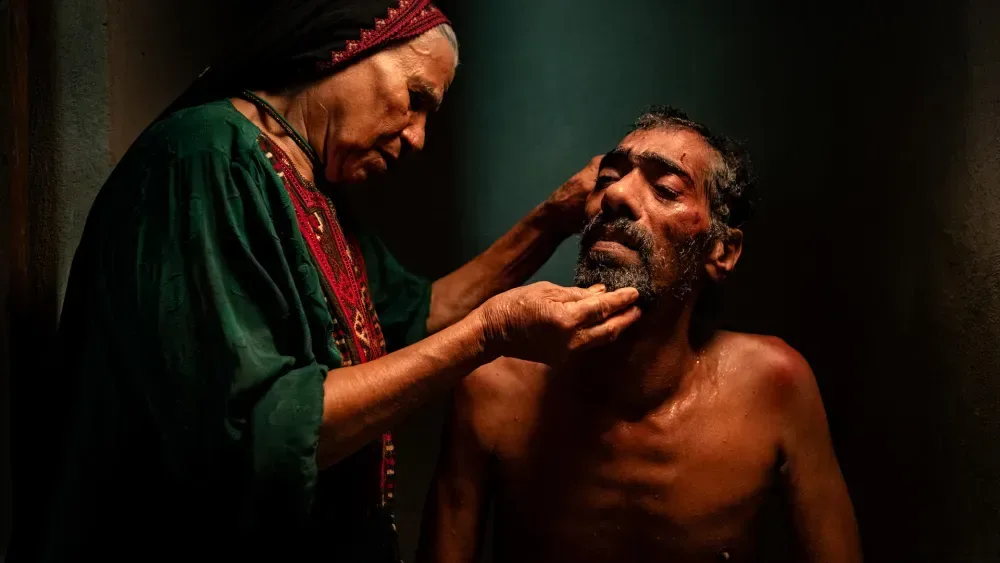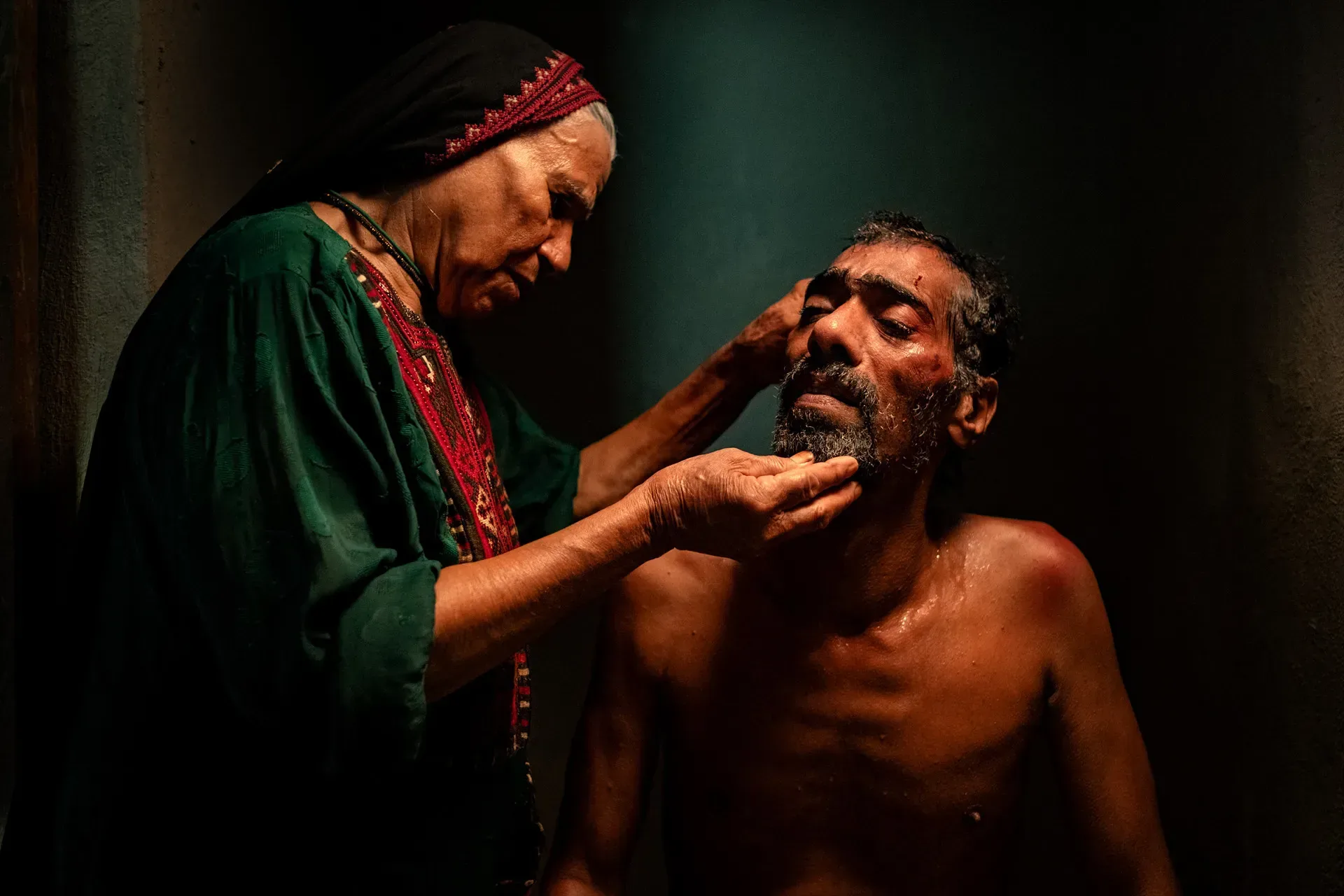
Midday Meal takes a premise that sounds narrowly practical—a rural teacher needs to keep lunch on the table for his students—and finds an escalating ethical crisis inside it. Directed by Majid Majidi and set in the Iranian village of Goorankesh, the 133-minute Persian-language drama centers on Davoud Soulan, played by Mohammad Rahimi, a schoolteacher attempting to prevent the collapse of the institution where he works and lives.
The immediate danger is not framed as an abstract budget dispute. A private benefactor who supported student lunches has died, and the man’s heirs do not intend to continue that assistance. Soulan receives a salary through the Ministry of Education but works as a contractor, leaving his own position insecure. More urgently, the interruption to the food supply creates a simple and brutal chain reaction: hungry children will not attend class, and the school may close after roughly two weeks without them.
That makes lunch both a material necessity and the film’s organizing idea. Food is not treated primarily as cuisine or domestic comfort. It represents the condition that makes education possible at all. In a dry, forbidding landscape where daily survival already demands compromise, the shared meal becomes evidence of whether a community can care for its children when official structures do not.
A teacher whose good intentions have a cost
Soulan responds by cutting his own living costs. He stays in the school building rather than renting elsewhere, directing what he can toward the children’s meals. He also smuggles and sells fuel to sustain the school. The film presents fuel smuggling as an activity found across the community, including among children, but it does not wave away the consequences or turn Soulan into an uncomplicated folk hero.
That distinction is what gives Midday Meal its tension. The story asks whether an illegal act changes morally when its proceeds are used to feed pupils and keep a school operating. Soulan argues that his offense is small beside the conduct of powerful people who profit from the same trade. His point is not dismissed outright, yet neither does it settle the question. Majidi keeps returning to the distance between a defensible motive and the damage that can be done while pursuing it.
Pragmatism, in this context, means choosing what appears workable under harsh constraints rather than what is ideally fair or lawful. Soulan’s pragmatism can look like sacrifice: he gives up personal space and security to preserve meals and lessons. But it can also look like exclusion and control. His uncertainty about admitting children from nearby villages, and his anger when his mother feeds guests while pupils may go hungry, reveal how quickly scarcity forces him to measure people against one another.
Those choices matter because the film refuses the easy version of a “good teacher against a broken system” story. Soulan may sincerely wish to serve the children, but another character questions whether he is also protecting a dependable paycheck. The possibility does not erase his work or his hardship. Instead, it gives the character conflicting incentives—a crucial feature of a character study, where the point is not simply what someone does, but the unresolved reasons they do it.
Mohammad Rahimi carries the uncertainty
Rahimi’s performance is central to the film’s balance. Soulan is vulnerable, frequently sympathetic and plainly under pressure, but he is not entirely readable. His plans and immediate intentions are sometimes held back, leaving viewers to reassess him as the circumstances become more severe. When a sick older man comes under Soulan’s care, that uncertainty deepens and an act of deception is revealed gradually rather than announced in advance.
Related coverage includes ‘Midday Meal’ Puts a Rural Iranian School’s Survival on One Teacher.
This is an effective use of moral ambiguity: a character is neither cleared of responsibility by a noble goal nor reduced to a villain because of questionable decisions. The film does not offer ambiguity as a puzzle-box trick. It uses it to show what deprivation does to ordinary judgment. A person can be generous and self-protective, devoted to children and resentful of demands, all within the same day.
Majidi’s approach is described as restrained and naturalistic. Naturalism here refers to a style that emphasizes the everyday texture of a setting and behavior instead of relying on heightened speeches or obvious cues that tell an audience whom to admire. That restraint is especially important for a story with an urgent social argument at its center. The film’s anger at institutional failure comes through the pressure placed on Soulan, not through a lecture delivered on the audience’s behalf.
Majidi previously directed Children of Heaven, the 1997 drama that became the first Iranian production nominated for the Academy Award for Best International Feature. With Midday Meal, he again focuses on the stakes that appear small until a family or community can no longer meet them. Here, however, the frame is explicitly institutional as well as personal: an education system benefits from Soulan’s labor while treating his funding arrangements with suspicion and leaving him to improvise survival.
Institutions appear, but care does not reliably follow
The authority figures in Midday Meal are not depicted as simple monsters. An officer rebukes Soulan for setting a poor example for children through smuggling. On its face, that objection has weight. A representative from the education department scrutinizes Soulan’s financing and organization. Again, oversight is not inherently unreasonable. But these encounters happen after the teacher has effectively been abandoned to solve a public need with private money and illicit side work.
The drama lies in that contradiction. Rules arrive with clarity; support does not. The school’s survival is treated as contingent on the ingenuity and moral endurance of one precarious worker, even though the threatened closure affects an entire group of children. The film’s criticism is therefore not just that individual officials can be frustrating. It is that a system can demand compliance from someone while failing to provide the basic conditions that would make compliance possible.
That is why the title’s meal carries so much weight. The lunch is not an extra incentive tacked onto school. It is the thing holding attendance together. Removing it does not merely make the day more uncomfortable; it makes the promise of education inaccessible for children who cannot afford to separate learning from nourishment.
There are moments of grace amid the pressure. A stern inspector comes to recognize Soulan’s charity and chooses to help in the limited way available to him, even though the inspection itself remains highly stressful. The gesture does not repair the wider neglect, and the film does not pretend it does. It does, however, prevent the story from becoming relentlessly punishing. Individual recognition can matter, even when it is no substitute for a functioning safety net.
Why the setting sharpens every decision
Goorankesh is presented as arid and inhospitable, a physical environment that mirrors the narrow margin in which the school operates. The setting is not merely scenic shorthand for hardship. It clarifies why every resource—food, rent money, fuel, attendance and time—becomes consequential. There is little room in Soulan’s life for a mistake that remains just a mistake. One missed meal can become lost attendance; lost attendance can become a closed school; a closed school can mean the disappearance of a community resource that was already fragile.
The film also uses the rituals around food to bring its larger concerns down to a human scale. Sharing a meal can express welcome, family obligation or care. Yet in conditions of shortage, feeding one person may feel like withholding from another. Soulan’s reaction to guests being fed is painful precisely because it is not presented as an objection to hospitality in the abstract. He sees every portion as part of an arithmetic that might determine whether children eat the next day.
For viewers drawn to socially grounded cinema, Midday Meal appears most compelling when it resists a tidy answer to that arithmetic. It recognizes the urgency of feeding children and the dignity in Soulan’s persistence, while remaining alert to the coercive and sometimes ruthless choices that scarcity can produce. The result is a drama in which charity is never entirely free of calculation, and calculation never entirely cancels compassion.
The film screened in competition at the Busan Film Festival on October 10, 2026. Majidi co-wrote the screenplay with Houman Behmanesh, who also served as cinematographer. Mahyar Behmanesh edited the film, Ramin Kousha composed the music, and Majidi and Amir Banan are credited as producers. The supporting cast includes Kheyri Zakeri, Rahim Bakhsh Pira and Heybatmorad Damani.
For another recent example of a film story built around the unusual conditions of exhibition rather than conventional spectacle, see this look at The Pineapple and its one-person theater experiment. Midday Meal, by contrast, locates its drama in a far more fundamental question: what happens when feeding children depends on one desperate person’s ability to keep making impossible choices?