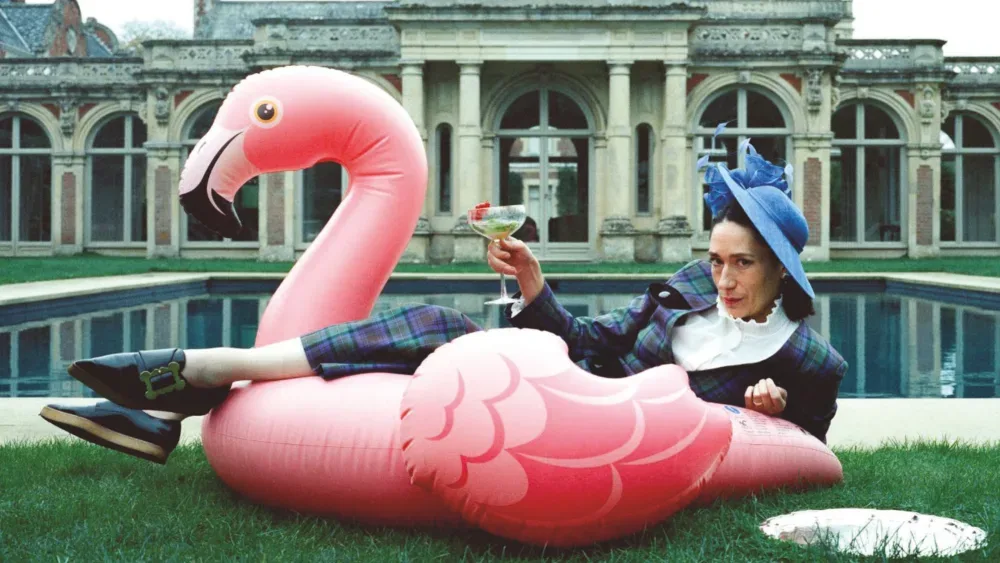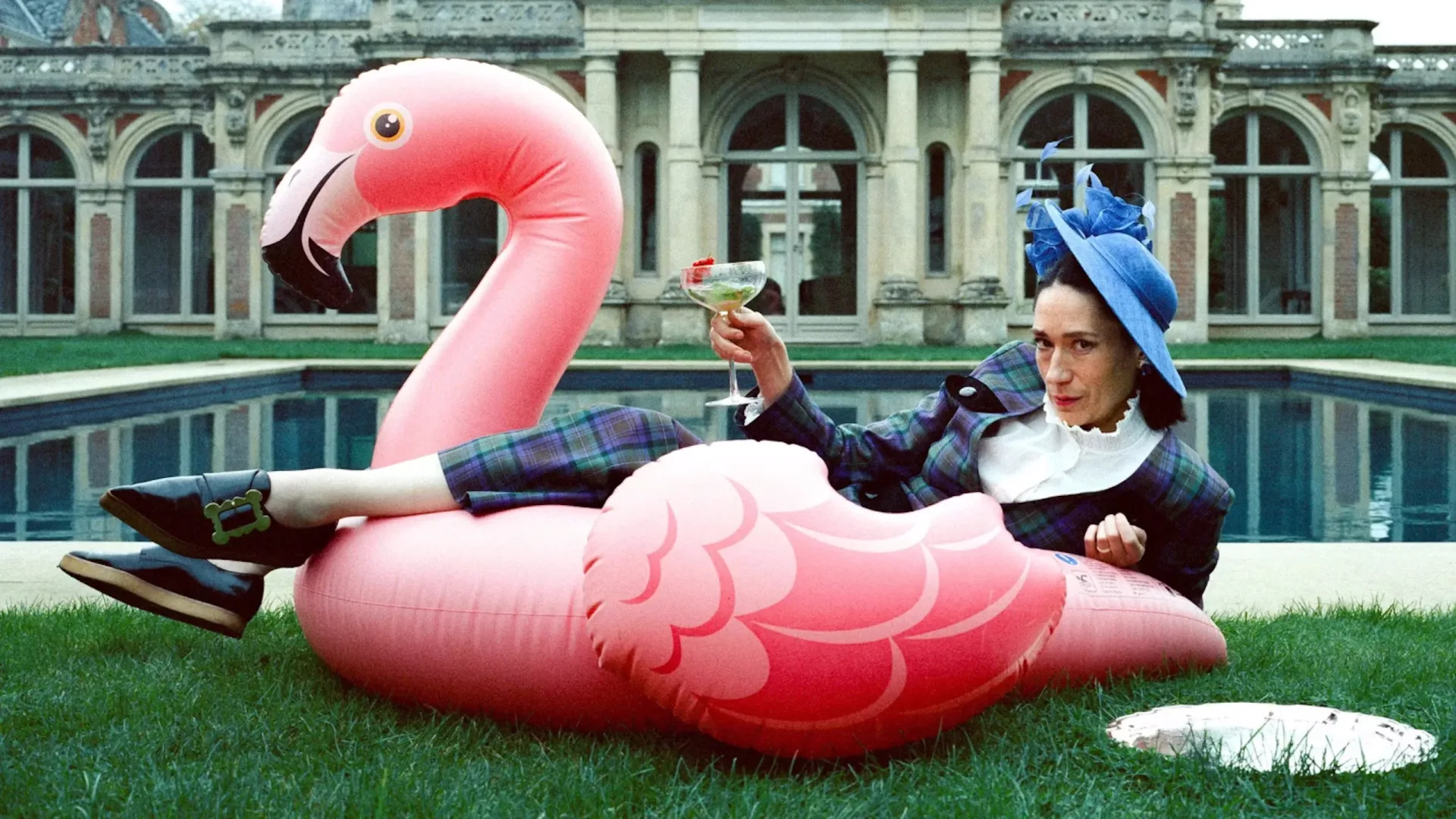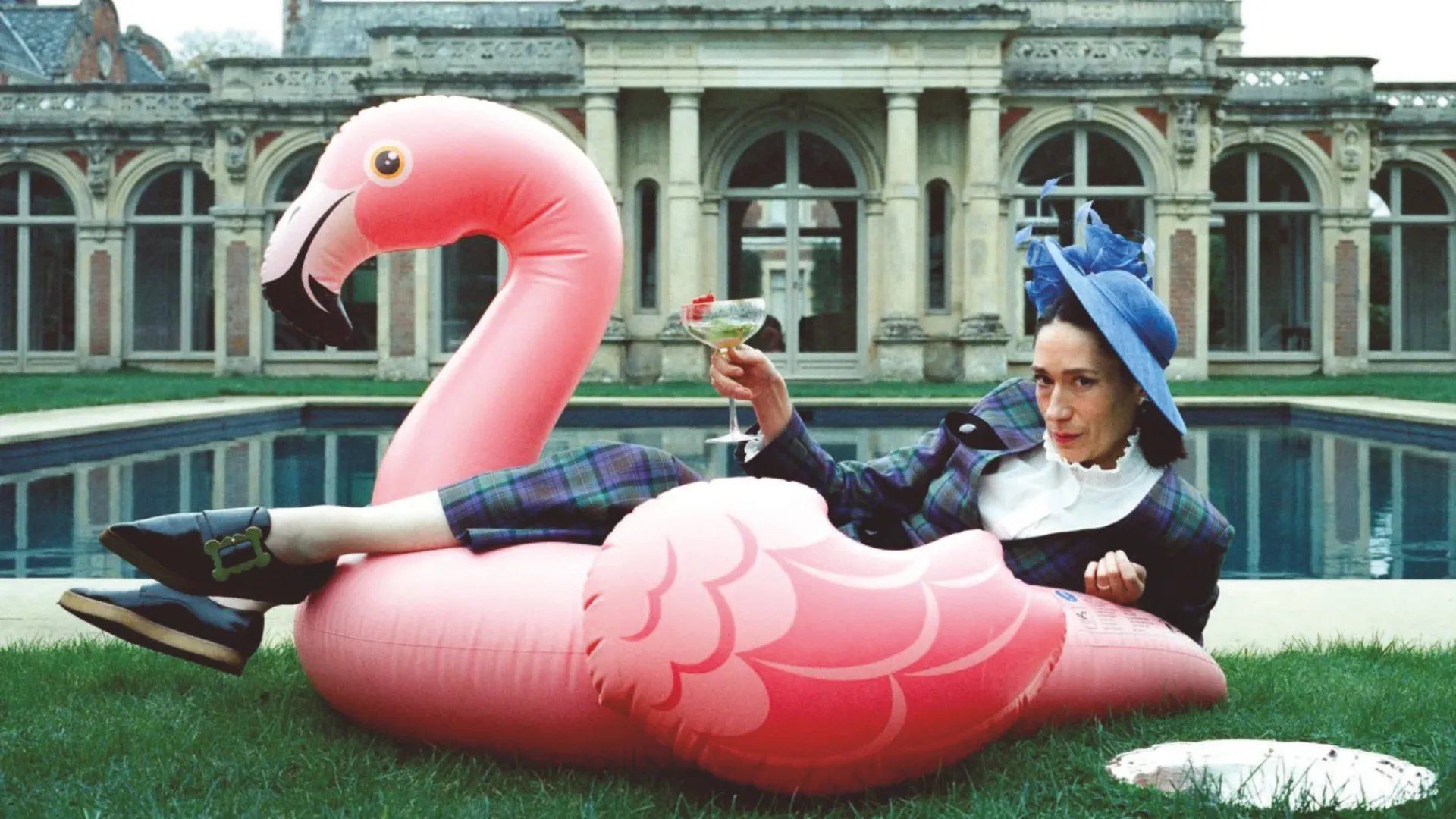
There are few comic targets more durable than inherited wealth meeting an absolute refusal to read the room. Lady, writer-director Samuel Abrahams’ debut feature, takes that premise to a country manor and lets Sian Clifford go spectacularly overboard as Lady Isabella Ravenhyde: a fabulously wealthy aristocrat convinced that she is one camera crew away from the celebrity recognition she deserves.
The result is a 95-minute mockumentary with a deliberately silly, unstable energy. Its focus is not merely the gulf between Lady Isabella’s wealth and the rest of the world, but the particular self-mythology that grows when someone mistakes privilege for natural stardom. She does not just want attention. She believes attention is the proper order of things.
Clifford, best known to many viewers for playing Fleabag’s tightly wound sister in Fleabag, gets a radically different kind of canvas here. Lady Isabella is loud, needy, inventive, nasty and frequently ridiculous, but the performance reportedly finds room for exposed nerves beneath the grand gestures. That combination matters. A character this vain can be funny for only so long if she is merely a punchline; the film’s sharper prospect is that her delusions become revealing as well as absurd.
A documentary subject who has already cast herself
Lady uses a documentary-within-the-film setup. Laurie Kynaston plays Sam, a young filmmaker whose professional prospects appear uncertain despite a short-film BAFTA nomination. His agent connects him with Lady Isabella, who says she has a Netflix commission for a biographical documentary. That claim is false, one of many falsehoods she deploys as she pushes Sam and his crew to keep filming.
The mockumentary form is central to the joke. A mockumentary is a fictional work presented through the visual language and habits of nonfiction documentary: supposedly candid footage, an embedded crew, a subject speaking as if the camera records reality rather than performs a version of it. It can create comic tension because everyone has a different understanding of what the footage means. The subject sees a triumphal portrait. The filmmaker may be looking for a story. The audience sees the gap between the two.
Lady Isabella’s assumption is remarkably simple: show the manor, the money, the drinks and the wardrobe, and people will obviously want to watch. Her self-appointed comparison is “aristocracy’s answer to the Kardashians,” a line that frames the film’s satire of modern visibility. The point is not simply that she is rich. It is that a media culture built around personality, access and conspicuous lifestyle can encourage the already privileged to regard fame as an entitlement.
That makes Sam more than a passive straight man. As a middle-class filmmaker trying to locate a workable subject in Lady Isabella’s chaotic life, he is caught between professional need and her forceful demand to control the narrative. Their mismatch drives the premise: he is there looking for a film, while she believes she already is one.
Clifford’s large-scale turn is the attraction
The report on the film emphasizes that Clifford’s work is what keeps this intentionally slender setup airborne. Her Lady Isabella is described as a whirlwind of physical comedy, sharply acidic line readings and openly frayed emotion. A performance at that pitch needs precision as well as volume. The character’s hunger to be watched must appear extravagant enough to lampoon, but recognizably human enough that viewers can see the insecurity powering it.
Related coverage includes ‘Lady’ Review: Sian Clifford Drives a Wild Aristocracy Mockumentary.
This is especially notable in contrast with Clifford’s public profile from Fleabag. There, she played Claire, a character defined by repression, strain and the feeling that life is coming apart despite enormous efforts to appear composed. In Lady, the restraint is gone. Lady Isabella appears to treat every room as a stage, every person as a potential audience and every camera as an overdue confirmation of her importance.
The film also puts that vanity into tangible comic details. Lady Isabella day-drinks, makes lukewarm Bloody Marys, gives obtuse orders to her maid Becky, played by Juliet Cowan, and displays an aggressively garish wardrobe. At one point, her regional-talent-contest ambitions lead to a modern-dance sequence involving an oversized crow costume. The logic behind her fixation on the contest is not presented as especially robust. But in a film structured around a performer’s capacity to make an entrance, the spectacle may be justification enough.
There is an important difference between a character who is merely eccentric and one who has constructed an entire worldview around being observed. Lady Isabella seems to fall decisively into the latter category. Her weirdness is not detached from status. The manor, staff, clothes and confidence all reinforce the belief that the world should accommodate the performance.
Class satire with a media-age twist
English aristocracy has long been a dependable subject for comedy, but Lady grounds its absurdity in ongoing social inequality and the distance wealth can create from ordinary experience. Lady Isabella’s wealth is not background décor; it is the insulation that permits her fantasy to persist. She has resources, space and people around her, yet still seems intensely preoccupied with proving that she matters.
That is why the mockumentary premise is more pointed than a simple fish-out-of-water setup. It sends a camera into an environment where money already shapes how people are seen. Lady Isabella wants the apparatus of media to certify what aristocratic status has already suggested to her: that she deserves fascination. The camera both serves her fantasy and exposes it.
The film’s satire does not stop with the titled class. It also takes aim at the systems that turn extravagant lifestyles into content. Lady Isabella may be self-deluded, but the cultural proposition she embraces is familiar: expensive surroundings, access and relentless self-display can be presented as a personality in themselves. Her mistake may be less that she wants a show than that she thinks she can dictate the show’s meaning.
An uncanny development in the story reportedly gives her unexpected grounds for thinking the material is watchable, though the details are best left unspoiled. That restraint is useful for prospective viewers because the film’s appeal appears to hinge on discovering how its documentary premise mutates rather than simply watching a known gag repeat.
Freeform construction, carefully shaped craft
Abrahams co-wrote Lady with Miranda Campbell Bowling. The script is characterized by pointed one-liners and small throwaway jokes, even as its overall plot remains light and, at times, intentionally hard to rationalize. That is a potential limitation of the film’s approach: a one-joke engine can run out of road. Yet the construction seems designed to prioritize comic escalation, character behavior and Clifford’s performance over densely engineered story mechanics.
The technical work helps sell the conceit. Josh Mallalieu’s editing is described as jagged and agitated, a fitting texture for footage following a woman whose desires and declarations may shift by the moment. In mockumentary storytelling, editing does more than dictate pace. It determines the rhythm of awkward pauses, reaction shots and contradictions between what a subject says and what viewers are allowed to notice.
Terri Higgins’ costume design also appears integral rather than decorative. Clothes are character exposition in a film about self-presentation, and Lady Isabella’s outsize, gaudy fashion choices communicate her hunger for spectacle before she even speaks. The crow costume is the clearest example, but the wider wardrobe establishes a person who has no interest in blending into her supposedly refined surroundings.
Korsshan Schlauer handled the camera, while Jonny Woodley composed the music. Producers are Anna Mohr-Pietsch and Stewart Le Marechal. Alongside Clifford, Kynaston and Cowan, the cast includes Olisa Odele.
Why the premise has more bite than a posh-person spoof
The best version of this kind of comedy does not ask audiences to laugh only because a rich person is strange. It asks what protects that strangeness, who is forced to manage it, and why it seems plausible to the character herself. Becky, the long-suffering maid, is positioned to show the labor hidden beneath Lady Isabella’s lifestyle. Sam, meanwhile, represents the creative worker trying to make a career in close proximity to wealth without possessing its security.
Lady Isabella’s relationship with Sam grows still more uncomfortable when she starts making advances toward him. That development intensifies the power imbalance already sitting inside the premise. The filmmaker has a camera, but she has the house, the resources and the social confidence to insist that the situation should revolve around her.
For viewers interested in screen performances that sharply overturn familiar casting expectations, Clifford’s leading role is the clearest reason to seek out Lady. The movie sounds knowingly messy, highly performative and unconcerned with making its central figure conventionally likeable. Its success rests on committing to that scale rather than apologizing for it.
Lady is a MetFilm Productions film. It is listed as an An Obscured Releasing release in the United States and a MetFilm Distribution release in the United Kingdom. For more recent film and television coverage, see Jessica Lange’s SCAD Savannah Film Festival lifetime achievement recognition.