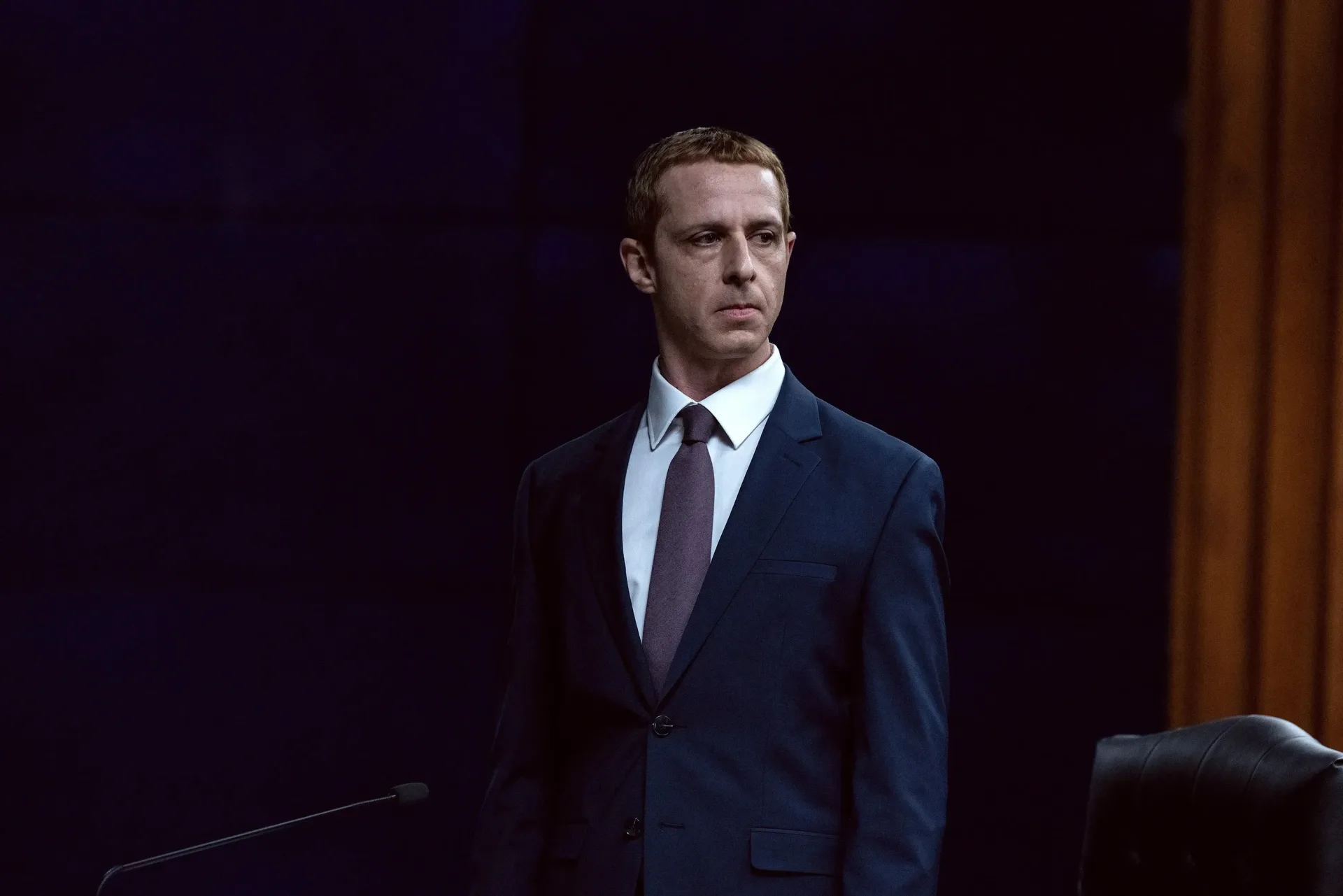
Broadway is sending A Few Good Men back into the courtroom—not as a staged copy of its enormously familiar film adaptation, but as a newly revised encounter with the original play. The first Broadway revival of Aaron Sorkin’s military courtroom drama opens October 29 at Lincoln Center’s Vivian Beaumont Theater, directed by Michael Arden. Tom Blyth plays Navy lawyer Daniel Kaffee, Krysta Rodriguez takes on fellow lawyer Joanne Galloway, and Bradley Whitford plays Colonel Nathan Jessep.
The central machinery remains intact. Two U.S. Marines face a court-martial after the death of a Private. Galloway presses Kaffee to follow evidence that could tie Jessep to the killing, forcing the initially reluctant lawyer to decide whether professional ease is worth more than confronting a powerful superior. But Sorkin has used the revival to make additional revisions and place a clearer emphasis on a question he describes as a search for decency.
That adjustment is significant because the play arrives with an unusual cultural burden. Many theatergoers know A Few Good Men primarily through the 1992 movie, starring Tom Cruise and directed by Rob Reiner, rather than through Sorkin’s 1989 Broadway hit. Arden has emphasized that this is not a theatrical remake of the movie. It is a revival of the play that preceded it—an important distinction, and one that could give an audience room to hear its story differently.
The original play, not a movie imitation
In practical terms, a revival is a new staging of an existing work, whereas an adaptation reshapes material from one medium for another. Sorkin adapted his own stage play for the screen in 1992, so the two versions share plot, characters and a great deal of identity. They are not, however, interchangeable objects.
For more context, explore VMX Launches on Meta Quest 2 and Quest 3 With Gesture-Driven BMX, MTB and Scooter Riding.
That is the production’s central creative challenge. The film has become a modern classic in the public imagination, with Cruise associated with Kaffee, Demi Moore with Galloway and Jack Nicholson with Jessep. Blyth, Rodriguez and Whitford therefore inherit recognizable roles without being asked to reproduce a screen performance. Arden’s approach is to treat the text as a classic work in its own right, even for attendees who arrive carrying detailed memories of the movie’s faces, delivery and courtroom confrontations.
Whitford is especially well positioned to understand the circularity of the moment. He was a replacement Kaffee in the original stage production and now returns as Jessep, the commanding officer at the core of the play’s moral and legal conflict. That trajectory alone illustrates why the revival should not be reduced to casting actors in the shadows of famous film parts. It reconnects the production to its theatrical lineage while giving one of its early stage participants a radically different vantage point.
For audiences, that framing may be the most useful expectation to bring into the Vivian Beaumont: the movie is part of the story of A Few Good Men, but it is not the sole template for this staging. The production intends to be a fresh reading, not an exercise in perfect recall.
A courtroom drama about power and responsibility
A Few Good Men is structured around a court-martial, meaning a military legal proceeding. Its stakes go beyond the guilt or innocence of the two accused Marines. The investigation raises whether a chain of command can make violence appear necessary, defensible or invisible—and whether the people lower in that chain can be made to carry the consequences.
The term extrajudicial killing, which has come up in discussion of the revival, refers to a killing carried out outside legal judicial process. Within the play’s dramatic framework, the question is whether authority and institutional loyalty were used to authorize the death of an inconvenient soldier without lawful accountability. Jessep is not merely an antagonist in a legal puzzle; he represents a version of military authority that treats rules as constraints for other people.
That puts Kaffee’s arc under a sharper light. His task is not simply to uncover information. It is to choose an inconvenient responsibility over a more comfortable path. Rodriguez has similarly pointed to Galloway’s persistence: although she outranks Kaffee in the military hierarchy, she operates as the second member of the legal team and is regularly insulted, dismissed and told no. Her resolve becomes another expression of the revived production’s interest in decency—not passive politeness, but refusing to let power define what can be investigated or said aloud.
The revised version does not move the story into the present. Sorkin considered contemporary relevance, but the Guantanamo Bay setting has become complicated by the base’s role as a detention facility for migrants. Keeping the period framework allows the production to retain the existing dramatic circumstances while inviting viewers to draw their own connections to current arguments about military leadership, law and civil institutions.
That relevance is not presented as a claim that every modern event maps neatly onto the play. Rather, the enduring tension is broad and disquieting: does security depend on law and civil structures, or does fear encourage the belief that violence can solve anything? In the play, institutional discipline is supposed to be a guardrail. The drama tests what happens when people in charge present the guardrail as weakness.
Political art often works best when it gives an audience a specific human conflict rather than a lecture. Here, the political dimension resides in choices: whether Galloway keeps pursuing the case, whether Kaffee acts on what he learns, and whether Jessep’s authority is treated as answer enough. A recent discussion of the revival’s new decency theme is also available at this overview of the production.
Gender is part of the legal battle
Galloway’s position supplies a second, crucial pressure point. Rodriguez notes that the character has to push forward while being diminished and insulted, even as she is doing the same serious professional work as the men around her. The character’s military rank does not magically protect her from misogyny, a contradiction that makes the hierarchy within the play more complicated than rank insignia alone.
Her costuming also has an expressive function. Rodriguez notes that Galloway confronts these barriers while wearing a pencil skirt and heels. That detail can seem cosmetic on paper, but in a story about competence, authority and who is permitted to command a room, it helps make the imbalance visible. Galloway has to establish credibility in an environment where she is simultaneously expected to meet gendered standards of presentation and to withstand hostility toward her professional presence.
That is why the production’s interest in decency need not be limited to the most overtly lethal question in the plot. It also encompasses ordinary workplace contempt, the casual effort to make a highly qualified woman feel smaller, and the determination required to keep going anyway. Whitford has argued that the misogyny depicted by the play does not feel like an obsolete artifact. The revival’s tension emerges from that recognition: some systems change their vocabulary without fully changing who gets interrupted, belittled or disbelieved.
Sorkin dialogue as stage choreography
Politics and legal stakes may be the reason to revisit A Few Good Men, but the production’s theatrical energy comes from Sorkin’s rhythm-driven dialogue. His scenes are known for speed, interruptions, pivots and volleys of argument. Arden, whose directing credits include the Tony-winning musicals Parade and Maybe Happy Ending, sees a musical quality in this straight play: scenes move with a pace and dexterity that resembles musical storytelling.
That comparison does not mean anyone suddenly breaks into song. It describes construction. In a musical, story and character can be advanced through rhythm, repetition, tempo changes and carefully timed handoffs between performers. Sorkin’s dialogue uses comparable tools, only through spoken language. A sentence may be information, a joke, a defense mechanism and a tactical maneuver at the same time. If the rhythm slips, the audience can lose both the humor and the logic.
Rodriguez has identified another function of that fast exchange: it demonstrates the characters’ competence. The legal team’s ability to trade arguments quickly signals that they understand the terrain, even when they disagree. Crucially, the dramatic friction is not based on making one side foolish. The characters contest one another as capable people with different instincts and priorities.
For Blyth, the velocity is also a way to make heavy material approachable. He has described the play as buoyant and has suggested that an audience can be more receptive to difficult realities when it is first allowed to laugh. That is not a retreat from seriousness. It is an argument for contrast. Comedy can lower a viewer’s guard; a sudden turn toward moral consequence can then land more forcefully.
Whitford draws a related distinction between the play and the movie, saying the screen version carries a solemnity that the stage work does not always have. The point is not that the play lacks gravity. Its concern with obligation, institutional power and violence is plainly grave. But it does not accept the simplistic rule that a drama must be humorless to be serious. Sorkin’s writing creates room for wit and momentum alongside anger and unease.
A demanding lead role and a Broadway debut
Blyth’s Kaffee faces a particularly demanding theatrical assignment. The actor has noted that the character scarcely leaves the stage, creating a workload that is easy to underestimate when viewers are following plot rather than tracking an actor’s entrances and exits. In rehearsals, Blyth has joked about reflexively moving toward the wings at the end of a scene, only to realize Kaffee is needed immediately in the next one.
That continuous presence matters dramatically. A courtroom story can make its lead seem reactive: questions are asked, witnesses arrive, evidence changes the picture. Kaffee’s near-constant stage time instead keeps the audience close to his evolution. There is little opportunity to reset elsewhere while the case shifts around him. His moral decision remains the spine that holds the story together.
The production is Blyth’s Broadway debut. He came to the United States from England to study at Juilliard and has led films including The Hunger Games: The Ballad of Songbirds & Snakes and People We Meet on Vacation. Taking on Kaffee means assuming a part indelibly associated with Cruise while working in a medium that asks something different of its performers: the performance must unfold live, at pace, in direct relationship with an audience.
That audience relationship may be the revival’s most immediate asset. The debates in A Few Good Men concern rules, hierarchy and the uncomfortable work of challenging power. In a theater, those debates cannot be paused, scrubbed back or received in isolation. Laughter, silence and tension become part of the room’s shared response. With Sorkin’s revisions and Arden’s non-film-first approach, the new staging is positioned to make a familiar title feel less like a museum piece and more like an active argument.
Its premise has always been stark: rules are only meaningful when people are willing to enforce them against the powerful. The revival’s added emphasis asks a deceptively simple companion question. When doing the right thing is costly, inconvenient and unpopular, what does decency require?