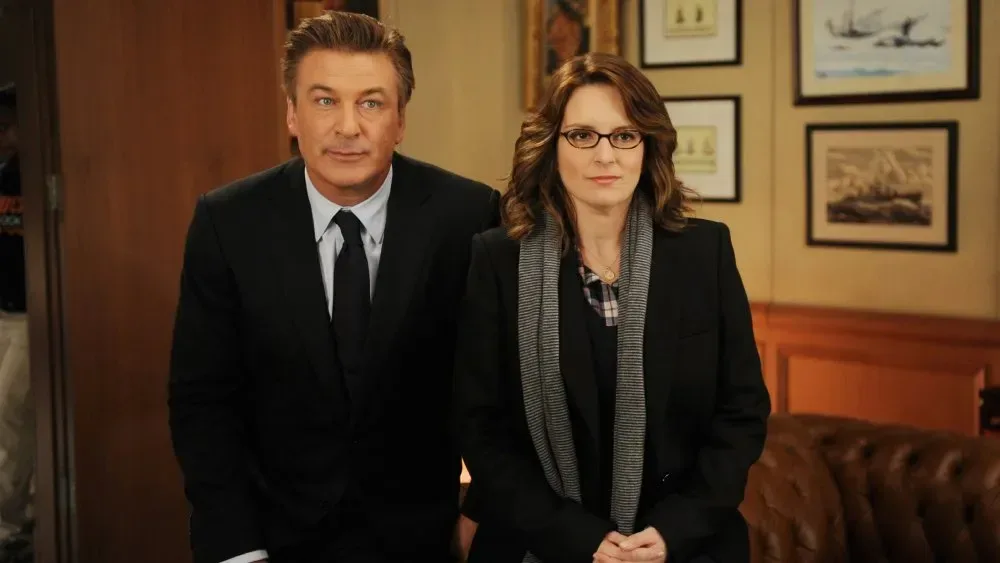
30 Rock marked its 20th anniversary with the sort of escalation that would have made Liz Lemon nervous: a 90-minute, one-night-only benefit at Radio City Music Hall, a packed house of 5,000 people, returning cast members, surprise visitors and a deliberately unruly mix of music, games and topical sketches.
Conan O’Brien opened the evening by calling it the greatest night in entertainment history, then promptly undercutting the claim by acknowledging his own reputation for exaggeration. It established the right tone for a reunion built around a sitcom whose comedy was never especially interested in behaving sensibly for long.
Tina Fey, Alec Baldwin, Tracy Morgan and Jane Krakowski were joined onstage by a wider circle of performers and guests that included Jon Hamm, Tom Hanks, Lin-Manuel Miranda, Will Forte and Brian Williams. The event was not presented as a conventional cast Q&A. Fey described it as an overly ambitious collection of nonsense, and the structure matched that promise: old lines were tested, characters returned, songs were revived and the show’s reputation for absurd predictions was examined with the appropriate amount of self-congratulation and disbelief.
The reunion also served a purpose beyond nostalgia. It raised money for the Boys and Girls Club of Harlem. Fey connected the choice to the organization’s standing as a New York institution, while also making a callback to a Season 5 storyline in which Tracy Jordan struggles to film a public-service announcement for the Boys & Girls Clubs of America.
A reunion designed like an episode, not a panel
30 Rock ran on NBC for seven seasons, from 2006 to 2013. Fey created the comedy and played Liz Lemon, head writer of the fictional sketch series TGS With Tracy Jordan. Baldwin played NBC executive Jack Donaghy, while Morgan and Krakowski portrayed TGS stars Tracy Jordan and Jenna Maroney.
That premise matters to the anniversary show because 30 Rock was always a workplace comedy about the machinery of making television, even as it blew that machinery up for jokes. A show built around writers, performers, network executives, pages, demanding guests and impossible production problems has a built-in reunion format: put the people back on a stage and let them recreate the instability.
Fey said Jack McBrayer, who played the relentlessly upbeat NBC page Kenneth, had suggested a 20th anniversary reunion. His apparent idea may have been a cast dinner; Fey instead expanded it into an event at Radio City. She even warned the crowd that the performers had not rehearsed it, while promising microphone problems from the heart.
That line did more than set expectations. It was a compact statement of 30 Rock’s comic sensibility. The series often made production failure part of the entertainment: a malfunction, a poorly planned special, an executive intervention or a celebrity disaster became the engine of the scene rather than an obstacle to it. A live benefit that foregrounded potential chaos was, in that sense, unusually faithful to the show.
O’Brien’s return supplied another strand of continuity. He had appeared as himself on the series and, in one plotline, dated Liz Lemon. At Radio City, he joked about being reduced from a screen presence to an off-camera reference while Lemon’s other romantic interests included Jon Hamm, Jason Sudeikis and Matt Damon. The gag worked as both a pointed self-own and a reminder that 30 Rock regularly used real people as exaggerated pieces of its fictional TV universe.
Elaine Stritch’s guest-star legacy took center stage
One of the night’s clearest reminders of 30 Rock’s guest-star range arrived in the form of a mock award. The series featured appearances from performers including Carrie Fisher, Steve Martin, Oprah Winfrey, Al Gore and Queen Latifah, an unpredictable mix that reflected the show’s willingness to cast public figures as themselves, send them up or hand them entirely fictional roles.
The benefit’s prize for best guest star went posthumously to Elaine Stritch for playing Colleen Donaghy, Jack’s formidable mother. The other nominees named during the bit were Marcella Roy as young Liz Lemon, Sherri Shepherd as Angie Jordan and Kelsey Grammer as Tracy’s alter ego, Frajer.
Tom Hanks accepted for Stritch, who died in 2014 at age 89. His appearance was framed as an accidental detour while he was near Rockefeller Plaza, and the whole segment embraced the show’s affection for a celebrity cameo that arrives with an implausible backstory. The tribute also landed because Colleen was not a disposable stunt role. Stritch’s character was a crucial ingredient in the Jack Donaghy world: imperious, cutting and perfectly capable of making one of television’s most confident executives look small.
There is a useful distinction here between a cameo and a recurring comic presence. A cameo can provide recognition; a recurring role can reshape the rhythm of a series. Colleen did the latter. The reunion’s award sketch used a deliberately silly format, but it put attention on a performance that had become part of the show’s lasting vocabulary.
The “predictions” montage showed how satire gets re-read
A segment dubbed “30 Rock-stradomus” revisited jokes that now look unexpectedly close to later real-world developments. The writers pointed to Jenna’s “Free Lyle Menendez” tattoo, which gained new context after the brothers received an early parole hearing. The montage also included a Tracy Jordan phone call that referenced Bill Cosby years before allegations that he drugged and sexually assaulted women became widely known.
Other examples were less dark but equally strange. The fictional Mystic Pizza: The Musical later had a real counterpart that began a national tour, while 30 Rock’s reality-show parody MILF Island was set beside the existence of the real dating series FBoy Island.
Calling a comedy “predictive” is usually shorthand, not proof that its writers forecast events. Satire often arrives at its strange results by observing incentives and exaggerating them: entertainment formats become more exploitative, branding becomes more aggressive, and celebrity culture becomes more surreal. When reality catches up with the exaggeration, the old joke can feel prophetic. The Radio City segment was a celebration of that eerie overlap, while still acknowledging that much of the original writing was created as absurdist material by a tired writers’ room.
For a related look at the pressures surrounding television institutions and broadcast policy, see ABC’s response to the FCC’s early license renewal order.
Fey and Morgan were tested on the lines fans remember
McBrayer’s quote game, “What’s My Next Line?,” put Fey and Morgan’s character memories to work. They began with recognizable material. Fey recalled that a Liz Lemon party is mandatory, while Morgan remembered Tracy’s advice to live every week like it is Shark Week.
The point was not flawless recall. Fey missed Liz’s actual line in a clip where the character dresses as Princess Leia to avoid jury duty, guessing a different sci-fi explanation before being corrected. Morgan turned to the audience when he could not complete the “Horseville” joke, prompting the crowd to supply the “naysayers” wordplay. He also could not summon several other Tracy lines, responding with a reference to having been hit by a truck.
This is precisely the kind of reunion segment that benefits from imperfection. Sitcom dialogue becomes quotable because it is tightly shaped in the final episode, not because its performers retain every setup and punchline years later. Fans, meanwhile, preserve lines through reruns, clips and repetition. The audience filling in the missing answer made the relationship visible: the cast made the material, but viewers helped keep it alive.
Characters returned to comment on a changed world
Chris Parnell returned as Dr. Leo Spaceman, the wildly unqualified physician who ends the series as Surgeon General of the United States. His segment offered intentionally unreliable “health recommendations” in response to questions about vaccines, lettuce and GLP-1s. The premise is important: this was character comedy, not medical information. Leo Spaceman’s authority is the joke because the character is conspicuously unfit to dispense authority.
Brian Williams then introduced a sketch imagining how Jack Donaghy might have processed major stories from the years after 30 Rock ended. Maulik Pancholy returned as Jonathan, and McBrayer again played Kenneth. The setup leapt across moments including the Sony hack, the #MeToo movement, the Jan. 6 attack on the U.S. Capitol and the Barbie/Oppenheimer box-office phenomenon.
The sketch’s method was familiar Donaghy logic: Jack treats a moral, political or corporate problem as an opportunity to demonstrate his own warped certainty. The comedy does not come from offering a serious replay of the events. It comes from placing a character who mistakes dominance for wisdom into situations too consequential for his style of boardroom bravado. That distinction is what lets a revived character sketch function as satire rather than as a claim that the past has not changed.
Krakowski’s medley made Jenna Maroney the evening’s headliner
Jane Krakowski’s musical performance supplied the biggest display of 30 Rock’s musical absurdity. Wearing a silver dress and backed by dancers dressed as pages, she began with “That’s Her,” the theme to The Girlie Show, before moving through “Muffin Top” and “Chunk of My Lung.” The latter is associated with Jenna’s failed attempt to play Janis Joplin in an unauthorized biopic.
The medley expanded from there. John McEnroe joined Krakowski for “Tennis Night in America,” while Will Forte appeared as Paul L’astnamé, Jenna’s angel-costumed partner, for “O Holy Night.” Marceline Hugot, who played Kathy Geiss, made a trumpet appearance. Lin-Manuel Miranda performed “Werewolf Bar Mitzvah,” and Krakowski closed the night with the “Rural Juror” theme song.
These songs endure because they are more than reference jokes. Each takes a recognizable entertainment format—an empowerment anthem, a sports broadcast theme, a prestige musical, a seasonal novelty track—and bends it into a piece of Jenna Maroney self-mythology. Krakowski’s performance style lets the material operate on two tracks at once: Jenna is always hilariously desperate for approval, but the musical execution is committed enough to make the numbers feel like genuine event pieces.
The Radio City gathering did not announce a new season or promise a filmed revival. It was explicitly a live, never-to-be-televised benefit. That limitation is part of what made the occasion distinct. Rather than trying to manufacture a new chapter of 30 Rock, the event used the show’s own chaotic grammar—guest stars, callbacks, topical digressions, failed professionalism and a very large musical finish—to celebrate what seven seasons left behind.