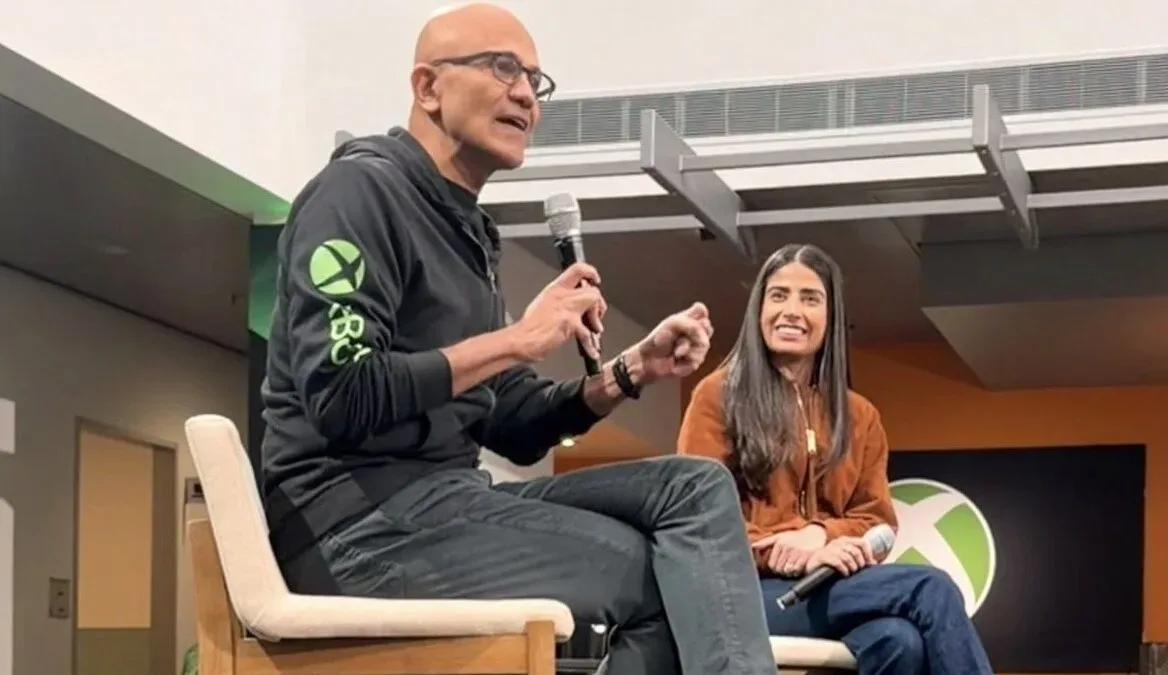
Microsoft CEO Satya Nadella has offered a clear, if notably corporate, description of Xbox’s current direction: preserve and exploit a portfolio of game franchises, reach more people across PC and Xbox, and find a business model that can sustain that expansion. His comments arrive while Xbox is undergoing a broader reset under new CEO Asha Sharma—one that has reportedly included more than 1,600 job cuts this year, with a further 1,600 planned before the fiscal year ends.
Nadella characterized the reductions as “some amount of streamlining” and said it was “great to see.” The wording matters because it puts layoffs in the same strategic frame as platform growth and game production rather than treating them as a separate human consequence of the company’s restructuring.
“I feel fantastic about the IP we have right now,” Nadella said, referring to Xbox’s studios, franchise portfolio, and ability to make games in the future.
That confidence in the catalog sits alongside a less celebratory discussion of the commercial challenge. Nadella said Xbox needs to create “the right sustainable business model” to bring games to more people, with an ambition to be both a major publisher and a platform provider across PCs and Xbox consoles. Sharma and her team, he added, are pursuing growth in the next fiscal year while also producing strong games.
What “streamlining” means in this context
In executive language, streamlining generally means simplifying an organization to reduce costs, overlap, layers of management, or operational complexity. It can include layoffs, studio divestments, reorganizing teams, and relocating franchises inside a larger corporate structure. Here, the reported reset has involved all of those broad categories: employee reductions, Microsoft divesting from multiple studios, and teams and properties being rearranged. Halo, for example, has reportedly moved under Activision.
That word can make an extensive change program sound mechanically neutral. It is not neutral for the people affected. More than 1,600 reported cuts this year, followed by plans for another 1,600, represent thousands of jobs and an enormous amount of experience leaving, or expected to leave, the Xbox organization. Nadella’s remarks do not include a direct acknowledgement of those employees’ circumstances. Instead, they connect the cuts to Sharma’s effort to rework the business for future growth.
There is an important distinction between explaining management’s rationale and proving that the approach will work. A company can reduce headcount and consolidate responsibilities, but that alone does not establish that it has solved a product, audience, or revenue problem. The success test is still ahead: whether Xbox can release compelling games, support its platforms, retain expertise, and grow the audience and business at the same time.
The strategy is bigger than console sales
Nadella’s formulation is deliberately broad. He did not describe Xbox only as a console maker. He described it as a publisher and a platform provider, operating across PCs and Xbox consoles. That distinction is useful for players trying to interpret what “Xbox growth” may mean.
Related coverage includes Microsoft CEO Backs Xbox 'Streamlining' as Layoffs Continue During Reset.
- A publisher finances, manages, markets, and releases games. A publishing strategy puts the emphasis on the game catalog and on reaching audiences wherever the company chooses to distribute those games.
- A platform provider operates the hardware and software environment through which people access games. In Xbox’s case, Nadella explicitly mentioned both PCs and Xbox consoles.
- IP, short for intellectual property, refers here to owned game brands, characters, worlds, and franchises that can support future releases.
- A sustainable business model means an approach intended to keep generating sufficient revenue over time to support the products and operations behind it. Nadella did not specify the precise model Xbox will use.
That last caveat is significant. The comments state the goal—wider reach with a sustainable economic foundation—but do not spell out which products, services, distribution decisions, or organizational changes will deliver it. The public can therefore assess the stated direction, but not yet a detailed execution plan.
The focus on both PC and Xbox also makes it risky to judge the reset solely through console sales. Xbox console figures are not publicly shared at the level that would make an outside assessment straightforward. The available context says Microsoft reported 500 million monthly users across all of its platforms in 2025, rather than providing a directly comparable console-only number. Those are different measurements: monthly users across platforms do not tell readers how many consoles were sold, and console sales alone would not capture every person using Xbox games or services elsewhere.
A billion daily people is an exceptionally high bar
Sharma’s stated ambition is for Xbox to entertain more than one billion people every day. It is a striking target beside the reported 500 million monthly users across Microsoft’s platforms in 2025. The two figures should not be treated as a simple progress bar, however. One measures a daily ambition; the other is a reported monthly user total across platforms. Daily and monthly activity are different, and neither figure in the available information identifies exactly which products are counted or how frequent every person’s engagement is.
Even with those measurement limits, the scale of the ambition is plain. Reaching more than one billion people each day would require Xbox to substantially expand or deepen its audience from the 2025 platform-wide monthly figure cited here. It also makes the company’s language about publishing and platform reach easier to understand: a daily audience of that size cannot be assumed to come from one piece of hardware alone.
The challenge is that reach and profitability do not automatically rise together. Serving more players can require more infrastructure, more customer support, more content investment, stronger technical operations, and a steady release pipeline. A large audience is valuable only if the underlying model supports the cost of serving it. Nadella’s reference to “invent[ing]” a sustainable business model implicitly recognizes that the desired formula is not being presented as finished.
Why the IP portfolio is at the center of the pitch
Nadella sounded most assured when discussing Xbox’s intellectual property. That is understandable as a strategic statement: franchises are reusable creative foundations. A familiar game universe can potentially support new installments and help a publisher build recognition with audiences across different devices. But ownership is only the starting point. The value of a franchise depends on the games and support built around it, which requires teams with creative, technical, production, and operational knowledge.
This is the tension at the heart of the reset. Microsoft’s leadership is saying it has a strong slate of studios and brands, while the reported restructuring reduces staff, divests studios, and shifts teams and franchises. The company believes it can emerge more focused and capable of growth. Critics will reasonably ask whether cuts on this scale make it harder to maintain the development capacity needed to turn a large portfolio into consistently successful releases.
No single executive interview can settle that question. It will be answered by the results of the reorganization over time: the quality and regularity of games, the stability of the teams that make them, the clarity of Xbox’s platform offering, and whether the company can demonstrate growth without continually shrinking the people doing the work.
What players should watch next
For customers, the practical outcome is more important than the vocabulary. “Reset,” “streamlining,” and “sustainable business model” are useful only insofar as they result in games people can play and platform services they want to use. The next signs of progress will likely be concrete rather than rhetorical.
- How Xbox defines growth. Nadella said the business is targeting growth next fiscal year, but the remarks do not identify the metric. Audience size, revenue, engagement, game releases, and platform performance are not interchangeable measures.
- Whether its reorganized studios can deliver. The reported movement of Halo to Activision is an example of organizational change whose effect will depend on execution, not the chart alone.
- Whether the publisher-and-platform approach becomes clearer. Nadella’s PC-and-console framing is broad; future decisions will show how that balance works in practice.
- How the company handles development capacity after cuts. Great franchises do not produce games without the people and structures required to build, maintain, and support them.
The wider games industry is also debating whether new technology automatically reduces the labor and time required to make games. As a recent industry perspective noted, AI research does not automatically make game development faster. That principle is relevant here without implying any particular Xbox technology plan: efficiency claims and staff reductions should not be confused with an automatic shortcut to better games.
Nadella’s comments offer a candid view of Microsoft’s priorities. Xbox’s leadership believes its franchises remain a major strength, wants to distribute games more broadly across PC and console, and is pursuing next-fiscal-year growth. At the same time, the company is carrying out a restructuring that has already affected more than 1,600 people and is expected to affect 1,600 more before the fiscal year ends. The strategic promise is expansion; the immediate method includes contraction. Whether those two directions can produce a stronger Xbox is the central unresolved question.