Xbox’s reported restructuring has become a flashpoint for players, developers and industry watchers, not simply because of the scale of the proposed job cuts but because the reported changes reach into the identities of several long-running studios and franchises. The plan is described as part of an ongoing “reset” expected to affect roughly 3,200 employees in total. This latest phase reportedly combines layoffs with studio consolidation, reassignment and closures.
That distinction matters. A layoff is an immediate human cost: people lose jobs, teams lose colleagues and projects lose accumulated knowledge. A studio reorganization can have longer effects that are harder to quantify, changing who leads a series, where creative decisions are made and whether a team keeps its distinct role inside a much larger corporate structure. The public response has therefore been focused on both the workers directly affected and the future of the games those teams make.
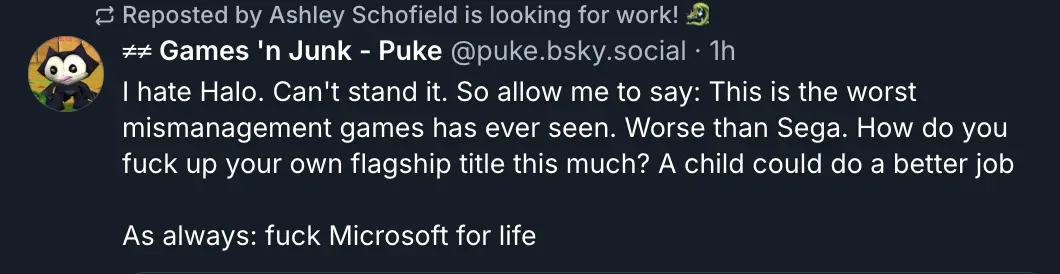
The reaction has been notably bleak. Many posts framed the moment as the painful consequence of years of acquisitions followed by integration, with frustration directed at the prospect of familiar studios being absorbed into larger units or disappearing as independent entities. Others questioned whether the announced moves add up to a comprehensible long-term strategy at all.
Halo’s reported move is the most emotionally charged change
The biggest point of contention is the reported shift of Halo development away from 343 Industries and toward Activision Blizzard, which is also said to be developing the next Halo title. Halo is not merely another recognizable Xbox property. It has long functioned as one of the brand’s foundational series, so changing the studio responsible for it inevitably reads as a statement about both the franchise’s past and its intended future.
For more context, explore LEGO Dragon Ball Is Officially Teased, With Seven Orbs Pointing Toward a Shenron Display Set.
Community reaction splits in two directions. One side sees the transfer as an alarming loss of stewardship, particularly at a time when the broader reorganization is reportedly putting jobs and studio structures at risk. The other sees a dramatic handoff as potentially necessary because Halo has not met expectations for some players in recent years.
Those views are not mutually exclusive. A person can be dissatisfied with a franchise’s direction while still being uneasy about workers being laid off or a studio being diminished. That tension is central to the discussion: a change in developer may be viewed as a creative reset by some fans, but it does not erase the cost of the organizational process behind it.
What a franchise handoff actually changes
In practical terms, assigning another studio to a franchise does not automatically reveal what the finished game will be, when it will arrive or how much authority the original team retains. It does, however, change the development structure. Teams carry institutional knowledge: familiarity with game technology, internal tools, production pipelines, player feedback, art direction and the many small decisions that define a series over time. A handoff can bring new skills and a fresh perspective, but it can also create transition costs as responsibilities, knowledge and personnel shift.
There is no supplied detail on Halo’s design, release schedule, staffing composition or whether 343 Industries will retain a role after the reported change. Those unanswered questions are why much of the online discussion is speculation rather than a settled assessment of what the next game will become.
Rare, Obsidian and the Forza teams are reportedly being reorganized
The Halo report is accompanied by several major studio changes. Rare, the studio best known today for Sea of Thieves, is reportedly being moved into Activision Blizzard. Obsidian is said to be joining Bethesda. Turn 10, the Forza developer, and Playground Games, the team behind Forza Horizon and Fable, are reportedly being combined.
Each move carries a different meaning for fans because each studio occupies a different place in Xbox’s lineup. Rare has an especially strong historical identity, and reactions have focused on fear that its distinctiveness could be narrowed by placement alongside the company’s largest franchises. Jokes about studios being sent to “Call of Duty mines” are dark humor, but they express a real concern: that teams with their own creative culture could increasingly be oriented around a smaller number of blockbuster properties.
Obsidian’s reported move under Bethesda has sparked its own irony-filled discussion. The studio is closely associated in fans’ minds with a previous Fallout game, while Bethesda is the current home of that franchise. Yet a reporting-line change is not confirmation of a new Fallout project, nor does it establish that Obsidian has been assigned to one. It is important to separate the fan inference from what is actually known: the supplied information supports a reported organizational move, not a game announcement.
The Turn 10 and Playground combination has similarly prompted questions about what consolidation means for the two strands of Forza and for Playground’s work on Fable. Combining teams can mean shared leadership, shared resources or a new umbrella organization, but the available details do not specify the model. It would be premature to treat the move as proof that any individual series is being cancelled, delayed or redirected.
Why “IP-focused” is becoming the shorthand
A recurring interpretation is that the reorganization puts intellectual property—usually shortened to IP—at the center of Xbox’s structure. In games, IP means the owned creative property around a recognizable universe or brand: its name, characters, settings and associated rights. Halo, Call of Duty, Forza, Fable and Sea of Thieves are all examples of game properties whose value extends beyond any one release.
An IP-led model often means organizing multiple teams around durable franchises rather than treating studios as largely independent creative units. That can offer obvious corporate advantages: brands are recognizable, marketing is more direct and expertise can be concentrated around a continuing series. It can also be more predictable on paper than funding a broad slate of unrelated new projects.
But the concern voiced by critics is that predictability may come at the expense of studio identity and creative range. If a company’s structure increasingly revolves around a limited set of established brands, fans may worry that smaller, stranger or less immediately marketable ideas will have less room. The reported placement of Rare within Activision Blizzard is drawing this kind of scrutiny precisely because Rare’s reputation is much broader than any single genre or current game.
That criticism should not be mistaken for proof of a specific future release plan. The available information does not identify what projects the reorganized teams will make. It does explain why the perception of an IP-first strategy is powerful: the named changes connect studios directly to large internal groups and major franchise portfolios.
The layoffs are the part no strategy debate can abstract away
There is an understandable tendency in videogame conversations to jump immediately to predictions: Will Halo improve? Will Rare make another beloved classic? Could Obsidian work on Fallout? Will the Forza teams become more efficient together? Those questions are natural, but they can obscure the core fact that the reported reset includes thousands of projected layoffs.
For people losing their jobs, corporate terms such as “streamlining,” “realignment” and “consolidation” can make a disruptive event sound bloodless. They are not. Games are built by people with specialized skills, and the effects can be felt by remaining teams as well as those leaving. A smaller or reshaped group may need to absorb work, adapt to new reporting structures and preserve a project’s continuity while the organization around it changes.
This is why the public response has been less interested in treating the news as ordinary corporate maneuvering. Anger has been directed at the scale and duration of the reset, the apparent mismatch between investment in high-profile properties and reductions elsewhere, and the sense that major decisions are arriving without a clear picture of the destination.
Physint adds to questions about priorities, not answers
The timing is also feeding skepticism. Xbox recently said it would be the home of Hideo Kojima’s Physint, a project alleged to have been cancelled elsewhere after budget and deadline issues. The report does not provide financial details on the deal, and none should be inferred. Still, the proximity of a prominent project announcement to more restructuring has made it easy for players to ask how Xbox is balancing marquee acquisitions and long-term portfolio ambitions against cuts to its existing workforce.
That does not establish that one decision directly funded or caused the other. Corporate spending and studio staffing are not simple one-to-one equations, and the supplied information does not present such a link. It does explain the optics: a company can appear to be simultaneously pursuing prestige projects and shrinking or rearranging the teams that built the catalog it already owns.
The contrast has amplified demands for a clearer account of what the reset is meant to achieve. Some commentators have speculated wildly about Xbox’s future, including whether the business could be sold, but that is speculation rather than confirmed information. The more grounded question is simpler: what does success look like for this new structure, and how will the company show that the upheaval has led to healthier teams and stronger games?
What remains uncertain for players
There are several things that the reported changes do not establish. They do not confirm release dates, game cancellations, platform plans, staffing totals at each studio or the exact development responsibilities for every franchise. They also do not tell players whether the studio combinations will be temporary transitional arrangements or a permanent new map of Xbox development.
For now, the clearest confirmed public reality within the report is the reaction: a community that sees beloved names being moved, merged or placed under new umbrellas while a large projected reduction in staff is still unfolding. Even the people open to a new direction for Halo are often responding with apprehension to the cost of getting there.
That is why this has become more than another argument over a franchise’s quality. It is a debate about whether an ecosystem built through acquisitions, recognizable IP and large studio groups can retain the people, creative autonomy and continuity that make those names meaningful in the first place. Until Xbox provides more specifics on the end state, the uncertainty surrounding the reset will remain as consequential as the individual moves themselves.