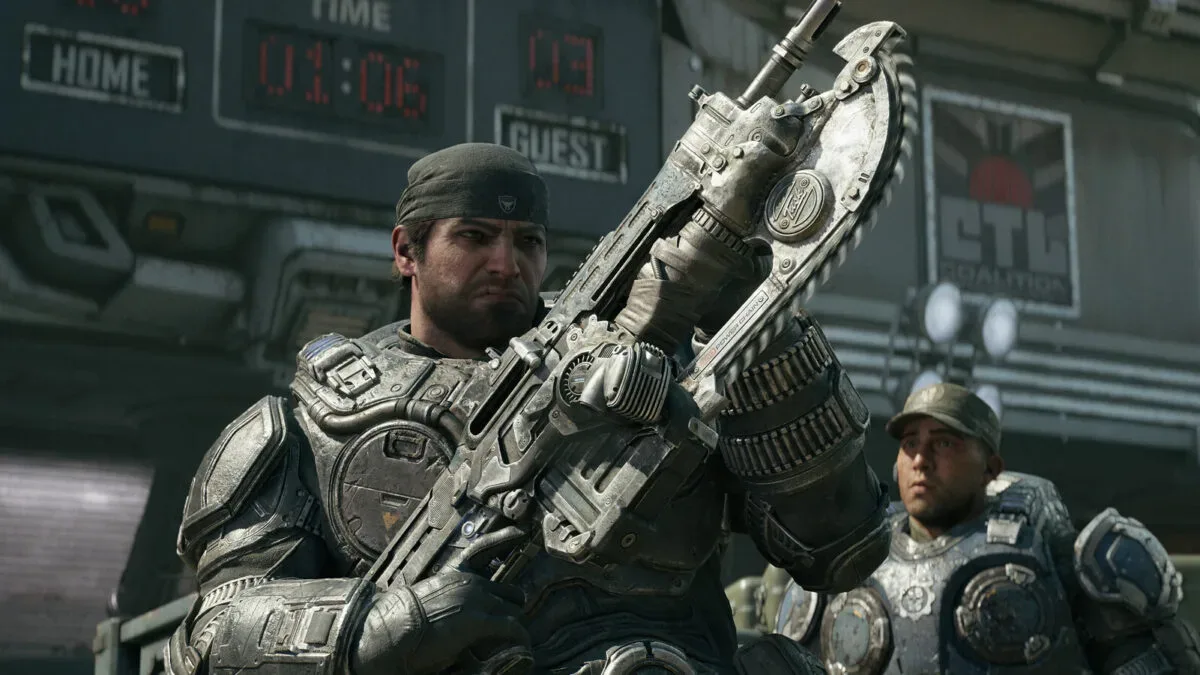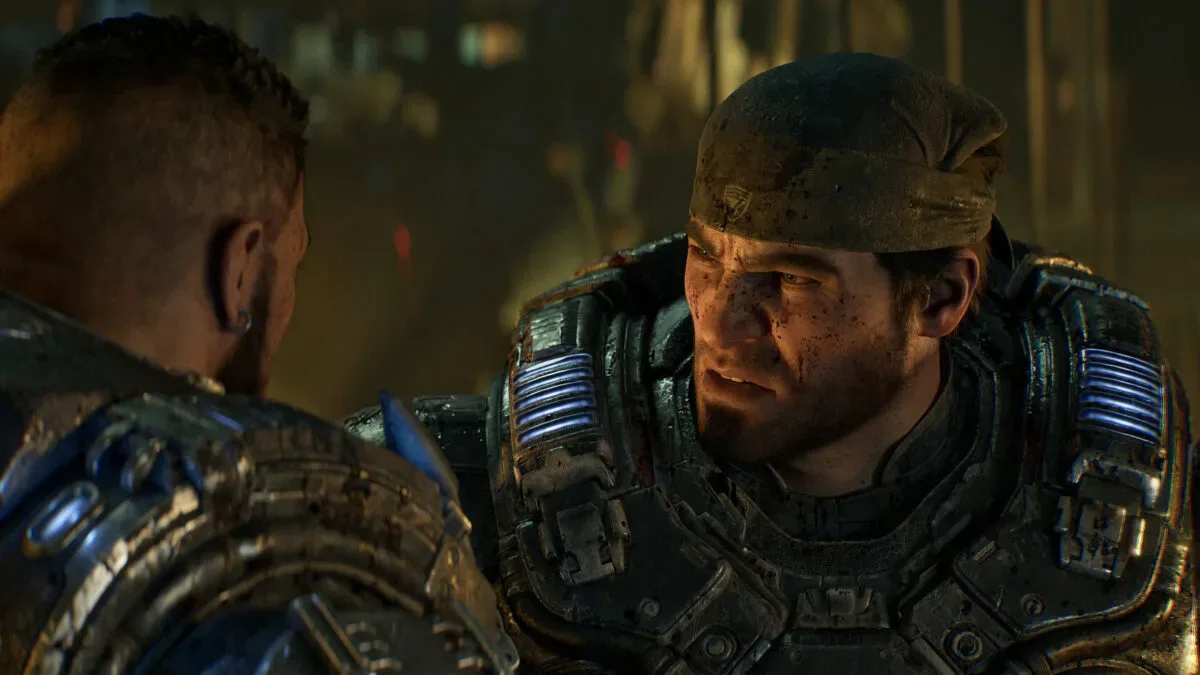
Gears of War: E-Day has reportedly landed well with critics, reaching the series’ strongest Metacritic result since the original Xbox 360 trilogy. Yet the early commercial picture being discussed around the game is far less triumphant. A claimed development cost above $500 million, before marketing, sits alongside third-party estimates of 230,000 copies sold and $37 million generated in its first week.
Those figures are neither official financial disclosures nor a complete account of the game’s lifetime business. Microsoft has not commented on the reported budget and has not released performance metrics for E-Day. They should therefore be treated as estimates and claims, not as settled fact. But if the broad outlines are accurate, E-Day is a revealing test of what Xbox expects a major exclusive to accomplish in an era when its games can also be released on other platforms.
The central question is not simply whether a PlayStation 5 version could have produced more revenue. It almost certainly could have produced some additional revenue. The harder question is whether that revenue would materially change the outcome for a game with an exceptionally large reported cost—and whether withholding a flagship title can create more valuable effects for the Xbox ecosystem than a wider release would.
The reported numbers leave a very large gap
The headline figure deserves careful framing. E-Day’s cost has been described by a person familiar with Xbox’s business as more than $500 million before marketing. Earlier talk placed the cost above $400 million, while another account cautioned that calculating the expense of developer The Coalition is complicated because the studio also supports other teams within Xbox Game Studios.
That distinction matters. A project budget can mean different things depending on what costs are included: direct game development, shared studio operations, technology work, external support, or other internal services. Without an official breakdown, it is not possible to know how the reported figure was assembled. Still, even the lower rumor would put E-Day in a high-risk tier of blockbuster production.
Against that backdrop, the early forecasts are stark. Alinea Analytics estimated 230,000 copies sold in week one and $37 million in revenue. That revenue figure reportedly includes a meaningful contribution from Game Pass users purchasing a $30 Premium Edition Upgrade for early access. In other words, it is not necessarily a simple count of full-price $70 purchases.
Revenue is not profit. This is the most important technical distinction in conversations about enormous game budgets. Revenue is the money generated through sales and upgrades before costs are subtracted. It does not itself reveal the amount retained after platform fees, distribution, refunds, taxes, development, marketing, and ongoing support. It also cannot tell outsiders how much subscription activity Microsoft attributes to the game.
Nor does a first-week estimate settle a game’s future. Sales can accumulate through later retail purchases, upgrades, promotions, catalogue visibility, and continued Game Pass engagement. But the reported starting point means E-Day would need a dramatic long-tail performance if its development cost really exceeds $500 million. Marketing would widen the deficit further.
Related coverage includes Gears of War: E-Day's Reported $500 Million Cost Raises Xbox Exclusivity Questions.
Why a PlayStation release may not solve the arithmetic
The obvious response is to put an expensive game in front of every possible buyer. That is the basic appeal of a multiplatform strategy: more storefronts create access to more customers. But broader distribution is not a magic receipt printer, particularly when the alleged budget is this large.
Alinea Analytics previously estimated that Gears of War: Reloaded, the $40 remaster that became the franchise’s first PlayStation release, sold 684,000 copies on PS5. Using that result as a rough reference point, the analysis suggests comparable E-Day sales on PS5 would have equated to about $33 million in additional revenue after Sony’s standard platform fee.
That comparison has limits. Reloaded is a remaster, while E-Day is a new entry with stronger review momentum. E-Day costs $70, not $40. A new installment could potentially reach a different audience on PlayStation than a remaster did. Equally, the higher price is a barrier that makes a direct comparison unreliable. E-Day is also estimated to have sold fewer than 100,000 copies on Steam so far, though Game Pass is available on PC and may affect the traditional Steam sales picture.
The useful takeaway is not that a PS5 release would be worthless. Tens of millions of dollars are consequential. Rather, it is that even a substantial PlayStation debut might not remotely erase an alleged nine-figure shortfall. A game facing a $500 million-plus pre-marketing cost cannot depend on a single additional platform to make the spreadsheet turn cheerful.
That changes the strategic debate. If a multiplatform release cannot plausibly make the project whole on its own, Xbox has to decide what it wants the game to do besides sell copies. An exclusive can be evaluated as a driver of hardware use, subscriptions, community activity, and customer retention. Those benefits are real in principle, but much tougher to quantify from outside the business.
Exclusivity is a platform lever, not a recovery plan
Console exclusivity means a title is available on one console ecosystem rather than rival consoles. In E-Day’s case, the important practical framing is Xbox console exclusivity alongside PC availability, rather than a game locked to one device. That setup can still give people a reason to use an Xbox Series X or Series S, return to a dormant console, or keep the platform in mind during a major buying season.
The argument for keeping E-Day off PS5 is not that doing so directly turns the game into a profitable product. The available estimates argue against such a simple result. It is instead that a high-profile exclusive may create knock-on effects: secondary outcomes such as more time spent on Xbox, more Game Pass use, greater visibility for the ecosystem, and a clearer reason to purchase within it.
Those outcomes can matter most when audiences are choosing where to play major releases. A fall blockbuster does not have to generate all of its value at checkout if it persuades users to re-engage with a platform and perhaps buy or play other games there afterward. The difficulty is attribution. Publicly, there is no clear way to separate engagement sparked by E-Day from engagement caused by other releases, seasonal habits, promotions, or an existing subscriber’s normal use.
There is also a trade-off. Every player who would have bought E-Day on PS5 but will not buy an Xbox console or use PC represents foregone software revenue and a lost opportunity to expand the series’ audience. Exclusivity works only if enough players change behavior—or if the ecosystem value of those who do outweighs the sales left on the table.
Microsoft’s silence on E-Day player numbers makes that assessment particularly difficult. When Gears 5 launched in 2019, Microsoft said it had surpassed 3 million players at launch, doubled the first-week debut of Gears of War 4, and became Xbox Game Studios’ most-played title in its first week since Halo 4 in 2012. No comparable public E-Day figure has been provided so far. Absence of a figure is not proof of a weak result, but it leaves analysts working largely from estimates.
The survey suggests Xbox is testing competing identities
A leaked Xbox Insider survey adds context to the uncertainty. It reportedly asked people with multiple devices how their habits would change if future Xbox-developed franchises, with Call of Duty excepted, became console-exclusive to Xbox. The scenario also contemplated Minecraft no longer being purchasable on PlayStation or Nintendo platforms and receiving no new content there, while preserving previously owned material and leaving PC unchanged.
Surveys are not announcements. Companies test hypotheticals for many reasons, and respondents’ stated intentions do not guarantee what they would do after an actual policy change. Still, the questions are revealing because they focus on behavior: would people turn on an Xbox they already own, buy a new console, move to PC, or skip the game?
That is the core strategic fork. Xbox can place more emphasis on being a console platform with games unavailable elsewhere, or it can prioritize being a large publisher whose games pursue revenue and audience on as many devices as possible. It may pursue elements of both approaches, but the combination creates confusion when the treatment of individual franchises appears inconsistent.
Forza Horizon 6 illustrates the timing problem. Its PS5 release, initially expected during 2026, has reportedly moved to January 2027. That timing could preserve Xbox’s ability to use the game as a differentiator during a period crowded with annual sports titles, Call of Duty: Modern Warfare 4, and Grand Theft Auto 6. It also delays potential PlayStation revenue. Neither outcome is cost-free.
What E-Day means for players and future Xbox games
For players, the immediate impact is straightforward: platform policy determines where a game can be played and where friends may need to gather. For Xbox, E-Day could become a larger test of whether prestige releases can restore a simple message around its hardware—buy or use an Xbox because certain major games are there.
There are hints that more franchises could be part of that calculation. The reported survey included references that raise questions around series such as The Elder Scrolls and Fallout, though there is no confirmed final platform plan for The Elder Scrolls 6 or a possible Diablo 5. Xbox has said players should expect signature exclusives each year, but the exact meaning of “exclusive” can differ when PC releases and later ports are involved.
The biggest lesson from the E-Day discussion may be about production scale. A game reportedly costing more than $500 million is difficult to justify under almost any release model. Multiplatform sales may soften the impact, while exclusivity may support broader platform goals, but neither is a guaranteed answer to costs that large. The choice is not between an easy financial win and a self-inflicted loss; it is between different kinds of risk.
That strategic pressure is part of a wider industry conversation around how publishers balance expensive development, subscriptions, first-party storefronts, and cross-platform audiences. Recent studio news, including the uncertainty facing teams attached to major game projects, underscores why the economics of blockbuster development matter beyond any one title.
E-Day’s eventual performance may look different months from now. The reported budget may also prove incomplete or inaccurate. But the current claims make one point clear: Xbox cannot judge exclusivity only by a calculation of PS5 copies not sold. If it wants its consoles to compete through exclusive games, it must show that those games produce platform-wide value. If it primarily wants publishing reach, it must accept that exclusivity limits the audience. Trying to signal both priorities at once risks making a costly game like E-Day carry more strategic weight than any one release reasonably can.