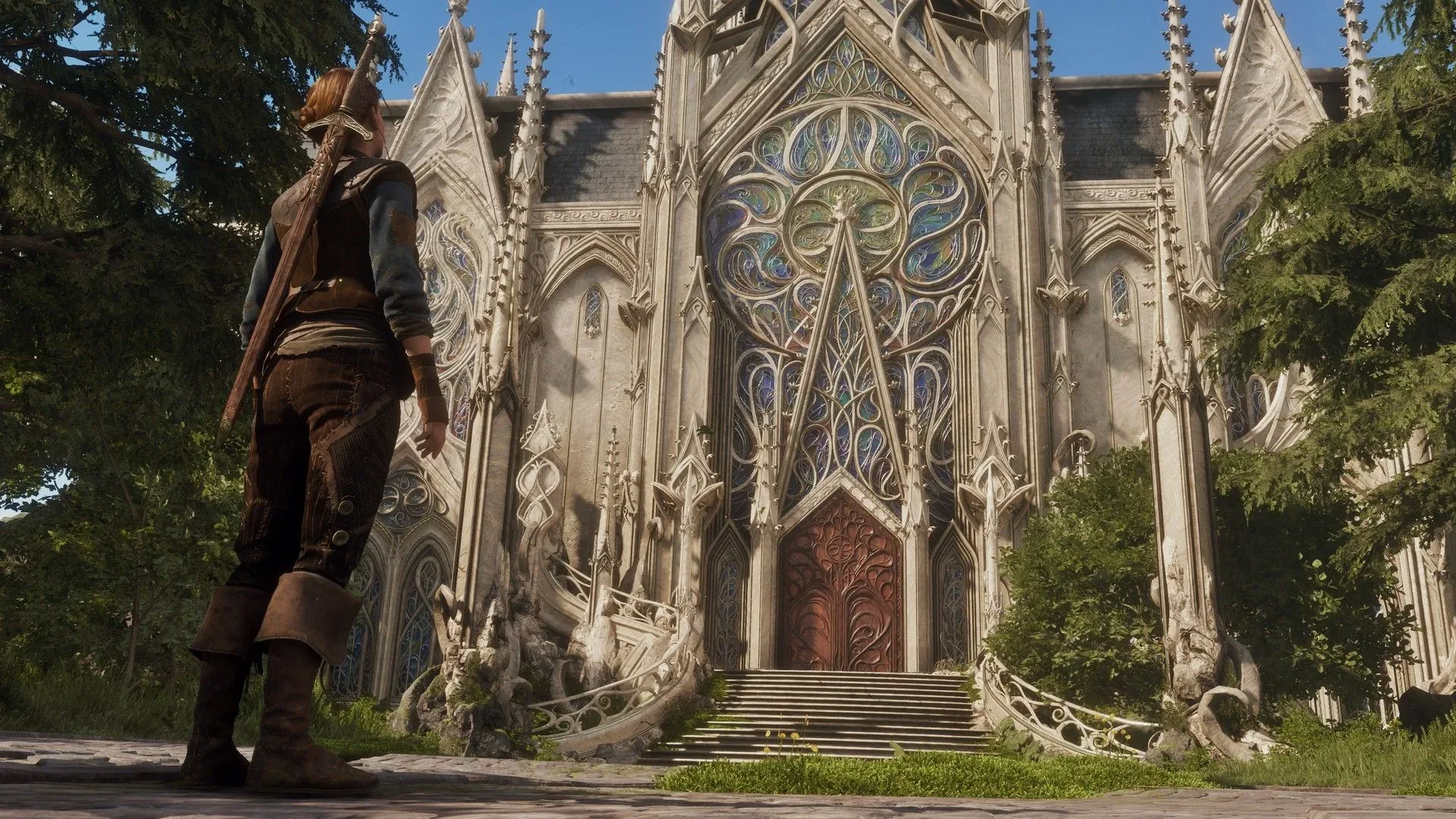
Fable’s final act is being framed as a major priority for Playground Games rather than an obligation to rush through after the adventures, jokes and detours are done. Ralph Fulton, co-founder of Playground Games and director of Fable, says the team has pursued quality “relentlessly” for the finale of the RPG, which is slated for 2027.
The concise promise is that the new Fable will “stick the landing.” It is an unusually direct bit of messaging for a series whose reputation includes a famously abrupt climax in Fable 2. But it is also a promise that needs careful reading: it confirms the developers’ ambition for the ending, not what that ending will contain or whether every player will like its outcome.
What has been described so far suggests a deliberate structure. The main quest is intended to feel less urgent for most of the game, giving players room to wander and engage with the world. The finale, by contrast, is expected to be the one point at which players are locked into the story. Fulton has also indicated that the conclusion culminates in a choice that asks players to consider who they are, balancing a personal cost against the result.
That combination matters because a role-playing-game ending is not merely the last cinematic or the final encounter. It is where the game has to make the player’s accumulated decisions, relationships and interpretation of their character feel as though they led somewhere meaningful. Fable has long been associated with player identity, moral texture and irreverent fantasy. A final choice with an actual sacrifice attached could be a strong fit for that premise—provided the game establishes what is at stake before asking players to decide.
Why Fable 2’s finale remains the obvious comparison
Discussion around a Fable ending almost inevitably returns to Fable 2 and Lucien, the antagonist pursued throughout that game. The confrontation is remembered not for a demanding, extended boss battle but for how quickly it resolves: Lucien can be stopped after the music-box moment with a single shot, or another character can do so if he is allowed to speak for long enough. The result has an intentionally comic edge, but it can also feel sharply anti-climactic given the suffering tied to the villain’s actions across the story.
“Anti-climax” is not automatically a flaw. A story can reject a conventional final battle to make a point about power, inevitability or the emptiness of a villain’s grand plan. The issue is whether the resolution supplies a satisfying replacement: emotional reckoning, thematic payoff, player agency or a consequence that recontextualizes the journey. For some players, Fable 2’s joke-like finality did not carry enough weight to match the build-up.
That history makes Fulton’s emphasis on the new game’s finale understandable. The developer’s comments do not say that the 2027 game will hinge on a difficult boss fight, nor should “sticking the landing” be reduced to combat. In an RPG, a satisfying finale can be a confrontation, a moral dilemma, an irreversible decision, a quiet aftermath, or a mixture of all four. What matters is the relationship between the ending and the experience that came before it.
The stated plan appears to recognize that distinction. A choice that challenges the player’s idea of their character, while demanding a real personal cost, points more toward consequence than spectacle. It implies the ending may ask something that cannot be neatly optimized away. Still, the precise choice, its alternatives, and the way the game responds to it have not been detailed. Those unknowns are the difference between an intriguing premise and a proven conclusion.
Related coverage includes Fable Director Says the 2027 RPG Is Built to "Stick the Landing".
Giving players room before the point of no return
Fulton’s description of the main quest as less urgent is another meaningful clue. In game-design terms, narrative urgency is the pressure a story puts on players to act immediately: a looming catastrophe, a person in danger, an enemy’s deadline or another crisis that makes a leisurely side trip seem strange. A highly urgent plot can create momentum, but it can also clash with an open-world game built around exploration and optional activity.
A lower-pressure main quest gives players permission to spend time in the world without feeling that they are abandoning a supposedly immediate emergency. That is especially important for an RPG where the fun may lie in unexpected encounters and self-directed choices as much as the critical path. It also creates room for players to form their own understanding of the protagonist before the story asks them to make a defining call.
The trade-off is clear. If a central threat lacks urgency for too long, the story can lose dramatic pull. If it becomes urgent too early, players may feel guilty or mechanically discouraged from exploring. The stated approach—freedom for most of the game, then a story lock-in only at the finale—looks like an attempt to separate those two needs.
A story lock-in, sometimes called a point of no return, is the moment after which players can no longer freely return to previous areas, activities or quest states until the ending is completed, if at all. It can give a finale focus because the game signals that the player is crossing from open-ended adventuring into a committed narrative sequence. Used well, it lets the final act build momentum without the odd tension of a world-ending crisis paused for errands. Used poorly, it can surprise players or cut off unfinished business without sufficient warning. No details have been given about how Fable will handle that practical side, so players should not assume anything yet about reversibility, cleanup or post-ending access.
A finale built for the players who get there
Fulton also addressed a difficult development reality: industry completion metrics can show every player beginning a game while only a fraction finishes it. That creates a cold incentive to place more effort earlier, where more people will see it. The stated response for Fable is to resist that temptation and invest in the final act.
That is a notable stance because the ending is where a game is most vulnerable to being judged in retrospect. Players can enjoy dozens of hours of systems and side content yet still come away disappointed if the narrative finish feels rushed, evasive or disconnected from their choices. Conversely, a strong conclusion can provide a sense of shape to a sprawling RPG and make earlier decisions feel more deliberate.
It is worth avoiding an overstatement, though. A polished finale cannot repair every possible issue in the rest of a game, and a minority completion rate does not make endings less important to the wider audience. People who do not reach the finale may still care about it through discussion, videos, friends and the series’ broader reputation. In that sense, an ending serves both the players who finish and the game’s long-term memory.
That memory is particularly potent for Fable. Its past games are still discussed in terms of the unusual expectations surrounding them, their humor and their signature decisions—as well as the moments where those elements did not fully meet expectations. For readers interested in how older games maintain a life through technical and community history, our look at the Nintendo 64’s backup stations, flash carts and homebrew era offers a separate example of how game legacies can keep evolving long after release.
What “meaningful choice” needs to mean
The most promising part of the available description is not the phrase “stick the landing” itself but the mention of a choice with personal cost. Meaningful choice is an often-used RPG term, and it can mean several different things. It does not necessarily require radically different campaigns for every option. At a minimum, it means the player understands why the decision matters, can identify a genuine tension between the outcomes, and sees the decision acknowledged in a way that fits the game’s values.
“Personal cost” raises the bar. If one option delivers every desirable result while the other only produces a punishment, there is little to weigh. A difficult Fable-style decision would need competing values: perhaps the outcome the player wants for the world versus the price their particular hero must pay. The source material does not reveal the subject of that choice, so any more specific prediction would be speculation. But the language establishes a useful expectation: the finale is being designed to ask for more than a routine good-or-evil selection.
There is also an opportunity here for the game’s less urgent midsection to support the final decision. The time spent exploring could give players relationships, memories or priorities that make a late sacrifice feel personal rather than abstract. This is analysis, not confirmation of a particular feature: whether the game successfully connects its open-world freedom to its ending remains unknown until players can experience the complete story.
The longer development context
Fulton has said that many people within Xbox view Fable as vital to the platform’s DNA, and that this support protected the project during a long development cycle. The comment arrives amid continuing layoffs at Xbox, a context that makes confidence in a major project’s continuity especially consequential.
It also helps explain why the team is putting so much emphasis on a finished, cohesive ending. Long development alone does not guarantee quality, and no public statement can settle how the completed game will play. Yet the director’s remarks indicate that the final act was not treated as an expendable portion of the production.
For now, the clearest expectation is modest but meaningful: the next Fable is intended to let players roam before eventually committing them to a finale centered on consequential choice. It is due next February within its announced 2027 window. Whether that produces the emotionally satisfying payoff the series needs will remain an open question until release—but Playground Games has made the ending a promise it will be judged on.