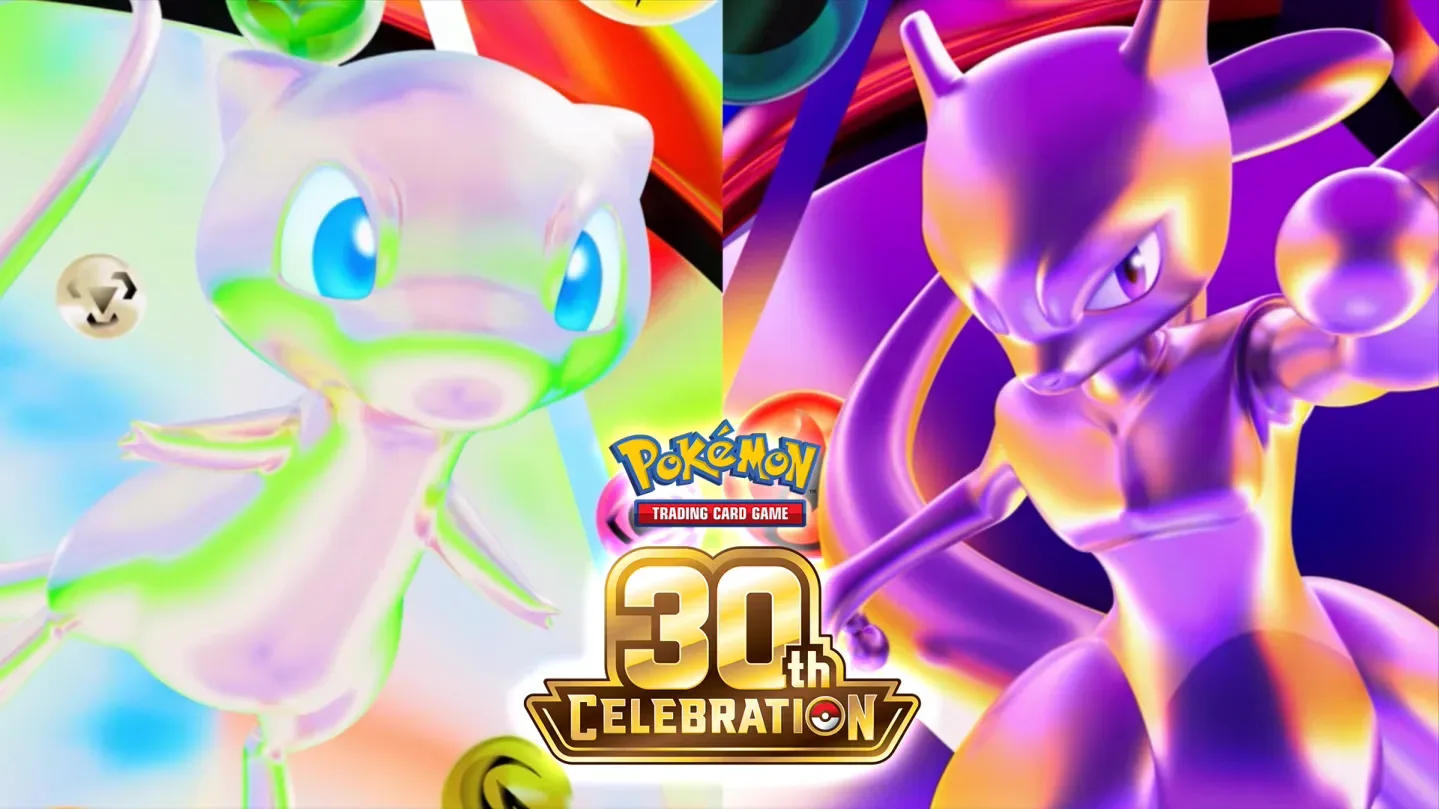
Pokémon Trading Card Game’s 30th anniversary release has arrived in stores, and the early conversation has swiftly narrowed to three unusual-looking Mew cards. Known among collectors as the RGB Mews, the trio uses artwork with a photo-negative-like appearance and comes in red, green, and blue variants. They were initially met with enough disbelief to be treated as a possible hoax. They are now evidently real, and they have become the release’s most conspicuous chase cards.
The secondary-market reaction has been immediate, noisy, and predictably difficult to interpret. Early online listings begin in the four-figure range, while at least one raw blue RGB Mew has reportedly sold for more than $20,000. At the more speculative end, sellers have posted asks reaching $150,000. Those figures should not be read as a settled market value for the cards. A seller’s asking price is a request, not proof that a buyer accepted it; a completed sale is more meaningful, but even one sale can reflect the rush and emotion of release week rather than a stable long-term price.
For a wider rundown of the anniversary product itself, see Pokémon TCG: 30th Celebration Launches Worldwide With 150+ Cards and a Classic Collection.
What makes the RGB Mews different?
The three cards’ visual gimmick is central to their appeal. Instead of conventional Pokémon card presentation, the Mew illustrations evoke a photographic negative: an intentionally strange, inverted-looking treatment that makes them stand apart at a glance. The red, green, and blue versions give collectors a three-card target rather than a single flagship pull.
That matters in practical collecting terms. A collector who wants one example can focus on the color they like or whichever version becomes comparatively obtainable. Someone attempting a complete RGB set must locate all three. In a release where scarcity is being heavily discussed, completing that trio can add pressure to an already frantic opening-week market.
The cards have also benefited from the type of attention that can turn a rare insert into a chase card almost overnight: visual distinctiveness, a recognizable Pokémon, uncertainty over supply, and anniversary-set visibility. Mew is not merely an obscure card subject hidden deep in a checklist. The unusual art treatment makes the cards instantly legible in photographs and listings, which helps online speculation move quickly.
A reported $20,000-plus sale is notable, but it is not a price guide
The reported sale of a blue RGB Mew for more than $20,000 is a remarkable early data point. It demonstrates that at least one buyer was willing to pay a five-figure amount for an ungraded copy during the release window. It does not, on its own, establish that every blue card is worth that amount, that the other two colors should match it, or that prices will remain there after more cards enter circulation.
This distinction is especially important because “raw” has a specific meaning in card collecting. A raw card is not encapsulated and assigned a condition grade by a third-party grading company. Buyers of raw cards are judging centering, corners, edges, surface condition, printing, and authenticity from the card itself or from photos supplied in a listing. Two raw examples of the same card can therefore attract very different bids if their visible condition differs.
Similarly, a listing at $150,000 tells readers something about a seller’s ambition or testing strategy, but not necessarily about demand. Completed transactions are generally more useful evidence than active listings, and multiple comparable sales over time are more useful than one extraordinary result. The source material also notes that some listings offer the complete three-card group for substantially less than the most eye-catching single-card asks. That spread is another reason to resist treating the largest number on a marketplace page as a definitive valuation.
The crucial unknown is the physical pull rate
The main unanswered question is how often the RGB Mews appear in physical booster packs. No confirmed physical-pack pull rate is provided. Some collectors have speculated about odds as low as one card in 20,000 packs, while players examining code in Pokémon Trading Card Game Live have found an apparent one-in-10,000 rate. Neither figure can currently be treated as confirmed odds for the physical anniversary product.
That gap is not a technicality. A pull rate is the frequency at which a card appears in sealed product, often described as a probability per pack. It is the foundation underneath most scarcity arguments. If a card is truly extraordinarily rare in physical packs, the supply arriving through openings could be limited. If the rate turns out to be less severe, additional pulls may materially change the market once more product is opened and listed.
Digital data may be interesting, but it is not automatically a physical-product blueprint. Pokémon Trading Card Game Live is a digital app, and the apparent rate found in its code may not map directly to printed booster collation. Collation refers to how cards are distributed and assembled into packs and products. Until the physical rate is confirmed or a very large, credible sample of openings develops, the relationship between the app’s apparent number and the real cards remains uncertain.
Even a genuine one-in-10,000 rate would need careful interpretation. It describes an expected frequency, not a promise that exactly one Mew will appear in every 10,000 packs. Randomized distribution can produce long dry spells and occasional clusters. In other words, opening more packs does not create a guaranteed shortcut to a particular Mew. Treating an extremely low proposed rate as a shopping plan is a fast route to spending far more than a direct purchase might cost.
Launch-week market mechanics are doing a lot of work
The anniversary set’s first days combine limited immediate visibility with unusually high attention. Fans want to pull the cards, resellers want to list them before competitors, and buyers who dislike uncertainty may be tempted to secure an early copy at almost any price. That environment can make headline-grabbing figures appear before anyone has a reliable picture of supply.
There are several reasons the first wave can look more dramatic than the eventual market. Initially, fewer opened packs mean fewer cards photographed, compared, and sold. Sellers may set high prices to see whether a deep-pocketed buyer bites. Buyers may fear that a card will become even harder to obtain. Then, as more packs are opened, the number of visible copies can rise quickly. None of that guarantees prices will decline, particularly if physical scarcity proves extreme, but it explains why the early numbers deserve caution rather than instant canonization.
The result is a market with three separate signals that can easily be confused:
- Active listings: what sellers hope to receive.
- Completed sales: what at least one buyer actually paid at a particular moment.
- Confirmed pack odds: the supply information that could eventually help explain whether those sales are sustainable.
At present, the first signal is abundant, the second includes at least one notable blue-card result, and the third remains unresolved. That is not enough evidence to declare a lasting value for any RGB Mew, let alone to rank the colors by rarity or desirability.
Practical advice for collectors who want an RGB Mew
Collectors do not need to ignore the cards just because the market is volatile. They do, however, need to decide whether they are chasing the experience of opening packs, building the three-card set, or buying a single piece of striking Mew art. Those are different goals with different financial risks.
- Separate the card from the hype. If the negative-style Mew design is the attraction, consider which individual color you would be happiest owning. A full trio may be appealing, but it is not the only valid collecting objective.
- Do not equate a huge ask with a proven sale. Check whether a number reflects an accepted transaction, and remember that even a completed sale can be an early outlier.
- Account for condition when comparing raw copies. “Raw” does not mean interchangeable. Clear photos and careful inspection matter more when prices are high.
- Keep physical and digital odds separate. The apparent one-in-10,000 rate found in app code is not confirmed as the rate for physical anniversary packs.
- Give the market time to produce evidence. More listings, more sales, and more opened product may reveal whether early prices were durable or driven by launch-week urgency.
The most sensible response to the current frenzy is patience. There is a large distance between enjoying an unusual Mew card and making a financially extreme purchase because a handful of listings have made scarcity feel absolute. Until physical pull rates are established and sales data broadens, the RGB Mews are best understood as a spectacularly hot, visually distinctive, and still highly uncertain anniversary chase.
What to watch next
The next meaningful developments are straightforward. Collectors will be watching for more verified sales, clearer evidence of how often each card appears in physical packs, and whether the red, green, and blue variants settle into noticeably different pricing tiers. It will also matter whether sellers continue to find buyers at four- and five-figure levels once the initial flood of attention recedes.
For now, the blue card’s reported $20,000-plus sale is the biggest concrete headline, while the loftiest listings remain requests rather than outcomes. The RGB Mews have unquestionably become the cards everyone is talking about. Their actual scarcity and durable market value are questions that the first few days of sales cannot yet answer.