Magic: The Gathering’s Reality Fracture preview season has put a familiar metallic face back in the spotlight: Karn, the silver golem. His return is notable not merely because he is a long-running character with a sizeable card history, but because the set’s echoed-pairs premise gives collectors two distinct Karn cards at once. One represents the established Multiverse, while the other comes from Jace’s Echoverse.
That framing makes Karn more than a standard character cameo. He is a clear demonstration of how Reality Fracture intends to handle alternate versions of major figures, and it creates several lanes for interest: gameplay, character collecting, borderless art, and potential renewed attention on older Karn cards. It does not automatically mean every existing Karn printing is headed upward, especially given his substantial reprint history. Still, the character’s reappearance creates a timely reason to separate scarce versions, heavily supplied staples, and the new treatments that may appeal to set collectors.
Karn’s previous card was Karn, Legacy Reforged, released in March of the Machine: The Aftermath in 2023. In the story, he had already surrendered his planeswalker spark during March of the Machine. The two new versions remain sparkless, so this is not a return to the planeswalker-card template. Instead, both are legendary artifact creatures, fitting Karn’s identity while serving two notably different jobs.
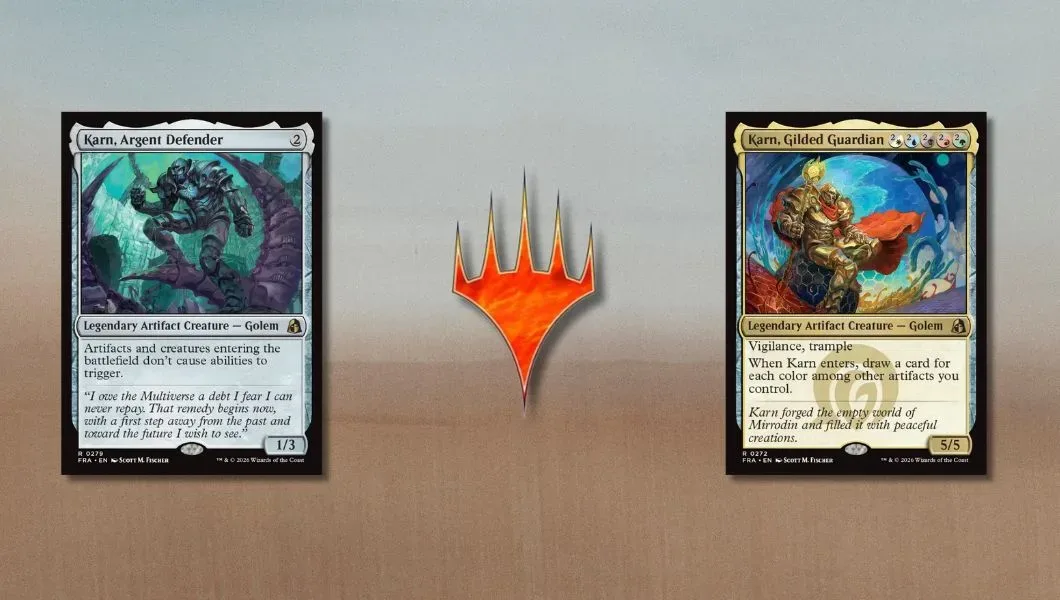
Echoed pairs put the two Karns side by side
The echoed-pairs structure centers on two cards for the same character: one from the known Multiverse and one from the Echoverse associated with Jace. Karn is especially useful as a showcase for that idea because his visual identity is immediately recognizable, while the alternate version can still take the concept in a different direction.
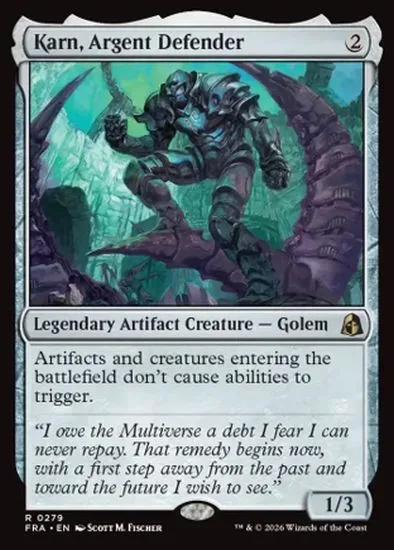
Karn, Argent Defender is the Multiverse card. It is a two-mana 1/3 legendary artifact creature with a static ability that prevents artifacts and creatures entering the battlefield from causing abilities to trigger. Put more simply, it shuts down enter-the-battlefield triggers from both of those permanent types.
That is an unusually broad piece of disruption on a colorless creature. Creature ETB effects are foundational to Commander games, but artifact entry triggers can be just as important in the right decks. Karn’s low mana value also makes him easy to deploy early. The tradeoff is equally important: as a creature, he is generally more vulnerable than an enchantment or a noncreature artifact serving a similar disruptive purpose. Removal is plentiful, and a 1/3 body is not likely to stay on the table merely through combat stats.
For Commander players, though, redundancy can be a feature rather than a flaw. Decks looking to slow down value engines often welcome another usable colorless option, including decks that cannot conveniently access particular colors. That does not establish Karn, Argent Defender as a format-defining card before the wider card file is known. It does mean the design has an identifiable audience beyond collectors who simply want every Karn.
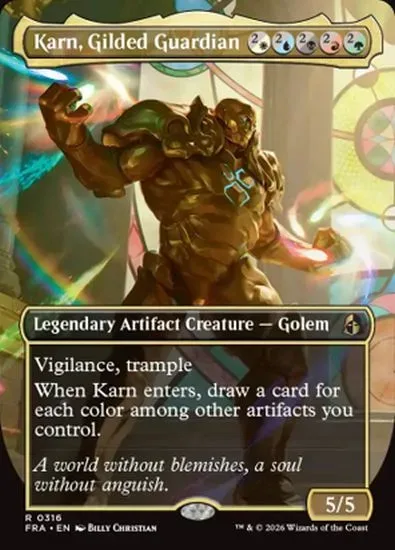
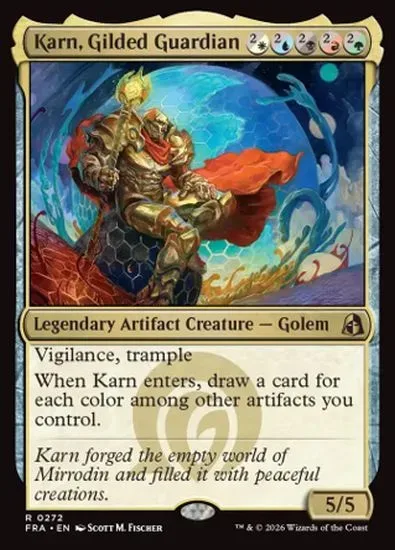
The Echoverse version, Karn, Gilded Guardian, heads in a much larger and splashier direction. It can be cast for five hybrid mana or for 10 colorless mana. The card is a 5/5 with vigilance and trample, and it draws a card for every color among the other artifacts its controller has. That puts deck construction squarely at the center of the payoff. A diverse artifact board can turn its arrival into a substantial refill, while a colorless artifact pile offers far less.
The two cards therefore form a functional contrast as well as an aesthetic one. Argent Defender is a cheap, narrow-looking but disruptive utility piece. Gilded Guardian is a big artifact payoff whose strongest moments depend on a multicolored artifact setup. Collectors may pursue the pair because they belong together; players may divide their attention based on format and deck needs. Those are separate sources of demand, and neither should be mistaken for a guarantee of high prices.
Borderless echoed pairs are the collector version to track
Both Karns also have borderless echoed-pairs versions. The cards share a single connected piece of art by Billy Christian, which is a deliberate part of the echoed-pairs presentation rather than two unrelated borderless illustrations. For collectors who enjoy diptychs, linked art, or binder displays built around a character, this makes the two-card set much more compelling than a pair of ordinary alternate frames.
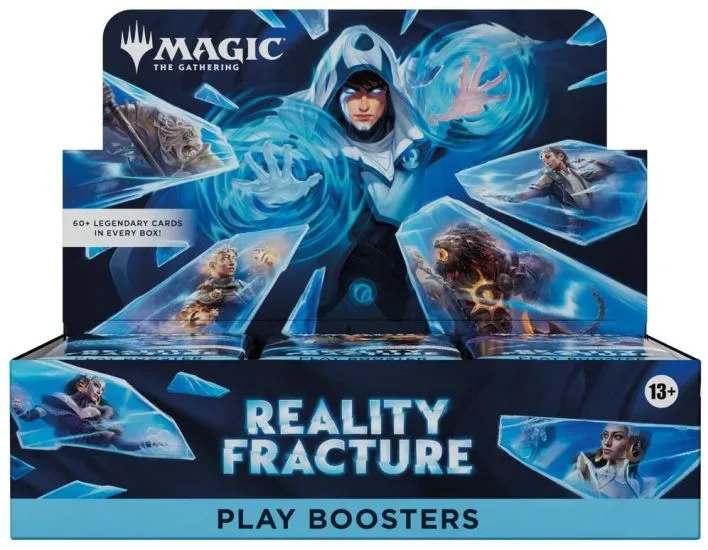
Rarity and product placement matter here. Across Reality Fracture, there are 66 uncommon, 14 rare, and six mythic rare individual echoed-pairs cards. Play Boosters contain three echoed-pairs slots. The published probabilities for those slots are 88.9% uncommon, 6.7% rare, and 1.4% mythic rare.
Borderless echoed-pairs cards sit on a scarcer track. The stated chance is 1.7% for an uncommon borderless echoed-pairs card, while rare and mythic rare borderless cards each land below 1%. Since the Karn borderless cards are rare, the important practical takeaway is simple: they are not the kind of card collectors should expect to repeatedly open just because a box contains multiple echoed-pairs slots.
Collector Boosters do not provide an obvious dedicated shortcut to rare echoed pairs, either. Their dedicated echoed-pairs slots are uncommon-only. Rare borderless Karn cards instead appear through the broader Booster Fun slot structure. That distinction is worth remembering when comparing sealed-product expectations against the secondary market. A booster with more premium treatments in general is not necessarily a direct pipeline to the particular rare treatment a collector wants.
For anyone collecting both versions, condition and presentation will likely matter as much as raw scarcity. Linked artworks encourage matched copies, and a clean, centered pair may attract more attention than two individually purchased cards with visibly different condition issues. The lesson applies broadly across premium card collecting, whether someone is assembling a modern character page or working through a theme set such as the historical and pop-culture mix found in 2012 Panini Golden Age Baseball.
Older Karn cards have supply on their side
The more speculative question is whether two new Karn cards can lift the older catalog. Character returns often prompt players and collectors to revisit previous versions, particularly when a new set puts a recognizable name at the center of its marketing and mechanics. Attention can matter, but it should be weighed against supply, format demand, and the reason a particular old card was valued in the first place.
Karn Liberated is the clearest example of why reprints cannot be ignored. The original New Phyrexia mythic became closely associated with Modern Tron strategies, yet completed sales for that printing have generally been around $5. It has appeared again in Modern Masters 2015, Ultimate Masters, Double Masters, The List, and Jumpstart 2022. It remains a major Karn card historically, but the market has had numerous opportunities to absorb additional copies.
Karn, the Great Creator is in a similar current range, with completed War of the Spark sales around $6. The new reveal does not itself create a newly identified competitive reason to buy either card. A brief surge of browsing, character-driven Commander purchases, or collector interest is possible; a durable price move would need stronger support than nostalgia and headlines alone.
That makes selectivity important. An older Karn card can be attractive because it has original-set appeal, a premium treatment, recognizable competitive history, or a role in a specific deck. But “Karn is back” is not a substitute for checking how many printings exist and whether the card’s game text remains relevant. It is better viewed as an attention catalyst than a confirmed market catalyst.
The September dates that could change the picture
Two scheduled preview moments may clarify how large Karn’s role will be. Commander previews arrive September 16, followed by the full Card Image Gallery on September 18. Both dates matter because the current reveal may not represent the complete set of Karn-related cards or treatments.
One item to watch is Multiverse Reforged, the four-color Commander deck led by Jace. It includes 18 cards new to Magic. If Karn appears there, it would create another new version and another source of supply during the release window. It could also reveal whether the set intends to support a deeper Karn artifact theme beyond the two echoed-pairs cards already shown.
The other unknown is the premium-promo space. Reality Fracture has 10 Japan Showcase cards and 10 Secret Lair Bundle promos. Five Japan Showcase positions have already gone to Hexhaven’s Founder Sphinxes, while the Secret Lair Bundle promos have only been partly shown. A Karn in either program would change the character-collection checklist and could become an important target for treatment-focused buyers.
The schedule then moves quickly: prerelease events run from September 25 through October 1, MTG Arena receives the set on September 29, and the tabletop release is October 2. That gives the existing Karn market only a short span to react before new copies enter circulation.
For now, the most defensible read is that Reality Fracture has made Karn relevant again without yet proving a major shift in the value of every card bearing his name. Argent Defender has a potentially useful Commander disruption role. Gilded Guardian provides a high-ceiling artifact payoff for the right mana base and board state. Their shared borderless art makes the rare pair a focused collector target. The complete gallery and Commander reveals will determine whether this is a memorable two-card comeback or the start of a much larger Karn chase.