The SCN Challenge is entering Week 11 with two developments driving the conversation: collectors are moving toward Joe Burrow cards amid his rising MVP case, and the competition’s waiver system is facing its sharpest argument yet over which sales can establish a card’s value.
The season-long contest puts 10 card-focused creators in charge of five-card football portfolios. Like a fantasy-football league, participants can use waivers during the season and playoffs to replace holdings. The winner is determined by the largest percentage increase across the season, making the timing of each acquisition, sale and valuation decision just as important as identifying a player whose market might rise.
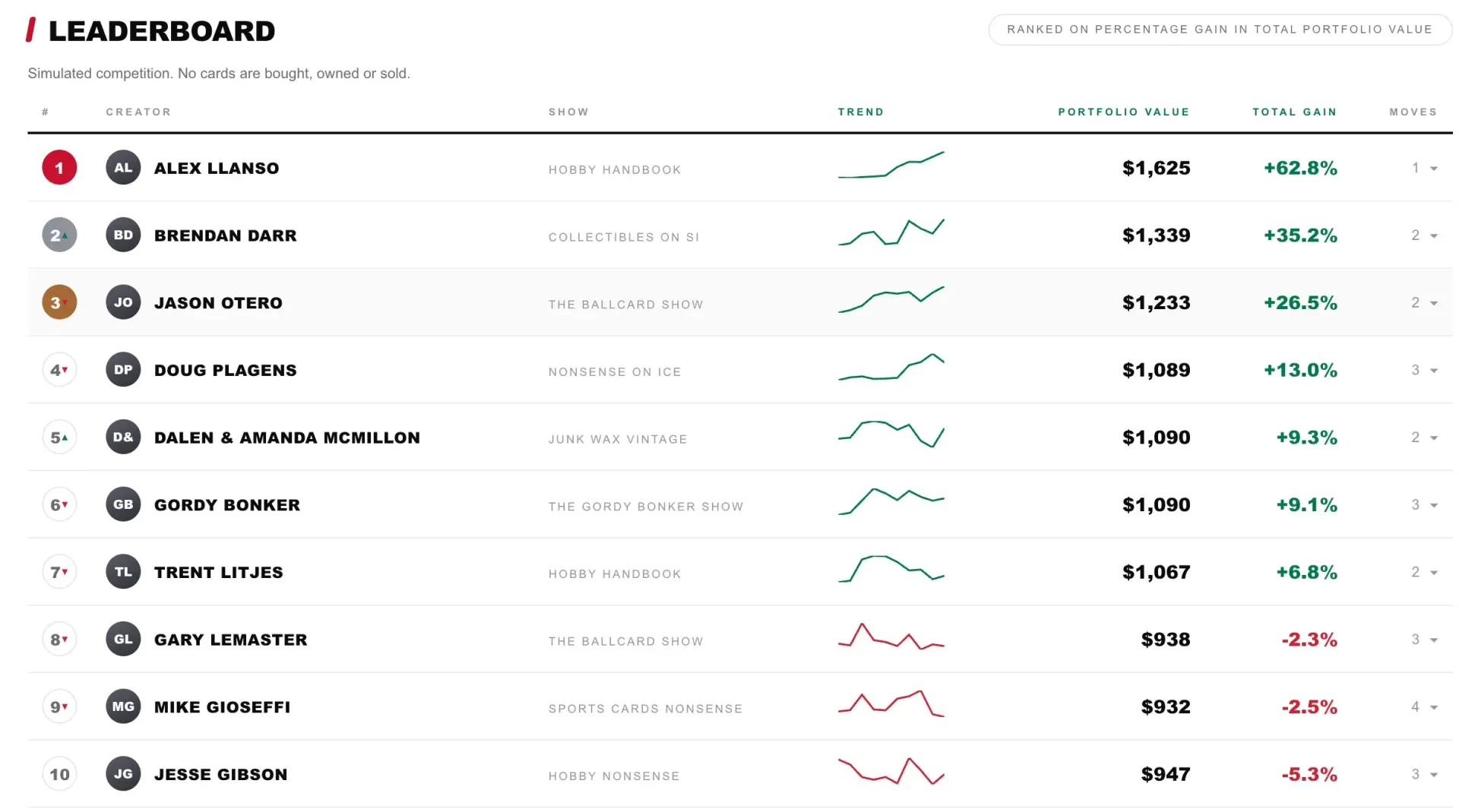
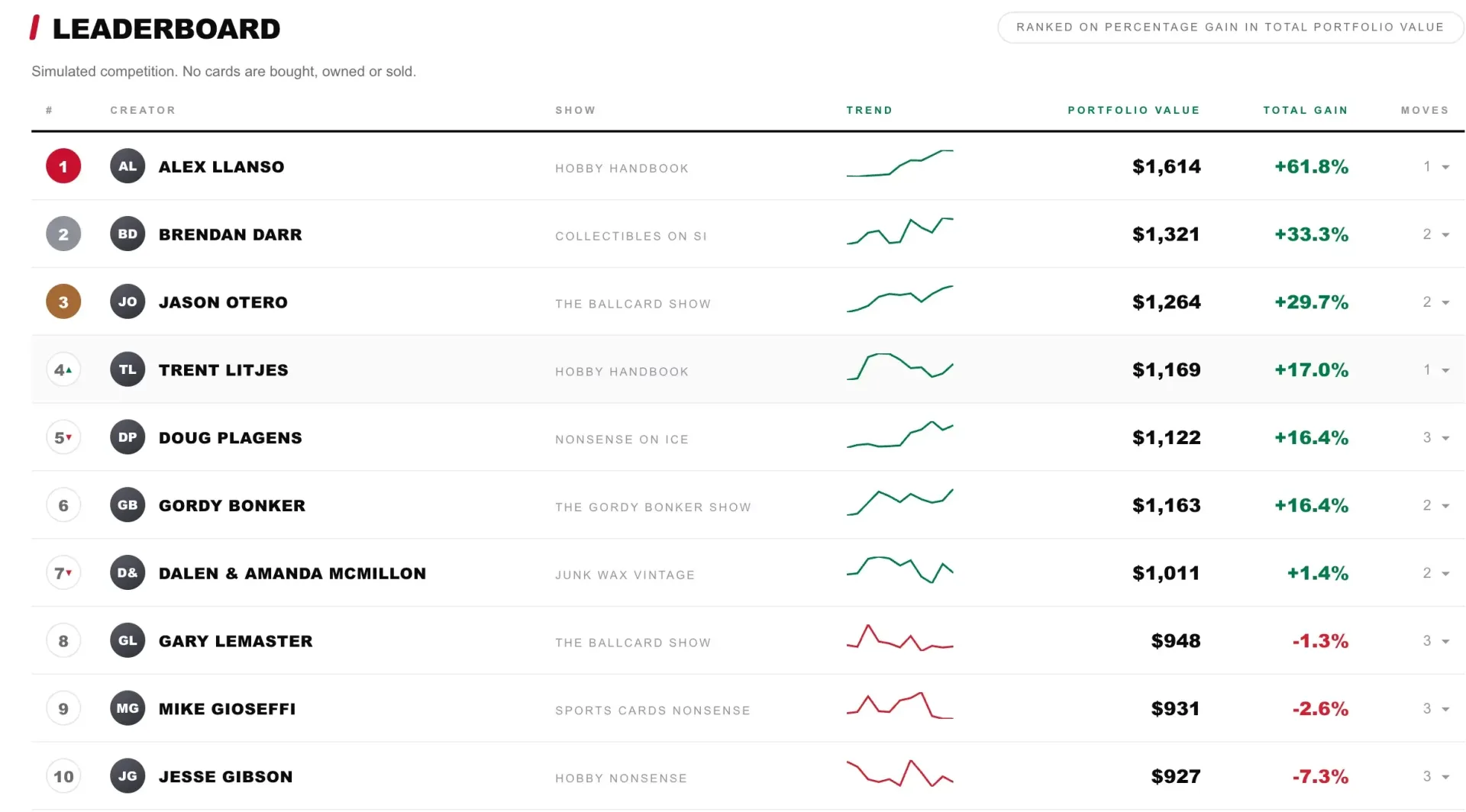
That format has rewarded quick reads on changing attention. Alex Llanso remains in first place heading into Week 11. The leading portfolio, identified as CleverCubanCards, has benefited from selling Tyler Shough at a favorable point and from timing positions in Caleb Williams, Burrow and Josh Allen. Jason Otero remains on the podium after a strong week, while Trent Litjes climbed from seventh to fourth. Gordy and Doug also posted solid weeks despite slipping behind Trent.
Why Burrow is becoming the central Week 11 play
Burrow has become a popular addition in recent weeks, with collectors in the challenge leaning into the possibility that on-field attention could translate into card-market momentum. He has moved into favorite status in the MVP race and has a Monday Night Football matchup against the Commanders ahead. In a portfolio contest measured by percentage growth, that kind of spotlight matters because it can concentrate interest around a player in a very short window.
That does not mean a strong game automatically produces a higher card valuation. A card market is not one item: it is a collection of different products, serial numbers, conditions and grades. A buyer considering a base card, an autograph, a numbered parallel or a top-population graded copy is not necessarily participating in the same market as buyers of another Burrow card. But a high-profile player narrative can increase the number of people looking across those products, which is why the challenge’s managers are treating Burrow as a potentially timely roster decision.
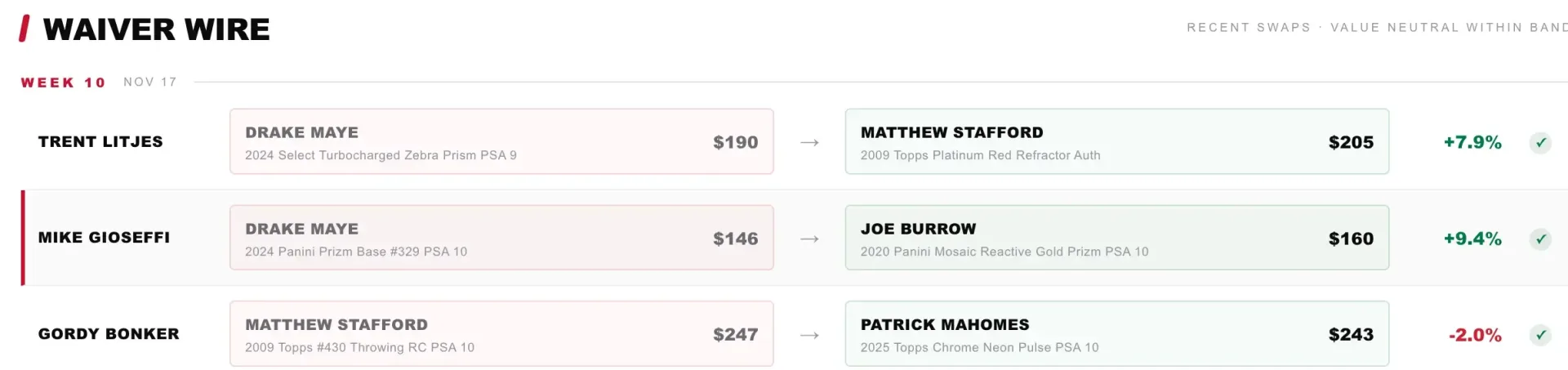
Mike Gioseffi made the most notable Burrow-related transaction of the latest waiver period, replacing Drake Maye with Burrow. It was Gioseffi’s first move of the season and came after his portfolio fell into last place behind Jesse. In a contest built around percentage return, a late move can be meaningful, but it also carries a clear trade-off: the manager gives up any future recovery in the outgoing card to pursue a more immediate catalyst elsewhere.
Practical implication: collectors following player-driven markets should separate the player thesis from the card thesis. “This player may receive more attention” is one premise. “This particular card can be reliably valued, bought and later sold at a favorable level” is another. The challenge’s latest dispute shows why the distinction is not merely academic.
The Matt Stafford waiver dispute is really about comparable sales
Trent’s waiver move is the most debated decision of the season so far. He was permitted to exchange Drake Maye for a Matt Stafford card whose last recorded sale dates to 2022. The objection is not simply that the card is old; it is that the card is currently at auction on eBay and is already above the historic sale used for the roster valuation.
Related coverage includes SCN Challenge Week 11: Joe Burrow Gains Steam as Waiver Debate Intensifies.
At issue is the role of a comparable sale, often shortened to “comp.” A comp is a completed transaction used as evidence of what a similar collectible has recently commanded. Its usefulness depends on several details: whether it is the exact same card, whether its condition and grade match, whether the sale was recent enough to reflect current demand, and whether the market has changed in the meantime.
Using a completed sale from 2022 may be the only available data for a scarce card, but scarcity does not automatically make that result a dependable present-day price. A multi-year gap can encompass significant changes in a player’s form, hobby demand, grading populations and the number of collectors willing to pursue that specific issue. Meanwhile, a live auction is evidence of current bidding interest, but it is not a completed sale. Bids can change before the close, and an auction price only becomes a firm transaction reference once it is finished.
This is why the waiver decision has become a governance question rather than a simple argument over one Stafford card. A league needs a consistent answer to two questions: how old can a comp be before it is no longer acceptable, and can a current auction affect a valuation before it ends? Without clear rules, a manager with a rare card may receive a favorable entry point from stale data, while another manager may be denied a similarly uncertain valuation.
The concern is sharpened by a prior reversal involving a JSN Green Scope Prizm Auto graded PSA 9. That proposed move was abandoned because its last sale was 105 days old and a raw copy had sold for $500 more than the value that was going to be locked in for the PSA 9. The contrast being raised is straightforward: if a sale a little more than three months old can be too weak when a relevant newer data point challenges it, how should a Stafford result more than 1,460 days old be handled?
Analysis: neither a rigid age limit nor automatic acceptance of every older sale is a perfect solution. A hard cutoff can leave genuinely scarce cards with no usable comps at all. But an exception process needs to be transparent. A workable rule could require the league to label an old comp as provisional, disclose why no better completed sale exists, and specify what will happen if a live auction or a newer sale closes at a materially different value. The important point is consistency: rules should not change based on which player or manager is involved.
Tyler Shough illustrates the liquidity problem
The challenge also has a more familiar card-market problem in Tyler Shough: a collector can have a plausible valuation argument and still struggle because there are too few completed transactions to support it. One portfolio includes a Tyler Shough Teal Refractor numbered to 199 and graded PSA 10. Only eight examples of that card have been graded, including two PSA 10s and two PSA 9s.
That low population sounds appealing, but it does not create liquidity by itself. Liquidity is the ease with which an asset can be bought or sold near an observable market price. A card can be rare and still be illiquid if too few buyers are actively seeking it or too few sales take place to establish a credible range. In an ongoing portfolio competition, illiquidity is especially punishing because a mark-to-market value must be calculated even when the market has provided very little fresh evidence.
The Teal Refractor’s difficulty is that the limited data makes it hard to establish where the PSA 10 should sit relative to adjacent versions. A standard refractor most recently sold for $200, a figure that would imply only about a 2% loss if the numbered PSA 10 tracked in a comparable way. Instead, the position is presently down about 20%, largely because the /199 version lacks enough relevant transactions to move its recorded value with confidence.
Collectors often call this a population-versus-demand issue. Grading population reports tell us how many copies have been graded at each level; they do not tell us how many collectors currently want the card, what they will pay, or when one will next sell. A PSA 10 label can matter greatly, but its premium is still discovered through actual buyer behavior. With only two PSA 10s recorded, there is a scarcity story—but not necessarily a series of sales that can prove a stable market price.
What scarce-card owners can take from the Shough situation
- Do not treat rarity as a guaranteed floor. A low serial number or low graded population can limit supply, but absent sales can make valuation more uncertain rather than more secure.
- Use adjacent cards carefully. A non-numbered refractor can offer context for a numbered parallel, yet it is not a direct substitute. Grade, print run and collector preference may change the relationship.
- Distinguish a listing or auction from a completed comp. Asking prices and early bids may indicate interest, but a completed transaction is stronger evidence of a market-clearing price.
- Expect thinly traded cards to lag a player narrative. Even if a player’s profile rises, a rare card may not receive a fresh sale quickly enough to reflect that change in a tracked portfolio.
Puka Nacua forces another roster decision
Mike Gioseffi may need to use another waiver soon because Puka Nacua, the other key card in his portfolio, has been ruled out for the remainder of the season following season-ending MCL surgery. His week had already been unusual after a suspension despite being on injured reserve. With Nacua unavailable for the rest of the season, the only Nacua holder in the challenge now faces a decision similar in structure to the Burrow swap: retain a position in the hope that its card value holds up, or replace it with a player whose immediate circumstances create a clearer path to movement.
For the broader contest, the Nacua development reinforces why roster construction cannot rely solely on choosing good players. Portfolio managers also need cards with enough recent transactional activity to be measured fairly, a rule set that treats comparable sales consistently, and enough flexibility to react when player circumstances shift suddenly.
The tension between Burrow’s surge, Shough’s illiquid rare parallel and the Stafford comp argument is what makes Week 11 more than a simple standings update. It is a concentrated version of the decision-making collectors face outside a contest: player hype can create opportunity, but the card’s exact identity and the quality of its sales evidence determine whether that opportunity can be priced responsibly. For another card-focused take on a very different kind of deckbuilding experience, see Mr Magpie’s Harmless Card Game.