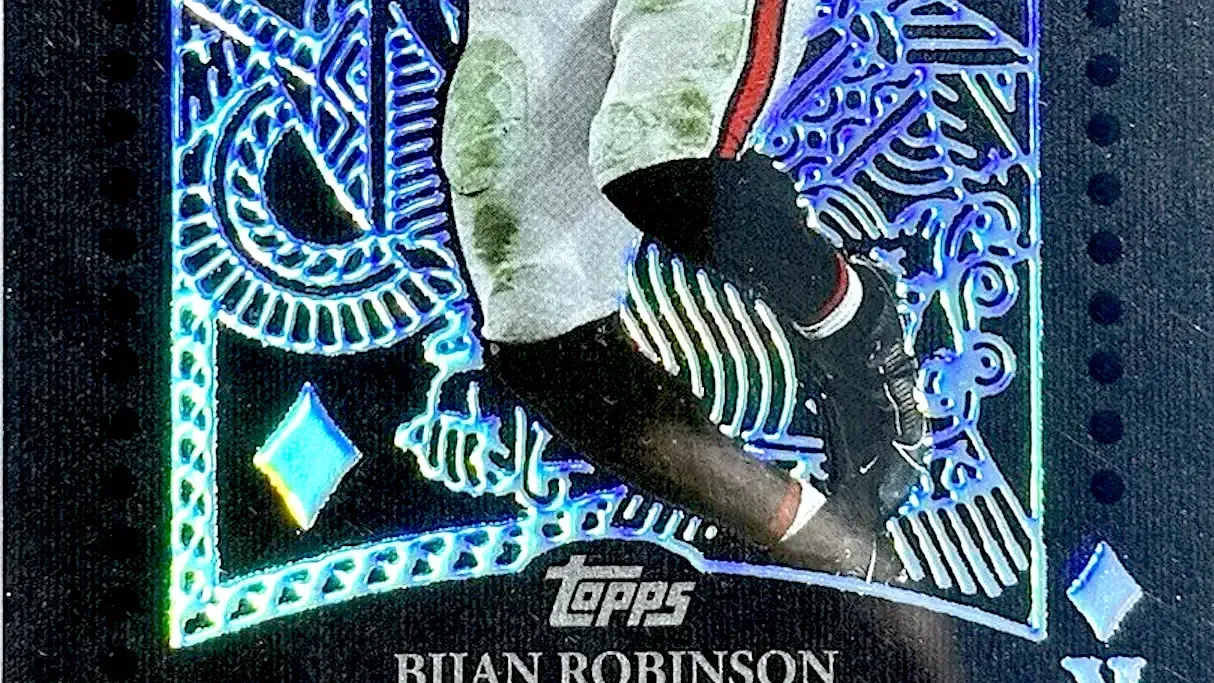
Football’s running back arguments have always been wonderfully impossible to settle. One fan values power, another values burst, another points to receiving production, and everybody has a spreadsheet—or a memory—ready to make the case. The current version has a particularly clean setup: Detroit Lions star Jahmyr Gibbs and Atlanta Falcons centerpiece Bijan Robinson entered the NFL four picks apart in the 2023 draft, then rapidly became high-volume, all-purpose threats.
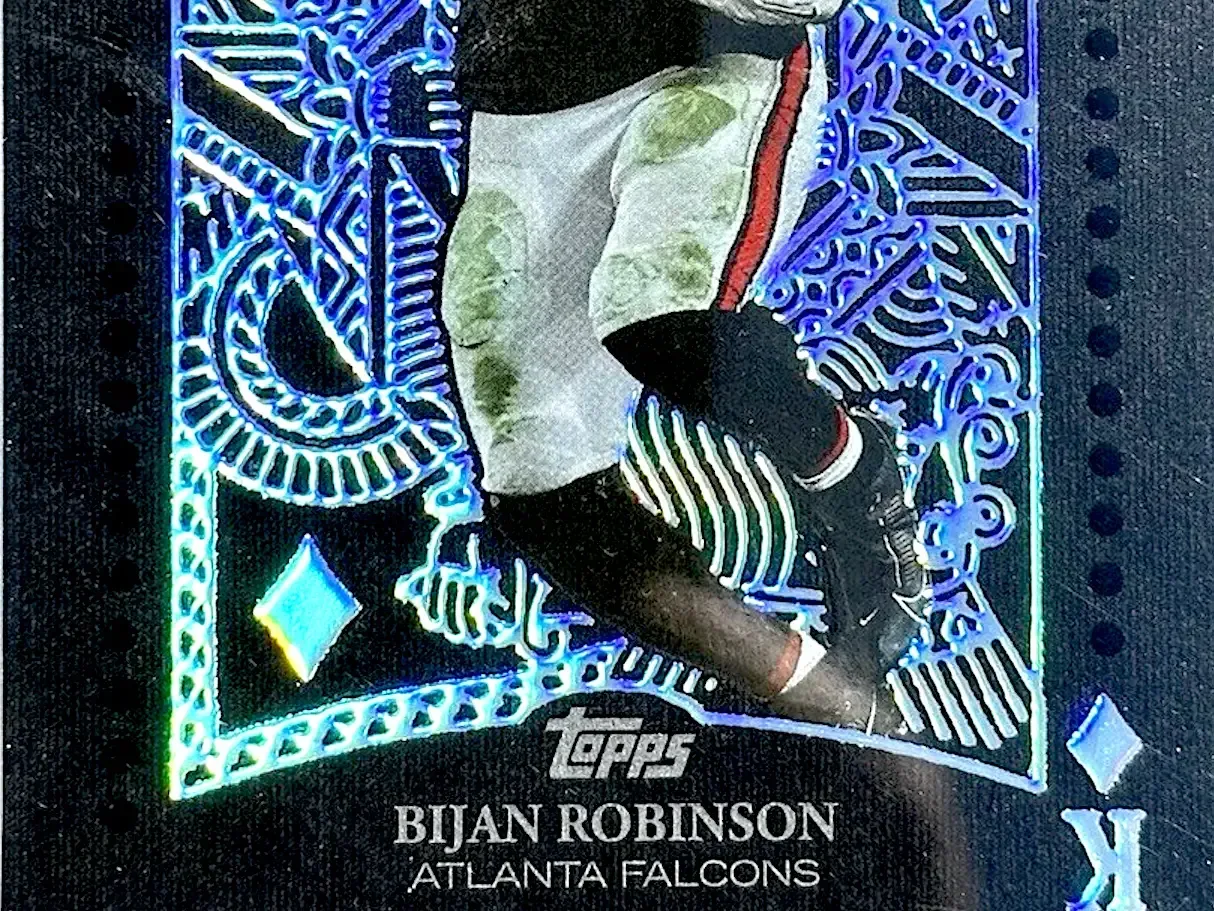
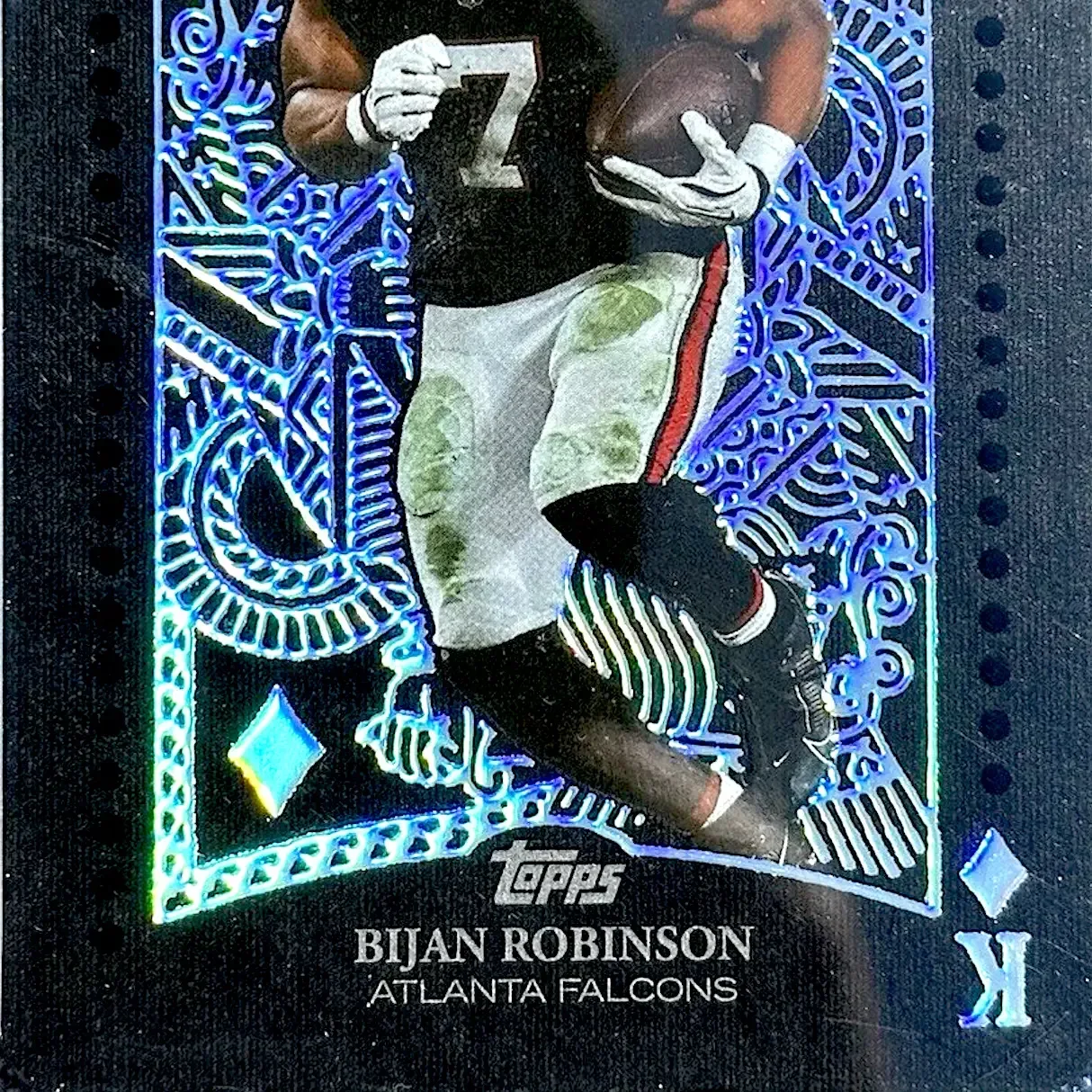
That on-field comparison is now taking root in trading cards. Recent marketplace results for both players show meaningful demand for major rookie-year inserts, ultra-limited cards, autographs and top-graded copies. Neither player’s recent high-end sales consistently occupies the sort of five-figure territory that can define the hobby’s most fevered player markets. But the available results suggest collectors are paying close attention—and that the Gibbs-versus-Robinson conversation has moved from fantasy lineups and Sunday debates into card displays and auction searches.
For collectors, the important part is not declaring a winner after a handful of sales. It is understanding what kinds of cards are drawing bids, why similar-looking copies can sell for very different amounts, and how continued production could affect attention without guaranteeing any future value.
Two versatile backs, one increasingly visible card-market comparison
Gibbs’ 2025 totals combined 1,223 rushing yards with 77 receptions and 616 receiving yards. Robinson posted 1,478 rushing yards, adding 79 catches and 820 receiving yards. Those are not merely rushing-stat lines; they illustrate why each player has broad appeal in modern football conversation. Both were heavily involved as runners and receivers.
The early 2026 sample kept both in focus. Through four games, Gibbs had 540 total yards and seven touchdowns for Detroit. Robinson had 457 total yards and three touchdowns through three games. That production gives card collectors a live sporting narrative to follow alongside the cardboard: weekly performances can raise visibility, bring new buyers to searches and intensify the familiar player-versus-player debate.
It does not, however, mean every card moves equally. Recent sales show that demand clusters around recognizable premium card types rather than treating all issues from a player as interchangeable. Scarcity, set identity, condition, signatures and memorabilia elements all materially change how a card is perceived.
For a wider football-business perspective, see this look at an NFL executive’s move to CAA.
Gibbs’ strongest recent results
Gibbs’ headline result was a 2023 Panini Absolute KABOOM! vertical rookie card in PSA 10 that sold for $4,000 on 28 bids. A PSA 9 copy of the same card sold for $2,804 on 26 bids. The difference is a useful demonstration of the premium collectors can attach to a highest-grade example, even when the design and player are otherwise identical.
Other recent Gibbs sales include a mixture of unique cards and recognizable case-hit-style inserts:
- An ungraded 2025 Topps Chrome Sapphire #1/1 sold for $2,850 on 29 bids.
- A 2023 Donruss Optic Downtown! rookie graded PSA 10 brought $2,252 on 65 bids; another PSA 10 copy reached $2,150 on 23 bids.
- A 2023 Panini Flawless signed dual-patch card numbered 10/25 and graded PSA 10 sold for $2,125 on 20 bids.
- A 2025 Panini Absolute KABOOM! Horizontal graded PSA 10 sold for $2,025 on 36 bids.
- An ungraded, autographed 2023 Panini Contenders Optic Rookie Ticket #1/1 sold for $1,925 on 14 bids.
The $4,000 KABOOM! result sits clearly above the rest of this group, but the notable detail is the depth beneath it. Gibbs had multiple recent examples crossing $2,000, from a unique Sapphire card to a premium patch autograph and two well-known insert families. This is not evidence that every Gibbs card occupies that price range. It is evidence that several distinct high-end collecting lanes exist for him.
What the Gibbs sales say about card formats
KABOOM! and Downtown! are distinctive insert brands that can command attention because the designs are immediately recognizable. Collectors are not only buying a player name and a year; they are often choosing a visual identity with an established following. The two recent PSA 10 Downtown! sales, at $2,252 and $2,150, also provide a small same-card comparison. They are close, but not identical—an appropriate reminder that individual auction outcomes reflect the specific bidding pool at that moment.
The Flawless card presents a different proposition. It is numbered 10/25, signed and includes two patch pieces. That creates several layers of collectibility: a limited serial number, an autograph and memorabilia content. Meanwhile, the Sapphire #1/1 and the Contenders Optic Rookie Ticket #1/1 are unique by stated numbering, yet their results differed. Rarity remains important, but it is not a universal price-setting cheat code. Brand, aesthetics, rookie-card status, grade and collector preference remain part of the equation.
Robinson’s market is led by scarce rookie issues and a fast-moving newer card
Robinson’s top listed recent sale was $3,016 on 35 bids for an ungraded 2023 Panini Contenders Optic Rookie Ticket Gold Vinyl #1/1. That result puts a one-of-one rookie ticket at the top of his group and slightly above the strongest listed Robinson graded parallel.
His other highlighted sales were similarly varied:
- A 2023 Panini Prizm White Sparkles rookie graded PSA 10 sold for $2,224 on 37 bids.
- A PSA 10 2023 Panini Prizm Green Sparkles parallel numbered 1/8 brought $2,025 on 50 bids.
- A 2023 Panini Prizm Color Blast rookie graded PSA 10 sold for $1,875 on 21 bids.
- An ungraded 2026 Topps Flagship All Kings card sold for $1,600 on 60 bids.
- A 2023 Panini Donruss Optic Downtown! graded PSA 10 sold for $1,471 on 28 bids; another PSA 10 copy brought $1,426 on 20 bids.
- A 2023 Panini Absolute Kaboom! Horizontal graded PSA 10 sold for $1,400 on one bid.
The $1,600 All Kings result is especially eye-catching because it came from an ungraded 2026 card and drew 60 bids. It should not be treated as proof that grading does not matter. Rather, it shows that a newer card with a compelling design or perceived desirability can attract substantial attention before a graded population develops. The bid count also tells a different story from the final price: it measures auction participation, not an objective score for a card’s long-term standing.
Why Robinson’s Prizm results deserve a closer look
Robinson’s Prizm cards show three different forms of high-end appeal. White Sparkles in PSA 10 reached $2,224. Green Sparkles, numbered 1/8 and also graded PSA 10, reached $2,025. Color Blast in PSA 10 sold for $1,875. The results are tightly grouped enough to show sustained interest in premium Prizm variants, while their order also cautions against assuming that the lowest stated serial number must always sell for the most.
That is normal collector behavior. A parallel is a variation of a card that differs from the standard version through color, finish, numbering or another production treatment. A lower print run can increase scarcity, but buyers may also prefer a particular visual treatment, chase a familiar insert name, prioritize rookie status or care most about a card’s condition. The market is a collection of preferences, not a formula with one input.
A practical glossary for reading these results
Sports-card listings can compress several crucial details into a single line. A few terms appearing in these sales are worth separating.
- PSA 10: A card graded 10 by PSA. In the listed Gibbs and Robinson sales, top grade often coincided with stronger results, especially for cards where another graded copy offered a comparison point.
- PSA 9: A slightly lower graded example. Gibbs’ vertical KABOOM! provides the clearest direct comparison: the PSA 10 sold for $4,000, while the PSA 9 sold for $2,804.
- #1/1: A card marked as the sole copy in its numbered run. It signals stated uniqueness, although unique cards from different sets can still sell at very different levels.
- Numbered 10/25 or 1/8: A card from a limited run, with the first number identifying that copy’s serial number and the second indicating the stated run size.
- Rookie card: A card issued in the player’s rookie-card period. Collectors often place special emphasis on rookie issues, which is why 2023 cards feature so prominently for both players.
- Patch autograph: A card combining a player signature with a memorabilia patch element. Gibbs’ Flawless dual-patch autograph is an example.
- Ungraded: A card offered without the cited third-party numerical grade. Ungraded does not automatically mean poor condition; it means a buyer is not relying on that particular grade in the listing.
The comparison is close, but it is not one-to-one
It would be easy to place Gibbs’ $4,000 vertical KABOOM! beside Robinson’s $3,016 Gold Vinyl Rookie Ticket and call the first player the card-market leader. That would flatten too many differences. These are different products, different formats, different levels of stated scarcity, different grading situations and different auctions.
A fairer reading is that both players already have a credible high-end market centered on cards that are scarce, visually prominent, premium-branded or authenticated in top condition. Gibbs’ listed results show strength in KABOOM!, Downtown!, Sapphire and autograph/memorabilia cards. Robinson’s show strength in Contenders Optic, Prizm variants, Color Blast, Downtown!, KABOOM! and the newer All Kings issue.
There are also informative counterexamples within the numbers. Robinson’s PSA 10 Horizontal Kaboom! sold for $1,400 on one bid, while his PSA 10 Downtown! examples reached $1,471 and $1,426 with 28 and 20 bids. A final sale price alone does not provide a complete account of demand; the number of bids and the exact card configuration add context. Conversely, bid counts do not create a universal ranking either. They are one signal among several.
What collectors can reasonably watch next
The stated case for further momentum is straightforward: if Gibbs and Robinson approach their 2025 yardage totals in 2026, ongoing performance could expand the attention around both players’ cards. That is a possibility, not a promise. Player production can influence visibility, but collectible values also depend on which cards surface for sale, their condition, the auction format and the particular buyers who show up.
Collectors comparing the two can keep the exercise grounded by recording the full card description rather than only the player and final price. Note the year, product, whether the card is a rookie, its serial number, autograph or patch status, grade, auction bid count and whether comparable copies have recently sold. The most useful comparison is between genuinely similar cards—such as the two PSA 10 Downtown! examples for each player—not between any two expensive cards bearing their names.
For now, the Gibbs-Robinson rivalry has a healthy cardboard shape: two young, productive running backs, multiple recognizable chase cards, and recent sales that reward careful distinctions. The debate remains open on the field. In the card market, that uncertainty is part of what makes the next sale worth watching.