High-end trading card sales surged during the November 15–22 window, with the five largest reported TCG transactions combining for $2.69 million. The headline result was a 1999 Pokémon Base Set First Edition Shadowless Holo Charizard #4 in PSA 10, which changed hands for $990,000 on November 20.
That near-seven-figure Charizard was not alone. The top five included four Pokémon cards spanning early English-language releases, Japanese promos and the EX era, plus a 1993 Magic: The Gathering Alpha Black Lotus. A presentation Blastoise reached $630,000, a Pristine Gold Star Pikachu sold for $372,000, Black Lotus brought $384,000, and a Japanese Masaki promotional Gengar realized $316,564.80.
Compared with the prior week’s $1.24 million top-five total, this was a major rebound. It is important, however, to read a weekly leaderboard for what it is: a record of a handful of exceptional transactions, not a price guide for every card carrying the same character name or set logo. These results are driven by a narrow combination of version, condition, provenance-related context and buyer demand.
1. First-Edition Shadowless Charizard reaches $990,000
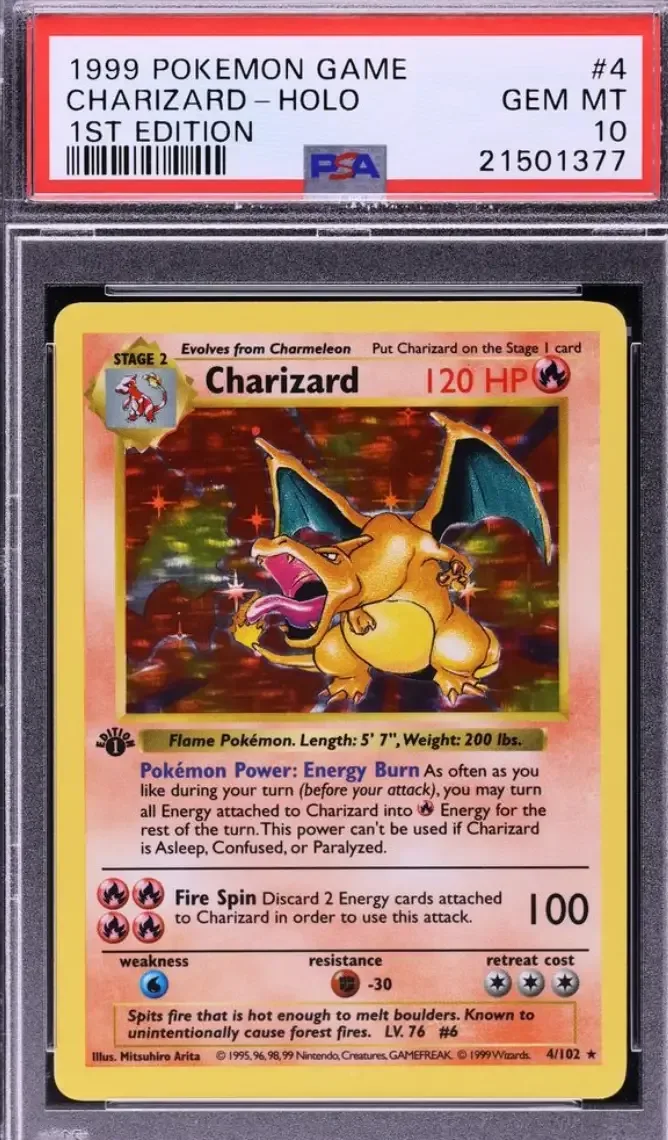
The week’s top result came from a 1999 Pokémon Base Set First Edition Shadowless Holo Charizard #4 graded PSA 10. Sold through Fanatics Premier on November 20, it fetched $990,000 and represented more than one-third of the five-card total by itself.
Its label contains several value-defining details. First Edition refers to the version carrying the first-edition stamp. Shadowless identifies an early design variant from the English Base Set, visually distinguished from later unlimited-printing versions by the absence of the drop-shadow effect around the Pokémon image frame. And holo means the card has holographic foil in its artwork area.
Then there is the grade. PSA 10 is the highest grade on the PSA scale and signals a card judged to be Gem Mint under that company’s standards. The grade does not transform a card into a universal substitute for every Charizard, but it is central to understanding this specific result. A first-edition stamp, Shadowless layout and top numerical grade all sit together on the same copy.
The timing offers a useful within-character comparison. Twelve days earlier, a non-first-edition Shadowless Charizard in PSA 10 sold for $264,000 through Fanatics Weekly. Both cards were highly desirable Shadowless PSA 10 Charizards, yet the first-edition example brought roughly 3.75 times as much. That difference is a reminder that collectors should compare exact configurations rather than rely on a broad “PSA 10 Charizard” search.
2. Presentation Blastoise sets a new character record
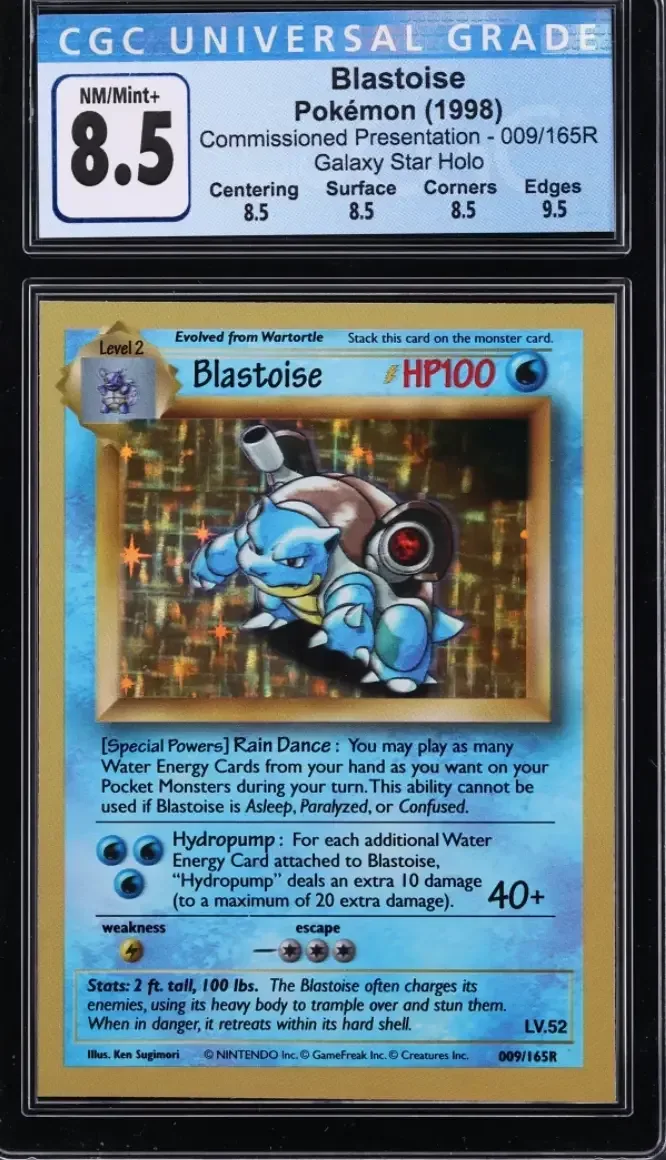
A 1998 Pokémon Commissioned Presentation Galaxy Holo Blastoise #009 graded CGC 8.5 sold for $630,000 through Fanatics Premier on November 20. The transaction established a new record for Blastoise.
Related coverage includes $990,000 First Edition Charizard Leads $2.69 Million Week for TCG Sales.
This is arguably the week’s clearest case for looking beyond a numerical grade alone. CGC 8.5 is below a Gem Mint designation, yet the card was the second-largest TCG transaction in the ranking. Its appeal rests in what it represents: a presentation piece connected to Pokémon’s early work introducing the trading card game to the English-language market. It was created for promotional and business use rather than distributed in ordinary booster packs.
That distinction matters. Cards from a conventional set are often assessed through their release, rarity, condition and collector demand. A presentation card adds a different layer: its role in the product’s history and a distribution path that was not built around normal retail pack opening. The $630,000 result does not mean an 8.5 is inherently more valuable than a 10; it illustrates that card type and historical context can be just as consequential as the grade number.
For collectors reviewing sales, “presentation” should not be treated as a decorative term. It describes why this Blastoise belongs in a separate comparison pool from pack-issued cards, even if those cards feature the same Pokémon. The correct question is not simply whether another Blastoise sold for less or more, but whether it was the same kind of item with comparable distribution and grading context.
3. Alpha Black Lotus brings Magic into a Pokémon-heavy week
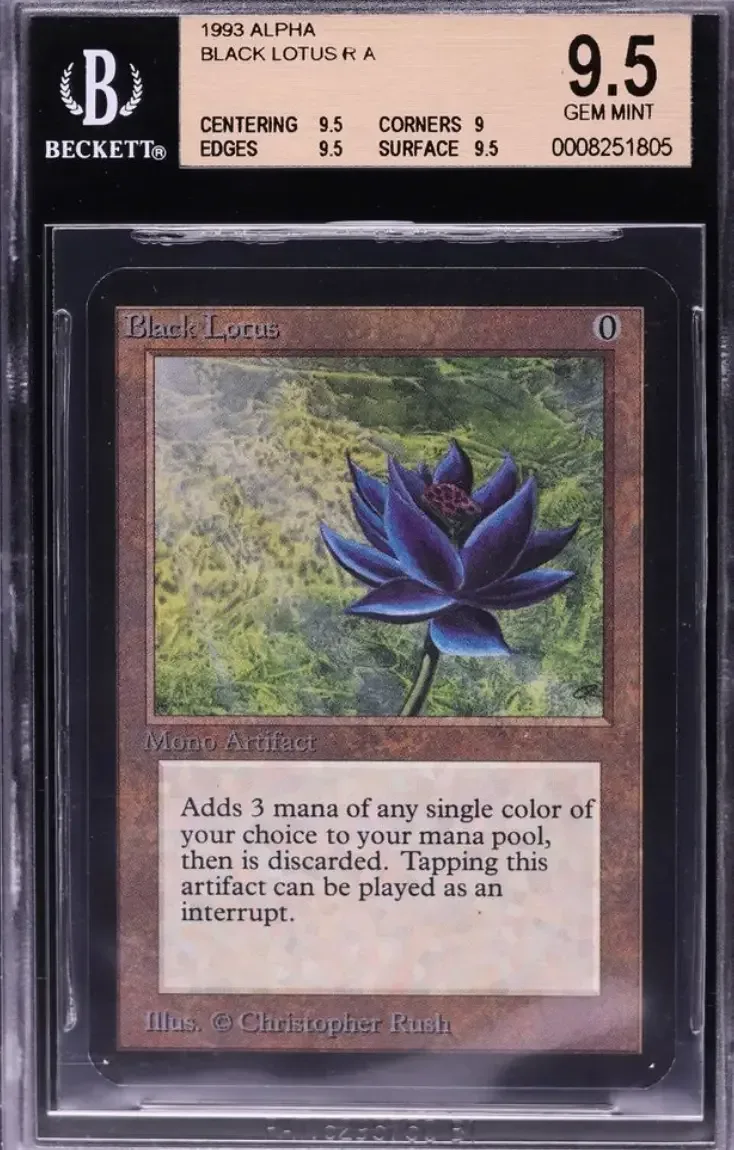
The leading non-Pokémon sale was a 1993 Magic: The Gathering Alpha Black Lotus in BGS 9.5, sold through Fanatics Premier on November 20 for $384,000.
Black Lotus is one of the hobby’s defining cards because it belongs to Magic’s original Alpha release, had limited early production and is famous for its powerful in-game ability. In a weekly list otherwise dominated by Pokémon, it is a meaningful reminder that the high-end TCG market is broader than one franchise.
BGS 9.5 is a grade assigned by Beckett Grading Services. Grading-company scales should not be casually equated label for label: PSA 10, BGS 10 Pristine, BGS 9.5 and CGC 8.5 are different evaluations from different companies, with their own terminology. The central takeaway is not that a 9.5 “beats” an 8.5 in every context, but that this Black Lotus married an elite grade with a formative card from another foundational TCG.
Its place at No. 3 breaks a recent pattern in which Pokémon accounted for nearly all leading TCG sales. That diversification also happened while sports cards produced some even larger individual transactions across the wider card market. A one-of-one Stephen Curry Topps Chrome Update Superfractor autograph sold for more than $1.23 million, placing the TCG activity within a competitive overall trading-card week. Readers interested in how relative pricing works in another segment can also see how baseball-card values are often assessed against peers.
4. Pristine Gold Star Pikachu sells for $372,000
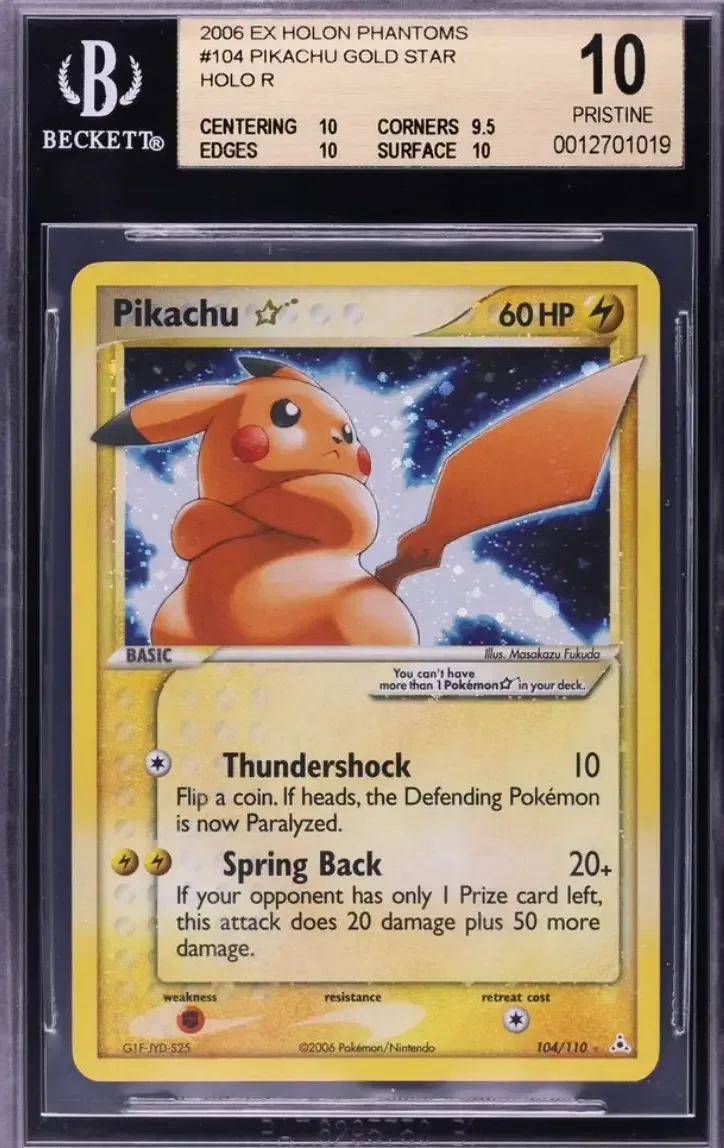
At No. 4, a 2006 Pokémon EX Holon Phantoms Gold Star Pikachu #104 graded BGS 10 Pristine sold for $372,000 through Fanatics Premier on November 20.
The Gold Star designation is immediately recognizable to Pokémon collectors, and this example features Pikachu in shiny coloration. Gold Star cards remain especially sought after from the EX era, with exceptional condition carrying particular weight. Here, the BGS 10 Pristine grade supplies that condition component at the highest stated level in the listing.
Pikachu had appeared in the previous week’s leading sales as well, when a Legendary Collection reverse-holo example sold for $264,000. The two sales demonstrate the enormous range concealed by a character name. They are not duplicates competing in a simple head-to-head: one is an EX Holon Phantoms Gold Star with a BGS 10 Pristine grade, while the other was a Legendary Collection reverse holo. Set, card treatment and grade all differ.
For anyone cataloguing a collection, this is a practical reason to record the full identity of a card: year, set, card number, language, foil or parallel treatment, edition markers and grading label. “Gold Star Pikachu” is much more useful than “Pikachu,” but the complete listing is what makes a sales comparison meaningful.
5. Japanese Masaki Promo Gengar reaches $316,564.80
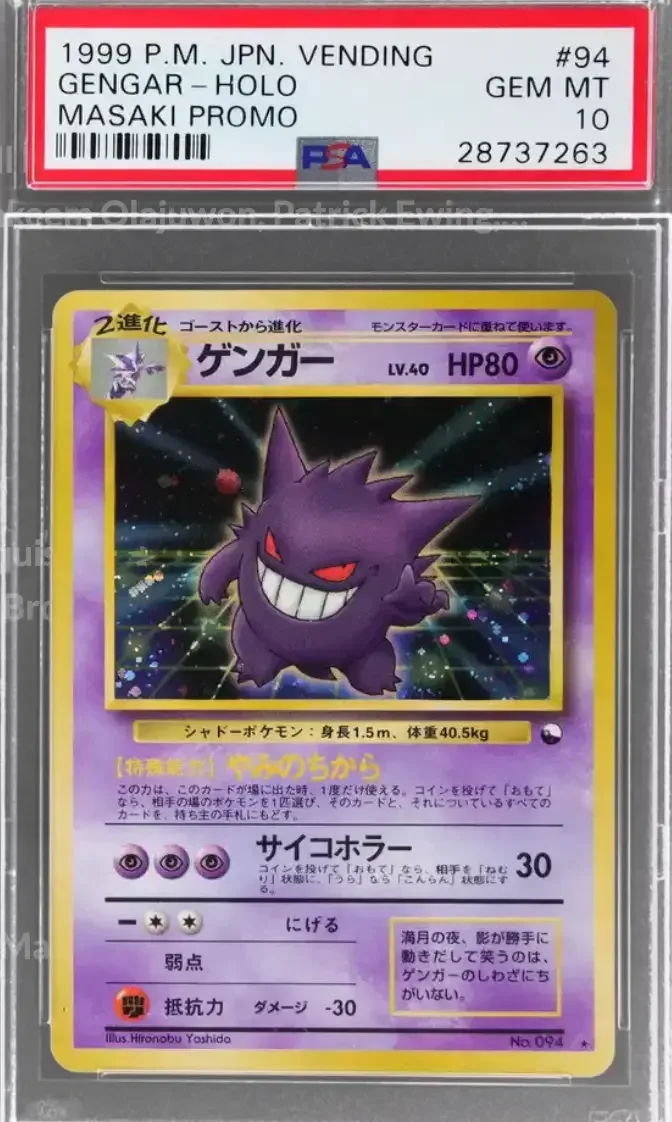
The fifth-largest transaction was a 1999 Pokémon Japanese Vending Masaki Promo Holo Gengar #094 in PSA 10, which sold for $316,564.80 through ALT on November 19.
The Masaki Gengar originated in a Japanese mail-in promotion. Collectors had to submit specified Pokémon cards in order to receive special holographic versions. That redemption-based distribution is a major part of the card’s identity, separating it from a regular retail release and helping explain why it is a recognizable Japanese promotional piece among serious collectors.
The Gengar was also the only top-five entry not sold through Fanatics Premier; the remaining four were. Auction venue can be useful sale-record context, but it should not be mistaken for an intrinsic card feature. The more durable identifiers remain the exact card, the grade, its language and the particular distribution story behind it.
What the $2.69 million total does—and does not—say
The five reported transactions were, in descending order, $990,000 for Charizard, $630,000 for Blastoise, $384,000 for Black Lotus, $372,000 for Pikachu and $316,564.80 for Gengar. Together, they show collectors willing to spend heavily on several forms of scarcity: early-edition status, unusual promotional distribution, high grades, historic releases and franchise-defining cards.
They do not establish a blanket value for Base Set Charizards, all Blastoises, all Black Lotuses, every Gold Star card or every Japanese promo. A near-million-dollar first-edition Shadowless PSA 10 Charizard is distinct from a non-first-edition Shadowless PSA 10, as the $264,000 sale from 12 days earlier makes plain. Likewise, the presentation Blastoise’s result reflects a card made for promotional and business purposes, not the economics of a standard booster-pack pull.
The biggest practical lesson is precision. When following high-end sales, compare like with like; identify the grading company and grade; note language and edition; and distinguish retail cards from promos and presentation pieces. The November 15–22 leaderboard was a strong week for TCGs, but its more interesting story is the variety of ways a card can become exceptional.