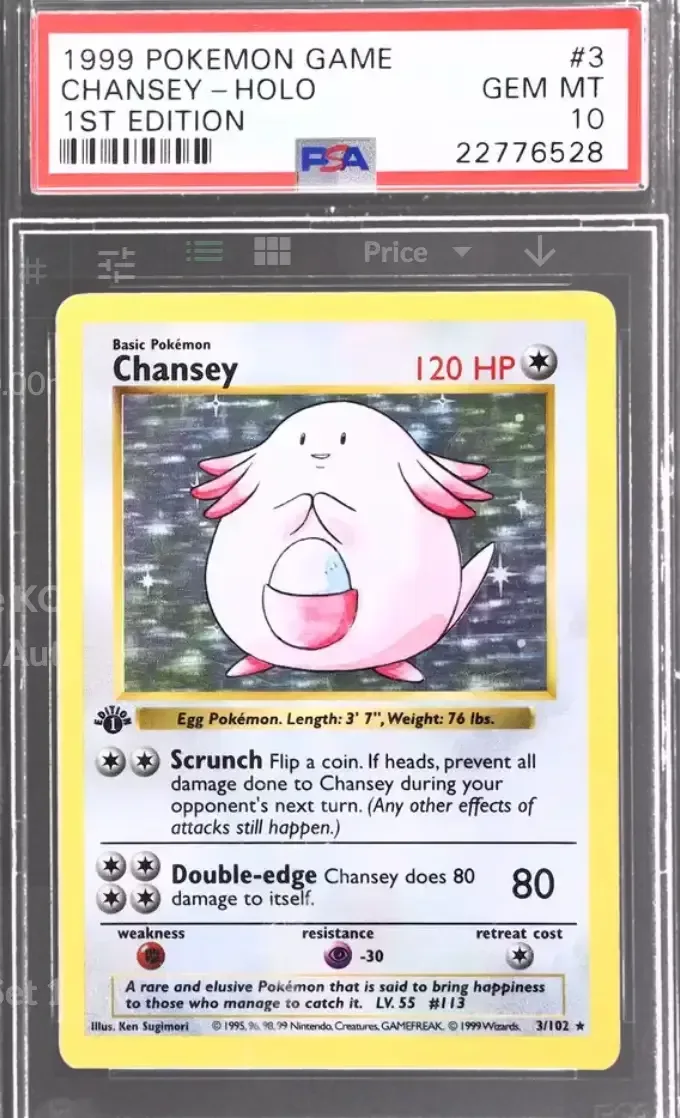
Chansey took the unlikely top spot in a week where Pokémon cards filled five of the six largest transactions across the wider trading-card hobby. A 1999 Pokémon Base Set 1st Edition Holo Chansey #3 in PSA 10 sold for $276,001 on November 12, finishing ahead of equally priced $264,000 sales for a Shadowless Charizard and a Legendary Collection reverse-holo Pikachu.
That result is notable precisely because Chansey is not usually the mascot-level name collectors expect to see leading a six-figure Pokémon leaderboard. Yet the sale is a useful reminder that the high end of the hobby is not a simple popularity contest. Edition, condition, print treatment, card type and the route by which a card was originally distributed can all matter enormously.
The five leading Pokémon transactions from November 7 through 14 totaled $1,236,001. That was below the prior week’s $2.28 million total, but Pokémon’s share of the very top of the market remained striking. The only non-Pokémon card among the six largest hobby sales was a 2008-09 Upper Deck Exquisite Kobe Bryant Limited Logos Patch Autograph numbered to 24, which sold for a little more than $305,000 on eBay.
The week’s five biggest Pokémon sales
- 1999 Base Set 1st Edition Holo Chansey #3, PSA 10 — $276,001. Sold through ALT on November 12; the transaction was confirmed paid.
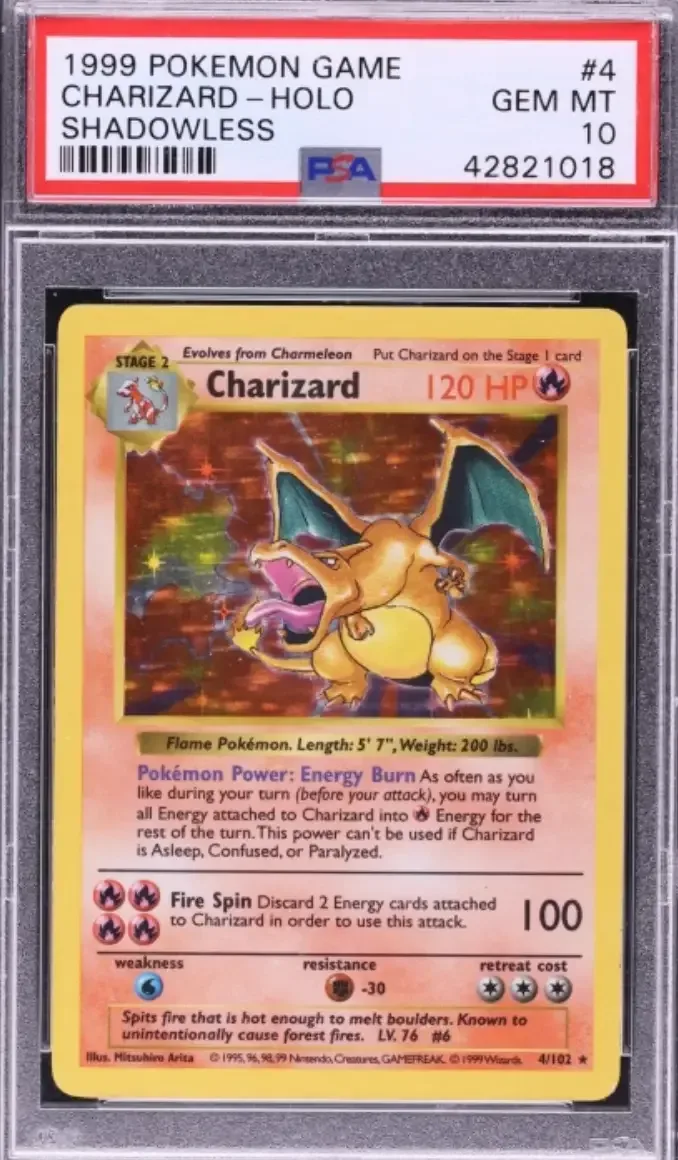
- 1999 Base Set Shadowless Holo Charizard #4, PSA 10 — $264,000. Sold through Fanatics Weekly on November 8.
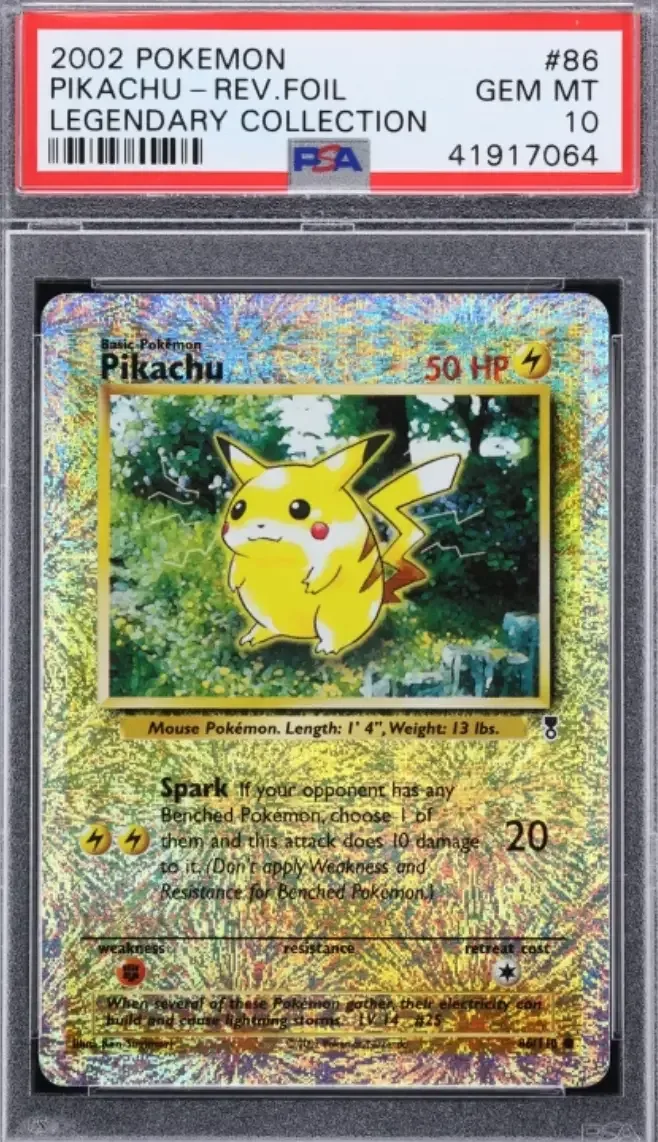
- 2002 Legendary Collection Reverse Holo Pikachu #86, PSA 10 — $264,000. Sold through Fanatics Weekly on November 8.
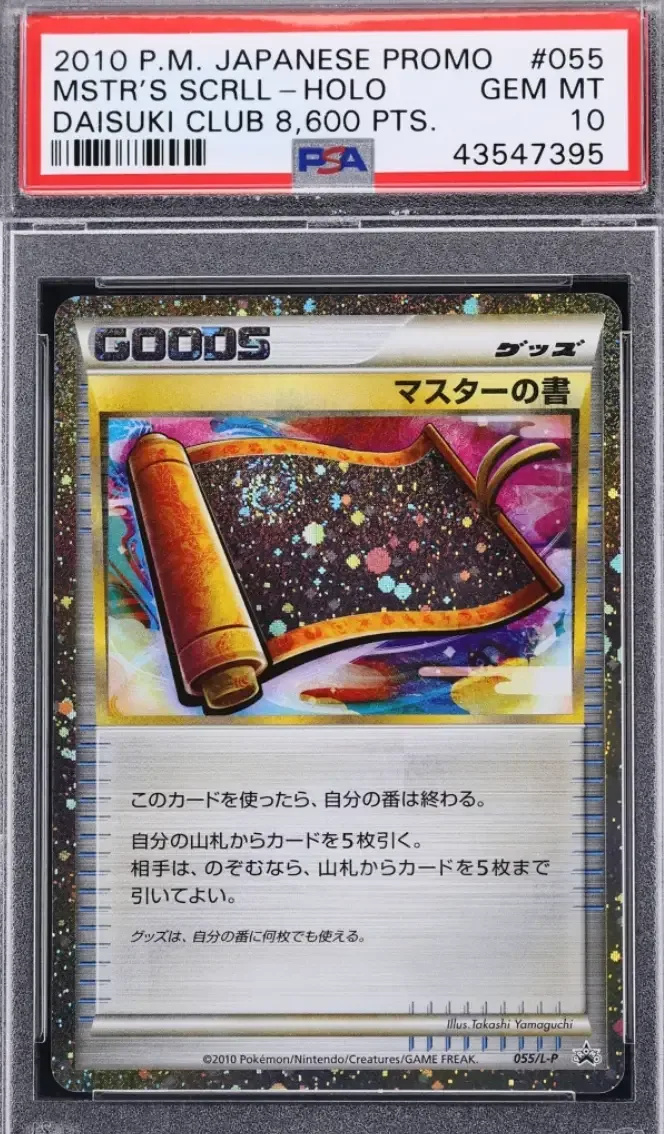
- 2010 Japanese Daisuki Club Masters Scroll #55, PSA 10 — $228,000. Sold through Fanatics Weekly on November 8.
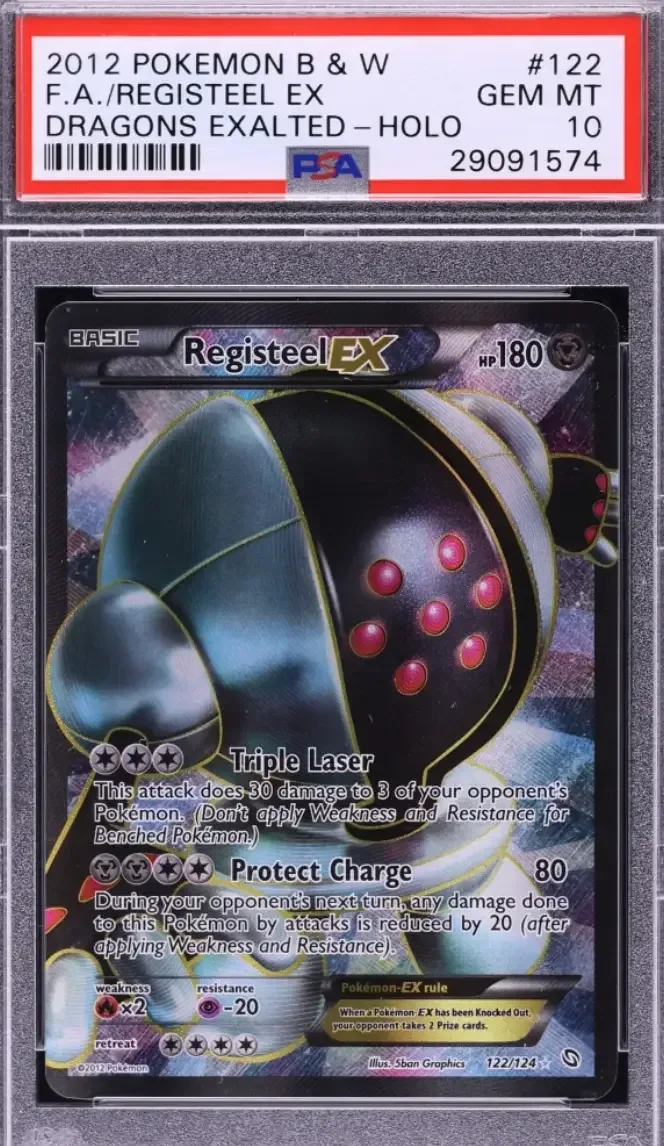
- 2012 Black & White Dragons Exalted Full Art Registeel EX #122, PSA 10 — $204,000. Sold through Fanatics Weekly on November 8.
The gap from first to second was only $12,001. More importantly, the list spans early English Base Set cards, a 2002 specialty foil, a difficult Japanese rewards promotion and a 2012 full-art card. It is a broad cross-section for a five-card sample, rather than a ranking dominated exclusively by the usual Base Set superstars.
Why Chansey finished first
Chansey’s winning card belongs to the original English Base Set and carries two of the labels collectors closely watch: First Edition and PSA 10. First Edition identifies an early version of the release, while PSA 10 is the grading company’s Gem Mint designation. The grade reflects the condition of this particular submitted card, not merely the fact that it is a First Edition Chansey.
At this level, the interaction between those attributes matters. Holographic surfaces can reveal scratches and other visual flaws, while Chansey’s light-colored design can make imperfections especially conspicuous. The result is that an example that presents at a pristine level can be a fundamentally different collecting proposition from the same card in a lower grade.
It would be too simplistic, however, to treat the price as proof that Chansey has suddenly displaced Charizard or Pikachu in general collector appeal. This was one completed transaction for one PSA 10 First Edition holo. It does show that a blue-chip early-set card does not need to feature the franchise’s most famous character to reach the top of a weekly sales chart when edition and grade align.
For collectors evaluating old Pokémon cards, this is the distinction worth keeping in view: a character’s fame can create interest, but scarcity and condition can determine how intensely buyers compete for a particular copy. The grade is meaningful, though it is not the entire story; card identity, print variation and eye appeal remain part of the equation. For a wider primer on that principle, see why the number on a card grade is not everything.
Related coverage includes Chansey Leads a Pokémon-Powered Week in the Trading Card Market With $276,001 Sale.
Charizard and Pikachu tie at $264,000
The two cards immediately behind Chansey arrived at precisely the same sale price, but they represent different ways a Pokémon collectible can command attention.
Shadowless Charizard: an early-production marker
The 1999 Base Set Shadowless Holo Charizard #4 is one of the most recognizable variations in early English Pokémon. “Shadowless” refers to the missing drop shadow around the card’s illustration box. That visual trait identifies the card as part of early English-language production and separates it from later Base Set printings with the shadow present.
First Edition Charizard is typically the most discussed version of the Base Set dragon, but a PSA 10 Shadowless holo remains a major card in its own right. The $264,000 sale demonstrates the continuing weight of the Shadowless designation, particularly when coupled with a Gem Mint grade. It also puts the week in perspective: even a Charizard with exceptional collecting credentials did not claim the number-one position.
Legendary Collection Pikachu: a distinctive foil treatment
The matching $264,000 Pikachu was a 2002 Legendary Collection Reverse Holo #86 in PSA 10. Its key attraction is its reverse-holographic finish, often nicknamed the fireworks pattern by collectors. A reverse holo is a foil treatment applied to areas of the card other than the main illustration in the conventional holo layout; in this Legendary Collection example, the patterned presentation is especially recognizable.
The sale combines Pikachu’s central place in Pokémon with a visually unusual version of an older card and the highest stated grade. In practice, that means it is not useful to compare the result directly to every Pikachu card that shares the same character name. Set, foil pattern and grade are essential identifiers. A sale headline may start with Pikachu, but the market is bidding on a specific 2002 Legendary Collection reverse holo in PSA 10.
The Masters Scroll shows why distribution matters
The 2010 Japanese Daisuki Club Masters Scroll #55 sold for $228,000 in PSA 10. Unlike a typical card obtained from a booster pack, it originated in a rewards program for members of Japan’s Pokémon Daisuki Club. Members accumulated points through activities, and the Masters Scroll required 8,600 points to obtain.
That distribution method is central to the card’s identity. Promotional cards are not all alike: some may be readily available at an event or attached to a product, while others require sustained participation in a program. The Masters Scroll belongs to the latter category, where access depended on collecting enough points rather than simply opening packs.
That does not create a universal formula for value. But it explains why collectors consider origin as well as artwork and character. A card’s acquisition path can shape how many people had a realistic opportunity to obtain it in the first place. In the Masters Scroll’s case, the 8,600-point requirement makes the program context inseparable from the card’s appeal.
The sale also underscores that high-end Pokémon collecting has a strong international and promotional dimension. A collector looking only at English booster-set cards would miss a significant part of the market’s rarest material.
Registeel brings a later-era full art into the ranking
The fifth-place card, a 2012 Black & White Dragons Exalted Full Art Registeel EX #122 in PSA 10, realized $204,000. Registeel is a Legendary Pokémon, but it is not usually placed in the same celebrity tier as Charizard or Pikachu. Its appearance on this list is therefore another argument against reducing premium Pokémon sales to character recognition alone.
The card’s full-art format is important context. Full-art cards expand the visual presentation beyond the more traditional character-in-an-illustration-box look, and this style gained increasing popularity during the Black & White era. Registeel’s result gives the week a representative from a much later period than the 1999 and 2002 cards around it.
For collectors, the practical lesson is not that every later-era full art should be viewed as a six-figure candidate. It is that later generations should not be automatically dismissed when assessing the hobby’s upper end. Scarcity and elite condition can make a substantial difference, even for a Pokémon outside the most obvious headline names.
What this compact leaderboard actually indicates
The weekly total declined meaningfully from $2.28 million to $1.236 million, so it would be wrong to frame this particular five-card total as a week-over-week increase. At the same time, Pokémon accounted for five of the six biggest card transactions across the hobby during the period. Those are separate observations: the aggregate dollar amount was lower, while Pokémon’s prominence among the largest individual sales remained unusually strong.
The leaderboard also resists one tidy explanation. Chansey’s win came from an early English First Edition holo in PSA 10. Charizard’s strength came from the Shadowless variation. Pikachu combined a beloved character with Legendary Collection’s unmistakable reverse-holo treatment. Masters Scroll was built around a Japanese points-program reward, while Registeel illustrated demand for a scarce high-grade full art from 2012.
In other words, this was not just a Charizard-and-Pikachu week with familiar names occupying the top slots. It was a week where condition, early-print indicators, specialized foil treatments, promotional distribution and later-era design all appeared in the same narrow band of $204,000 to $276,001.
That range is the headline. Chansey’s $276,001 result may be the attention-grabbing surprise, but the fuller picture is a market in which several very different forms of Pokémon rarity attracted serious money at once.