Vintage baseball cards were not born as investments. They were handled, traded, flipped against walls, carried in rubber-banded stacks and, in some cases, recruited to make bicycle wheels sound more exciting. That ordinary childhood use is a huge part of why surviving 1950s cards in strong condition now command extraordinary prices.
It also explains why a PSA 7 is a particularly useful benchmark for comparing the era’s biggest rookie cards. A PSA 10 comparison can make sense for modern cards or later issues with far more pristine survivors. With 1950s cardboard, though, a 7 represents a meaningful level of preservation without pretending that near-perfect copies are common. The resulting list is led by Mickey Mantle’s 1951 Bowman rookie at $125,800 and Willie Mays’ 1951 Bowman rookie at $80,000, based on recent PSA 7 sales.
Yet the ranking is not simply a greatest-players list, and it is not a permanent price guide. It is a snapshot of recent recorded sales for a specific grade. Set prestige, print scarcity, supply at a given grade, the player’s legacy and the visual quality of an individual card all pull value in different directions. For collectors, that is the real lesson behind the numbers: grade is important, but it is only one part of the vintage-card equation.
What PSA 7 means—and what it cannot tell you
PSA is a third-party card grader that assigns a numerical condition grade. A PSA 7 sits below high-end mint territory, but it is still a strong surviving example for cardboard that may have spent decades exposed to play, handling and imperfect storage. The population counts attached to these cards are also useful context: they show how many examples PSA has graded at a 7, how many received a higher grade, and the total PSA-graded population.
Those figures should not be mistaken for the total number of cards in existence. They reflect cards submitted to PSA, not every copy still tucked away in collections. Even so, they provide one concrete way to assess how difficult it may be to find a particular card in a desired condition.
More importantly, the label does not fully describe what a card looks like. Eye appeal is collector shorthand for the visual impression of a particular copy: centering, color, print quality, clarity, surface presentation and how distracting its wear is at a glance. Two cards can share a PSA grade and look dramatically different. A beautifully centered lower-grade card may appeal more than a higher-grade example with poor centering or an unattractive presentation.
That creates a practical distinction between buying a card as a registry-grade target and buying one to enjoy in a collection. A grade is a standardized assessment; eye appeal is the individual copy’s aesthetic case. Some sellers have begun including separate eye-appeal evaluations in listings, an indication that the market is paying closer attention to that difference.
Tier 1: Mantle and Mays at the summit
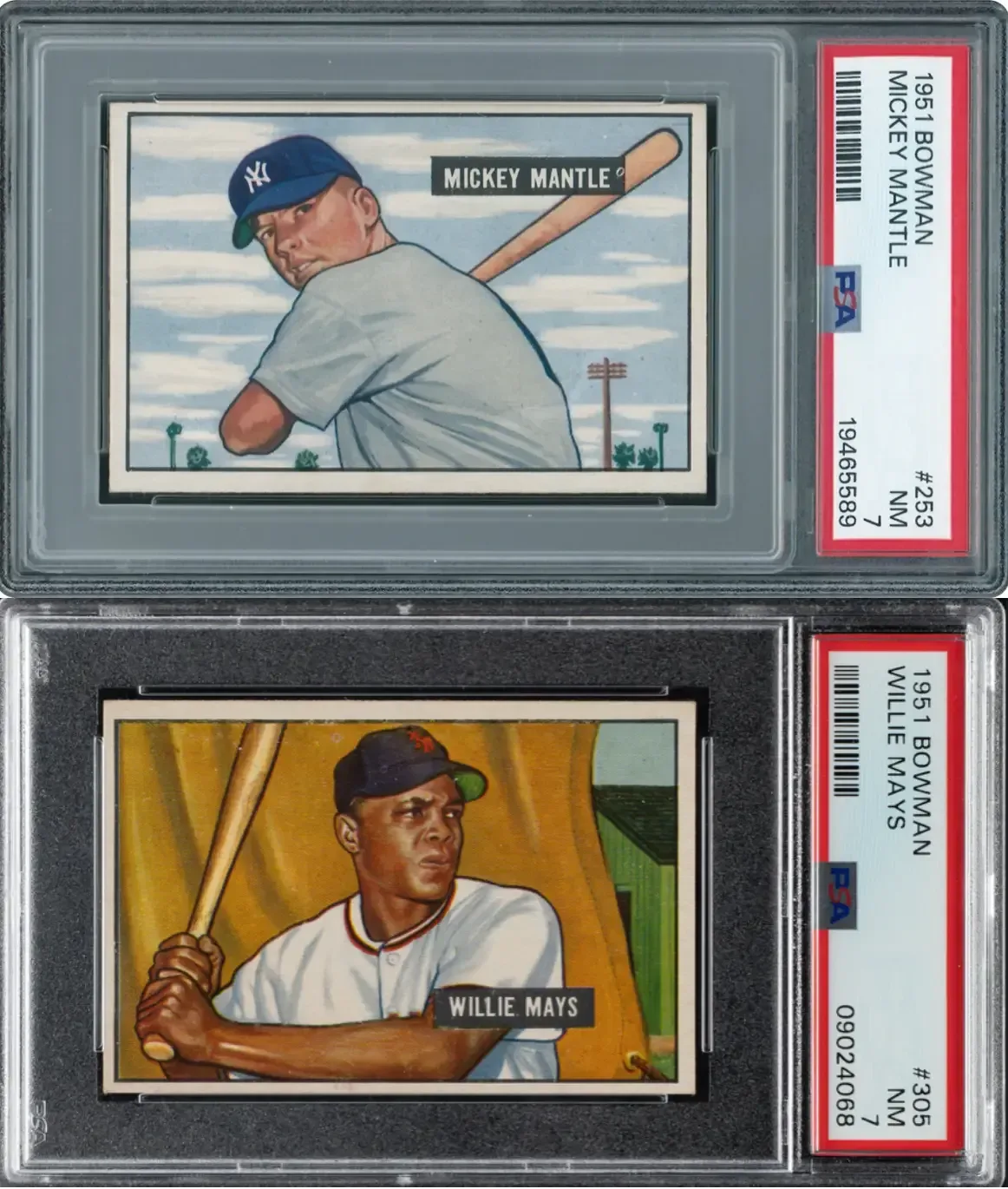
- 1951 Bowman Mickey Mantle #253 — $125,800
115 PSA 7s; 93 graded higher; 2,988 total graded. - 1951 Bowman Willie Mays #305 — $80,000
123 PSA 7s; 92 graded higher; 2,618 total graded.
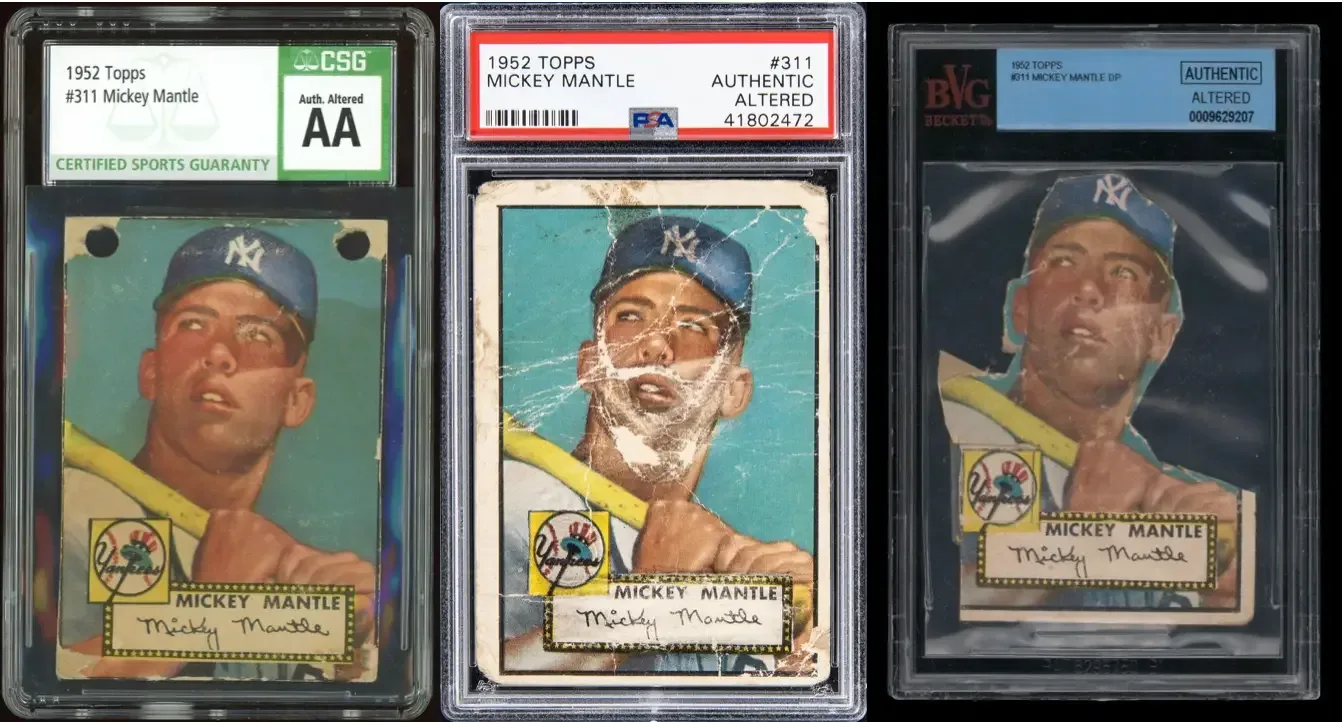
Mantle’s 1951 Bowman is his only true rookie card, even though the 1952 Topps Mantle is the image that dominates the hobby’s mythology. That distinction matters. A PSA 7 1952 Topps Mantle recently sold for $716,800, a massive gap from the $125,800 recent result for the 1951 Bowman rookie. The contrast shows how set identity can become as commercially powerful as rookie-card status.
Related coverage includes The Most Valuable 1950s Baseball Rookie Cards in PSA 7.
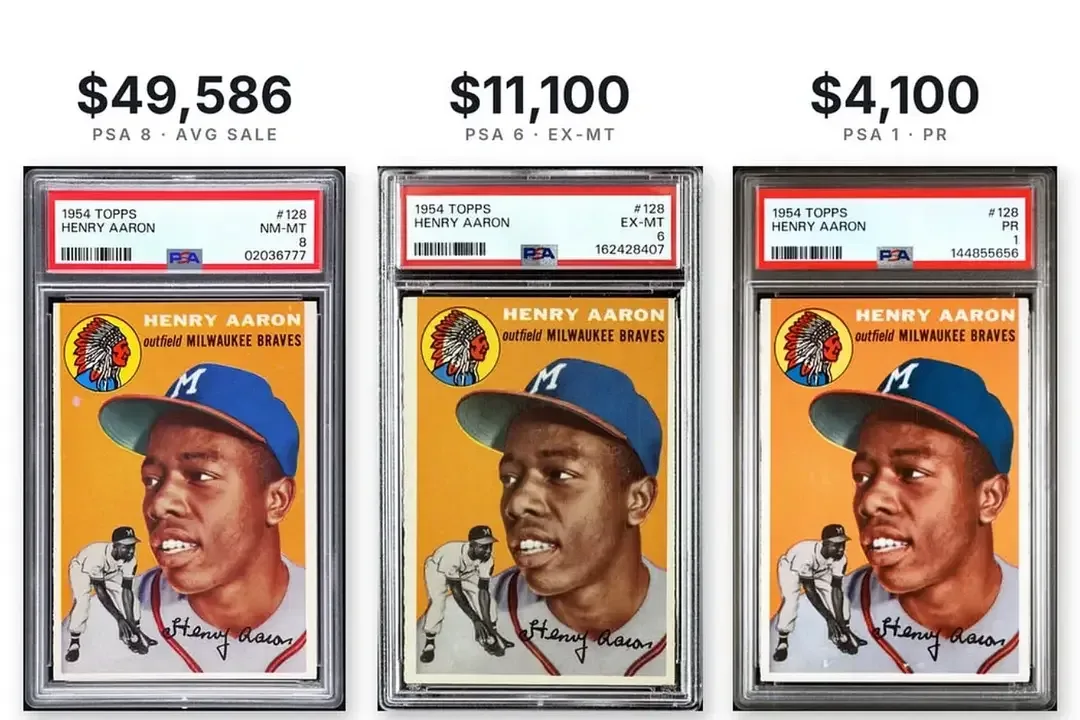
Condition does not make Mantle accessible at the bottom of the scale, either. A PSA 1 1951 Bowman Mantle sold for $17,000 in October, compared with a sub-$3,000 level noted in 2018. Mays’ 1951 Bowman rookie has moved sharply as well: a PSA 7 that could be found around $10,000 in 2019 has reached $80,000 in this comparison.
These are the era’s true grails, but the price disparity between Mantle’s rookie and his famed 1952 Topps card is a reminder that collectors are often buying a story alongside the player. The 1952 card is not Mantle’s rookie, but its cultural status is exceptional.
Tier 2: Scarcity lets Eddie Mathews outrun bigger names
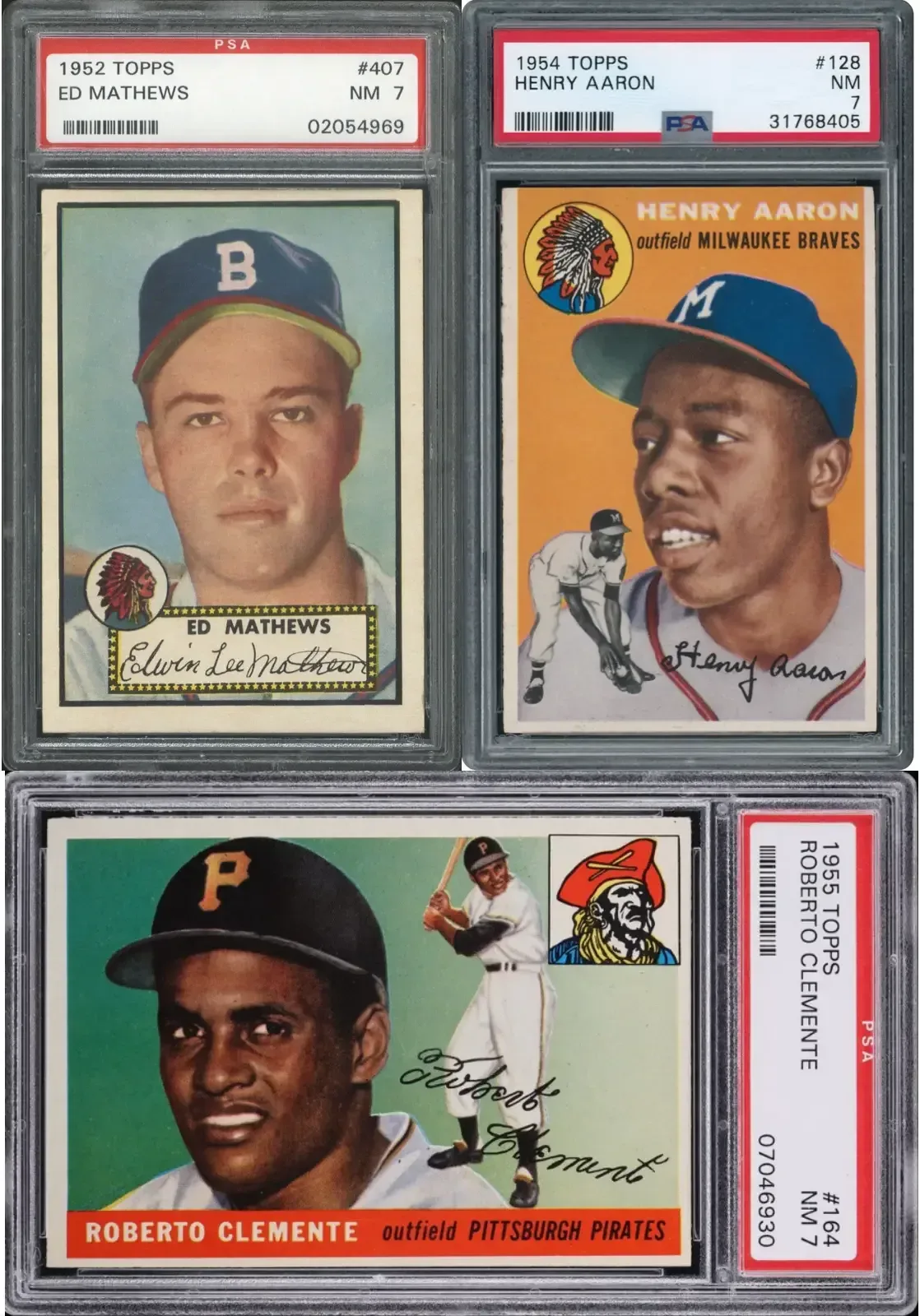
- 1952 Topps Eddie Mathews #407 — $34,800
29 PSA 7s; 19 graded higher; 1,038 total graded. - 1954 Topps Hank Aaron #128 — $25,500
400 PSA 7s; 258 graded higher; 8,331 total graded. - 1955 Topps Roberto Clemente #164 — $24,000
349 PSA 7s; 164 graded higher; 7,958 total graded.
At first glance, Eddie Mathews finishing above Hank Aaron and Roberto Clemente may look counterintuitive. The explanation is not a verdict on their baseball legacies. Mathews’ card comes from the scarce high-number portion of the 1952 Topps set, giving it a substantial supply advantage in this contest of price.
High-number series refers to the cards later in a set’s numerical run. In the case of 1952 Topps, the high numbers have become especially prized and difficult to find, which elevates cards of players who otherwise might sit lower on a pure popularity ranking. Mathews has only 29 PSA 7s in the stated population data, versus 400 for Aaron and 349 for Clemente.
Aaron and Clemente nevertheless carry immense recognition. Both were recently placed in the top 10 of a Topps ranking of 75 iconic Topps baseball cards, with Aaron third and Clemente eighth. Their respective rookie cards remain premier pieces; Mathews is simply an unusually clear example of how set scarcity can put a card ahead of even more broadly celebrated players.
Tier 3: The premium names beyond the very top
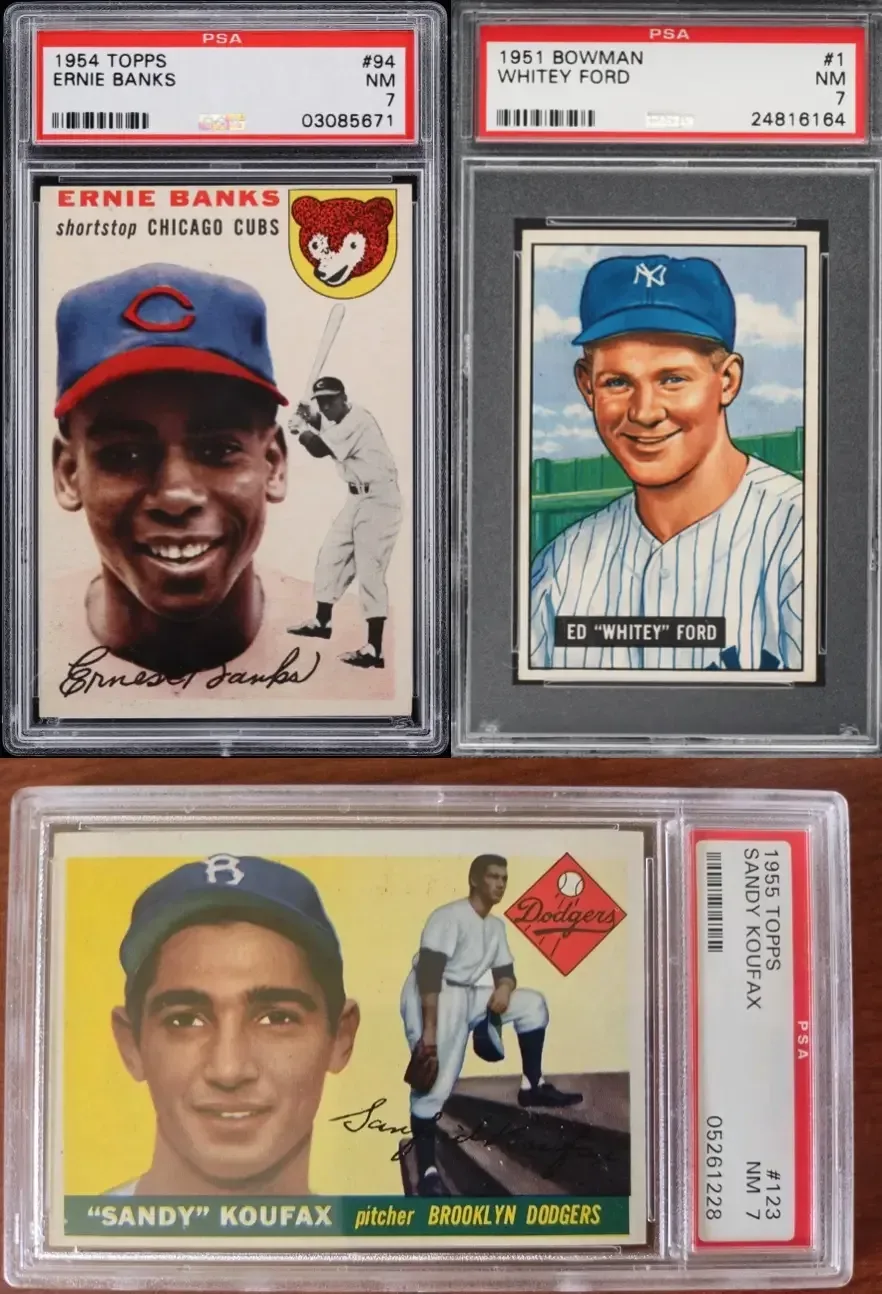
- 1954 Topps Ernie Banks #94 — $11,000
289 PSA 7s; 283 graded higher; approximately 4,202 total graded. - 1955 Topps Sandy Koufax #123 — $10,500
910 PSA 7s; 325 graded higher; 12,922 total graded. - 1951 Bowman Whitey Ford #1 — $5,700
101 PSA 7s; 62 graded higher; 2,290 total graded.
Sandy Koufax is the highest-priced card in this tier by player-demand momentum, with a recent rise visible even among heavily worn examples. PSA 1 copies of his 1955 Topps rookie were available for less than $400 one year earlier, while many recent PSA 1 sales have exceeded $1,100. That does not make every copy interchangeable, but it demonstrates how demand can lift the whole grade range for a defining player.
Ernie Banks and Whitey Ford show another enduring rule of vintage collecting: intense team followings matter. Banks is closely tied to Cubs history, while Ford carries enormous Yankees significance. Their rookie cards have different supply profiles and price points, but both possess the kind of player-and-franchise identity that keeps collectors engaged beyond a card’s formal grade.
For someone studying a card before purchase, this tier makes a strong case for looking beyond the latest sale headline. Koufax has 910 PSA 7s reported, far more than Ford’s 101, yet their prices are not separated by scarcity alone. Player demand, collector base and the card’s visual reputation remain part of the calculation.
Tier 4: Big baseball histories, four-figure PSA 7s
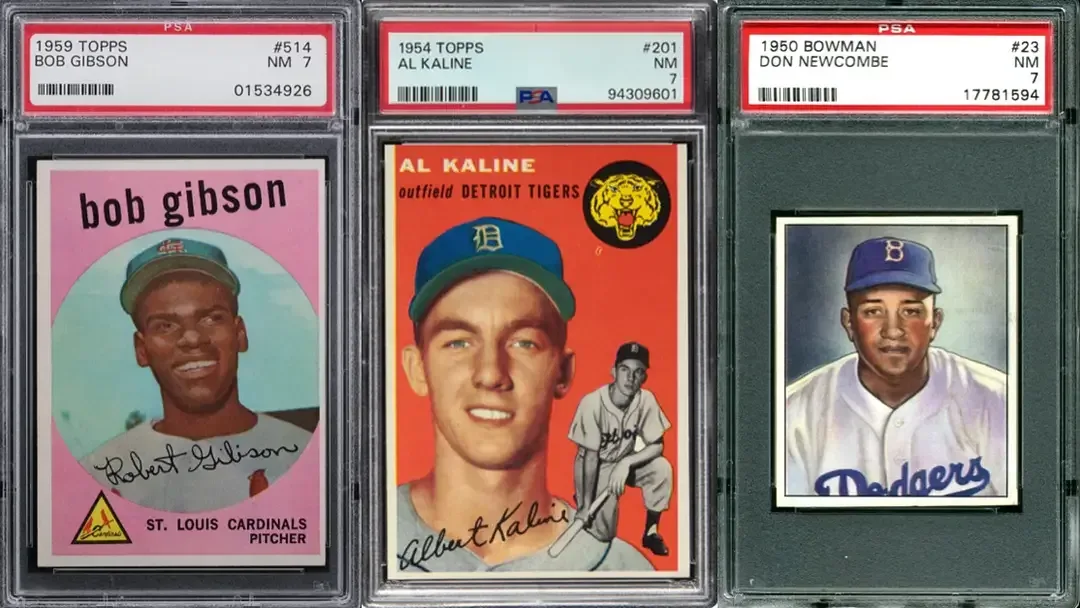
- 1959 Topps Bob Gibson #514 — $4,500
760 PSA 7s; 507 graded higher; 7,555 total graded. - 1954 Topps Al Kaline #201 — $4,148
350 PSA 7s; 252 graded higher; 5,306 total graded. - 1950 Bowman Don Newcombe #23 — $2,222
55 PSA 7s; 35 graded higher; 598 total graded.
Bob Gibson’s rookie has one of the more memorable visual mismatches in the hobby. The pitcher associated with an intimidating mound presence appears smiling against a pink background on his 1959 Topps rookie. The card remains a major market favorite, and its PSA 7 price has more than doubled from a level available less than a year earlier.
Al Kaline’s 1954 Topps rookie is another card where top condition is extraordinarily difficult. Only one PSA 10 exists in the cited population information. That does not automatically make every lower-grade copy a bargain, but it gives collectors an important sense of the condition ceiling: perfection is effectively unavailable for almost everyone.
Don Newcombe’s 1950 Bowman rookie connects the cardboard to a singular on-field achievement. He was the first pitcher to win Rookie of the Year, MVP and Cy Young awards; Justin Verlander became the second in 2011. Newcombe also has the smallest total PSA population among the three listed here, at 598. It is a useful reminder that a card can combine historical importance and relative scarcity without matching the prices of the hobby’s most famous superstar rookies.
Tier 5: Four cards that complicate the word “affordable”
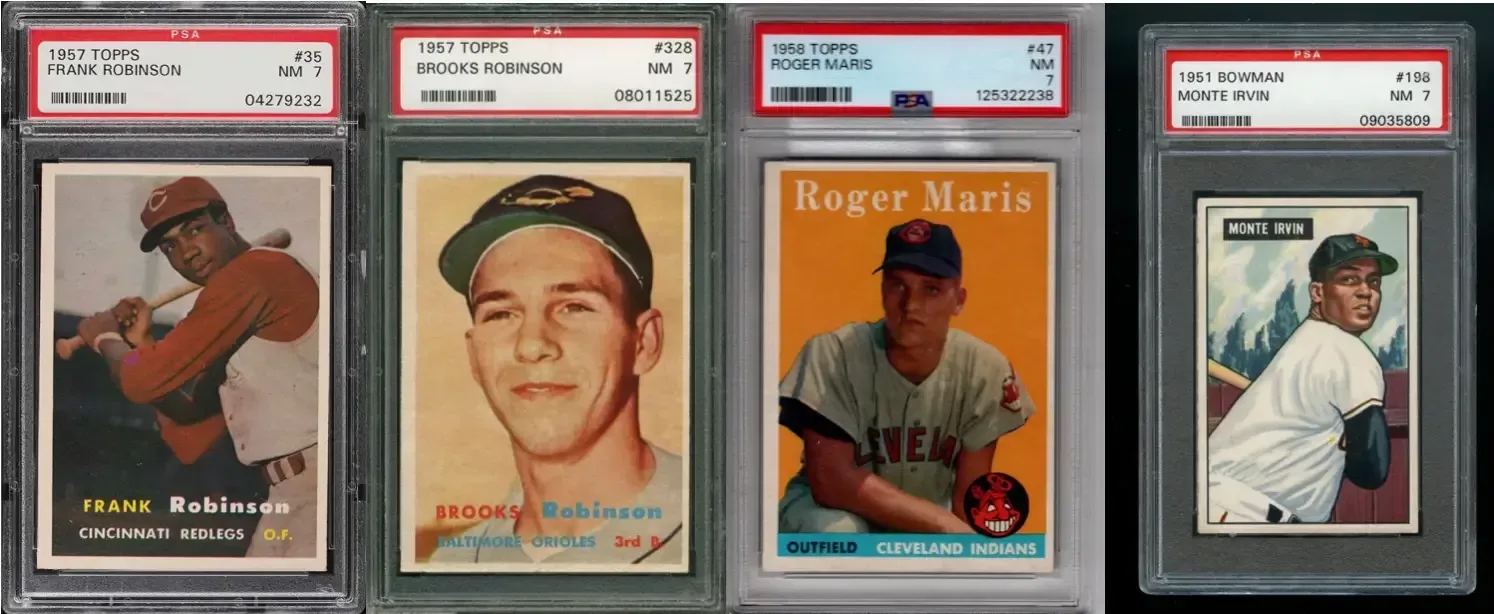
- 1957 Topps Frank Robinson #35 — $1,800
744 PSA 7s; 407 graded higher; 7,741 total graded. - 1957 Topps Brooks Robinson #328 — $1,800
683 PSA 7s; 426 graded higher; 5,481 total graded. - 1958 Topps Roger Maris #47 — $1,325
756 PSA 7s; 536 graded higher; 7,727 total graded. - 1951 Bowman Monte Irvin #198 — $999
106 PSA 7s; 68 graded higher; 1,169 total graded.
“Under the radar” is relative when the grade benchmark still carries prices from $999 to $1,800. Within the universe of 1950s Hall of Fame-caliber rookie cards, however, these four represent a substantially lower entry point than Mantle, Mays, Aaron or Clemente.
Frank Robinson’s card identifies the club as the Cincinnati Redlegs, the franchise name adopted in 1953 amid Red Scare-era concerns about communist associations. Despite more than 6,600 graded examples cited for the card, there is no PSA 10. Brooks Robinson shares the same $1,800 PSA 7 valuation, and the two later became Orioles teammates who helped Baltimore win World Series championships in 1966 and 1970.
Roger Maris appears as a Cleveland Indian on his 1958 Topps rookie, despite being traded to the Kansas City Athletics midway through that season. Monte Irvin’s 1951 Bowman is priced lowest in the tier, even with his major place in baseball history. He joined the New York Giants at 30 after starring with the Newark Eagles in the Negro Leagues and had been considered by Branch Rickey as a potential player to break baseball’s color barrier before Jackie Robinson.
These cards demonstrate that “more affordable” should not be confused with “less meaningful.” It often reflects a mixture of collector demand, population and the era’s hierarchy of household-name recognition.
The 1952 Topps effect: set collecting can reshape player-card value
The 1952 Topps set has an influence large enough to deserve its own category. Across 407 cards, roughly 125 are considered rookies, and at least 45 rookies from the set have recorded PSA 7 sales above $1,000. Many are players whose rookie cards would probably sell for much less if they appeared in a different set.
That is the power of set collecting: the buyer is not only pursuing a player, but participating in the chase for a landmark issue. The scarce high numbers intensify that effect. The result is that the identity of the set can place a durable premium on cards of otherwise ordinary players.
The historical contrast is enormous. A period F.W. Woolworth display reportedly held about 4,800 packs at five cents apiece, or roughly $240 for the display. Individual unopened 1952 Topps packs can now sell for more than $100,000. That theoretical comparison is not a practical valuation of an intact display; it is a vivid illustration of how dramatically this set’s reputation has grown.
A practical way to use the rankings
Recent PSA 7 prices are useful as a starting point, not a substitute for examining the exact card being sold. Before committing to a vintage rookie, compare the centering and color to other examples with the same grade, check for visual distractions, and distinguish the seller’s ask from actual completed-sale information. Population figures can frame scarcity, but they do not tell you whether the available copy is attractive.
Collectors should also be clear about their own goal. A person building a condition-focused registry may chase the number on the label. A fan of a player or set may find more satisfaction in an eye-appealing lower-grade example. And anyone entering a live-break or modern-card market should remember that vintage-card logic differs substantially from chasing a freshly pulled hit; today’s card-break landscape revolves around a very different supply environment.
The best 1950s rookies remain valuable because they preserve baseball history in a form that was never designed to survive untouched. Their price tiers reveal the familiar icons, but the deeper collector lesson is in the exceptions: a scarce Eddie Mathews can exceed Aaron and Clemente, a PSA 1 Mantle can still be a major purchase, and a handsome low-grade card may be more compelling than a technically higher-graded one. Vintage collecting is a numbers game—but it is never only a numbers game.