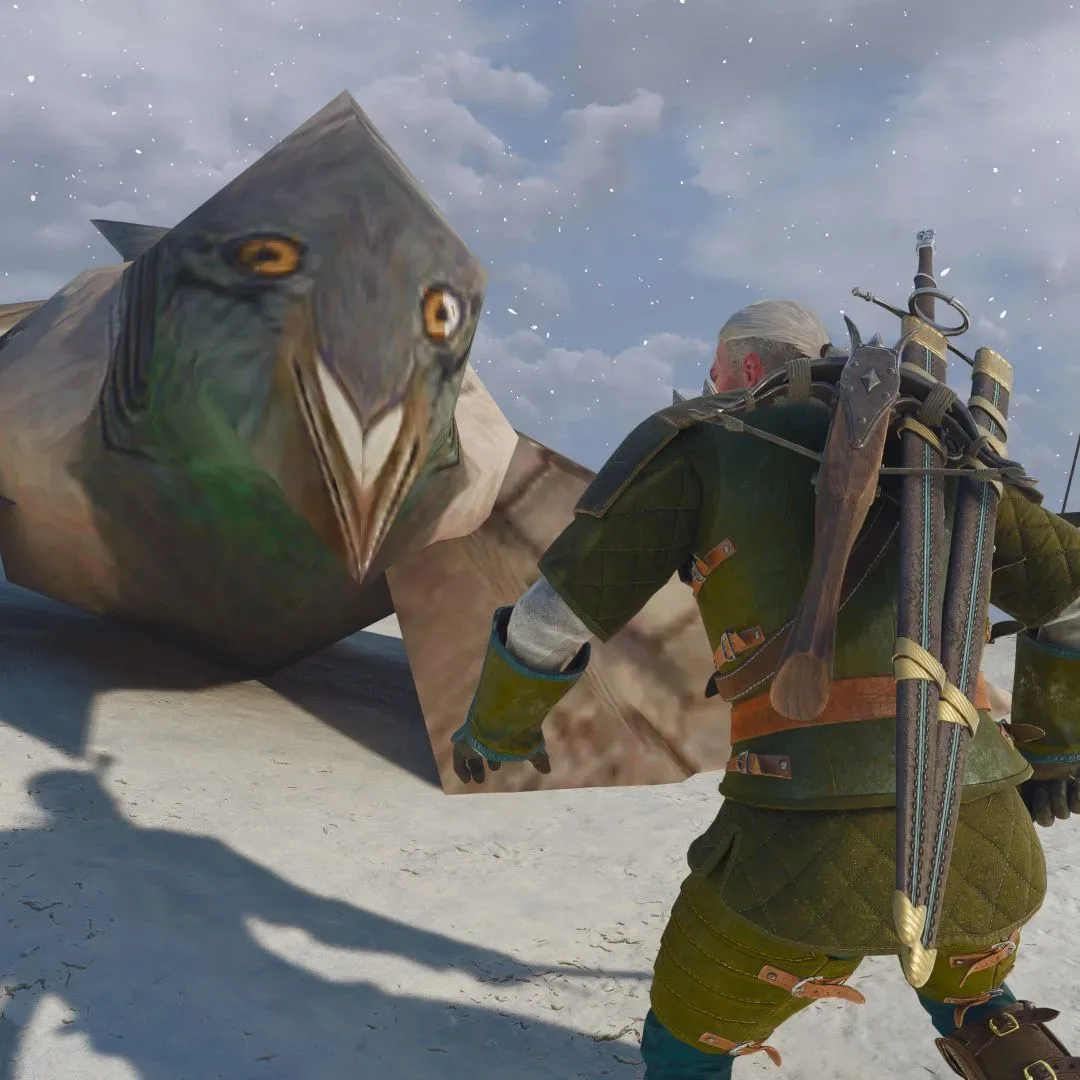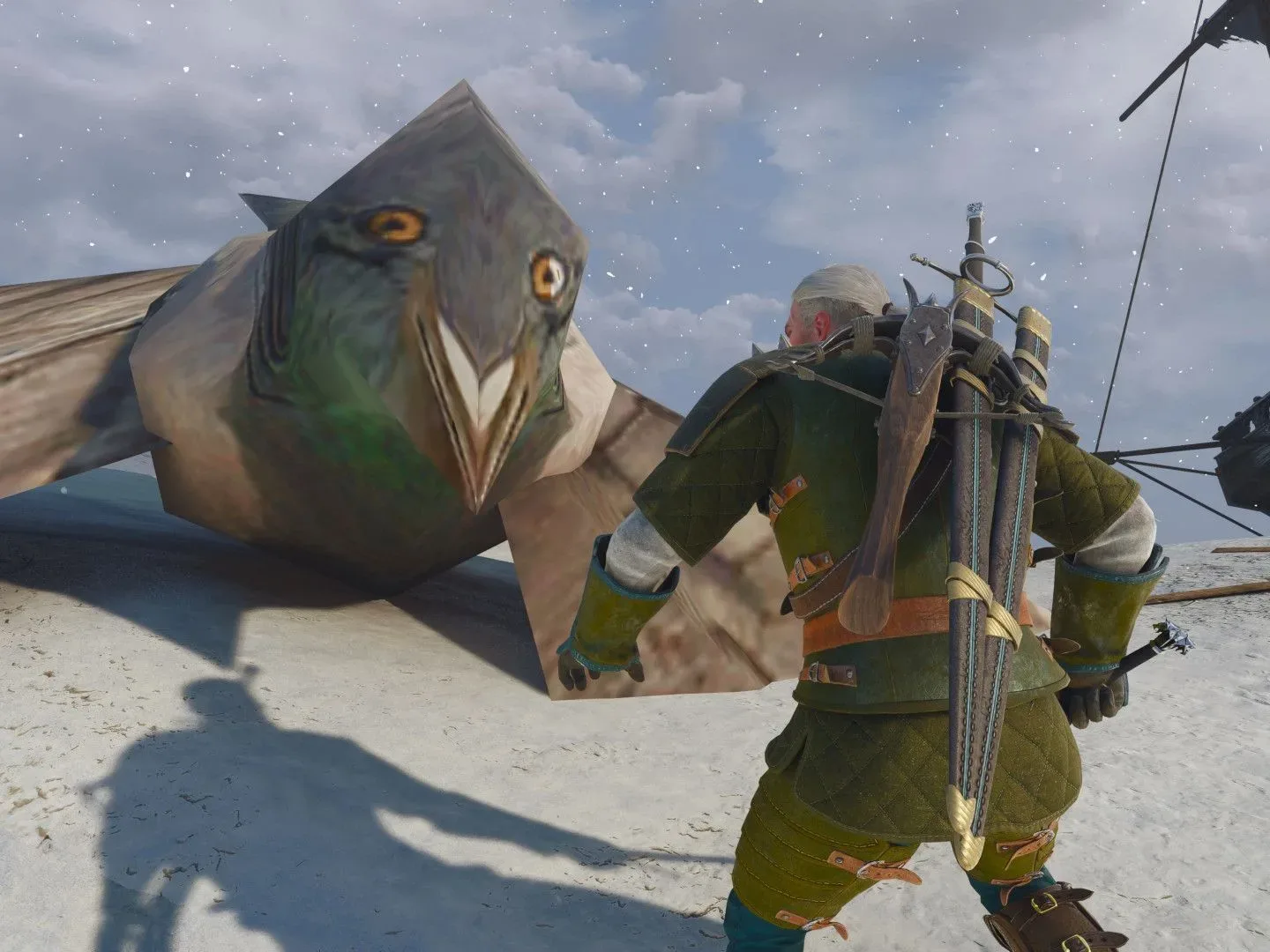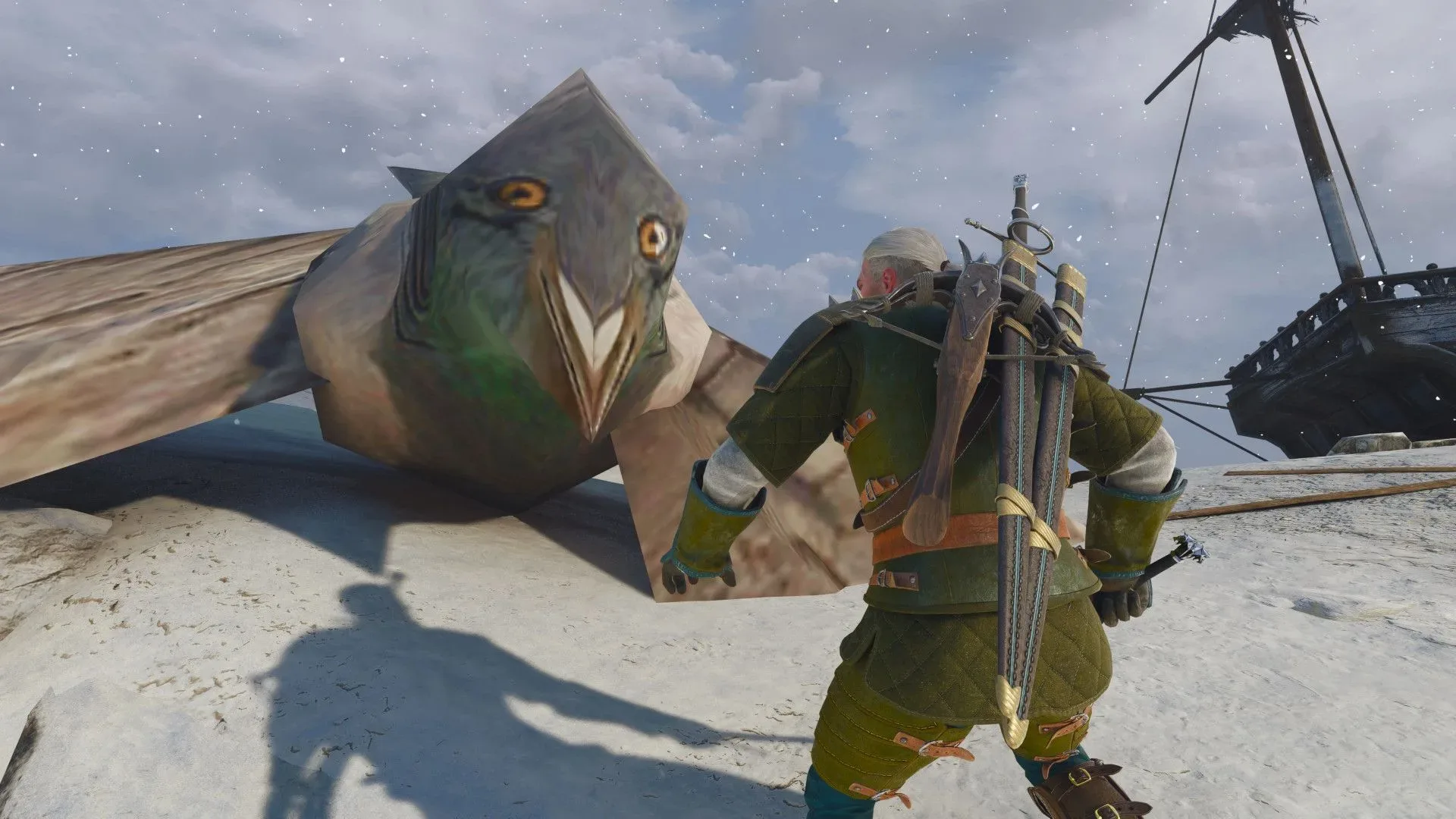
The Northern Realms have a new aerial menace, and it is significantly more rectangular than anyone remembers.
The Witcher 3: Wild Hunt has long contained one strangely low-detail pigeon amid its otherwise lavish fantasy scenery. Its angular, blocky model became a cherished community joke precisely because it looks so out of place next to the game’s polished characters, landscapes and monsters. Rather than correcting the odd bird, the game’s substantial upgraded version left it intact. Now a mod has given that pigeon an army—and claws.
Low-Poly Pigeon - The Revenge, created by grapedia, replaces every Griffin in Geralt of Rivia’s adventure with versions of the famous pigeon. The change is not merely cosmetic: the mod description says the Griffin audio has been replaced with pigeon cooing as well. That means a creature normally framed as an intimidating airborne predator will announce itself with the calm, everyday sound of a city bird before attempting to kill Geralt.
“Every Griffin encounter, every hunt and every supposedly terrifying aerial attack is now carried out by the same bird you once laughed at,” the mod description says.
A joke model becomes a full monster replacement
A model replacement mod changes the visual asset assigned to something in a game—in this case, the visual identity of Griffins—without necessarily changing the encounter’s underlying combat behavior. The practical joke here comes from that contrast. Players should not mistake a small, visibly crude pigeon for harmless scenery: the mod’s premise is that these birds still occupy the role of Griffins.
Grapedia’s description leans directly into the escalation. The pigeon, once the subject of screenshots and memes, is now presented as having claws, wings, several thousand hit points and a grudge. “Hit points,” often shortened to HP, are the numerical measure of damage a character or enemy can take before being defeated. The deliberately silly image of a low-poly bird retaining the durability of a boss-sized monster is the central gag.
That distinction matters because the mod’s comedy is built on preserving the danger while destroying the intended visual tone. A Griffin is supposed to signal a serious encounter: a large winged beast, a hunt, an aerial attack. A pigeon is familiar, innocuous and visually unserious—especially one that looks like it was made from a handful of sharp polygons. Replacing the former with the latter turns tension into anticipation for the next absurd reveal.
The mod’s altered soundscape gives the idea another layer. Visual swaps can be funny from a distance, but cooing makes the joke harder to ignore during an encounter. It changes the lead-in to an attack from an expected monster cue into something associated with an ordinary bird perched nearby. That mismatch is exactly the point: the pigeon is no longer background decoration. It is the threat.
Related coverage includes The Witcher 3's Low-Poly Pigeon Has Become the Northern Realms' Newest Griffin Threat.
Why this particular bird works
Not every graphical imperfection earns a reputation. This pigeon did because its crude geometry clashes with the world around it. In a game celebrated for detailed environments and creatures, a conspicuously angular bird can feel like an artifact from a different era of 3D games. Its charm lies less in technical quality than in the fact that it survived so visibly.
Its continued presence through the upgraded version made the bird feel less like a disposable accident and more like a piece of communal folklore. A tiny visual oddity that could easily have vanished instead remained recognizable enough for a modder to build an entire premise around it. The pigeon has become shorthand for the odd, endearing details players remember long after a game’s main plot and major battles.
That is also why replacing every Griffin is more effective than slipping the bird into one isolated spot. The mod takes a small background curiosity and gives it systematic reach across an established enemy type. It is an exaggerated answer to the pigeon’s perceived loneliness: it no longer has to be the only blocky bird in the Northern Realms, because every Griffin encounter can now reinforce the same gag.
The language of revenge is part of the performance. Grapedia’s description frames the pigeon as a character that endured public ridicule but could not respond—until it was granted monster-scale power. It is a knowingly melodramatic story for an object that was never meant to carry narrative weight. The humor comes from treating a rough-looking environmental NPC as though it were an aggrieved antihero returning to reclaim the world.
What players should expect from the premise
The supplied description supports a clear expectation: Griffin encounters and hunts are transformed visually into pigeon encounters, and their sounds become coos. It does not establish broader gameplay changes, difficulty alterations, new quests, or changes to the game’s combat systems. The safer reading is that this is a focused monster-and-audio replacement designed to make familiar moments ridiculous, rather than a sweeping overhaul of Geralt’s adventure.
For players, that makes the appeal straightforward. The mod is aimed at people who already know the game’s serious dramatic register and want to disrupt it without abandoning the basic structure of its monster encounters. An intimidating aerial enemy remains part of the action, but the presentation becomes impossible to take at face value.
It also demonstrates why humorous mods are more than one-note punchlines. A well-chosen substitution can change how a player reads a scene. A Griffin attack normally asks the player to register danger. A low-poly pigeon asks the player to hold two conflicting ideas at once: this is ridiculous, and this can still hurt. The tension between those responses is more memorable than a pure visual gag that has no relationship to gameplay.
A durable kind of game-community attention
The pigeon’s journey from graphical oddity to full-blown Griffin substitute is a reminder that communities often decide which tiny details become culturally durable. Major campaigns, dramatic villains and technical upgrades can all command attention, but an unassuming bird with conspicuously chunky geometry can persist for years because it is easy to recognize, share and reinterpret.
That kind of attention is especially valuable for modders. A player-made project does not need to explain a new fictional universe if it can build on a reference players already understand immediately. Here, the entire pitch fits in a single reversal: the meme pigeon is no longer the joke in the corner of the screen; it is now the thing swooping down with Griffin-level menace.
There is a broader industry lesson in how games compete for notice, even if this mod is firmly on the playful side of that conversation. Community-made surprises and persistent visual in-jokes can keep an older game present in players’ minds in ways that formal campaigns cannot always replicate. For a related look at how entertainment is pursuing audience attention across different spaces, see how entertainment advertising is chasing attention everywhere.
Low-Poly Pigeon - The Revenge does not need to pretend its premise is sophisticated. Its strength is total commitment. Every Griffin becomes the bird. The bird gets the monster role. The monster noises become coos. And the blocky animal that once stood out because it did not belong now gets to dominate the skies of the Northern Realms.
For anyone fond of the original pigeon, that is an unusually fitting promotion: from overlooked NPC to terrifying flying menace, without gaining a single extra polygon of dignity.