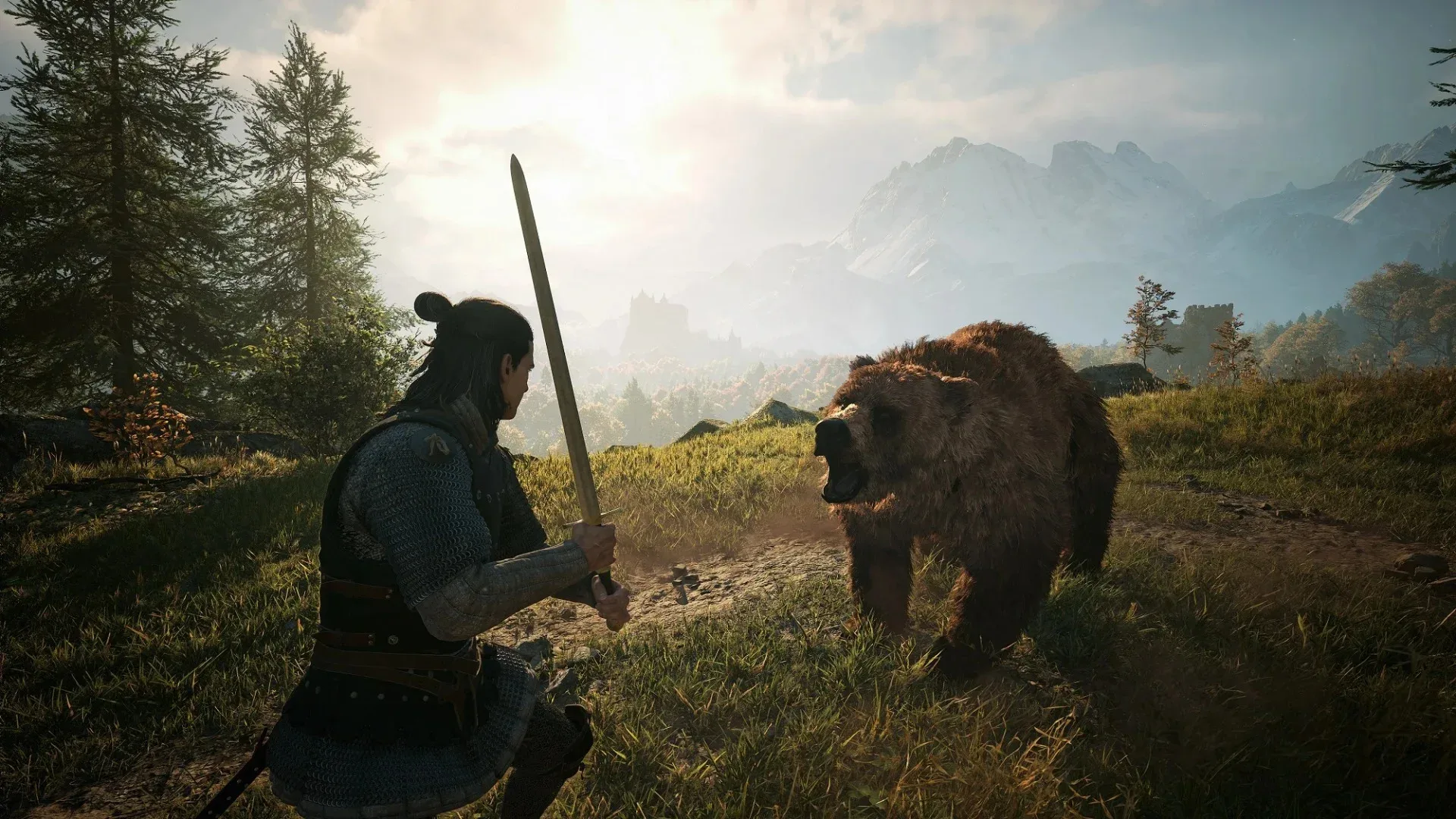
The Blood of Dawnwalker is preparing a major accessibility and combat update for early October. Its most consequential addition is a new Story mode intended for players who do not want to engage with combat at all. That is a materially different promise from simply making enemies weaker: it suggests the game’s narrative can be experienced without requiring players to master its fighting systems.
The game currently offers four difficulty options: Story, Fair, Challenging and Duelist, with further settings available for players who want to tailor the experience. The existing Story label, however, has still involved fighting. As part of the update, that current mode will receive a different name, making room for the new Story mode.
The distinction matters. Difficulty settings typically adjust numbers or margins for error—enemy damage, player resilience, timing windows, or similar variables. A combat-free option instead changes the basic relationship between player and game. Rather than asking someone to overcome an encounter at a lower pressure level, it aims to let them continue with the plot without that encounter becoming a mechanical obstacle.
A narrative route through Vale Sangora
The Blood of Dawnwalker follows protagonist Coen in Vale Sangora and combines its vampire-themed premise with time-management elements. Combat is not presented as an isolated side activity, either. Hostility toward the HVIC can lead to enemies being sent after Coen, including guards establishing checkpoints around the map. That makes the design of a genuinely combat-free path more complicated than merely lowering the health of bosses.
What the new mode will do with those systems has not yet been detailed. It is unclear whether confrontations will be skipped automatically, whether certain threats will not appear, or whether players will be given ways to bypass them. Likewise, there is no confirmed explanation for how major fights or guard checkpoints will be handled.
That uncertainty is important to keep in mind before treating the option as a fully defined feature. The stated goal is clear—serve people who do not want to experience combat—but the practical rules of that goal have not been laid out. Players interested in a narrative-first playthrough will likely want to look closely at the patch notes when the update arrives, particularly if they are concerned that map pressure or pursuit systems could interrupt exploration.
Still, the addition has a straightforward upside. A player can dislike action mechanics, struggle with multi-enemy encounters, or simply prefer the story without wanting to abandon a game built around those elements. A mode built to acknowledge that preference is more meaningful than asking every player to meet combat on its own terms.
Targeting and stun behavior are also changing
The patch is not exclusively for players choosing the new Story mode. It will also adjust combat targeting in situations involving stuns. At present, stunning an enemy causes the game to automatically change the player’s target. That can be useful amid a crowd because it shifts attention away from an incapacitated foe. But automatic target switching can be frustrating when a player deliberately wants to stay focused on that enemy.
Related coverage includes The Blood of Dawnwalker Patch Will Add a Combat-Free Story Mode.
The planned change is to keep the lock-on target on the stunned opponent. In practical terms, a target lock is the system that keeps player attacks, camera attention or directional inputs centered on a selected enemy. Retaining that selection should make a player’s immediate intention more predictable: if Coen stuns a target and the player wants to keep pressure there, the game will not immediately redirect that focus.
Stuns themselves are also set to become more durable. The director said it will take three hits to remove the stun. A stun is a temporary status effect that prevents or limits an enemy’s actions. When damage removes that state too quickly, it can create an awkward choice: use the opening to attack and prematurely restore the enemy, or avoid attacking and lose the benefit of the opening. The three-hit approach appears designed to make both styles more viable—players can leave an enemy incapacitated, or use a limited sequence of attacks without instantly ending the stun.
There is an experimental note in the explanation. The team plans to watch how players react to the adjustment, rather than presenting the specific three-hit rule as an untouchable final answer. That is sensible for a combat change with effects beyond one-on-one duels. In a group encounter, a longer-lasting stun could offer more room to manage several enemies; at the same time, it could alter the pace and degree of control available to players. The stated intent is flexibility, not a demand that everyone use stuns in one particular way.
Escape options could matter as much as offense
Another planned improvement concerns leaving fights. Work is underway on escaping from combat and on running during combat, described as a significant change for players. No exact control scheme or conditions have been confirmed, so it would be premature to assume that every battle can be abandoned without consequence. But the direction is notable.
An escape mechanic is often as much about player agency as it is about difficulty. When a game lets players disengage, it creates an alternative response to an encounter that is going badly: retreat, reposition, pursue another objective, or simply decline a fight. That can be particularly helpful in a game where opposition can appear around the map as a result of the player’s actions.
It may also reduce friction caused by the space itself. The update discussion acknowledged situations where movement away from enemies could be impeded by world geometry. In game-development terms, geometry means the physical shapes and boundaries that make up the environment—walls, rocks, props, terrain and other collision surfaces. Getting caught on it while attempting to flee can turn a tactical decision into a frustrating technical constraint. Better running and escape behavior will be judged by how reliably it lets players act on their choice to disengage.
For players staying with the game’s more demanding settings, the combined changes point toward a potentially clearer combat loop: choose a target, maintain that choice after a stun, take advantage of a more stable crowd-control window, and have a more credible way to withdraw when an encounter is not worth continuing. None of that removes challenge by itself. It does, however, put more emphasis on intentional decisions rather than forced target changes or unsuccessful attempts to create distance.
What is confirmed—and what remains only a possibility
The early-October patch is expected to include the new Story mode, a new name for the existing Story difficulty, targeting changes around stunned enemies, a three-hit threshold before damage breaks a stun, and work on combat escape and running. Those are the concrete items players can reasonably expect to hear more about as the update nears.
A New Game Plus mode is a separate matter. It has been raised as a possibility, but has not been announced or scheduled. New Game Plus generally refers to an option to begin another playthrough after completing a game, often while carrying forward some progression or equipment. No details about whether progression would carry over, or when such a mode might arrive, have been provided. For now, it should be treated as an idea under consideration rather than a patch feature.
The same caution applies to the combat-free mode’s implementation. The headline feature is promising precisely because it recognizes that accessibility is not always solved by asking players to “get better” at an unwanted system. But the specifics—boss encounters, roaming pressure, checkpoints and any narrative handling of skipped fights—will determine how seamless the experience feels.
As studios continue supporting games after release, clarity about what an update changes can be as valuable as the change itself. That is one reason players often ask for firmer plans around ongoing support, a concern also reflected in the broader call for clearer game roadmaps. For The Blood of Dawnwalker, the next meaningful details are likely to be the rules behind its new narrative-first option—not just the fact that it exists.