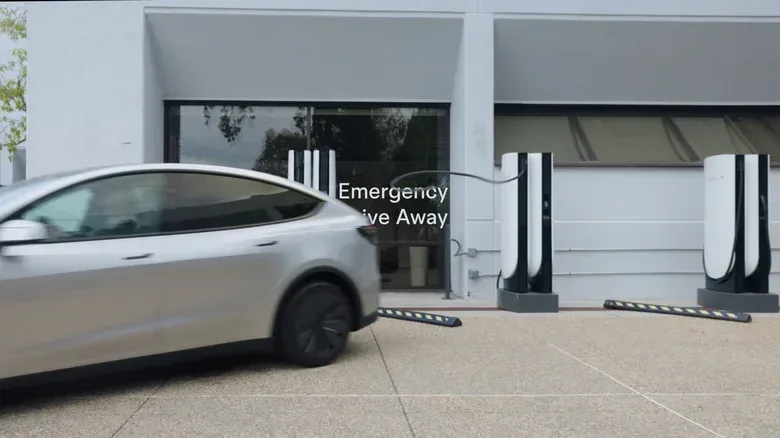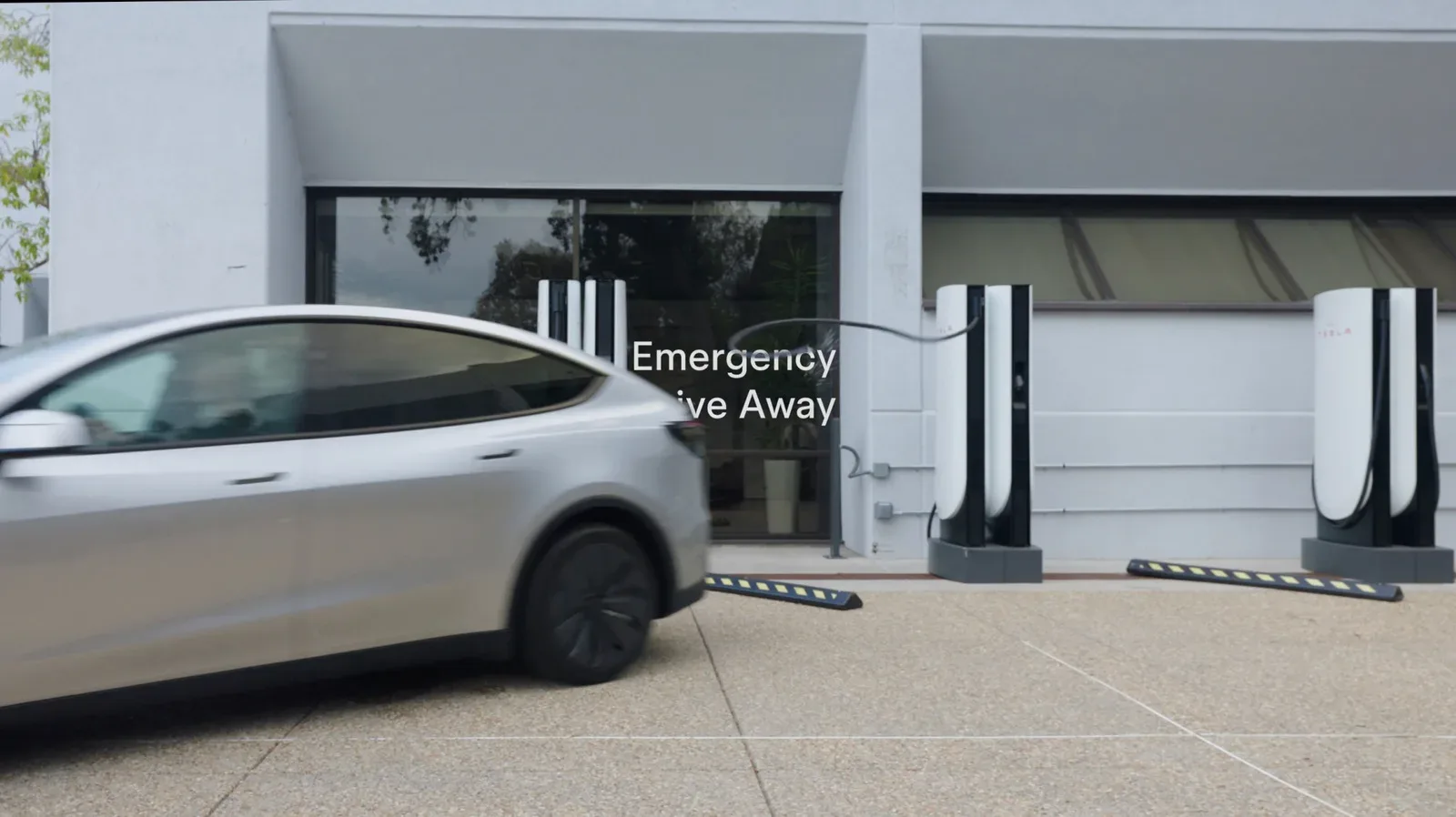
Tesla has introduced Emergency Drive Away, a software feature intended to give drivers a rapid exit option when their vehicle is still connected to a Supercharger. The change follows an incident a couple of months earlier in which a driver was shot inside a Tesla taxi while charging at an In-N-Out Burger location in Twin Falls, Idaho.
It is a narrowly defined feature with a deliberately severe trade-off: a driver can move the car while the charging cable remains attached, but Tesla warns that doing so will damage both the vehicle and Supercharger equipment. The system is not a faster version of ordinary unplugging. It is an emergency override for the normal charging lock, designed for the rare situation in which stopping to disconnect could feel unsafe.
For now, Emergency Drive Away works only at Superchargers in the United States. Owners need the latest vehicle software, and Tesla says pre-2021 Model S and Model X vehicles do not support it. Those eligibility limits matter. A Tesla owner should not assume the option will appear at every charging site, in every country, or on every older vehicle.
Why a charging cable can delay a departure
Under normal conditions, Tesla’s charging process involves a lock around the charge port connection. Before shifting from Park to Drive after charging, the driver must unlock the port through the car’s infotainment display, Tesla’s app, or a button on the charger handle.
That routine makes sense when a vehicle is sitting at a charger: it helps keep the connector secured through the charge session and sets a clear process for ending it. But it also creates a problem in the kind of crisis where seconds and attention matter. A driver who believes they need to leave immediately may not want to navigate a screen, reach for a phone, or step outside to handle the connector.
Emergency Drive Away changes that decision path. If the driver shifts into Drive while the cable is still connected, the infotainment system displays a notice explaining that the lock can be overridden. To activate the override, the driver must hold the brake pedal and tap Activate on the display.
The required confirmation is an important design choice. It means the car is not simply going to pull away because the driver accidentally selected Drive. Tesla is placing an intentional, on-screen barrier between a normal charging session and an action likely to break equipment. In practical terms, the feature appears built to be quick enough for an emergency while still requiring a conscious choice.
What “drive away” means in this case
The name could sound deceptively simple. It does not mean a charging session ends neatly while the car drives off. The cable is still attached, and Tesla’s warning explicitly says the action will cause damage to the car and Supercharger station.
That is the core technical distinction. A normal charge-port release separates a vehicle from the charger without force. Emergency Drive Away instead permits the vehicle to move despite the connected hardware. The likely result is damage around the connector, cable, charge port, or related equipment; Tesla’s own warning is the key fact drivers should take from the feature, rather than trying to predict which component will fail in a particular event.
Use only in an emergency.
That warning is not background legalese. It defines the intended use. This is closer to an emergency exit than a convenience tool for a stuck, slow, or inconvenient charging stop. Tesla has also said deliberate misuse will bring additional penalties.
When asked about the possible cost of damage, the company said electrical and civil costs can reach $25,000. That figure establishes the potential seriousness of an intentional misuse, but it does not provide a standard price for every activation. The available information does not make clear whether Tesla would charge someone who uses Emergency Drive Away in a genuine emergency, nor how the company would assess individual circumstances.
The feature answers a specific owner concern
Following the Twin Falls shooting, Tesla owners called for a way to leave quickly, including suggestions that drivers could pay for access to discourage abuse. Emergency Drive Away is Tesla’s answer, though not necessarily in the form of a paid escape option. No charge to enable or use the feature in a real emergency has been confirmed.
The distinction matters because the safety case and the abuse case pull in opposite directions. If the feature were too difficult to find or use, it would undermine its value in a stressful situation. If it could be triggered without meaningful friction, it could invite costly damage, disrupt charging locations, and potentially leave equipment unavailable to other drivers.
Tesla’s approach attempts to manage both: the vehicle warns the driver, asks for an explicit activation while the brake is held, and reserves the feature for a scenario where the driver accepts physical damage as the price of leaving. The prospect of penalties adds another deterrent against treating the override as a shortcut.
That balance is likely why the implementation remains screen-based rather than an automatic physical release. An emergency response has to be accessible, but a command that can damage infrastructure cannot sensibly behave like a routine control. The on-screen confirmation makes the driver acknowledge both the action and its consequences.
What eligible Tesla drivers should know
The first practical step is software status. Emergency Drive Away requires the latest update, so drivers who want the option available should ensure their eligible vehicle has received it. The next is location: Tesla limits the feature to its US Supercharger network at present. It should not be assumed to work at third-party charging locations or outside the US.
- Eligible setting: a Tesla connected to a US Supercharger, with current software installed.
- Known exclusions: pre-2021 Model S and Model X vehicles are unsupported.
- Activation path: select Drive with the cable attached, then hold the brake and tap the on-screen activation control.
- Expected consequence: Tesla warns of damage to the vehicle and Supercharger.
- Misuse risk: Tesla says deliberate misuse can trigger additional penalties, with electrical and civil costs potentially reaching $25,000.
Just as important is understanding what the feature does not replace. It does not remove the normal procedure for unlocking a charge port, and it does not make driving while plugged in safe for the vehicle or station. In ordinary conditions, owners should still end charging and disconnect in the standard way.
Safety software is most useful when the normal flow breaks down
Emergency Drive Away is a small addition to a vehicle interface, but its purpose is unusually direct: it acknowledges that a carefully designed routine can become a liability when circumstances change suddenly. Charging is ordinarily a stationary, predictable activity. The Idaho incident underscored that public charging locations can, in rare cases, become scenes where a driver wants mobility immediately.
There is a broader product-design lesson here. The best emergency controls are not necessarily the ones used often; ideally, they are never used at all. Their value comes from preserving an option when normal processes no longer fit the situation. At the same time, their consequences need to be impossible to miss. Tesla’s warning language, confirmation step, damage notice, and misuse penalties all point to that tension.
It is also a reminder that vehicle features increasingly arrive through software rather than physical redesigns. A functionality gap identified by owners can become an interface change delivered to supported cars. That does not make every software addition equally meaningful, but it does show why drivers need to stay aware of what an update changes and where its boundaries are. The same question—whether a new computing feature earns a place in everyday life—is relevant beyond cars, including the debate around whether local AI can earn a place on Windows.
For Tesla owners, the immediate takeaway is straightforward: check whether the vehicle is eligible and updated, learn the activation sequence before it is ever needed, and treat Emergency Drive Away exactly as Tesla labels it—an emergency-only measure whose benefit may be getting away quickly, and whose cost may be substantial damage.