Subscription-free security cameras are the appealing alternative for anyone who wants alerts and remote viewing without adding another monthly charge to the household ledger. The key difference is where video lives. Rather than relying solely on a company cloud service, the cameras here can save footage locally to a microSD card. One Reolink model can also send recordings to a network video recorder, or NVR.
That distinction does not make a local-storage camera an offline device. These models still use Wi-Fi, apps and remote access features. It means the primary recording storage described for them is under the owner’s control rather than locked behind an ongoing cloud-storage plan. Capacity, power arrangement, weather protection and camera coverage matter just as much as the lack of a fee.
For a broader reminder that connected-home hardware depends on both local radio range and wider networks, see our guide to Bluetooth distance, Compass View and the Galaxy Find Network. A camera’s Wi-Fi connection is similarly a core practical consideration, particularly at the edge of a home or outdoors.
What local storage changes—and what it does not
Cloud-connected cameras from major brands can be straightforward to install: battery power, Wi-Fi and a phone app remove the need to run cabling for many setups. But cloud recording and playback can require a subscription, and the footage is kept on a remote server.
Local storage shifts that arrangement. A camera records to a microSD card installed in the device, with listed support ranging from 256GB to 512GB among these choices. That avoids the stated monthly storage fee and gives the owner direct control over the stored data. It is still important to separate a few terms that are frequently bundled together in product listings:
- Resolution is the amount of image detail captured. The models below range from 1080p through 2K and 4K. A higher figure describes more recorded detail, not automatically better coverage of a large area.
- Field of view is how wide a fixed camera can see. The Tapo C465’s listed field of view is 135 degrees. Pan-and-tilt cameras add motorized movement, and some offer 360-degree coverage.
- Night vision describes a camera’s low-light capability. Several listed models have color night vision; the C465 also uses IR LEDs.
- IP ratings refer to resistance against dust and water. These cameras are listed from IP65 to IP67, but the rating should be considered alongside where and how the camera will be mounted.
- Two-way audio lets a user hear and speak through the camera via its app.
Local storage also creates a practical planning question: the memory card is the recording destination, so buyers should check each camera’s supported maximum capacity before selecting a card. The supplied specifications identify support for up to 512GB on several models and up to 256GB on the eufyCam C37.
TP-Link Tapo: the widest set of lower-cost choices
TP-Link’s Tapo range offers options that span a solar-equipped 4K wireless model, less expensive outdoor models and a plug-in pan-and-tilt camera. The most fully specified of the group is the Tapo C465 MagCam 4K, listed at $79.
The C465 has an 8MP sensor recording in 4K, a 135-degree field of view, up to 18x digital zoom and a microSD slot supporting as much as 512GB. It connects on either 2.4GHz or 5GHz Wi-Fi, provides two-way audio, motion alerts and activity zones, and works with Google Assistant and Alexa. AES 128-bit encryption is listed for the accessible camera feed.
Related coverage includes Budget security cameras that don’t need a subscription.
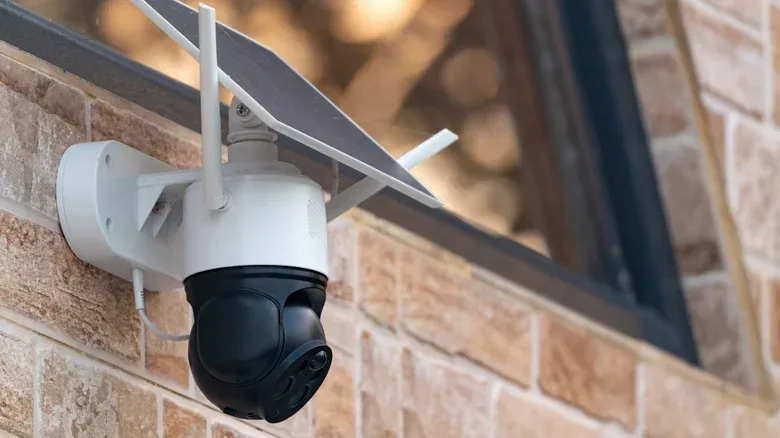
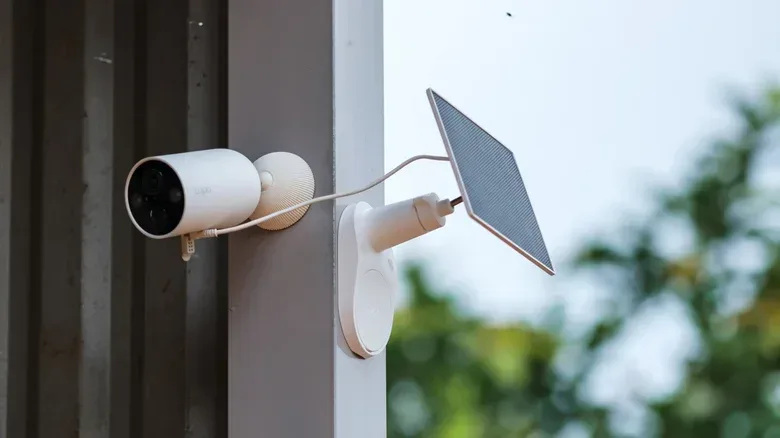
Its design is especially relevant for locations where an outlet is inconvenient. The camera is fully wireless, uses a magnetic base and combines a 7,800mAh battery with an integrated solar panel. The stated charging claim is that 50 minutes of sunlight per day is enough to replenish the battery. Its IP65 rating is intended to cover dust and water resistance, while full-color night vision distinguishes it from a simple daytime-only proposition.
The Tapo C425 MagCam 2K, listed at $54, trades the C465’s 4K/8MP camera for 2K/4MP recording. It has a larger 10,000mAh battery and IP66 resistance, but lacks the integrated solar panel. A bundled solar kit is listed at $65. That makes it a useful middle ground for someone who still wants the magnetic, battery-led approach but does not need the higher-resolution model.
At $44, the Tapo C402 SolarCam is the lower-cost outdoor option. It records at 1080p and retains the C425’s other listed features. The Tapo C216 HybridCam 360, meanwhile, is a $33 model with a 3MP, 2K dual-lens camera and pan-and-tilt functions. It can be installed outdoors because it carries an IP65 rating, but it is not wireless: it needs wall power. That limitation may be insignificant for an indoor room, garage or a covered location with accessible power, but it is decisive where no outlet is nearby.
Eufy: pan-and-tilt coverage with local recording
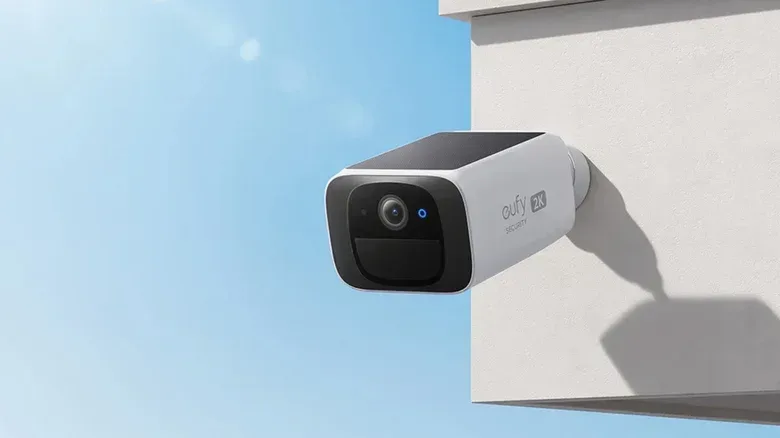
Eufy, an Anker sub-brand, has two relevant choices in this group. The $59 eufyCam C37 is a battery-powered camera with a 2K sensor, 6,700mAh battery, 2.4GHz Wi-Fi, IP65 dust and water resistance, color night vision and AI-assisted motion detection. Its microSD card slot supports up to 256GB.
The C37’s defining capability is its pan-and-tilt system, which provides 360-degree coverage and automatic subject tracking. In plain terms, that makes it designed to move its viewpoint as a subject moves, rather than preserving only the fixed framing of a conventional camera. It also includes real-time alerts and encryption for the feed through the Eufy app. Eufy has overhauled its security protocols during the past two years.
The $39 Wired Cam C31 offers a different compromise: it can be used indoors or outdoors and adds 360-degree coverage, dual antennae, color night vision, a microSD slot, two-way audio, real-time alerts and an IP66 rating. It has no battery, so it must remain plugged in. That is a constraint for placement, though it can be a sensible fit where continuous mains power is already available.
Reolink: stronger ingress ratings and an NVR-capable floodlight option
Reolink’s Argus Solar is the more conventional wireless outdoor pick in this lineup. It uses a 5MP camera that records at 2K, a 6,500mAh battery and an integrated solar panel. It supports microSD storage up to 512GB, 2.4GHz and 5GHz Wi-Fi 6, two-way audio, AI-assisted motion detection and real-time alerts, along with Google Assistant and Alexa integration.
Wi-Fi 6 is the newer Wi-Fi generation stated in the specifications; more importantly for placement, the Argus Solar supports both the 2.4GHz and 5GHz bands. Its IP67 rating is the highest listed among the wireless cameras discussed here. Reolink also states that it uses industry-standard encryption for data.
The TrackFlex Floodlight WiFi sits in a different class, both in price and in installation needs. At $184, it costs more than the other listed products. It has dual lenses that record in 4K, pan-and-tilt coverage for 360 degrees, automatic subject tracking, Wi-Fi 6, two-way audio and IP66 dust and water resistance. Its floodlight reaches up to 3,000 lumens and the camera supports 24/7 recording.
Unlike the battery-and-solar products, the floodlight camera needs a power connection. The upside is its continuous-recording capability and the ability to use either a microSD card up to 512GB or an NVR. An NVR is dedicated recording hardware on a local network. The TrackFlex can send video to one through RTSP, short for Real-Time Streaming Protocol, a protocol used to carry a live media stream across a network. For a household already using an NVR, that is the clearest expansion path in the choices described.
How to narrow the list without treating every spec as equal
The first decision is power. A battery model with integrated solar charging is the cleanest answer when running a cable is impractical. The Tapo C465, Tapo C402 SolarCam and Reolink Argus Solar are built around that kind of placement; the C425 can be bought in a solar kit. A wired model such as the Tapo C216, Eufy Wired Cam C31 or Reolink TrackFlex Floodlight WiFi requires a reachable power source but avoids depending on a battery.
The second decision is coverage. A fixed 135-degree view can be appropriate for a driveway or doorway, especially when activity zones can limit alerts to the relevant area. Pan-and-tilt cameras are intended for broader rooms or wider outdoor coverage. The C216, C37, C31 and TrackFlex all bring a 360-degree coverage claim, while the C37 and TrackFlex also list automatic subject tracking.
Third is recording ambition. A 1080p Tapo C402 SolarCam is the price-led choice at $44. The $54 Tapo C425, $59 eufyCam C37 and Reolink Argus Solar occupy the 2K tier. The $79 C465 and $184 TrackFlex record in 4K. None of those labels alone answers whether a camera is right for a location; they should be read together with coverage, available storage and the need for continuous rather than motion-driven recording.
Finally, prospective owners should account for the environment. Listed resistance ranges from IP65 through IP67. Solar capability is valuable only where the installation position receives the needed light. A magnetic mount eases installation, but a location still needs a stable Wi-Fi connection and a view that suits the desired monitoring area.
The common thread is straightforward: local microSD recording means these cameras can provide remote access, notifications, night vision and two-way communication without making cloud storage a required recurring expense. Tapo offers the broadest ladder from a $33 plug-in model to a $79 4K solar camera; Eufy puts pan-and-tilt coverage into $39 and $59 options; and Reolink adds an IP67 wireless solar choice plus the more costly, NVR-capable floodlight camera for always-on recording needs.