Major spoilers for a late-game Star Wars: Zero Company mission and Star Wars Jedi: Fallen Order follow.
Some crossover appearances exist to trigger applause. Star Wars: Zero Company’s encounter with Trilla Suduri appears to be doing something more useful: it makes the player’s existing knowledge dangerous.
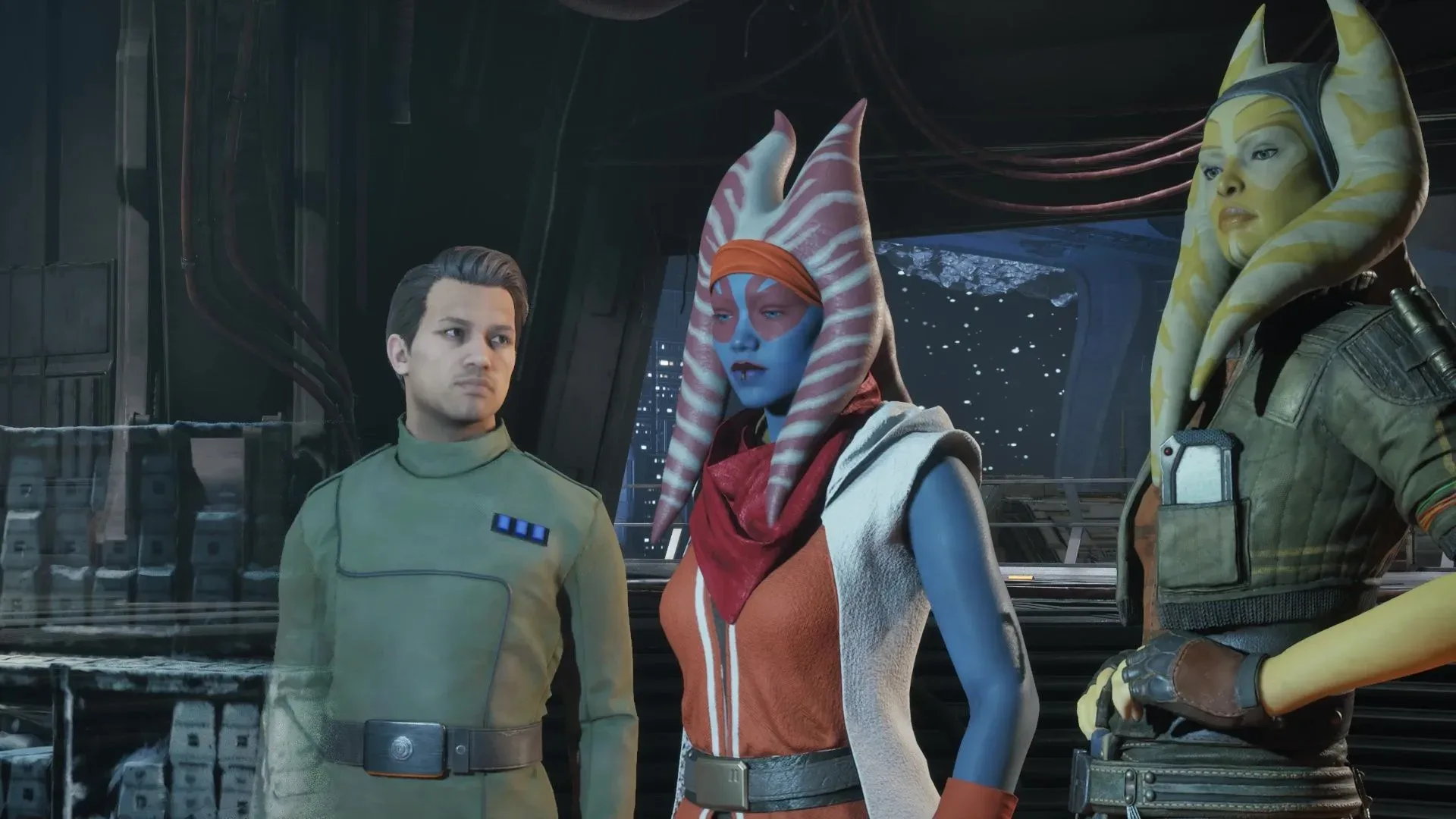
Zero Company is a newly released, XCOM-like turn-based tactical strategy game from EA. In its late-game story, the player leads Zero Company as Hawks, working alongside Tel-Rea, a young Tognath Jedi. When Tel-Rea receives a distress call from a friend she knew before the Empire’s purge of the Jedi and their allies, the immediate setup sounds hopeful. A surviving contact wants to meet. There may be other Jedi. There may be a way forward.
But the name attached to that message is Trilla Suduri. Players familiar with Star Wars Jedi: Fallen Order know that name carries a very different meaning. Suduri is no longer functioning as the Jedi friend Tel-Rea remembers. She has become the Second Sister, an Imperial Inquisitor hunting Jedi who survived the Empire’s rise.
For more context, explore Final Fantasy 7 Revelation Could Need Around 200GB, Making Storage a Major Part of Its 2027 Launch.
That gap in knowledge is the entire engine of the sequence. Tel-Rea knows a childhood friend from the Academy. The player may know the trap before the squad even boards its transport. Hawks and the company, however, do not have the benefit of a previous game’s history. The crossover therefore serves the story rather than interrupting it: information held outside Zero Company changes the emotional temperature inside Zero Company.
A rescue lead that was never safe
Tel-Rea asks Hawks to accompany her after learning that Suduri is supposedly gathering surviving Jedi to decide what comes next. Other members of Zero Company worry the invitation could be an Imperial operation intended to draw Jedi and their helpers into the open. That caution proves warranted, but it does not make Tel-Rea’s decision foolish. She grew up alongside Trilla and remembers her as a friend. In a period where Jedi survivors have been scattered and hunted, even a questionable connection may feel worth pursuing.
The mission takes the team to Dantooine. There, Suduri appears in the visual language the audience is meant to recognize: black clothing, a red lightsaber, and lethal intent. The reveal is not merely that an old acquaintance has changed sides. It is that Tel-Rea’s personal memory has been deliberately used as bait by someone whose Imperial role depends on finding people like her.
That makes the Second Sister a particularly fitting returning character. An Imperial Inquisitor is an agent tasked with tracking and eliminating the Jedi who remain after the purge. Suduri’s presence on Dantooine is consequently not a coincidence engineered just to unite two games. Zero Company puts a Jedi survivor in reach of an established Jedi hunter, then allows the encounter to unfold from that premise.
There is also a clear personal fracture behind the ambush. Before fighting begins, Tel-Rea and Suduri speak over comms. Suduri invokes Cere Junda, her former master and another character from Fallen Order. She also criticizes the Jedi Order’s practice of persuading parents to surrender children for Jedi training. Tel-Rea refuses an invitation to join the Inquisitors, and the confrontation turns from an uncertain reunion into an urgent escape.
Suduri’s complaint matters because it prevents the scene from reducing her to a lightsaber-shaped obstacle. It recalls that she has a history with the Jedi system and that her hostility includes resentment toward it. Zero Company does not need to stop and retell every earlier event for the reference to work; the mention of Cere and the criticism of the Order establish that Tel-Rea has walked into a conflict larger and older than the message that summoned her.
The objective changes from winning to living
Most tactical strategy missions train players to think in terms of control: eliminate threats, secure a position, protect allies and complete the stated objective. Zero Company deliberately bends that pattern in the Second Sister encounter. The squad is not expected to defeat Suduri. Its assignment is to endure several rounds, keep Tel-Rea safe and escape.
That distinction is more than narrative dressing. Suduri is presented as overwhelmingly powerful, nearly impossible to hurt, and able to act with exceptional freedom on the battlefield. In practical terms, the player is facing an adversary who is not balanced as a normal enemy for a conventional elimination objective. Trying to approach her as one can be the wrong mental model for the mission.
Turn-based tactical strategy refers to a format in which combatants act in separate turns and positioning, timing and unit protection are central decisions. The Second Sister mission turns those fundamentals toward survival. Instead of asking, “How do I remove the strongest unit?” the pressure becomes, “How do I spend the next few turns without losing Tel-Rea or giving Suduri an opening?”
That is a sharp use of an unwinnable or near-unwinnable encounter. It is not a failure state disguised as a boss fight, and it is not a usual duel with a long health bar. The game explicitly asks for endurance followed by extraction. The villain’s threat is made credible not only through dialogue or a cinematic entrance, but through the structure of the objective itself.
What players should take from the setup
- Read the mission goal literally: survival and escape, rather than defeating the Second Sister, are the stated priorities.
- Keep Tel-Rea central to every decision: her safety is essential to completing the encounter.
- Do not assume a famous opponent is a standard boss: Suduri’s extreme durability signals that conventional damage-focused thinking is not the point of this scenario.
- Plan around rounds: the win condition is lasting long enough to leave, so each turn survived advances the objective.
Those are not broad tactical prescriptions for every Zero Company mission. They follow directly from the unusual terms of this one. The game’s twist is that an intimidating enemy is not there to be conquered on the squad’s timetable. She is there to force a retreat.
Why the crossover earns its place
Star Wars stories have an enormous number of recognizable people, places and artifacts available to reuse. That abundance can make a cameo feel weightless if a character appears only to reassure the audience that a wider universe exists. Suduri’s role avoids that problem because she is tied to all three layers of the scene.
First, she affects the player’s expectations. Anyone who recognizes her name can feel apprehension before the reveal on Dantooine. Second, she affects Tel-Rea emotionally, turning a hopeful reunion with a friend into a cruel betrayal. Third, she affects the game system, because her power changes a tactical mission from a battle of attrition into an evacuation under pressure.
In other words, the reference is doing narrative, character and mechanical work at once. The encounter does not pause Zero Company’s story so that another game can be acknowledged. It develops Tel-Rea’s storyline while making a logical extension of the Second Sister’s ongoing hunt for Jedi.
It also creates an effective asymmetry between audience knowledge and character knowledge. Players who completed Fallen Order can anticipate the danger; Tel-Rea cannot see the same warning signs because the name means something intimate and positive to her. That dramatic irony gives the approach to Dantooine a sense of dread that does not require the game to announce the betrayal in advance.
For players without that background, the encounter can still function as a sudden, frightening reversal: a trusted name becomes an enemy with a red lightsaber and a seemingly impossible combat profile. For returning fans, the reveal gains additional force through recognition of Suduri, Cere Junda and the history that connects them. The scene works at both levels without requiring every player to have identical context.
A stronger case for game-to-game Star Wars continuity
Trilla Suduri is primarily known from video games, with a minor earlier appearance in comics. Her arrival in Zero Company is therefore notable not simply because Star Wars is crossing between projects, but because a character associated closely with one game is being used meaningfully in another. The appearance gives the games a stronger sense of shared continuity than a passing visual reference could provide.
Fallen Order and Star Wars Jedi: Survivor have helped establish a group of characters with clear stakes inside the Imperial era. Bringing one of them into a tactical game creates a bridge between styles of play without pretending those styles are identical. A character once encountered in an action-adventure setting becomes the central pressure point of a turn-based survival scenario. The continuity is carried by her purpose and history, not by forcing the new game to imitate the old one.
For a broader look at why this crossover’s escape-focused design stands out, the Second Sister encounter’s survival-mission framing highlights the core idea: the meaningful victory is getting Tel-Rea out alive.
Zero Company’s use of Suduri also demonstrates a practical standard for future appearances from game-originated Star Wars characters. Recognition is valuable, but the larger payoff comes when a returning figure has a credible reason to be present, a meaningful relationship to someone in the new story, and a role that alters what the player actually does. Here, the Second Sister meets all three tests.
The resulting mission is especially effective because it does not mistake familiarity for safety. Knowing exactly who Trilla Suduri is does not give Zero Company an easy answer. It only lets players understand, a moment earlier than Tel-Rea, how badly the meeting can go. Then the game makes that knowledge matter by demanding the one response a vastly outmatched squad can manage: protect its vulnerable ally, last a few turns, and run.