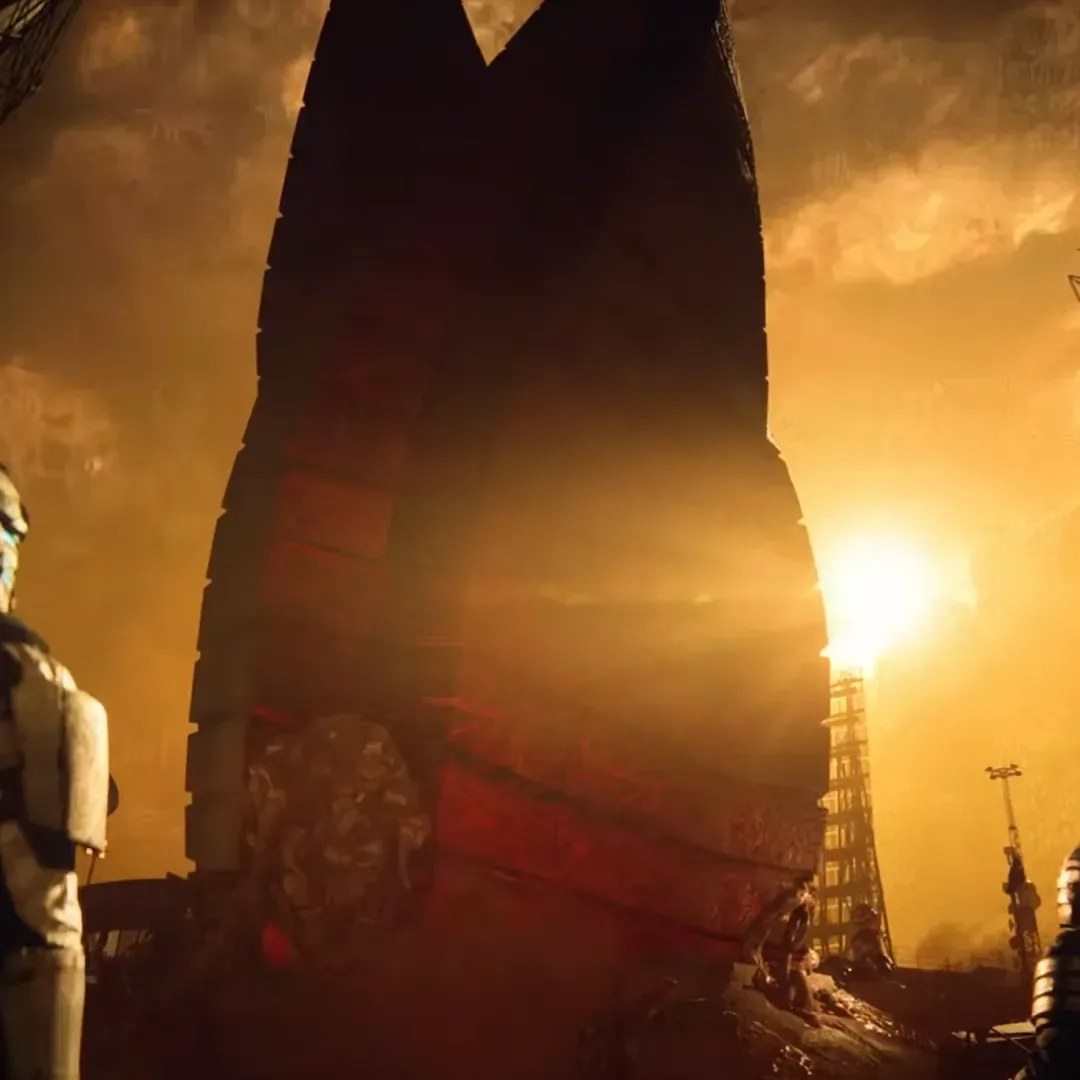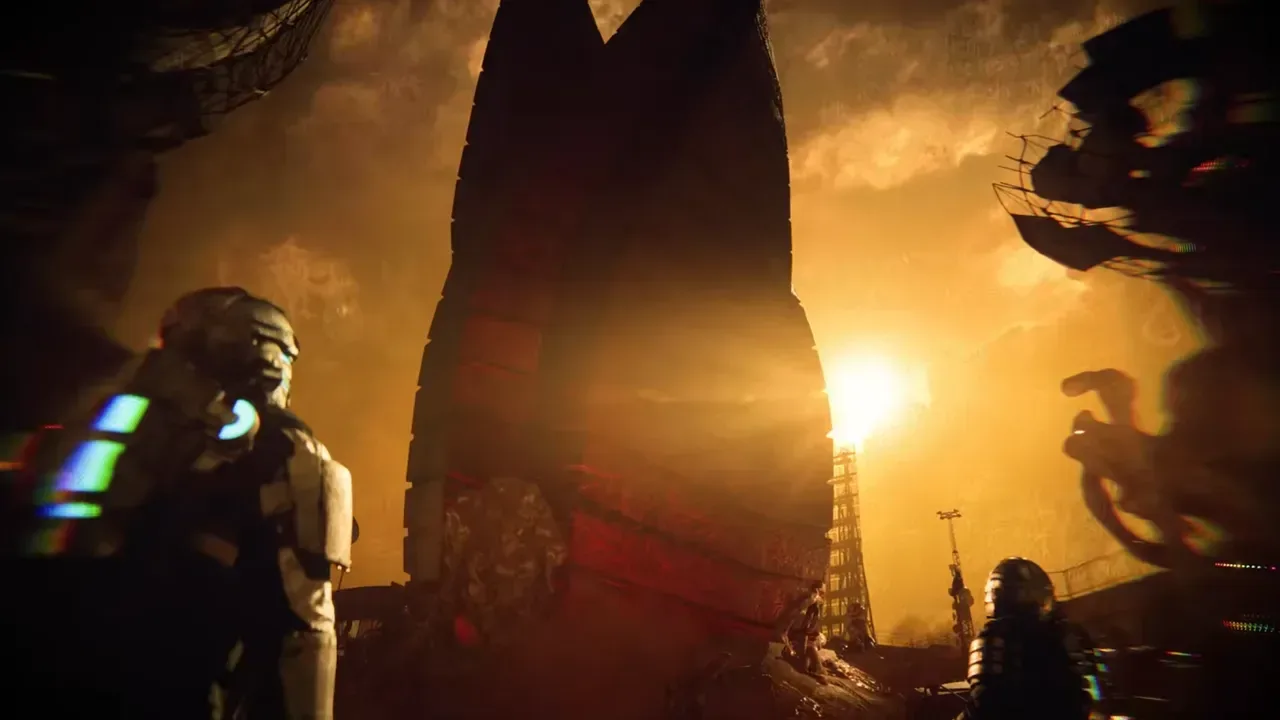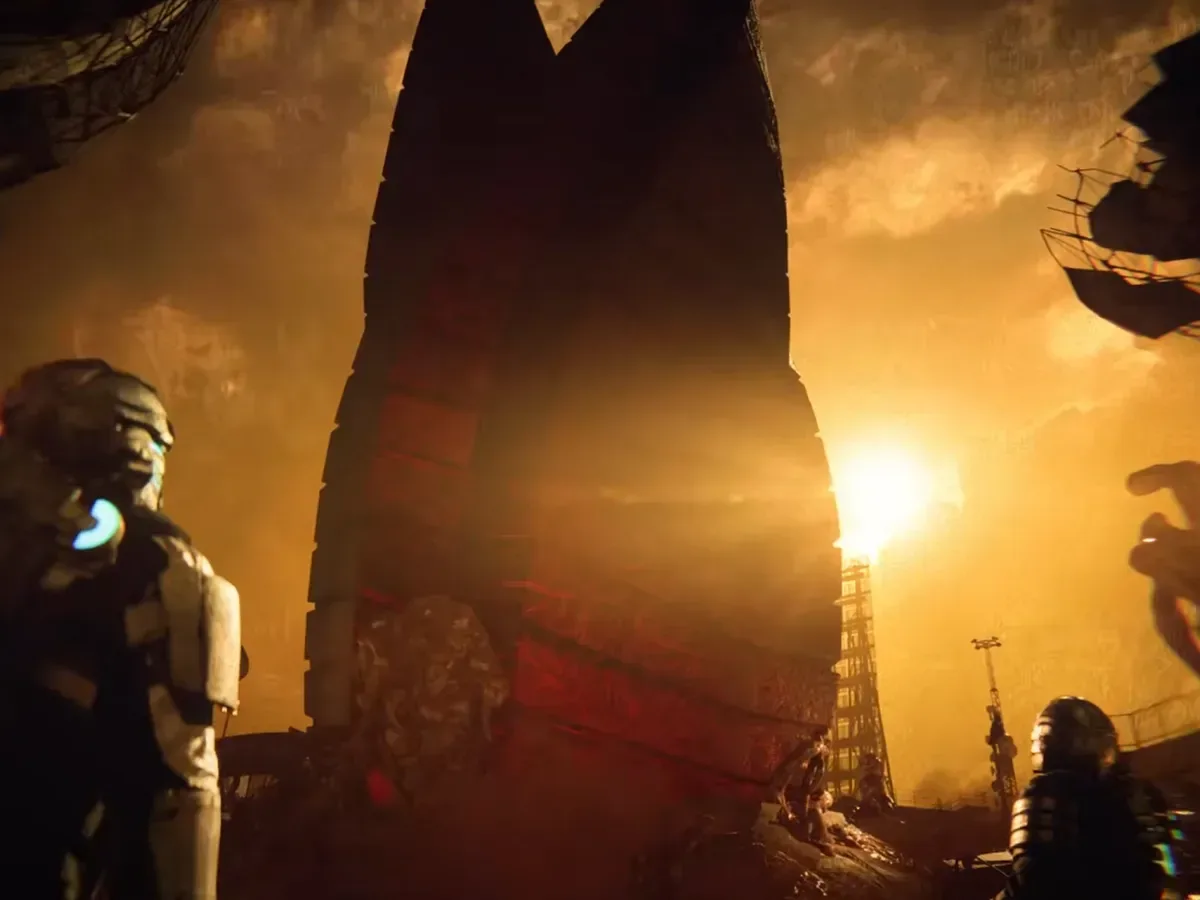
Battlefield 6’s Season 5 trailer appears to be making room for an unexpected passenger: Dead Space. After opening on the destructive spectacle of a new Las Vegas battlefield—helicopters, gunfire, casinos and skyscrapers along the Strip—the footage reportedly changes tone sharply. The soundtrack recedes, unsettling audio takes over, and two engineers look toward the Marker, the alien artifact at the centre of Dead Space’s nightmare.
That is a very deliberate set of imagery, but it is still important to separate what has been shown from what has not. The trailer is a tease, not a detailed reveal of an event, mode, item list, date or price. It strongly points toward a Dead Space-themed addition to Battlefield 6, particularly around October’s Halloween window. It does not, by itself, establish exactly how the collaboration will work.
Players have also identified what they believe could be Dead Space-inspired character skins, following prior rumors that such cosmetics would arrive with an October Halloween update. Taken together with the Marker scene, a cosmetic crossover looks like the most plausible reading. Until full details arrive, though, the sensible expectation is narrower: Dead Space imagery is being used to promote something connected to Battlefield 6 Season 5, rather than to promise a wholly new Dead Space game.
What Season 5 is bringing to Battlefield 6
The Dead Space reference lands inside a larger Season 5 package. The season is set to include three maps, six weapons and two vehicles. Vegas Strip and Area 51 are among the named maps, while Vegas becomes available on October 13.
Las Vegas is the immediate, concrete attraction in the trailer. It is presented as a dense urban combat space where the visual identity of the Strip is not merely a backdrop: casinos and tall buildings sit amid vehicle attacks and sustained small-arms fire. That matters because the trailer’s Dead Space coda is framed against a distinctly grounded military setting. The contrast is likely the point. Battlefield’s usual battlefield chaos gives way to a familiar piece of science-fiction horror iconography.
Area 51 also makes the timing feel especially suited to a Halloween-season promotional beat. But the available information does not say that Area 51 itself is a Dead Space map, that the Marker will be placed in a playable level, or that players will encounter enemies from the horror series. Those would be substantial gameplay claims, and the teaser does not confirm them.
The Marker is more than a spooky logo
For anyone who knows Battlefield but has skipped Dead Space, the Marker is not simply a decorative sci-fi monument. It is the alien artifact associated with the psychological horror at the heart of that series—the object that affects minds and helps give Dead Space its oppressive atmosphere. Showing engineers staring upward at it instantly establishes the crossover’s identity without needing a title card spelling out the connection.
That shorthand makes Dead Space a useful fit for a Halloween cosmetic event. Its engineering suits and industrial-future design language can be adapted into soldier skins more naturally than an overtly comedic guest character might be. The key question is implementation. A skin can evoke the source material while keeping the wearer readable in a competitive match; a full helmet, unusual silhouette or aggressively luminous effects may be more contentious if they make target recognition harder.
Related coverage includes Battlefield 6 Season 5 Trailer Appears to Tease Dead Space Crossover.
In multiplayer design, readability means a player can quickly understand what they are looking at: friend or foe, their general position, and often their role or faction. It is not just an aesthetic concern. When a collaboration changes silhouettes, colors or visual effects too drastically, players may feel it compromises the battlefield’s clarity and tone. That is why crossover cosmetics so often create a debate that is about more than whether a reference is cool.
A test for Battlefield’s stated cosmetic philosophy
The potential crossover is notable because Battlefield developers had previously said the game would avoid silly or immersion-breaking skins. “Immersion” in this context does not require a simulation that exactly mirrors reality. Rather, it is the sense that the game’s visual world follows a coherent military-action logic. A Dead Space engineer is fictional, but its armor-like, industrial look could be presented in a way that feels far closer to Battlefield’s existing style than a deliberately cartoonish costume.
Whether players see the crossover as a breach of that position will likely come down to the final art direction. A restrained suit inspired by Dead Space and designed around Battlefield’s visual rules may be accepted as horror-season flavor. An exact, highly conspicuous replica could produce a different response. The fact that the trailer leans hard into the Marker suggests the collaboration will not be invisible, but the teaser gives no reliable basis for judging the skins’ fidelity, color treatment, animations or effects.
Battlefield has already crossed over with Top Gun. That pairing had an obvious relationship to a series built around jets and military hardware. Dead Space is a stranger match on paper, which is precisely why the teaser has drawn attention. Yet it is not impossible to reconcile the two. Both use hard-edged technology, protective gear and catastrophic environments; the challenge is ensuring the horror branding decorates the battlefield rather than changing its core identity.
This is also a reminder that crossover strategy is usually a balancing act. Recognizable guest material can give a seasonal update a clear promotional hook and let players express an attachment to another franchise. At the same time, live-service games depend on a long-term visual identity. If every collaboration feels disconnected from the base world, the game can lose the particular atmosphere that brought part of its audience in to begin with.
That tension is visible elsewhere in the industry, where publishers continue looking for ways to maintain games and brands over time; the organizational pressures surrounding major game properties are one part of the broader business context. In Battlefield’s case, the immediate issue is simpler: a Dead Space reference may be exciting, but its execution will decide whether it feels like a fitting seasonal addition or a mismatch.
Pricing is another unanswered question
There is a recent precedent for Dead Space cosmetics outside Dead Space itself. A Dead Space skin was added to Skate for $40, prompting negative player reaction both to the item and its price. That does not establish what Battlefield 6 will charge, or even whether its Dead Space content will be sold separately. Still, it places attention on the eventual pricing structure.
Cosmetic monetization generally refers to paid items that alter a character’s appearance without directly changing competitive capability. In principle, that distinction avoids pay-to-win concerns. In practice, players still judge cosmetics by perceived value: how distinctive the design is, whether it can be used broadly, whether it comes as part of a bundle, and how its price compares with the game or season content around it.
Nothing presently confirms a price, bundle composition, currency model or earnable alternative for Battlefield 6’s apparent Dead Space material. Players interested in the crossover should therefore treat the Skate example as context for the conversation, not as a prediction. It demonstrates that Dead Space-branded cosmetics can be monetized; it does not show that Battlefield will repeat the same approach.
The tease is not Dead Space 4
The crossover arrives at a complicated moment for Dead Space itself. The 2023 remake from Motive Studio was well received, but the information available indicates it did not produce enough business to secure a follow-up. Former series writer Chuck Beaver has argued that the franchise’s high-end production expectations create a daunting sales threshold for a new entry.
Beaver suggested that a project of that scale would need sales above 10 million copies to recoup its costs, while also describing an even higher figure—around 15 million units—as the kind of expectation that can emerge as development costs rise. Those comments are an assessment, not a formal sales target announced by the publisher. They nevertheless illustrate the commercial problem: a beloved horror franchise can be viewed as successful by players and critics while still falling short of the returns required for another expensive production.
He compared that dynamic with the sales performance often associated with major horror releases and argued that companies increasingly pursue durable, recurring businesses rather than self-contained single-player releases. A live-service game is one built to receive continuing updates, events or monetized content over time. A single-player package game, by contrast, is usually sold as a more finite release. Neither format is automatically better creatively; the point is that their revenue patterns are different, and publishers may evaluate risk through that lens.
Dead Space co-creator Glen Schofield had also said in October of the previous year that he approached EA with an idea for Dead Space 4, including a proposal to reunite leadership and use existing Motive models to reduce costs. He said EA was not interested at that time. Schofield later said he had ideas for the series and saw a possible opening after EA’s reported acquisition, but that is not the same as an approved project.
For fans, Battlefield’s apparent crossover may therefore feel bittersweet. It puts the Marker and the series’ visual language in front of a huge multiplayer audience, but it does not answer the larger question of whether Dead Space will return as a dedicated game. A skin, event reference or trailer cameo can sustain awareness of a brand. It cannot be taken as evidence that a sequel has entered development.
What to watch for next
The October 13 Vegas launch is the nearest confirmed Season 5 date. For the Dead Space angle, the details that matter most are still missing:
- Whether the crossover consists only of operator skins or includes weapons, cosmetics, events or gameplay content.
- Whether the Marker imagery relates to a specific map, a limited-time experience or only the season’s marketing.
- How closely any Dead Space gear follows the original designs and whether it preserves Battlefield’s visual readability.
- Whether the content is paid, earnable, bundled, or distributed through a combination of those methods.
- Whether the collaboration receives a firm Halloween date separate from the Vegas map launch.
For now, the trailer does its job efficiently: it sells Las Vegas as a new arena for Battlefield mayhem, then ends with an unmistakable transmission from one of gaming’s more troubled horror franchises. The Marker is back in view. What it marks for Battlefield 6—and what it does not mark for Dead Space 4—will depend on the details that follow.