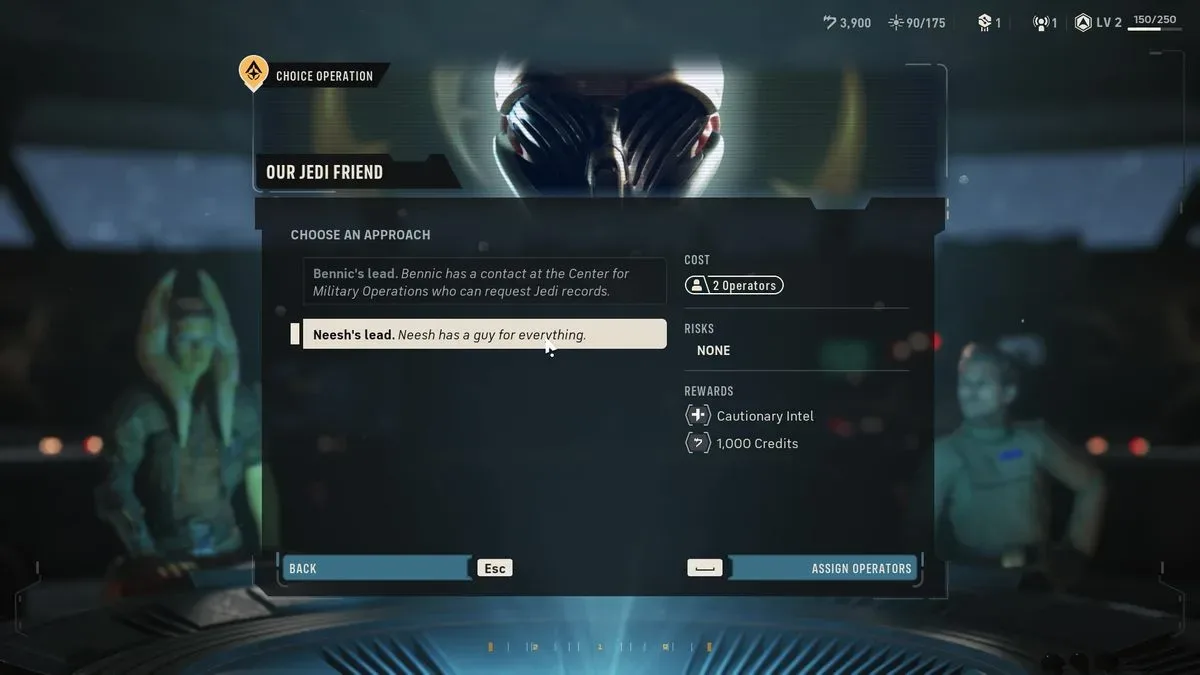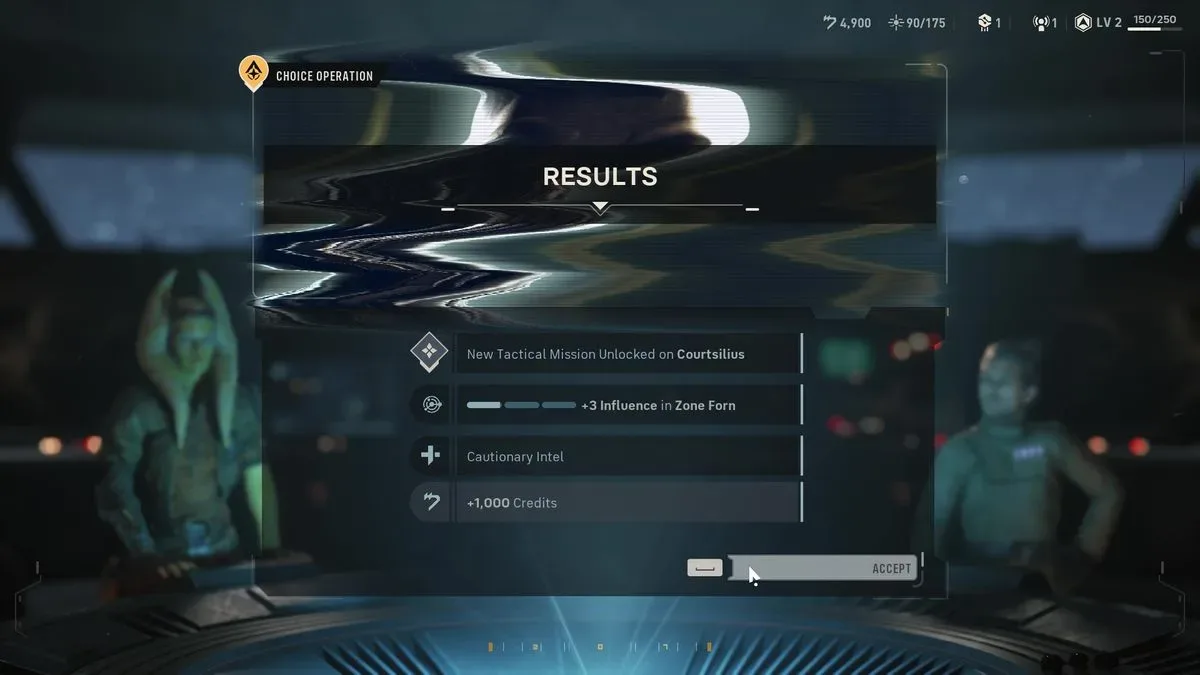
Star Wars Zero Company has a wonderfully serious name for a benefit that sounds as though it should come with a tiny clipboard and a mandatory safety briefing. Cautionary Intel is worth paying attention to, however. It is a permanent campaign benefit that reduces the chance of Operators suffering Injuries on Operations where injury is possible.
The most important number is straightforward: Cautionary Intel lowers Injury chance by 20% on Dangerous Operations. The more complicated part is the game’s wording. “Dangerous” can look like it refers to a named mission-difficulty setting, but in this context it means Operations that carry a risk of injuring the Operators sent on them. It is about the presence of injury risk, not necessarily a label on the difficulty selector.
There is a second wrinkle: the Den has a base upgrade also called Cautionary Intel, found in the Networking chain, and it displays the same 20% effect. Earning the mission reward does not unlock that upgrade. That strongly indicates the two are separate sources of the same protection and may stack, though the available information does not directly confirm the final combined percentage.
What Cautionary Intel does
Hovering over the Cautionary Intel reward reveals its practical function: it cuts the Injury chance for relevant Operations by 20%. In plain terms, it is a risk-management upgrade for the rest of the campaign rather than a one-operation consumable, a cosmetic reward, or a new mission setting.
That permanent status is why the reward deserves a closer look. A bonus that remains active after it is acquired can influence many future assignment choices. Whenever an Operation has the potential to harm an Operator, Cautionary Intel is intended to make that outcome less likely. It does not mean Injuries become impossible, and it should not be read as a guarantee that every assignment is safe. It reduces risk; it does not delete it from the galaxy with an especially stern memo.
The distinction matters because injury systems generally make players weigh potential rewards against the possibility that a valuable team member will be unavailable or otherwise affected afterward. A standing reduction in that risk makes hazardous-looking opportunities less punishing over time. It also provides a reason to read reward tooltips carefully rather than assuming that an item with an administrative-sounding name is merely flavor.
How to obtain the mission-reward version
Cautionary Intel can appear as a potential reward during the critical operation called Our Jedi Friend. To receive that route’s reward, players need to follow Neesh’s lead rather than Bennic’s.
That choice is the key detail for anyone deciding between the leads. The reward is attached to the Neesh outcome, not simply handed out for reaching the operation. Since the benefit lasts for the campaign, it is a meaningful strategic consideration even though the effect may not loudly announce itself every time an Operation resolves.
It is also worth separating what is known from what is merely a reasonable interpretation. Known: taking Neesh’s lead in Our Jedi Friend can grant Cautionary Intel, and the listed effect is a 20% Injury-chance reduction for Operations that can cause Injuries. Not established here: the exact alternative rewards or broader narrative consequences of following Bennic. Players should avoid filling in those blanks just because the Cautionary Intel route is clear.
“Dangerous Operations” is not a difficulty-level instruction
The word “Dangerous” causes the bulk of the confusion. Star Wars Zero Company uses Dangerous as one of its mission difficulty levels, so it would be easy to assume that Cautionary Intel only applies when a mission is set to that specific difficulty. The tooltip’s intended meaning is broader and more functional: it concerns any Operation where assigned Operators may be injured.
That means the sensible check is not simply, “Does this screen say Dangerous?” Instead, look for whether the Operation itself includes an Injury risk. If injury is on the table, that is the circumstance Cautionary Intel addresses. If injury is not possible, there is no relevant risk for the perk to reduce.
This is a small terminology trap with outsized consequences. Players who interpret the word only as a difficulty bracket may underestimate the perk, skip an otherwise attractive reward, or assume the effect has failed when they run an Operation outside that bracket. The perk’s value is tied to hazardous assignments in the injury sense, not a single named difficulty tier.
Why the duplicate Cautionary Intel name is confusing
The Den’s Networking chain includes a Cautionary Intel base upgrade with the same stated effect: a 20% reduction to Injury chance on applicable Operations. It is entirely reasonable to see the matching name and assume that the mission reward unlocks the Den node automatically. It does not.
That separation is the best clue to how the game treats the two versions. They have identical wording and purpose, yet they come from different systems: one is a reward connected to a critical-operation decision, while the other is a Den/base upgrade in Networking. Since acquiring the former does not mark the latter as unlocked, they appear to be distinct bonuses rather than two presentations of one shared unlock.
As a result, the likely outcome is that both effects can stack. That is an inference based on their remaining separately obtainable, not a confirmed breakdown of the game’s calculations. In particular, the information available does not establish whether two 20% reductions become a simple 40 percentage-point decrease, a 40% relative reduction, or another value produced by a hidden calculation. Treat stacking as probable, but do not promise yourself a specific final number until the game makes it explicit.
A practical reading of the two sources
- Our Jedi Friend / Neesh’s lead: can award Cautionary Intel as a permanent campaign reward.
- The Den / Networking chain: contains a separately unlocked Cautionary Intel base upgrade.
- Shared listed effect: each reduces Injury chance by 20% for Operations that can inflict Injuries.
- What remains uncertain: the exact mathematical result if both are owned.
In other words, do not ignore the Den upgrade because the mission reward has already appeared. The identical title is not evidence that one acquisition has made the other redundant. The fact that neither unlocks the other is the relevant detail.
Why a 20% injury reduction can matter over a campaign
A campaign-wide reduction has a different character from a reward that pays off once. It is not necessarily flashy in the moment: there may be no dramatic new weapon, no immediately visible battlefield trick, and no neon sign declaring that disaster was 20% less likely. Its benefit is spread over later Operations where injuries could happen.
That makes Cautionary Intel most useful when planning ahead. If an Operation is attractive but carries injury risk, the bonus helps soften the cost of committing Operators. It does not replace judgment about who to assign, nor does it turn every risky job into a free lunch in the Den cafeteria. It simply shifts the odds in the player’s favor where the relevant danger exists.
It is also a reminder that base progression and operation choices can overlap. The Den upgrade path is not only a separate checklist from mission rewards; in this case, it may reinforce the same kind of campaign protection. Players who enjoy arranging a resilient roster may see extra value in pursuing both sources, while still recognizing that the stacking behavior is an informed assumption rather than a published total.
For a similarly tactical conversation about the small social rules that emerge when people share a screen, see The Unwritten Rules of Couch Multiplayer, Now Written Down. The stakes are usually lower than an injured Operator, although someone sitting too close to the snack bowl can become its own critical operation.
Quick checklist before choosing or upgrading
- During Our Jedi Friend, remember that Cautionary Intel is linked to taking Neesh’s lead rather than Bennic’s.
- Read “Dangerous Operations” as Operations with a chance to inflict Injuries, not exclusively missions using the Dangerous difficulty label.
- Expect the reward to be permanent for the campaign, not spent after one use.
- Check the Den’s Networking chain separately; the base upgrade is not automatically unlocked by the mission reward.
- Consider the two bonuses potentially stackable, while leaving the exact combined percentage unconfirmed.
The practical answer is therefore pleasingly compact beneath the naming confusion: Cautionary Intel is a long-term 20% injury-risk reduction for Operations where injury is possible. Choose Neesh’s lead in Our Jedi Friend to obtain the operation-reward version, and do not mistake it for the separate Networking upgrade in the Den. Two identical labels may be trying to protect the same people from the same bad day—just through different progression paths.
If you are trying to keep older hardware viable alongside a current game backlog, the same basic principle applies: identify the system before spending resources. Before You Buy a Retro Console HDMI Adapter, Map the Connection offers a practical version of that rule for console setup rather than squad safety.