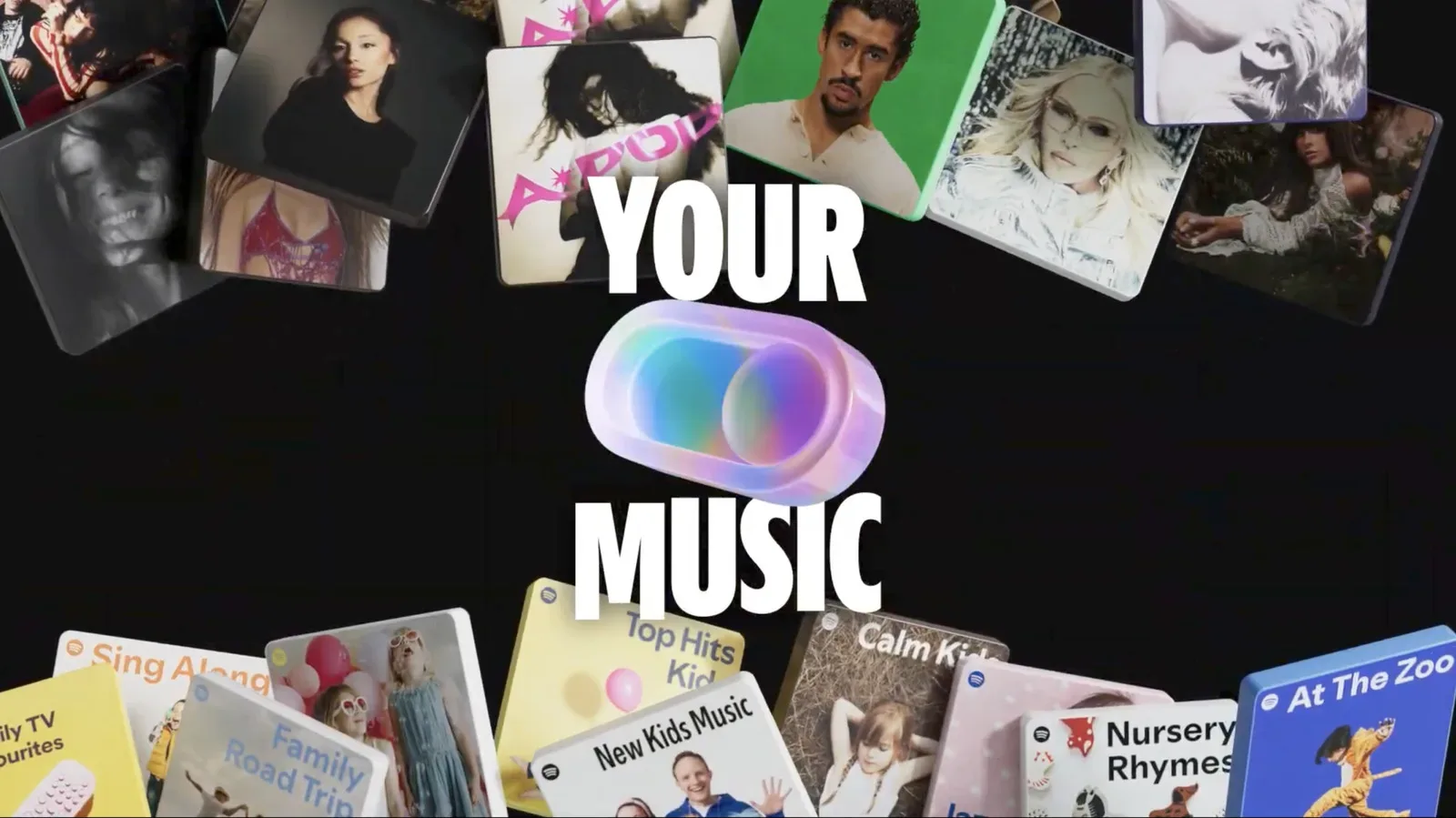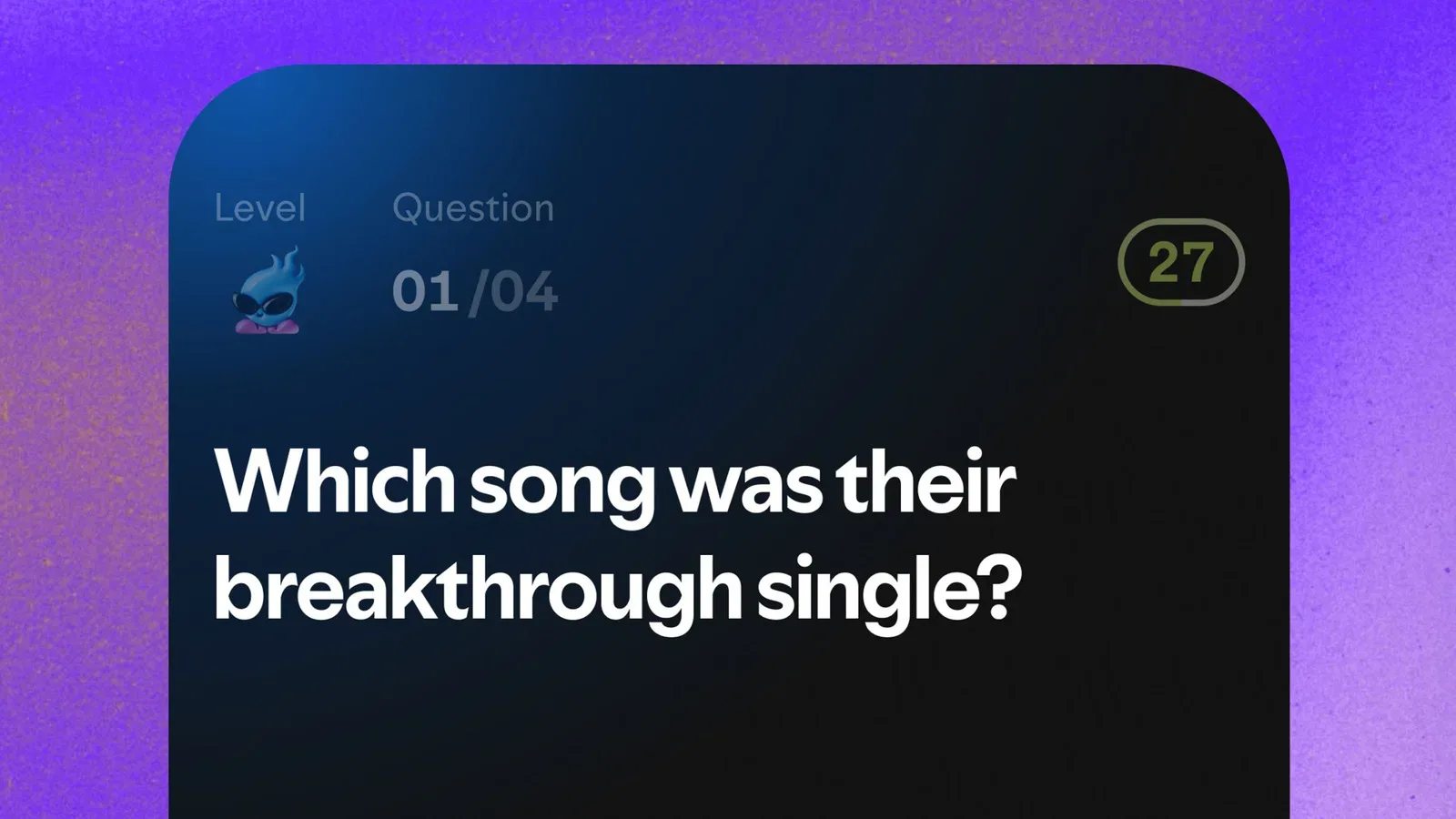
Spotify is widening Music Quiz from a BTS-focused novelty into a broader trivia feature covering more than 2,000 artists. The game is beginning its rollout for Premium subscribers on October 6 in the US, UK, Canada, Ireland, Australia, New Zealand, Singapore, India, Nigeria, South Africa and Indonesia.
The expanded quiz can be opened from a Music Quiz card in Spotify’s Now Playing view when a listener is playing a song by a participating artist. Players can then answer questions and share their results with friends. At launch, the experience is in English, while more languages and artists are planned over time.
What Spotify’s Music Quiz asks fans to know
Music Quiz is not framed simply as a test of song titles. Its question pool can span music trivia, album-cover reveals, audio track previews, an artist’s career and what Spotify describes as defining moments. That combination matters because it gives the feature several ways to challenge someone’s fandom.
An album-cover reveal question, for example, turns visual recognition into the prompt: a player may need to identify a release from its artwork rather than from a track. An audio track preview does the opposite, asking listeners to recognize music by sound. Career and defining-moment questions move beyond the immediate listening session and into artist knowledge.
The result is a lightweight game built directly into the place where people are already hearing a participating artist. Rather than asking listeners to search for a separate trivia hub, Spotify is tying the quiz to the Now Playing screen. In practical terms, eligibility depends on the artist whose song is on screen: the Music Quiz card appears for participating performers, not necessarily every track in the catalog.
From a single-artist game to a wider catalog
The feature first appeared earlier this year in connection with BTS returning to the studio. That edition focused on the K-pop group. The newly announced scope is much larger, with more than 2,000 artists represented, though Spotify has not provided the full artist list in the available details.
That distinction is useful for listeners managing expectations. “More than 2,000” refers to the number of artists whose music and careers can form the basis of quizzes; it does not mean every artist on the service has a quiz on day one. Likewise, the planned addition of more artists means the lineup is intended to grow after the initial rollout.
The expansion also makes Music Quiz less dependent on one fandom. A BTS-specific game naturally serves people who already have an interest in BTS. A multi-artist version can surface across far more listening sessions, potentially giving fans a reason to pause and engage whether they are listening to a long-time favorite or discovering an artist for the first time.
Related coverage includes Spotify Expands Music Quiz to More Than 2,000 Artists.
Who can use it at launch
Music Quiz is rolling out to Premium subscribers in 11 markets:
- United States
- United Kingdom
- Canada
- Ireland
- Australia
- New Zealand
- Singapore
- India
- Nigeria
- South Africa
- Indonesia
The initial language is English. Spotify says additional languages will arrive later, but there is no supplied timetable for those additions. Listeners outside the named countries, people on non-Premium tiers and users seeking another language should therefore treat the feature as unavailable or not yet confirmed for their circumstances at launch.
“Beginning to roll out” is also different from an instant, universal switch-on. Rollouts commonly mean access can reach eligible accounts over time rather than appearing simultaneously for every subscriber. The available information does not specify how long this stage will take, so the most accurate expectation is that eligible Premium users should look for the card in Now Playing when listening to participating artists.
A familiar listening-app move, with a game-shaped twist
Spotify has increasingly made listening data and catalog exploration into interactive products. Its year-end Wrapped reports are the largest example, packaging a person’s listening habits into a shareable recap. SongDNA takes a more liner-notes-like approach by presenting contextual information around songs. Music Quiz leans in another direction: it turns familiarity with an artist into a scoreable prompt-and-answer activity.
That structure matters because it changes what “engagement” looks like inside a music app. Streaming is normally passive or sequential: press play, queue tracks, save an album, move to the next recommendation. Trivia introduces a small decision loop. Hear or see a clue, make a choice, get a result, and compare or share it. It is not a full-fledged game platform, but the loop borrows a recognizable piece of game design: knowledge becomes something a player demonstrates.
The social element is equally deliberate. Results can be shared with friends, extending the quiz beyond a private score. A shareable result does not establish a leaderboard, competition format or reward system; none of those details have been announced here. It does, however, make the outcome portable, so an individual listening moment can become a prompt for conversation, friendly rivalry or a recommendation.
Why the placement in Now Playing is important
The Now Playing view is where a listener already has context: the song is audible, the artist is identified and the session is active. Placing the entry point there means a quiz can be prompted by the artist currently in someone’s ears. That is more immediate than a generalized trivia destination that asks users to decide what fandom they want to test before they hear anything.
It may also turn ordinary repeat listening into a different kind of interaction. Fans often replay familiar tracks precisely because the music is known. Music Quiz gives that familiarity a second use, asking whether the listener recognizes artwork, can place a preview, or remembers career-related information. For newer listeners, the same prompts could highlight parts of an artist’s catalog or history they have not encountered yet, although the supplied information does not detail how questions are selected or whether the game adapts to an individual’s listening history.
There is a practical boundary, though: the card is tied to songs by participating artists. If it is not visible during playback, that may simply mean the artist is not currently included, rather than a problem with the account. The broader artist set is promised to expand, but the initial roster has not been fully disclosed.
AI labels remain a separate part of Spotify’s product picture
The expansion arrives alongside other features meant to add context to listening, including labels for music that is not generative AI. Those labels address a different question from Music Quiz. A trivia game is about testing knowledge and encouraging participation; an AI-related label is about providing information on the nature of music in the catalog.
The distinction is worth keeping clear. Music Quiz’s questions may use track previews, cover art and artist career material, but nothing in the announcement says the new feature is connected to AI labeling or uses generative AI itself. They are separate product areas that happen to sit within the same broader effort to make a music-streaming interface more informative and interactive.
For Premium subscribers in the initial markets, the immediate takeaway is straightforward: play a participating artist, check the Now Playing screen for Music Quiz, and expect English-language questions that can range from audio recognition to visual and career knowledge. For everyone else, the relevant news is the scale of the expansion and the promise of future language and artist additions, not a confirmed date for access.
For a different look at how AI is being discussed around entertainment production rather than music-app features, see this report on Sega’s stated approach to generative AI and game creativity.