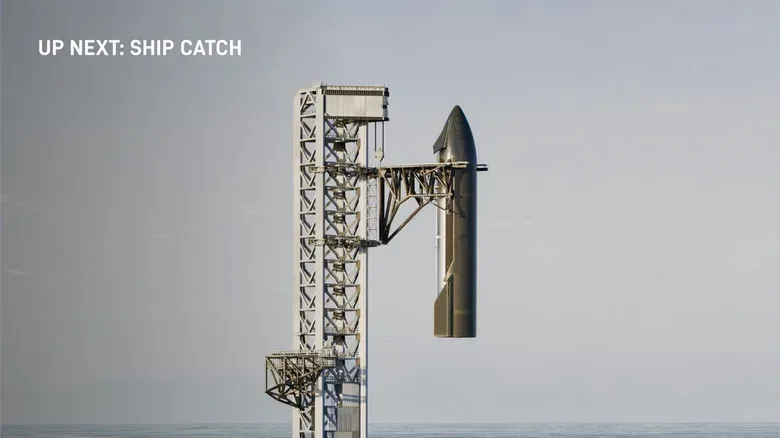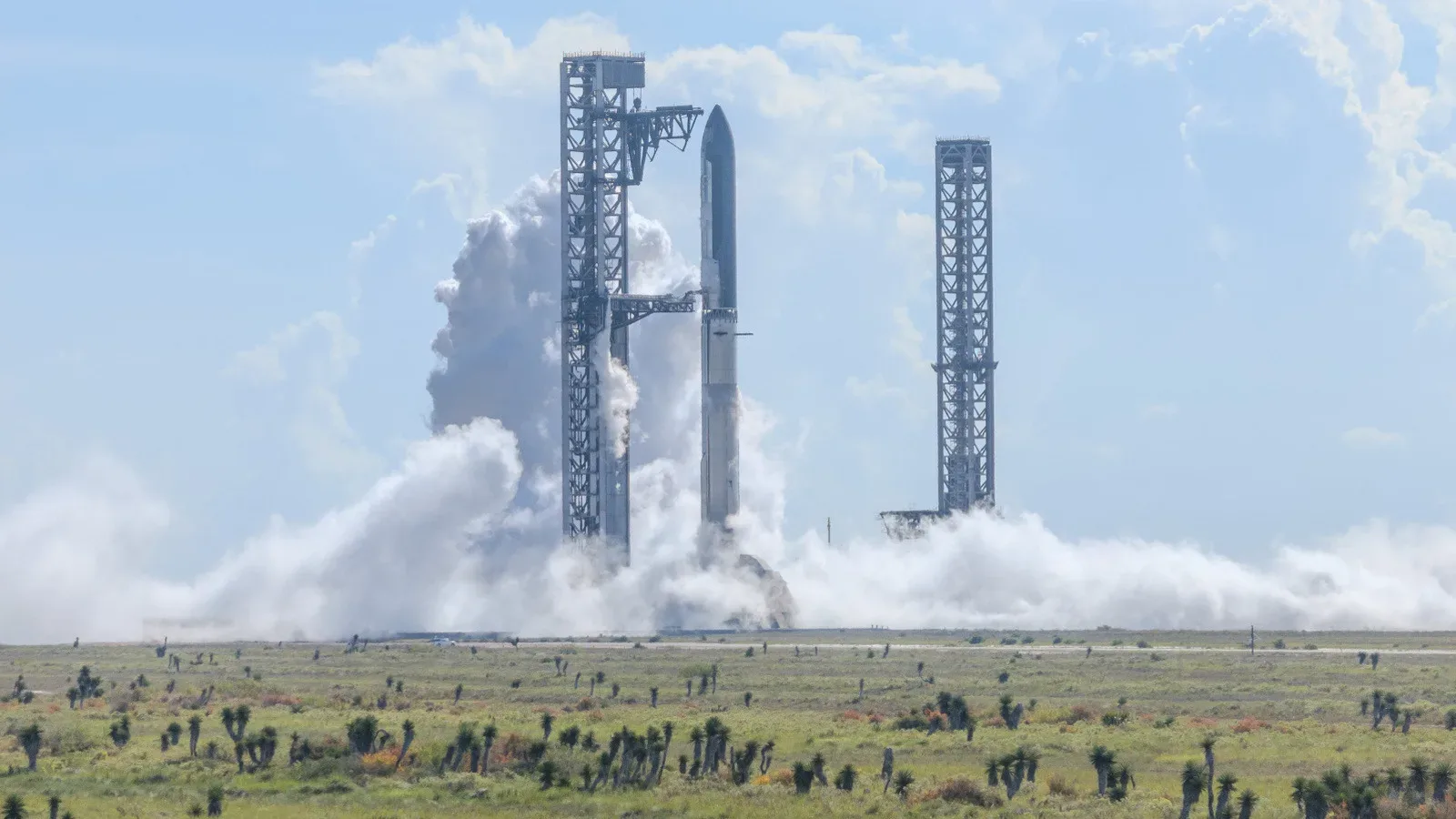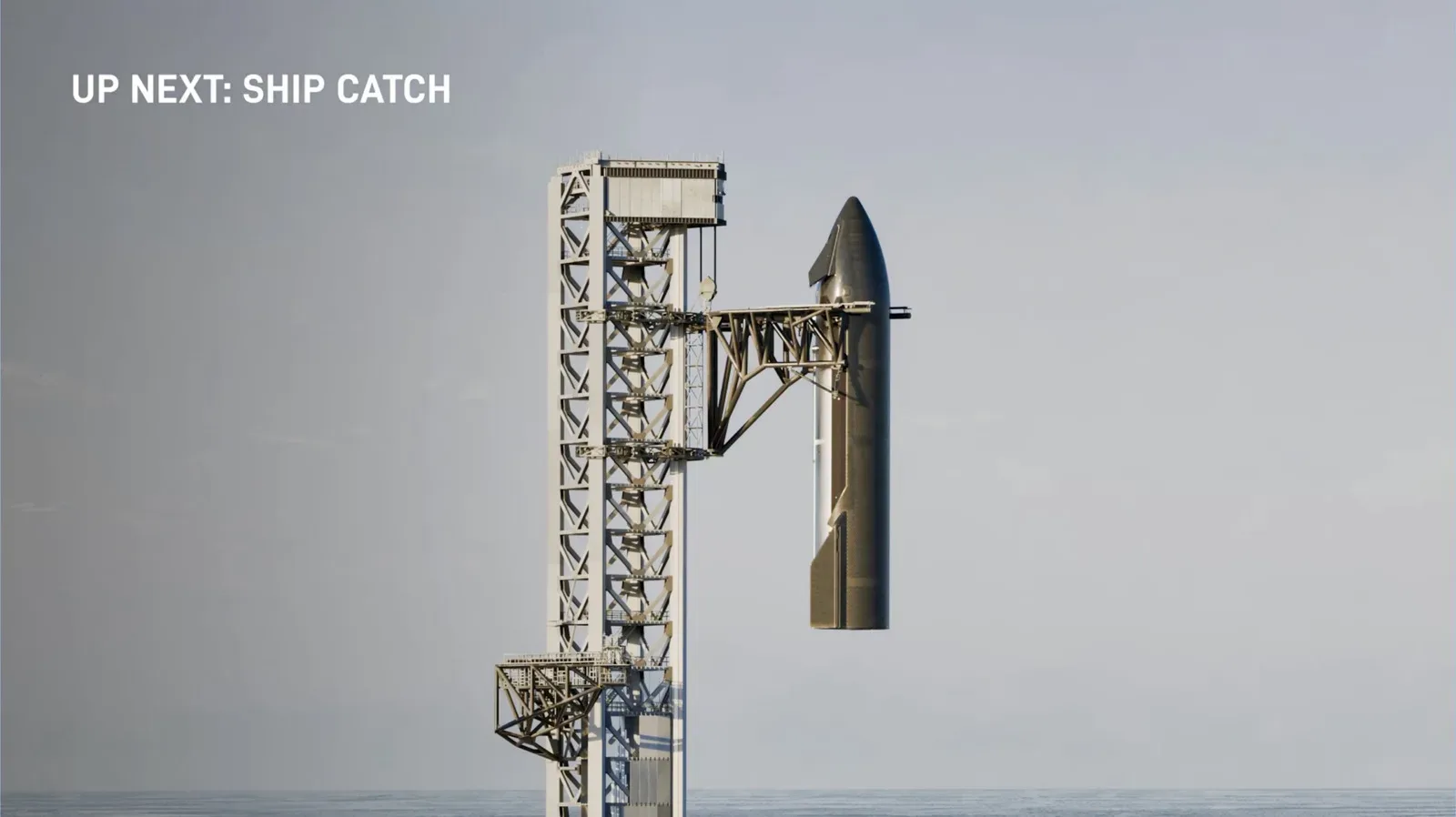
SpaceX says it intends to make Flight 15 a particularly consequential Starship test: a bid to recover both pieces of the launch vehicle at the launch site. The company has previously used the launch tower’s enormous mechanical arms to catch the Super Heavy booster. The new objective is to use those same arms to catch the upper stage, known simply as Ship, for the first time.
The attempt was outlined during a company earnings call streamed on X, where Elon Musk said Flight 15 could happen as soon as next month. That phrasing matters. It describes a plan and a potential timeframe, rather than a confirmed launch date or a guaranteed recovery attempt. Starship remains in flight-test development, and this proposed catch would be one of the program’s most ambitious recovery operations yet.
In the simplest terms, SpaceX wants the returning Ship to approach the tower precisely enough for the structure’s so-called chopstick arms to secure it. It is an image that naturally invites video-game comparisons: bring a huge, fast-moving vehicle back to one very specific landing zone, hit the timing window, and avoid ending the run in the sea. But the practical purpose is much more important than the spectacle. Recovering hardware at the tower is part of SpaceX’s stated goal of making Starship a fully and rapidly reusable orbital launch vehicle.
What Flight 15 is trying to do
Starship has two major stages. Super Heavy is the lower-stage booster, the portion that lifts the vehicle away from the ground after launch. Ship is the upper stage, the section designed to continue onward and intended to carry crew and cargo for future missions envisioned for the Moon and Mars.
For Flight 15, the proposed sequence is unusually clear in concept, even if it will be exceptionally demanding in practice:
- Super Heavy returns after its portion of the launch and is targeted for recovery at the launch tower.
- Ship continues much higher and farther on its mission profile.
- When Ship returns to Earth, SpaceX would aim to guide it back to the tower.
- The tower’s arms would attempt to catch the upper stage rather than having it splash down in the ocean.
The company showed a short simulation of the intended Ship recovery method during the call. A simulation can communicate the planned geometry and sequence, but it is not evidence that the maneuver has already been demonstrated in a real flight. The distinction is important here: SpaceX has caught Super Heavy with the tower arms in the past, while it has not yet attempted a capture of Ship.
Why catching Ship is a different challenge
The upper stage is not merely another booster recovery. The supplied flight history highlights the central issue: Ship goes higher, travels farther and moves faster than Super Heavy. That creates a very different return problem.
Super Heavy comes back only minutes after launch. Ship’s trip is on an entirely different timescale. On Flight 14, Ship was intended to remain in orbit for 10 hours and circle Earth. An engine malfunction cut that mission short, but Ship still took hours to return. The time difference illustrates why an upper-stage catch involves more than reusing the existing tower-arms concept.
For a catch to work, the vehicle must arrive at the tower at the right place and at the right moment, with the correct orientation and a controlled enough motion for the arms to secure it safely. That is not a claim about a disclosed Flight 15 operating procedure; it is the basic implication of attempting to catch a returning vehicle with a fixed structure. Compared with a splashdown, there is far less room for an off-target arrival.
The speed and distance involved also explain why the proposed test is significant even before its outcome is known. Returning an upper stage from a long, high flight is a different class of recovery objective from bringing back the lower stage shortly after liftoff. A successful Ship catch would demonstrate that Starship’s reuse plan can extend to both halves of the system, rather than stopping at booster recovery.
What the “chopstick” arms actually represent
“Chopsticks” is the informal name for the large arms attached to Starship’s launch tower. The nickname is memorable, but it can obscure their role. In this context, the arms are recovery equipment: the mechanism SpaceX proposes to use to receive the vehicle at the tower after return.
The terminology is useful because it separates the recovery approach from a conventional image of a rocket landing on a pad. SpaceX’s plan is not described as setting Ship down on the ground and then transporting it elsewhere. It is a direct tower catch. The recovery hardware is therefore part of the launch-site system, not an afterthought once the vehicle reaches Earth.
That approach aligns with the broader reusability ambition. A rapidly reusable vehicle is not simply one that survives a trip. It also needs a practical path back into future operations. Catching both stages at the launch tower could, if it works as intended, reduce the gap between recovery and another launch attempt. The material provided does not set out a turnaround schedule, a refurbishment process or a specific operational cadence, so those outcomes remain objectives rather than demonstrated results.
It is worth applying the same caution readers should bring to any impressive technical visualization. As our look at what product details can reveal beyond the headline claim argues in a different context, the important question is what has actually been established. Here, the established points are narrower but still notable: SpaceX has used the tower arms to catch Super Heavy, Flight 14 ended with both stages splashing down, and the company says it now intends to attempt the same broad recovery concept for Ship.
Flight 14 shows both the progress and the unfinished work
The previous test flight provides essential context for Flight 15. During Flight 14, both Super Heavy and Ship splashed into the ocean. Ship had been planned for a 10-hour orbital journey around Earth, but an engine malfunction caused SpaceX to shorten the trip. It nonetheless remained away for hours before coming back, unlike Super Heavy’s return a few minutes after launch.
That result contains no shortcut around the difficulty of the next stated goal. Flight 15 would move from ocean splashdowns for both stages to attempting tower catches for both. It also asks the upper stage to complete a recovery maneuver SpaceX has never attempted before. Even if the two stages are parts of the same overall vehicle, they are not interchangeable recovery targets.
There is a productive way to read the plan without treating it as a pre-written success story. Flight tests exist to gather information under real conditions, including when equipment underperforms or a mission must be altered. Flight 14’s shortened Ship mission because of an engine issue is a reminder that progress toward reuse will depend on more than the final approach to the tower. The vehicle has to complete its broader mission and return in a state that makes recovery possible.
Why a double catch would matter
SpaceX’s stated end goal is a fully and rapidly reusable orbital launch vehicle for deep-space missions. Starship was designed with carrying people and cargo to the Moon and Mars in mind. Under that vision, recovering both the booster and upper stage is not a side achievement; it is central to the case for the vehicle’s long-term usefulness.
A catch of Super Heavy demonstrates recovery of the lower stage. A catch of Ship would address the other half of the system—the stage that travels on the more distant and faster part of the journey. Pulling off both in a single test would therefore be a meaningful milestone toward the company’s stated reusability model.
Still, “meaningful milestone” is the right scale of language. It would not, by itself, prove routine rapid reusability, resolve the engine issue seen on Flight 14, or establish a timetable for Moon or Mars missions. It would demonstrate a new recovery capability in a live test, assuming the attempt goes ahead and succeeds. The difference between those statements is not nitpicking; it is the line between a test objective, a demonstrated capability and an operational system.
What to watch if Flight 15 proceeds
- Whether the flight occurs within the suggested window: “As soon as next month” leaves room for the schedule to change.
- Whether both recovery attempts are actually made: A plan to catch both stages does not guarantee that conditions during the mission will permit both attempts.
- Ship’s return profile: It is the unfamiliar portion of the proposed double recovery and the one that follows the longer, faster trip.
- The final recovery outcome: A tower catch is fundamentally different from the Flight 14 splashdowns, and success or failure will sharply define what has been learned.
For now, Flight 15 is best understood as a proposed escalation of Starship’s recovery testing. SpaceX has experience catching the Super Heavy booster, but it has not caught Ship. Trying to bring both stages back to the tower would put the company’s reusability vision into a far more demanding real-world test—one where the upper stage is the new and decisive challenge.