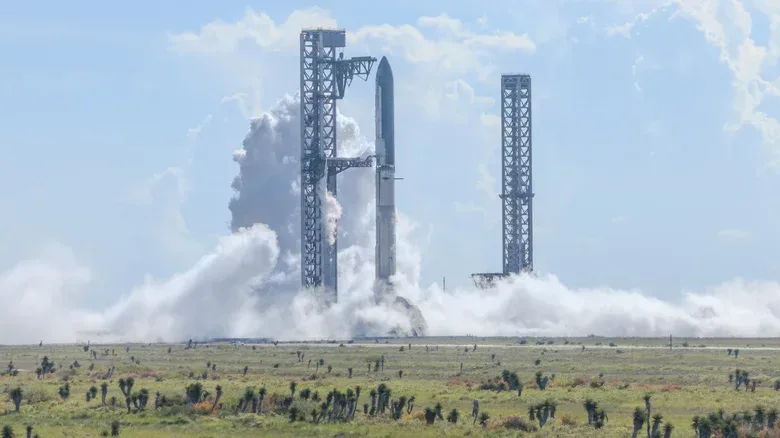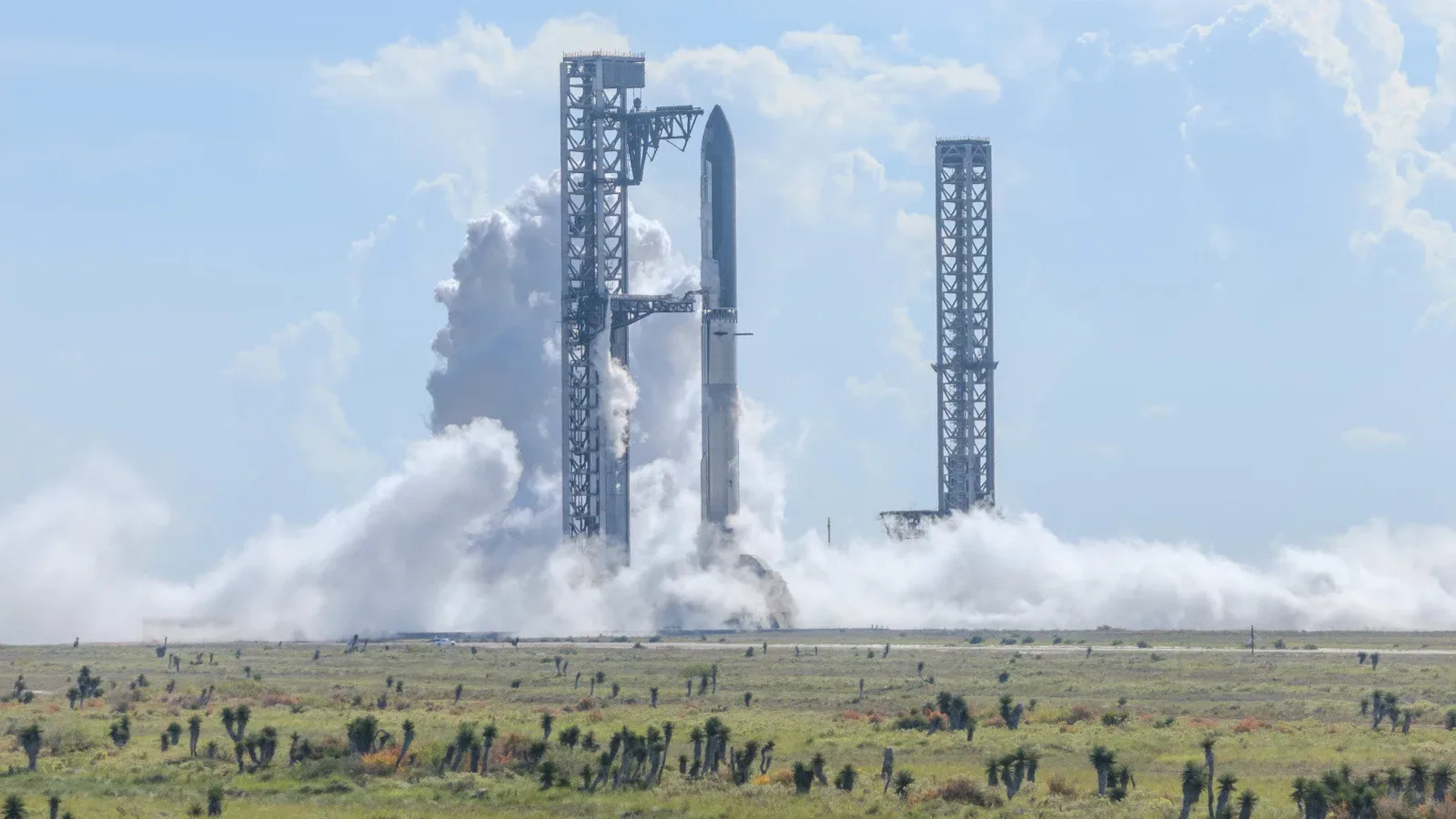
SpaceX says Starship has completed a wet dress rehearsal ahead of its planned Flight 14 mission, clearing an important ground-test milestone before what is intended to be the vehicle’s first orbital flight test.
The flight is scheduled for September 28, with a 75-minute launch window due to open at 8:15 a.m. Eastern Time. If the mission proceeds as outlined, Starship will make six orbits of Earth over roughly 10 hours, deploy 26 Starlink V3 satellites and then re-enter the atmosphere before ending in the ocean.
That is a notably more demanding objective than a suborbital test. Getting off the pad is only one part of an orbital mission: the vehicle must reach the speed and trajectory required to keep falling around Earth rather than immediately returning to it. It must then operate in space, release its payload, manage re-entry and complete its planned disposal sequence. Flight 14 is therefore set up to test a chain of systems rather than a single launch event.
What the wet dress rehearsal actually tested
A wet dress rehearsal is a full-scale launch simulation in which the rocket is loaded with its liquid propellants and powered on, but does not leave the ground. “Wet” refers to the presence of those real propellants, distinguishing the exercise from a dry run that might rehearse procedures without filling the vehicle.
For Starship, the rehearsal included final checks of fuel lines, software and communication with the ground team. The launch team also ran the full countdown sequence, practiced procedures for a weather-related scrub and drained the propellants afterward to simulate offload procedures.
That last point matters because a launch campaign is not simply a countdown that either ends in liftoff or failure. Teams need controlled procedures for stopping work when conditions are unsuitable and for safely returning the vehicle to a stable state. A scrub is the decision to halt or postpone a launch attempt; an offload is the process of removing loaded propellant. Rehearsing both means the operation is being evaluated as a complete sequence, including its contingencies.
The completed rehearsal does not guarantee the September 28 attempt will launch or complete every goal. It does, however, indicate that the vehicle and ground operation have gone through a major preflight check involving the systems needed during the most sensitive period of the mission: the time immediately before liftoff.
Why orbital flight is the headline objective
Starship has previously conducted multiple suborbital tests. A suborbital trajectory reaches space or near-space conditions without attaining the sustained path around Earth associated with orbit. An orbital flight, by contrast, requires the craft to travel with enough sideways velocity that Earth’s curvature continually carries the ground away beneath it.
Put simply, an orbital vehicle is not merely going high. It is moving fast enough to keep circling the planet. That distinction changes the mission profile in practical ways. The spacecraft must remain functional for longer, navigate in orbit, maintain communications with ground teams through the flight and execute a planned return from orbital conditions.
The proposed six-orbit, 10-hour profile gives Flight 14 a defined operational task beyond proving that Starship can reach orbit. It is expected to spend a substantial period circling Earth before re-entry, creating an opportunity to evaluate the vehicle across ascent, on-orbit operations, payload deployment and atmospheric return.
For viewers, it is worth separating the mission’s stated plan from a completed result. The planned sequence is: launch, reach orbit, conduct six orbits, deploy satellites, re-enter and end in the ocean. Each stage depends on the preceding stage working well enough for the mission to continue. A successful dress rehearsal is encouraging preparation, not a substitute for those flight milestones.
26 Starlink V3 satellites are part of the test
Flight 14 is also expected to carry 26 Starlink V3 satellites, described as the first next-generation models to be added to SpaceX’s satellite-internet constellation. Their inclusion makes payload deployment one of the mission’s central objectives rather than an incidental demonstration.
A satellite constellation is a group of satellites working together in space. In this case, the satellites are intended for the Starlink internet network. The key detail for this flight is not simply that Starship will be carrying cargo, but that it is expected to place 26 satellites into orbit during a mission designed to test the vehicle’s orbital capability.
Payload deployment adds another discrete operation to the flight plan. The vehicle has to reach its intended orbital environment and then release the satellites as planned. That makes the mission relevant both as a Starship test and as the intended introduction of the V3 satellites to the constellation.
The phrase “next generation” should be read carefully here. It identifies these as V3 models relative to earlier Starlink satellites, but the currently stated mission outline does not provide further technical specifications, performance claims or service timelines for them. The concrete expectation is their deployment: 26 V3 satellites are slated to fly on Flight 14.
A mission with a planned ocean ending
After six orbits, Starship is expected to re-enter Earth’s atmosphere and crash into the ocean. This is a test-flight endpoint, not an indication that the mission’s objective is to bring the vehicle back for recovery.
Re-entry is the phase when a spacecraft comes back into the atmosphere from orbit. It is a major portion of the planned profile because the vehicle must transition from operating in space to traveling through the atmosphere before its ocean impact. The available mission outline establishes the intended end state, but it does not specify the detailed re-entry path, recovery operations or any attempt to preserve the vehicle after splashdown.
That planned outcome also frames Flight 14 appropriately: it is an experimental mission with several ambitious objectives, rather than a routine transport operation. The test is intended to collect experience across a broad sequence, from propellant loading on the ground to orbital flight and an eventual atmospheric return.
What to watch on launch day
The first checkpoint is the opening of the launch window at 8:15 a.m. Eastern Time on September 28. The window lasts 75 minutes, meaning the stated opportunity extends beyond one exact instant. The wet dress rehearsal specifically included a countdown and scrub procedures, reminders that a scheduled window is not the same thing as a guaranteed liftoff time.
Beyond liftoff, the major stated events are orbital insertion, the six planned orbits, deployment of the 26 Starlink V3 satellites and re-entry. Those are the moments that will determine how much of the mission profile is accomplished.
For readers interested in the software side of complex modern systems, see our coverage of Microsoft Copilot’s Office integration, natural-language coding and Autopilot tasks. Starship’s rehearsal similarly underscores a simpler but crucial engineering reality: launch hardware does not work in isolation. Vehicle software, ground communications, procedures and people all have to align before an attempt can proceed.
The Starship launch is expected to be viewable on X. Until the countdown begins, the successful wet dress rehearsal is the clearest confirmed sign that Flight 14 is moving toward its scheduled orbital test attempt.