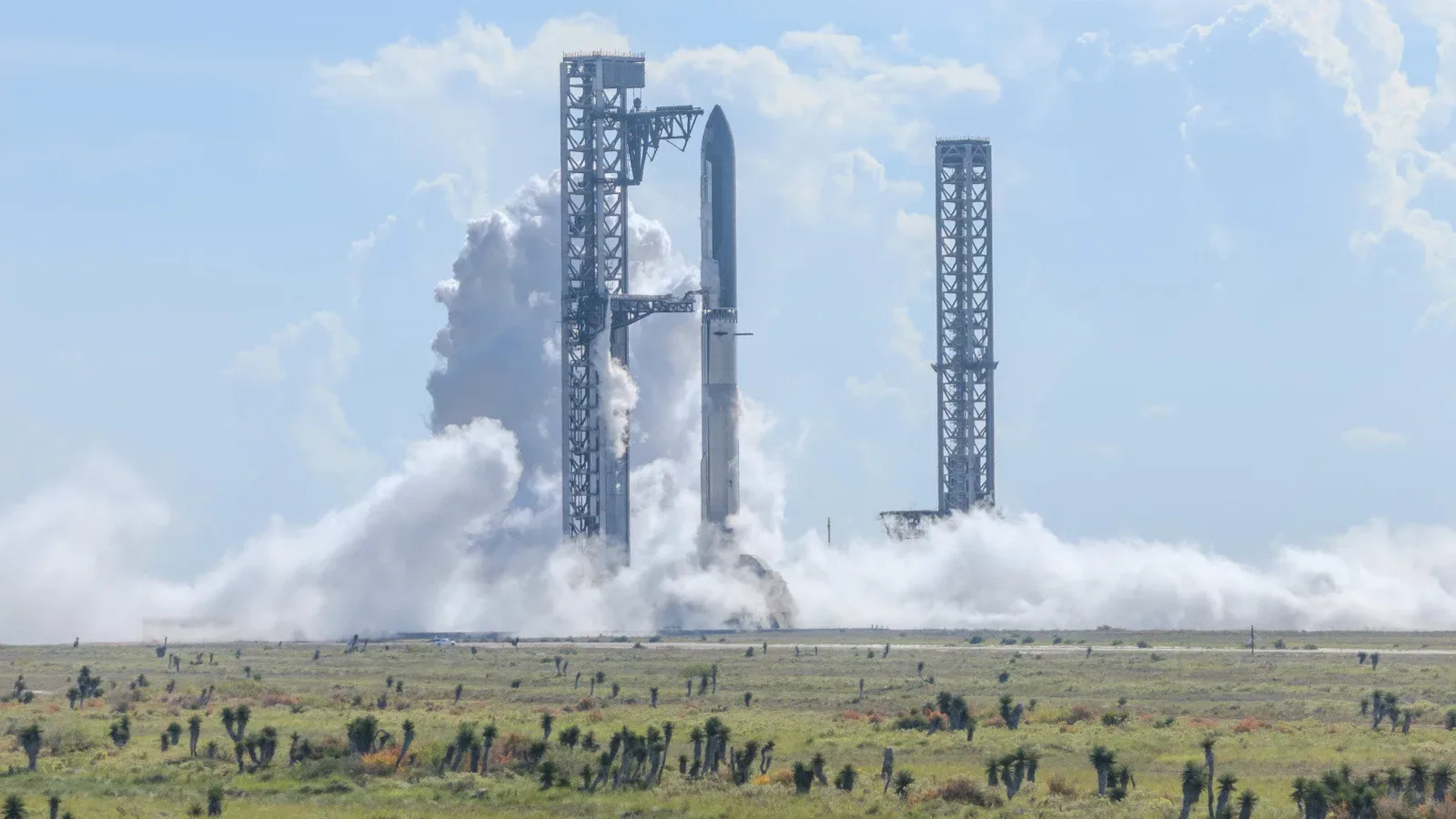
SpaceX’s 14th Starship flight has reached low-Earth orbit, a major step for the vehicle’s development that came with both a satellite deployment and an in-flight change of plan. The mission launched early Monday with Starship riding atop its Super Heavy booster, and it continued to orbit after one of Starship’s six Raptor engines was lost.
Rather than attempt the originally planned longer mission profile, SpaceX reduced the time Starship would remain in orbit. Flight 14 was initially intended to circle Earth six times over nearly 10 hours. With the engine offline, the vehicle instead spent roughly three hours in orbit before re-entering Earth’s atmosphere and landing in the Pacific Ocean.
The flight also deployed 26 Starlink V3 satellites. SpaceX said its Starlink team made contact with all 26 spacecraft after deployment. Those satellites are expected to become part of the company’s internet constellation and are intended to improve connection speeds for customers.
That means Flight 14 was not a simple all-or-nothing test. It combined a meaningful orbital milestone, a real deployment of new satellites, an altered mission plan prompted by an engine issue, atmospheric re-entry and a booster recovery exercise. Every one of those elements matters independently; accomplishing them in one mission is why this flight stands apart from the earlier Starship tests that carried V3 satellites only on suborbital trajectories.
What reaching low-Earth orbit changes
Low-Earth orbit, often shortened to LEO, describes the region of space close enough to Earth for many satellites to operate while still requiring a spacecraft to travel fast enough to keep falling around the planet rather than simply falling back to it. In practical terms, reaching orbit is distinct from a suborbital flight.
A suborbital vehicle goes into space and returns without sustaining an orbit around Earth. An orbital spacecraft has achieved the required trajectory and speed to continue circling Earth, at least until a controlled re-entry or a change in its orbit. Previous Starship flights had carried several V3 satellites as test payloads, but those missions remained suborbital. Their role was to check whether the new satellites could connect with the existing Starlink constellation, not to place them into operational orbit.
Flight 14 therefore moves the satellite portion of the program from a test arrangement to an actual orbital deployment. SpaceX has said contact was established with every one of the 26 newly deployed satellites, an important early confirmation that they were reachable after separating from Starship.
For people following launch systems through a gaming lens, the key distinction is the difference between clearing a difficult level and reaching the extraction point with the objective intact. Getting above the atmosphere is a significant achievement. Reaching orbit, deploying a payload and completing a return sequence turns that ascent into a much fuller mission demonstration.
Related coverage includes Starship Reaches Low-Earth Orbit on Flight 14, Deploys 26 Starlink V3 Satellites.
An engine loss changed the route, not the result
Starship’s orbital result came despite the loss of one of its six Raptor engines. SpaceX chose to proceed, but it did not treat the original flight plan as fixed. The company cut the planned duration from nearly 10 hours and six orbits to approximately three hours in orbit before re-entry.
That adjustment is important context when reading the headline result. The mission reached low-Earth orbit, but it did so with a compromise after an engine went offline. The shortened profile suggests a mission team balancing what could still be accomplished against the changed conditions during flight.
It is also a reminder that a launch result can contain multiple grades of success rather than being categorised neatly as either perfect or failed. Starship reached orbit, released its satellites and returned to Earth, while the engine loss prevented it from following the full original plan. The available details do not establish why the engine was lost, so it would be premature to draw conclusions about the cause or the longer-term implications for the Raptor system.
Raptor is the engine family used by Starship. On this flight, the reported loss involved one of Starship’s six engines, not a declaration that the mission had been immediately terminated. Flight 14’s revised trajectory demonstrates that the vehicle and mission operations were able to continue under that constraint, though the revised three-hour stay in orbit should not be confused with completing the initial six-orbit objective.
Twenty-six Starlink V3 satellites are now part of the mission’s practical value
The 26 Starlink V3 satellites give Flight 14 an immediate operational purpose beyond vehicle testing. Starlink is SpaceX’s satellite internet system, a constellation made up of many satellites working together to provide connectivity. The stated aim for these newly deployed V3 units is improved internet speeds for customers.
Contact with the satellites is an early and necessary stage after deployment. It indicates that the Starlink team can communicate with all 26 spacecraft in orbit. It does not, by itself, mean the satellites are already delivering improved service. The supplied mission details say they will eventually be used to improve speeds, which leaves a clear distinction between successful contact after release and their eventual role in the constellation.
The contrast with earlier test payloads is especially useful here. Those satellites were flown on suborbital Starship missions to test connectivity with the Starlink network. Flight 14’s V3 payloads were deployed into orbit, making this the first Starship mission in the provided account to take that further step.
For a broader read on people whose work connects with human spaceflight and the International Space Station, see our coverage of Victor Glover’s work on Artemis II and the ISS. Starship and Starlink are different programs with different immediate goals, but orbital missions depend on the same fundamental reality: reaching space is only one part of operating there.
Super Heavy’s recovery test took a different path
Flight 14 also tested the reusability of Super Heavy, the large booster that provides Starship’s initial lift. Once it had supplied the boost needed for Starship’s ascent, Super Heavy landed in the Gulf of Mexico. It is expected to be retrieved.
That outcome differs from the launch tower catch demonstrated previously. The tower’s mechanical arms are commonly called “chopsticks,” and they are designed to catch the returning booster. Flight 14 did not use that approach. Instead, Super Heavy landed in the Gulf, where recovery will follow later.
This distinction matters because “reusability” is not a single on/off achievement. A vehicle may demonstrate a controlled landing in one location and a tower catch in another scenario. In this case, the booster landing and planned retrieval are part of testing whether Super Heavy can be recovered for future use, but the mission did not repeat the tower-catch method.
The booster’s job is also separate from Starship’s job after separation. Super Heavy delivers the initial push required for the upper vehicle’s journey. Starship then continues toward orbit, carries the satellites and eventually performs its own re-entry and splashdown. Evaluating the flight means tracking both vehicles rather than treating “Starship” as shorthand for every event in the launch sequence.
Why Flight 14 is a consequential, qualified milestone
Flight 14’s clearest milestone is straightforward: SpaceX’s Starship reached low-Earth orbit for the first time. The mission also deployed 26 Starlink V3 satellites, and all 26 were contacted after deployment. At the same time, the engine loss and shortened orbital plan are essential parts of the story, not small footnotes to omit.
The operational picture is therefore encouraging but not spotless. Starship reached an orbital destination that earlier V3-carrying flights had not, while the mission’s duration was reduced from the original six-orbit, nearly 10-hour plan. Super Heavy completed a Gulf of Mexico landing and is slated for retrieval, but it was not caught by the tower’s chopsticks.
That combination is what makes the flight useful. It supplied data across ascent, orbital operations, payload deployment, re-entry and booster recovery while revealing a condition that required mission planners to adapt in real time. SpaceX now has an orbital Starship flight and an on-orbit batch of 26 V3 satellites to assess, alongside the question of what led to the Raptor engine going offline and what lessons the shortened profile will produce.