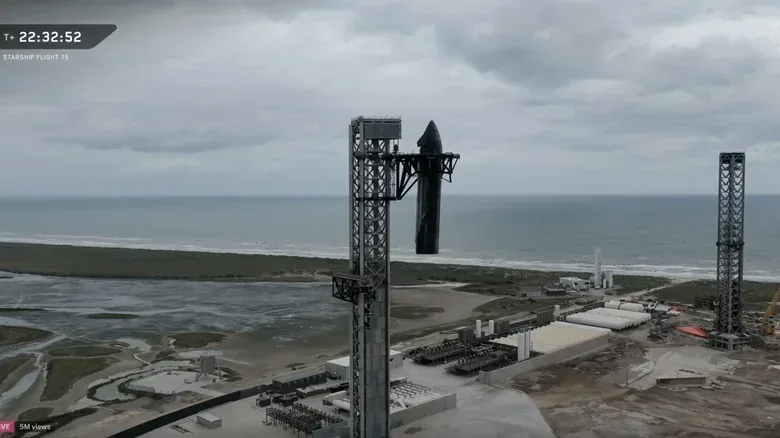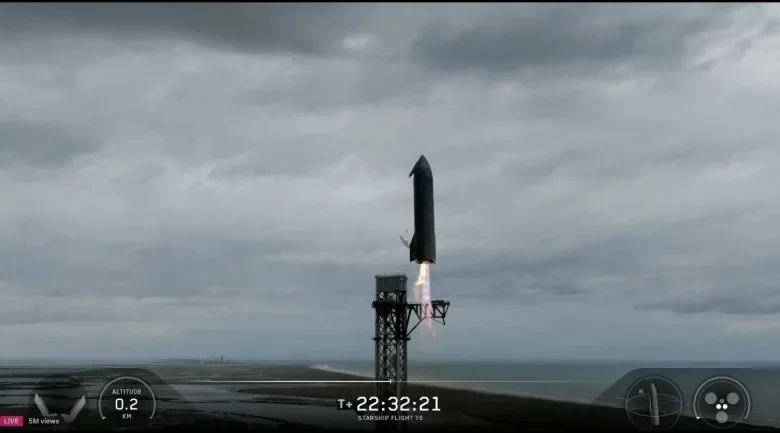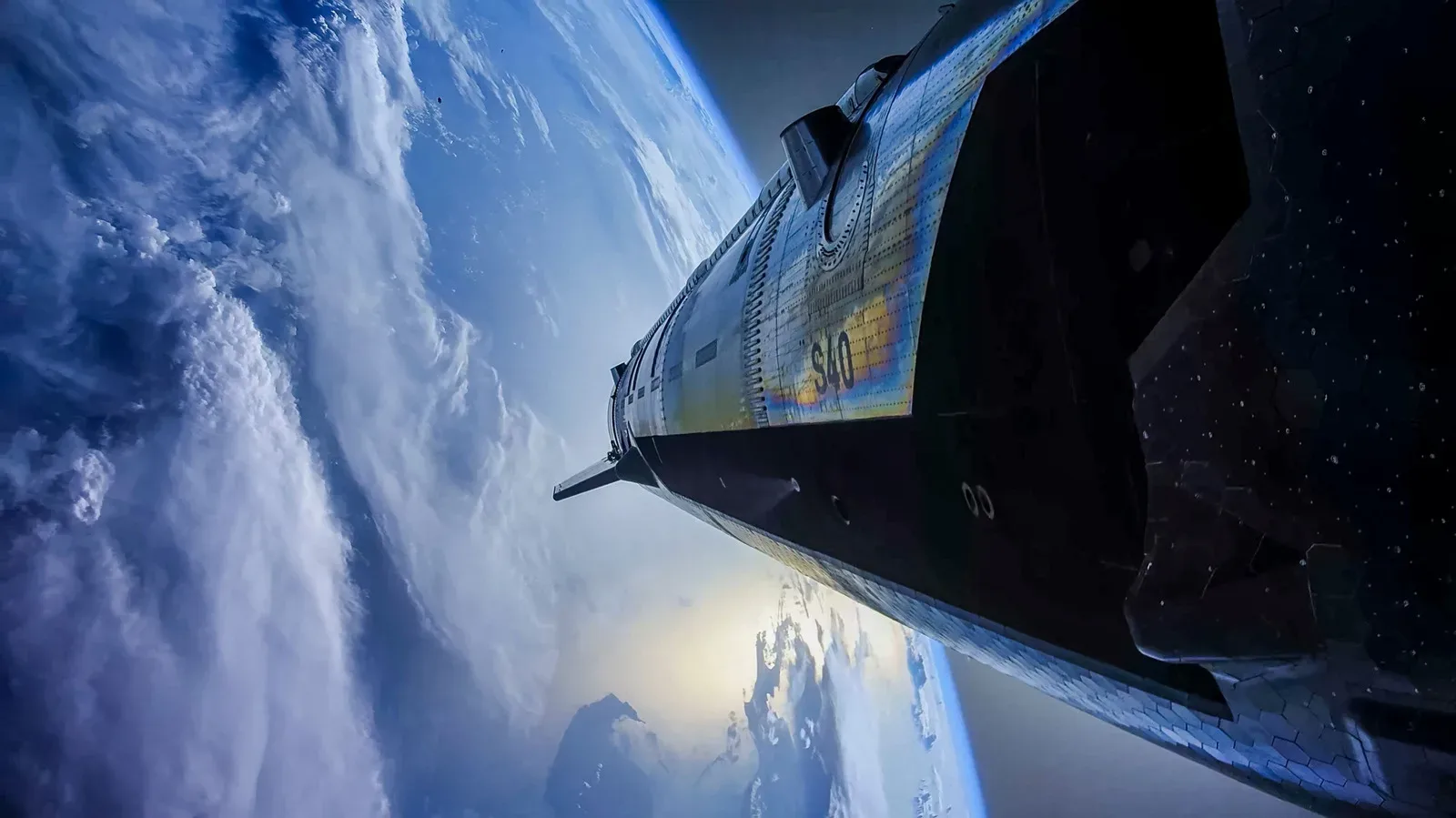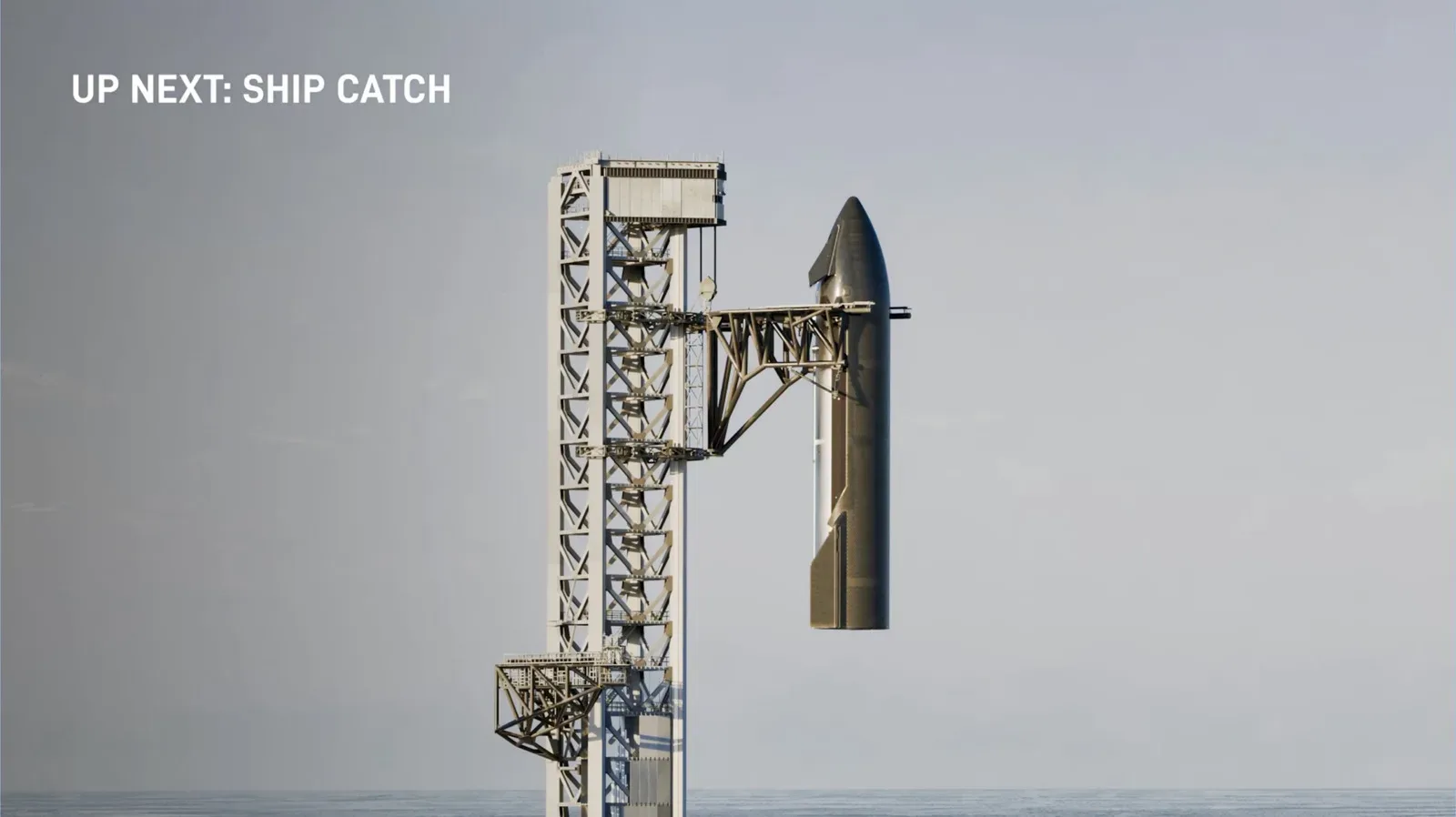
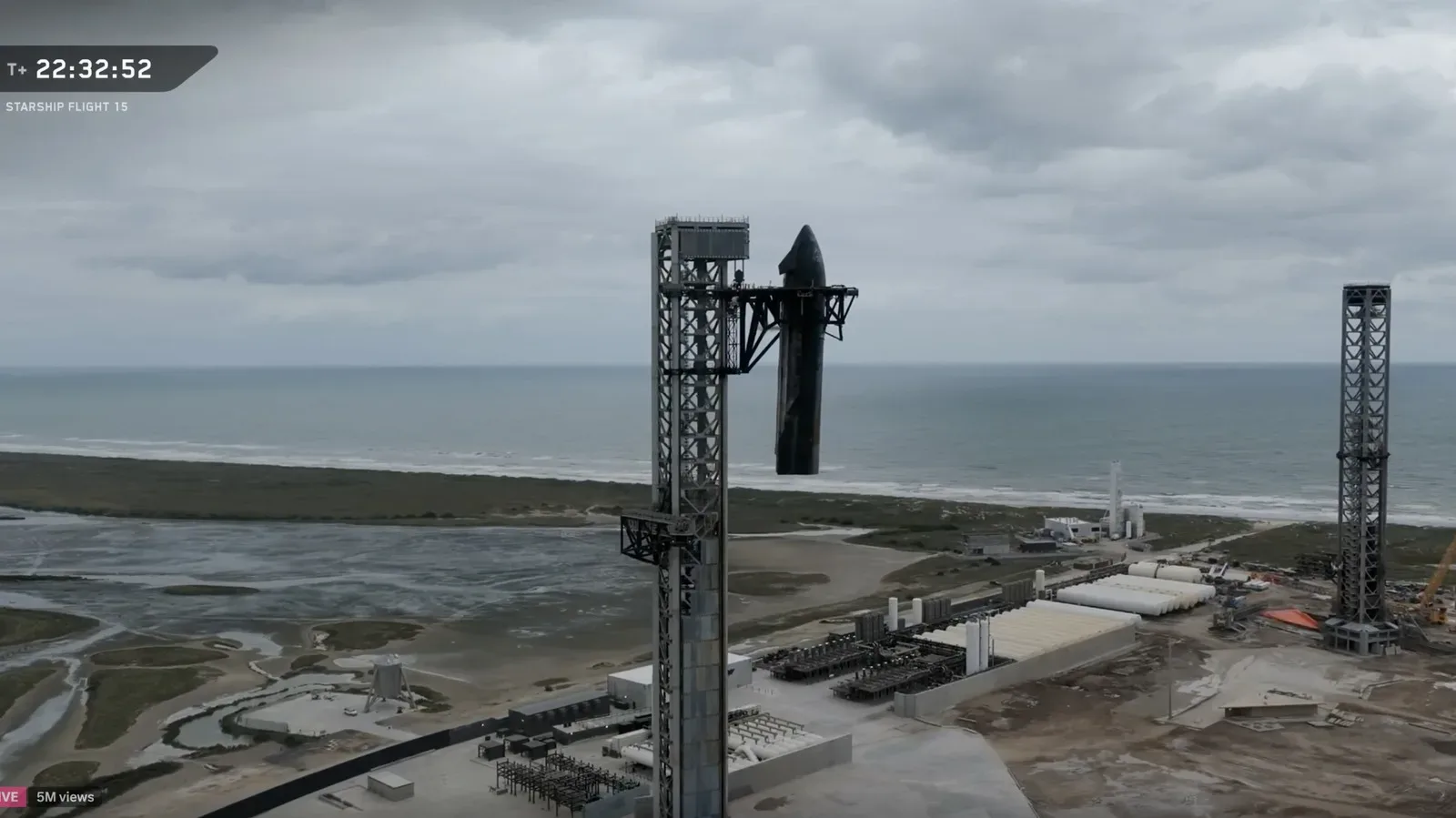
SpaceX has completed a milestone that sounds like it belongs in a sci-fi game’s endgame cutscene: it caught the Starship upper stage using the arms of the same launch tower it departed from in South Texas.
The maneuver occurred during Starship’s 15th test flight. It was the first time the company attempted to recover the upper stage—known as the Ship—through a tower catch, and it succeeded. The flight also deployed 26 Starlink V3 satellites to orbit.
That success came with an important caveat. SpaceX had planned a “double catch,” in which both major parts of the launch system would return to the site and be caught by the tower. The Super Heavy V3 booster encountered a problem during its descent, aborted its planned catch, changed course toward the Gulf, and exploded before reaching the water. The Ship continued its mission in orbit for roughly 22 hours after launch before returning for the successful tower landing.
What was caught—and why that distinction matters
Starship is described here as two primary pieces: the Super Heavy booster and the Ship upper stage. The booster is the first stage, the portion that begins the trip from the launch site. The Ship is the upper stage, which continues onward after the initial ascent phase.
That division is central to understanding why this flight is notable. SpaceX had already caught and reflown V1 Super Heavy boosters a couple of times. Recovering the Ship in this fashion was still unproven. Flight 15 therefore was not merely another demonstration of a previously established booster maneuver; it was an attempt to extend the same general recovery concept to the other half of the vehicle.
The successful Ship catch makes the test a genuine first for the program even though the booster portion of the planned sequence did not go as intended. In practical terms, the company demonstrated that its launch tower and upper stage could complete an extraordinarily precise reunion after the Ship had gone to orbit and remained there for about 22 hours.
The “chopstick” catch, explained
The launch tower’s catching hardware is often referred to as “chopstick arms,” a nickname that captures the visual idea without making the task sound simple. Rather than returning to a conventional ground pad or splashing down, the vehicle is brought back to the launch tower and received by its arms.
For Flight 15, the same tower in South Texas served as both Starship’s point of departure and the place where the Ship was recovered. That makes the landing sequence different from a typical image of a spacecraft coming down at a distant landing site: the goal was a controlled return to the launch infrastructure itself.
Related coverage includes SpaceX Catches Starship Upper Stage for the First Time on Flight 15.
It is worth separating what the result proves from what it does not. The flight proves that the Ship was caught by the tower on this attempt. It does not erase the booster’s aborted catch, nor does it turn the originally planned double catch into a full success. The accurate reading is more interesting anyway: SpaceX reached a major new upper-stage recovery milestone while encountering a separate first-stage failure during the same test.
How Flight 15 unfolded
- Starship launched from South Texas on its 15th test flight.
- The mission deployed 26 Starlink V3 satellites to orbit.
- The Super Heavy V3 booster began its return but developed a problem, prompting an aborted tower-catch attempt.
- The booster changed course toward the Gulf and exploded before it hit the water.
- The Ship continued in orbit for roughly 22 hours.
- The Ship then returned to the launch site and was caught by the tower arms.
That order matters because it illustrates the scale of the test’s ambition. The flight was designed to attempt a recovery of the booster soon after launch and then, a day later, seek the upper-stage catch. The Ship’s extended time in orbit means its catch was not an immediate continuation of ascent operations. It followed a long orbital segment and a return to the surface.
In that sense, the Ship catch was also a test of an entire mission chain: launch, orbital flight, return, and precise recovery at the original tower. The mission did not need the booster attempt to succeed in order for the Ship to continue its own journey and complete the later catch.
A major result beside a major failure
Test flights can produce results that resist an easy “win” or “loss” label, and Flight 15 is a clear example. The upper-stage catch is a major success, particularly because it was SpaceX’s first attempt at catching the Ship. The deployment of 26 Starlink V3 satellites is another stated mission objective that was completed.
At the same time, the Super Heavy booster failed to finish its planned return. It experienced an unspecified problem, did not proceed with the catch, and exploded before its redirected splashdown. The supplied information does not identify the nature of that problem, so it would be premature to attach a technical cause to it.
That uncertainty is significant. “Aborted” means the intended catch was deliberately discontinued rather than carried through to the tower after the issue arose. But it does not, by itself, explain why the problem happened or what changes may follow. For now, the firm factual line is narrow: the booster altered course, headed for the Gulf, and was lost before reaching the water.
SpaceX’s accomplishment with the Ship should therefore be viewed as a breakthrough within a mixed test outcome. The double catch did not happen. A first Ship catch did.
Why reuse is the big idea behind the spectacle
The repeated focus on catches and reflights points to the broader value of recovery. SpaceX has previously caught and reflown V1 Super Heavy boosters, demonstrating that the company is pursuing the ability to bring major launch hardware back rather than treat every flight vehicle as a one-time asset.
Extending that approach to the Ship is consequential because the Ship is not simply another booster attempt. It is the upper stage that went on to orbit during Flight 15 and deployed satellites before returning. A successful recovery after that orbital journey suggests a path toward bringing back more of the overall launch system.
That is analysis rather than a claim of a finished operational capability. One successful first attempt does not establish a routine cadence, reveal how quickly a caught Ship can fly again, or confirm that every future vehicle will follow the same sequence. Still, it establishes a new demonstrated event: a Starship upper stage has now been recovered by the tower arms.
The result also underlines why the tower itself is such a central piece of the system. It is not merely a structure used at liftoff. In this approach, it is part of the recovery operation. The same infrastructure is involved at the beginning and end of the Ship’s flight.
What gamers and tech fans can take from the test
The easy comparison is a precision-timing challenge: a huge vehicle must arrive at an exact target after a long sequence of dependent events. But Flight 15 is not a scripted quick-time event. The booster’s diverted descent is the reminder that an ambitious recovery sequence includes off-nominal outcomes and safety decisions. An abort is not the desired result, but it is distinct from forcing a planned maneuver to continue after a problem appears.
There is also a useful technical literacy lesson in the vocabulary. “Upper stage,” “booster,” “orbit,” “catch,” and “reflight” describe different parts of the mission and should not be folded into one broad idea of a rocket landing. The Ship went to orbit and was caught after about 22 hours; the Super Heavy booster attempted an earlier return and did not complete its catch. Both are Starship-related events, but they are not interchangeable.
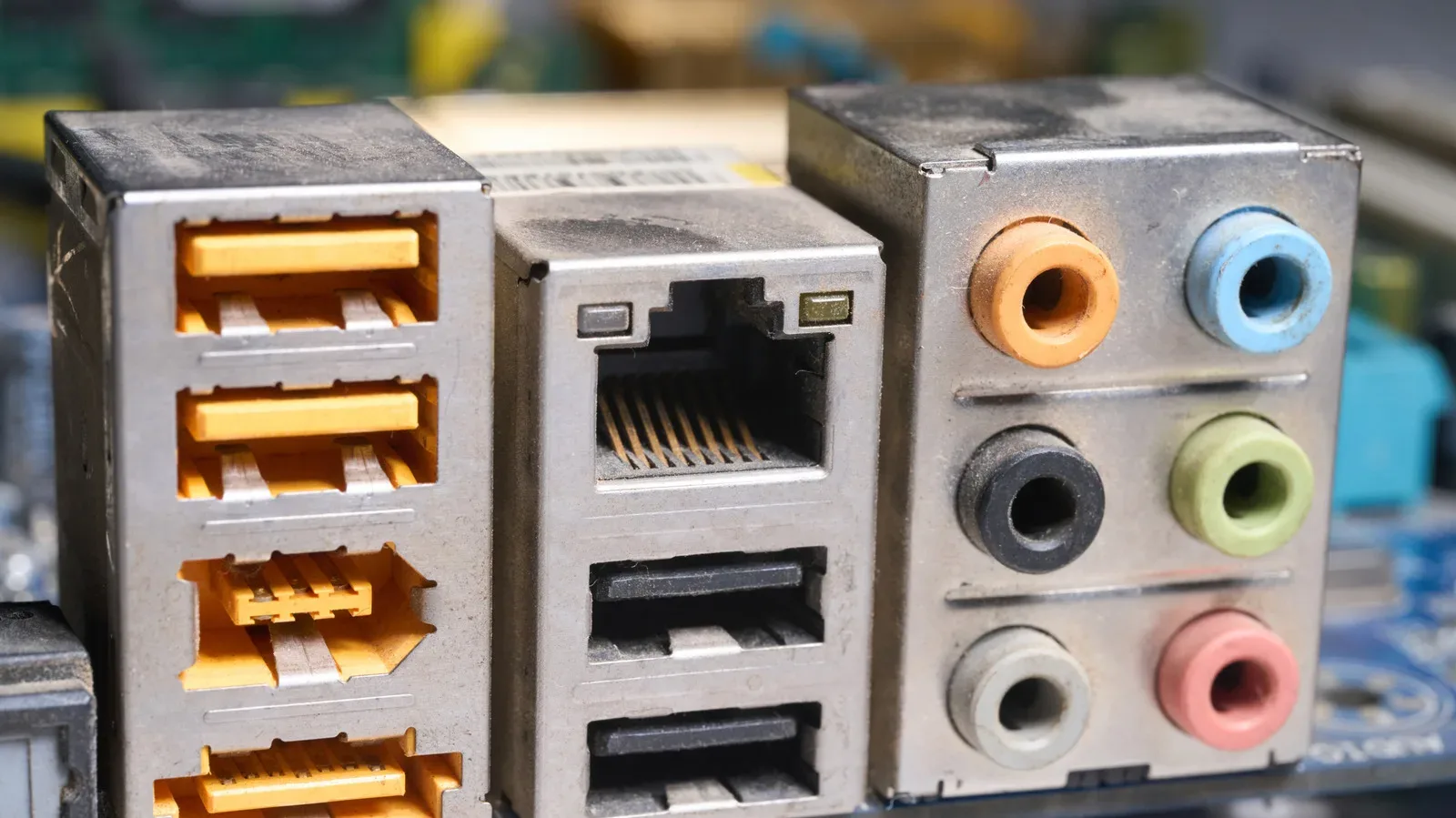
That sort of terminology matters in consumer technology too. Small labels can describe very different jobs or capabilities—a point worth remembering in hardware discussions such as what yellow USB ports usually signify. The Starship story is an unusually dramatic case of the same principle: knowing which component did what is the difference between understanding a headline and understanding the test.
What remains unknown after the catch
Flight 15 delivered a headline-making upper-stage recovery, but many details are not established by the available information. There is no stated diagnosis for the booster issue, no stated explanation for the explosion before splashdown, and no stated timetable for a next attempt. There is also no stated reflight plan for the caught Ship.
Those gaps should not diminish the confirmed achievement, but they do set its boundaries. The clearest takeaway is not that every part of the intended mission worked flawlessly. It is that SpaceX successfully carried out its first catch attempt of the Ship, following an orbital mission that included deployment of 26 Starlink V3 satellites.
For a program centered on recovering and reusing huge pieces of launch hardware, that is a concrete step forward. Flight 15 did not deliver the first double catch SpaceX wanted. It did deliver something that had not happened before: the upper stage came home to the tower, and the tower caught it.