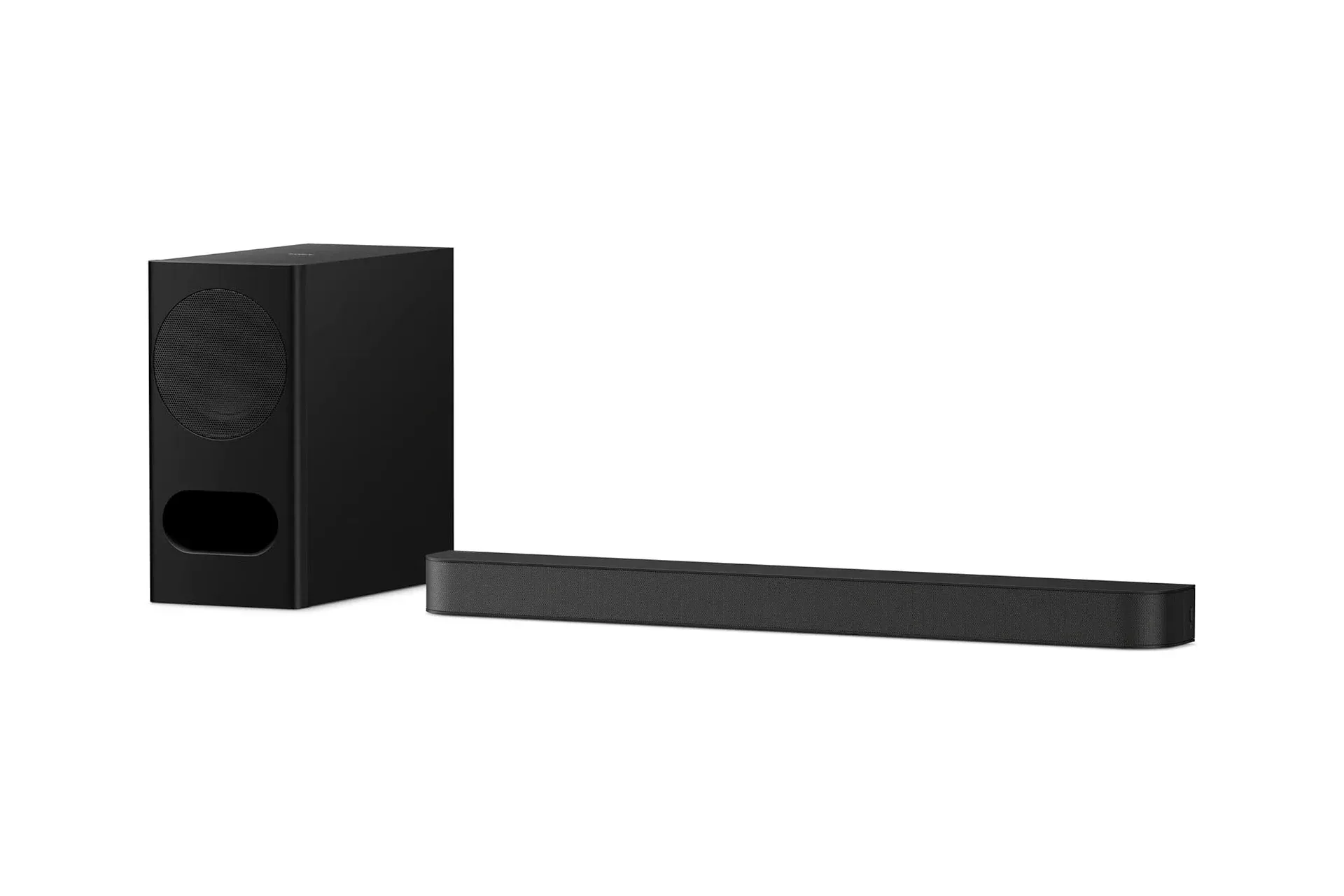
A television upgrade is often judged by pixels, panel size and refresh rate, but the sound side of the setup can be the part that changes everyday viewing most immediately. Sony’s BRAVIA Theater Bar 5 is currently listed at $278 for a limited time, a $72 reduction from its stated $350 regular price. The package includes the soundbar and a wireless subwoofer, making the deal relevant to anyone looking to move beyond television speakers without assembling a multi-speaker system piece by piece.
The headline discount is 21%, but the more meaningful question is what the bundle is designed to solve. Built-in TV speakers have to fit inside a very thin chassis and commonly leave dialogue, low-end effects and the sense of space competing for limited room. The BRAVIA Theater Bar 5 instead pairs a front soundbar with a separate subwoofer, while adding support for Dolby Atmos and DTS:X, Sony’s Vertical Surround Engine and a dedicated center channel for speech.
What is included in the $278 bundle
The offer covers Sony’s BRAVIA Theater Bar 5 along with its wireless subwoofer. The subwoofer uses a 160mm speaker and is intended to supply the bass that a television’s internal speakers generally cannot reproduce with much weight. That matters for the lower-frequency information in soundtracks: musical bass lines, environmental rumble and impact effects can all benefit from being handled by a separate, larger speaker.
“Wireless” here applies to the connection between the soundbar and its subwoofer. It does not mean either component works without power. For a living-room setup, though, separating the subwoofer connection from the TV connection can simplify where the bass unit is placed and reduce the need to run a speaker cable across the room.
The $278 price is described as temporary, so it should be treated as a current listing rather than a permanent new price. Anyone weighing the bundle should also make sure their TV’s available ports match the connection they plan to use.
The dialogue feature may be the practical standout
Specifications such as Dolby Atmos can draw attention, but the dedicated center channel may be the most immediately useful feature for many households. A center channel is a speaker channel focused on sounds positioned at the center of a mix, especially spoken dialogue. Sony says this channel can be adjusted independently of the rest of the audio.
That separate adjustment is useful because modern movie and television mixes can swing sharply between quiet conversations and loud action. Rather than repeatedly raising and lowering the entire system volume, a listener can prioritize speech through the center channel. It will not rewrite a program’s original mix, but it provides a more targeted control than a single all-purpose volume setting.
For viewers who frequently reach for closed captions because voices seem buried by music or effects, that is a feature worth putting ahead of more abstract surround claims. Clearer dialogue can matter just as much during a story-heavy game, where mission instructions, character exchanges and environmental cues may all be delivered through speech.
Related coverage includes Sony BRAVIA Theater Bar 5 Bundle Drops to $278 for a Limited Time.
Dolby Atmos, DTS:X and virtual surround explained
The BRAVIA Theater Bar 5 supports Dolby Atmos and DTS:X. Both are audio formats associated with more dimensional sound than conventional left-and-right stereo, including the possibility of overhead placement in compatible soundtracks. In a full home-theater installation, that can involve physical speakers located around and above the listener.
A soundbar does not necessarily mean a room has speakers in every direction. Sony’s stated approach includes its Vertical Surround Engine, which creates a virtual surround effect. “Virtual” is an important word: the system processes audio to produce a broader, more enveloping impression from the speakers that are physically present, rather than requiring a traditional array of separate rear and ceiling speakers.
How pronounced that effect feels can depend on the room and the material being played. The practical takeaway is not that a compact bar becomes a literal speaker installation all around the couch. It is that the Bar 5 is built to make compatible content feel more spacious than a TV’s integrated audio, while retaining a comparatively simple two-piece layout.
For a player or viewer, the combination of a dedicated dialogue channel, a separate bass unit and surround processing addresses different parts of the soundtrack at once. Dialogue handling is about intelligibility. The subwoofer is about low-frequency presence. Virtual surround processing is about perceived space and direction. They are related, but they are not interchangeable features.
HDMI ARC/eARC versus optical: the setup decision
Sony lists two ways to connect the BRAVIA Theater Bar 5 to a TV: optical cable or HDMI ARC/eARC. Both can provide a straightforward route from the television to the soundbar, but HDMI has a quality-of-life advantage described for this model: when connected over HDMI, the soundbar can be controlled with the same remote already used for the TV.
ARC stands for Audio Return Channel. It lets a compatible TV send sound back through an HDMI connection to an audio device such as a soundbar. eARC, or enhanced Audio Return Channel, is the newer form of that concept. For a buyer, the first step is simply to look for the HDMI port on the TV labeled ARC or eARC.
Optical remains the alternate option if HDMI ARC/eARC is not available or is not the preferred connection. But using HDMI can reduce remote clutter and make day-to-day operation less fussy, since TV remote volume control can also control the soundbar. That is a small convenience with a large practical impact: the best living-room upgrade is easier to enjoy when everyone using the television can operate it without switching remotes.
A quick compatibility checklist
- Check whether the television has an HDMI port labeled ARC or eARC if single-remote control is a priority.
- Use the optical connection option if that is the connection available on the TV.
- Plan a powered location for both the soundbar and wireless subwoofer.
- Leave room for the subwoofer’s 160mm driver to handle the system’s bass duties.
- Use the independently adjustable center channel when dialogue needs more emphasis than music or effects.
Why the bundle approach matters
There are two broad routes to improving a TV’s sound. One is building a larger system with separate components and more speakers. The other is choosing a soundbar package that combines multiple functions with a simpler installation. The BRAVIA Theater Bar 5 clearly belongs in the latter group: it offers a soundbar, wireless subwoofer, virtual surround processing and standard TV connection options without requiring a multi-speaker layout.
That does not make it the same thing as a room filled with discrete speakers. It does make the design easy to understand. The bar sits near the TV, the subwoofer adds the low end, and HDMI ARC/eARC can keep control on the existing television remote. For people whose current setup is exclusively the TV’s built-in speakers, those changes target the most familiar shortcomings: thin bass, difficult dialogue and a narrow soundstage.
It is also a reminder that an audio purchase should be evaluated by the problems it solves rather than only by format logos. Dolby Atmos and DTS:X support is useful for compatible material. Yet someone primarily frustrated by hard-to-hear voices may get more everyday value from the center-channel control. Someone who wants action scenes and music to feel less flat may care most about the included subwoofer. A buyer who dislikes juggling remotes may prioritize HDMI ARC/eARC.
Where this fits for game and movie setups
Games, streaming shows and movies put different demands on a system, but all can benefit from clearer separation among voices, effects and bass. In games, a dialogue-forward center channel can help keep character speech audible during busy sequences. A subwoofer can add more force to cinematic effects. Spatial processing aims to make sound feel less confined to the television itself.
The BRAVIA Theater Bar 5 is not presented as a headset replacement for competitive play, and its listed features do not establish a claim about competitive positional accuracy. Its more grounded appeal is shared-screen entertainment: games, films and series heard from the couch through a dedicated audio system rather than the television’s own speakers.
For another audio deal focused on portable, battery-powered playback rather than a TV-centered system, see our coverage of the Soundcore Boom 2 Plus listing.
At the currently stated $278, the BRAVIA Theater Bar 5 bundle’s clearest value proposition is straightforward: a wireless subwoofer is included, dialogue has a dedicated adjustable channel, and HDMI ARC/eARC can make setup and control less complicated. Those are tangible considerations for anyone whose expensive TV still sounds like it is doing its best from inside a thin frame.
Shop the products
Check current price, model and availability at the retailer.