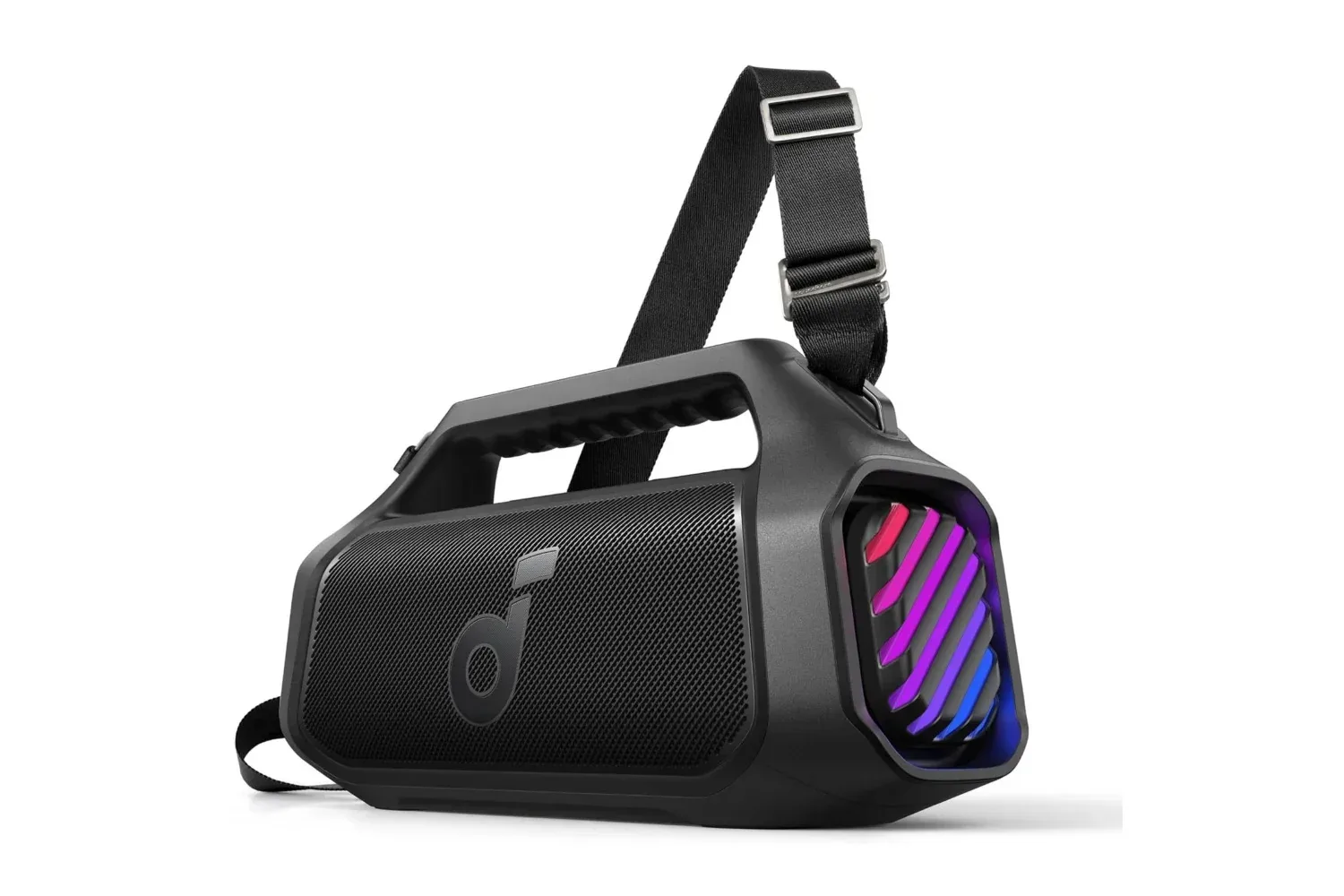
The Soundcore Boom 2 Plus is listed at $170 on Amazon, a reduction from its stated $250 regular price. That is a $80 difference, or 32% off the stated price, and the discount is presented as applying to the Black, Blue, and Green finishes.
For a portable speaker, the more interesting question is not simply how loud the number on the price tag looks: it is what the hardware is designed to do away from a desk or TV cabinet. The Boom 2 Plus combines a claimed 20-hour battery life, USB-C charging with output for topping up another device, IPX7 water protection, floating capability, app-based EQ controls, and music-synced lighting. It is a feature set aimed at outdoor gatherings, travel, poolside use, and anyone who wants one speaker to carry both music and a little emergency phone power.
The deal is framed as the lowest price yet seen for this model, though prices, retailer listings, and stock can change. Shoppers considering it should check the live listing, selected colour, and final price before ordering rather than assuming the promotion will remain in place.
What the Boom 2 Plus is built around
Soundcore specifies a driver layout of two 50W woofers and two 20W tweeters. A woofer is the driver responsible for lower-frequency sound, where kick drums, bass lines, and other weighty elements live. A tweeter handles higher frequencies, including much of the detail in vocals, cymbals, and sharp instrumental sounds. Separating those jobs can help a speaker avoid asking one driver to reproduce every portion of the frequency range at once.
The company also describes “smart crossover” processing. A crossover is the system that divides an audio signal into frequency bands and sends them to the most appropriate drivers. In straightforward terms, the cited processing analyzes what is playing and routes lower frequencies toward the woofers and higher frequencies toward the tweeters. The intended benefit is clearer separation: bass should have room to land while higher details are less likely to become lost in it.
That distinction matters for games as much as it does for music. Soundtracks can stack rumbling effects, dialogue, ambience, and score in the same few seconds. A speaker intended to keep lows and highs better organized may be attractive for casual living-room or backyard play, provided the listener understands that portability and big-volume output are the product’s priorities. Nothing in the available details establishes specific latency performance, supported wireless codecs, or its suitability for competitive play, so buyers who need those particulars should not infer them from the power figures alone.
A 100W mode, with a claimed 140W BassUp option
The Boom 2 Plus is described as delivering 100W normally, while the BassUp 2.0 feature raises output to 140W. BassUp is Soundcore’s bass-focused enhancement mode, and the practical idea is straightforward: it is intended for moments when a listener wants a bigger, more forceful low-end presentation.
That does not mean every track necessarily benefits from maximum bass treatment. Heavy electronic music, hip-hop, action-game effects, and outdoor party playlists may be the obvious use cases, but some listeners may prefer a more restrained balance for dialogue-driven games, acoustic music, podcasts, or movies. The useful part of the package is that the speaker can be adjusted rather than locked to one presentation.
The Soundcore app provides an equalizer, or EQ, for adjusting bass, midrange, and treble. Bass affects the low-end weight; mids carry a large part of voices and many instruments; treble covers the brighter high-frequency detail. The app also includes guided tools intended to help users create a preferred sound profile. For buyers who use the speaker in more than one setting, that flexibility could be more practical than leaving a bass boost enabled all the time.
There is also a path to a larger setup: the Boom 2 Plus can pair with another compatible Soundcore speaker to double output. This is potentially useful for a larger space or an event where one speaker is not enough. Compatibility is the important word, however. The provided information does not identify the full range of compatible models or describe channel behavior, so prospective buyers should confirm the pairing details for the specific second speaker they own or plan to buy.
Battery life and USB-C power-bank use
Soundcore rates the Boom 2 Plus for up to 20 hours from a single charge. “Up to” is a maximum claim rather than a promise that every use pattern will reach that figure. Volume, lighting, bass enhancement, and the type of material being played can all be relevant considerations in normal speaker use, though no performance breakdown is supplied here.
Even so, a 20-hour claim gives the speaker a clear role: it is meant to last beyond a short session without immediately needing an outlet. That can be more valuable than a raw output number for camping, a day outdoors, or a shared space where the speaker is routinely moved around.
The USB-C port supports input and output. Input is how the speaker itself is charged; output means its stored energy can be used to charge another USB-C device, such as a phone. This effectively makes the speaker a power bank in a pinch. It is a convenience feature, not a reason to ignore a dedicated battery pack if phone endurance is mission-critical, but it could help when a handset needs enough charge for maps, messages, tickets, or calls.
Portable technology is increasingly judged by how well it moves with a player rather than how permanently it occupies a shelf. That same utility-minded idea appears in devices designed to carry gaming progress between machines, such as 1Retro’s effort to synchronize retro emulator saves across devices. The Boom 2 Plus is a different kind of accessory, but its appeal similarly rests on reducing friction when people take entertainment out of one fixed room.
Water resistance, floating, and lights
The Boom 2 Plus carries an IPX7 rating and is described as waterproof and floatable. The “IP” label is an ingress-protection rating. The X indicates that no solid-particle or dust rating is stated in that classification, while the 7 refers to water-resistance testing at the relevant level. It is meaningful protection for a speaker intended to be near pools and beaches, but it should not be stretched into claims that are not provided: an IPX7 rating is not the same thing as a dust-resistance rating.
Floatability is an especially practical inclusion for pool use, since it makes an accidental drop into the water less dramatic than it would be with a conventional speaker. Still, water protection does not remove the need for common sense around ports, charging, or general care. The supplied details do not make broader claims about every environment or accessory configuration.
The speaker also has integrated lighting that synchronizes with music. Users can choose among eight effects and customize colours. This will be a quality-of-life feature rather than an audio one, but it contributes to the speaker’s party-oriented brief. It also gives buyers the option to make the speaker visually quieter or more expressive depending on the setting.
Who the current listing best suits
At the listed $170 price, the Boom 2 Plus makes the clearest case for someone seeking a single, substantial portable speaker rather than a tiny personal Bluetooth unit. The claimed 100W-to-140W output range, twin woofer-and-tweeter design, and option to pair another compatible unit all point toward fuller-room or outdoor use. The ability to tune the EQ means it is not exclusively for listeners who want bass pushed as hard as possible.
It may also appeal to people who place real value on resilience and flexibility: IPX7 protection, floating capability, a claimed 20-hour battery, and USB-C power output each solve a different portability problem. None makes a speaker automatically right for every buyer, but together they describe a device designed to stay useful well away from a wall outlet.
Before treating the offer as a must-buy, prospective customers should separate the confirmed listing details from unanswered needs. Check the current price and colour availability, and consider whether maximum volume, water resistance, lighting, app EQ, or phone-charging support are actually priorities. Those who chiefly need precise low-latency gaming audio or more detailed connection information should look for specifications that address those requirements directly. For buyers whose priority is loud portable music with configurable sound and outdoor-minded features, the $170 listing is the notable part of the story.
Shop the products
Check current price, model and availability at the retailer.