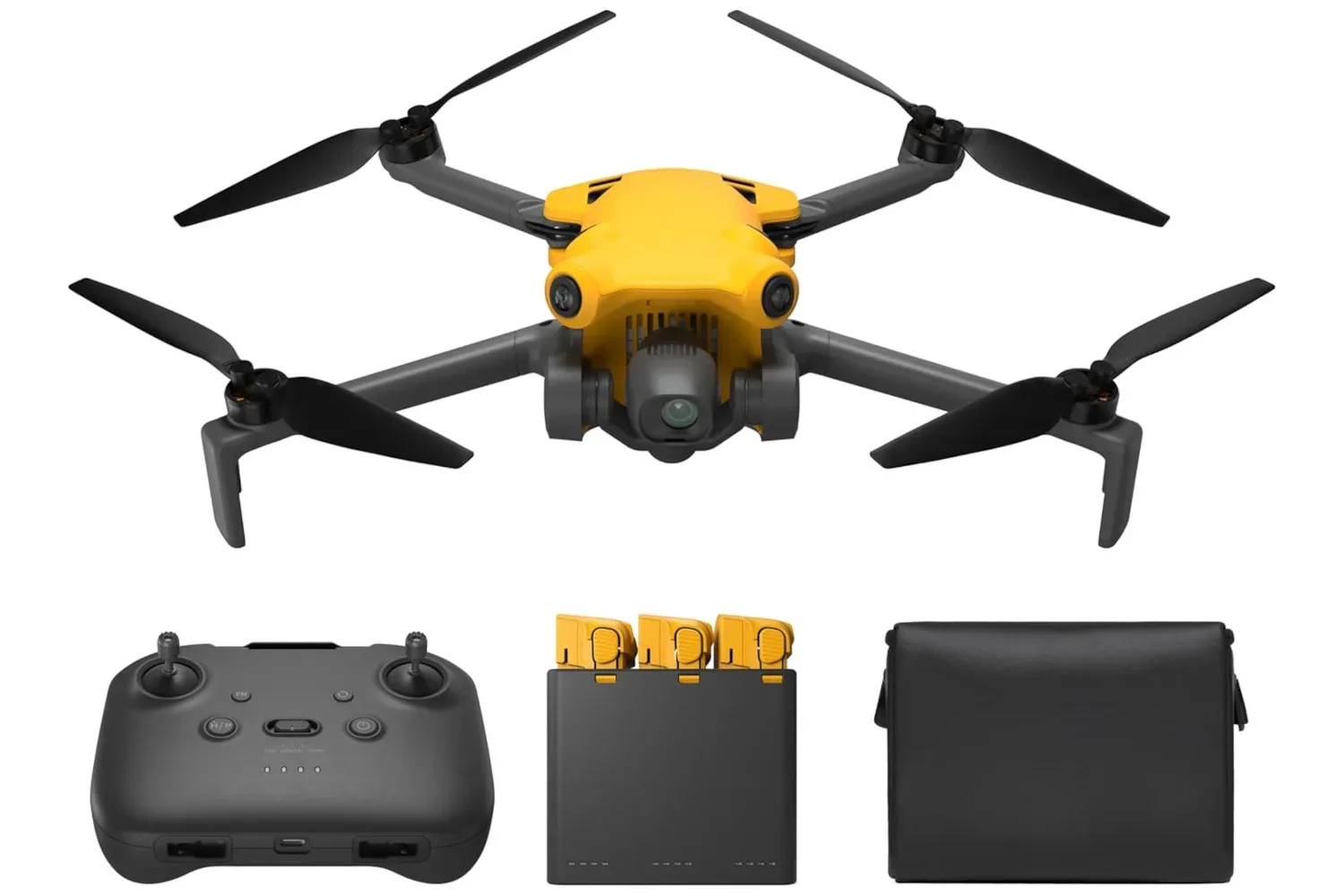
The SKYROVER X1 Combo is listed at $449 for a limited time, a reduction of 27% from its stated $619 regular price. That number matters less as a holiday-sale trophy and more as a practical shift in what the bundle includes: this is a camera drone package described as coming with three batteries, rather than a single-battery setup that sends the flight session home early.
For prospective aerial-video creators, travelers, and hobbyists who have graduated from watching dramatic drone footage to wondering whether they could make some themselves, the listed configuration has a notably ambitious spec sheet. It is described as supporting 4K video at 60 frames per second, 8K still photographs, AI-enhanced night photography, 360-degree obstacle avoidance, stabilization, and automatic subject tracking. Its quoted total flight time reaches up to 96 minutes across all three batteries, although that is naturally split between battery swaps rather than delivered in one heroic, uninterrupted sky marathon.
Like every time-limited retailer price, the $449 figure should be checked at the listing before purchase. Prices, stock, seller details, included accessories, shipping terms, and return conditions can change quickly during promotional periods. Still, the combination of camera modes, avoidance hardware, and spare power makes this one worth a closer look for shoppers who have a defined use for a compact aerial camera.
A bundle built around staying in the air longer
Battery count is one of the least glamorous lines on a drone product page, right up until the first battery is nearly drained and the best lighting of the day has finally appeared. The SKYROVER X1 Combo’s three-battery configuration is therefore a meaningful part of the appeal. The stated 96-minute total works out to several separate flights, giving an owner more room to scout a location, repeat a shot, or simply learn the controls without treating every minute aloft like a competitive speedrun.
Real flight duration can differ from a quoted maximum. Wind, temperature, speed, takeoff elevation, frequent acceleration, video settings, and return-to-home reserves all affect battery consumption. A cautious pilot should also avoid planning a flight around draining every pack completely. But a multi-battery bundle can still be more convenient than buying a drone first and discovering later that additional batteries are necessary for anything beyond a short outing.
That extra flexibility is especially useful for people practicing cinematic movements. Smooth reveals, slow orbit shots, tracking passes, and deliberate ascent shots frequently require retries. A first attempt may be too quick, a second may have an unwanted distraction in frame, and a third can be the keeper. Having reserve batteries means the learning process need not be compressed into one brief flight window.
Video and photo specs aim beyond casual snapshots
The advertised 4K/60fps capture capability is the headline specification for video-minded buyers. Recording at 60 frames per second can provide smoother motion than 30fps and can also allow footage to be slowed down in a 30fps timeline while retaining fluid movement. That can be handy for scenes involving water, cycling, sports, moving vehicles, or a simple pass over a landscape where a slower pace adds atmosphere.
Of course, resolution and frame rate alone do not guarantee a great image. Light, exposure choices, stabilization, sensor performance, compression, framing, and the person holding the controller all remain part of the final result. A drone with a lengthy feature list cannot automatically turn a hurried flight into a composed sequence. Yet 4K/60 support provides a useful foundation for creators who want more latitude when editing their material.
Related coverage includes Skyrover X1 Combo Falls to $449 With Three Batteries.
The X1 is also described as taking 8K photos. High-resolution stills can offer scope for cropping, though the value of that flexibility depends on the scene and image quality. It may be most appealing to someone shooting broad outdoor compositions, architecture, large group scenes, or landscapes where the aerial viewpoint can make an ordinary location look newly mapped by a friendly robot bee.
The drone’s yellow-and-black exterior is one of its more distinctive traits. Most consumer drones pursue neutral shades that seem designed to disappear into a drawer or merge with a cloudy horizon. The SKYROVER’s bolder appearance will not decide its camera performance, but visibility can be useful while locating equipment before a flight or spotting it after landing. It also has a little more personality than the usual slab of airborne graphite.
Obstacle avoidance helps, but does not replace pilot judgment
Among the most important claimed features is 360-degree obstacle avoidance. For newer pilots, obstacle sensing can make the difference between feeling comfortable enough to practice and spending every second braced for an encounter with the nearest tree branch. The feature is relevant in parks, wooded areas, and other environments with obstacles positioned outside a pilot’s immediate focus.
It should not be mistaken for permission to fly carelessly. Small branches, thin wires, reflective surfaces, low light, rapidly changing conditions, and obstacles entering from unexpected angles can challenge avoidance systems. Pilots still need to keep the aircraft in view where rules require it, maintain appropriate separation from people and property, and select open practice areas whenever possible. Automated safety features are best regarded as an additional layer of assistance, not an invisible force field.
The same common-sense approach applies to automatic subject tracking. Tracking modes can be useful for recording a person walking, cycling, or moving through an open scene, since they reduce the workload of keeping a subject centered. However, users should be mindful of their surroundings and make sure an automated route will not lead the drone toward trees, traffic, bystanders, restricted areas, or other hazards. An easier camera move is only worthwhile if the flight remains safe and lawful.
Who should consider this $449 listing?
The current price may make the most sense for a buyer seeking a first serious camera drone, particularly one who values a fuller package over the lowest possible entry price. A basic drone can be a fine way to learn orientation and controls, but creators who already know they want stabilized 4K footage, higher-resolution stills, tracking tools, and multiple batteries may prefer not to outgrow a starter model immediately.
It could also fit an existing content workflow. Travel videos, event recaps, outdoor channels, real-estate-adjacent visual projects, and hobby filmmaking can all benefit from an aerial establishing shot when it is appropriate to capture one. Even a few seconds of high, stable footage can change the sense of scale in a project. The important caveat is that drone video can create substantial files, especially at higher resolutions and frame rates. Anyone expecting to film regularly should prepare for storage, backups, and editing time. Our guide to picking phone storage without regret covers the broader question of planning capacity around media-heavy use.
On the other hand, buyers who only want an occasional toy for a few minutes of backyard flying may not need the X1 Combo’s stated imaging features or battery complement. The better purchase is not always the one with the longest list of specifications; it is the one that suits the flights a person realistically expects to make.
Check the practical details before takeoff
Anyone weighing the deal should confirm the exact contents of the $449 listing. “Combo” can mean different things across products and retailers, so shoppers should verify that three batteries are included and examine whether the package also contains a controller, charging hardware, a case, propeller spares, memory storage, or other accessories they consider essential. They should also review warranty coverage and the relevant return policy.
Drone operation brings responsibilities beyond the checkout screen. Rules on registration, remote identification, airspace, altitude, flight near airports, privacy, and recreational use vary by country and region. Users should consult the local aviation authority and applicable rules before flying, rather than assuming that a lightweight aircraft or a consumer-friendly tracking mode removes those obligations. Some locations also impose site-specific restrictions, including parks, events, and private venues.
Weather deserves equal respect. Gusts can turn a calm-looking route into a much more demanding flight, while rain, poor visibility, and fading daylight introduce risks that no specifications list can erase. Beginners are generally best served by open spaces, gentle conditions, a fully charged controller and batteries, and a short initial flight focused on familiarizing themselves with takeoff, hovering, directional control, landing, and return functions.
At its listed promotional price, the SKYROVER X1 Combo stands out because it pairs a claimed 4K/60 video mode and 8K photo capability with the less flashy but genuinely useful benefit of three batteries. The $449 listing may not last, so interested shoppers should verify the live details and decide whether its camera-centered feature set matches their intended use before adding another buzzing machine to the gear bag.
Shop the products
Check current price, model and availability at the retailer.