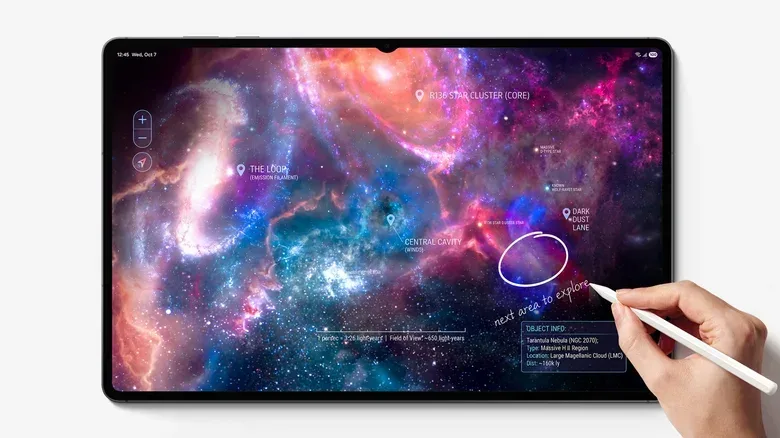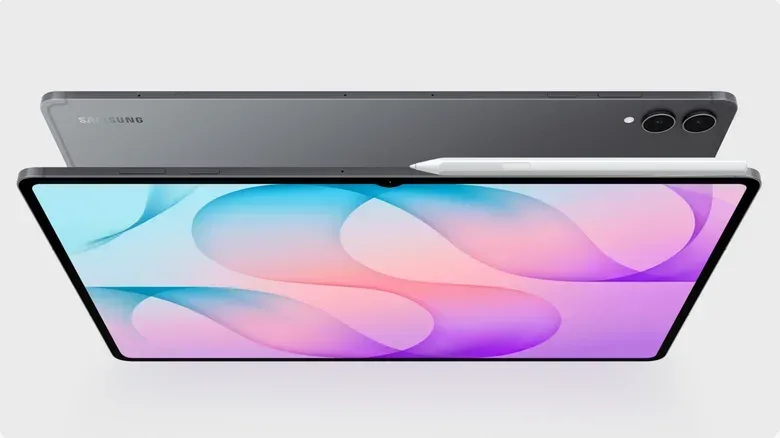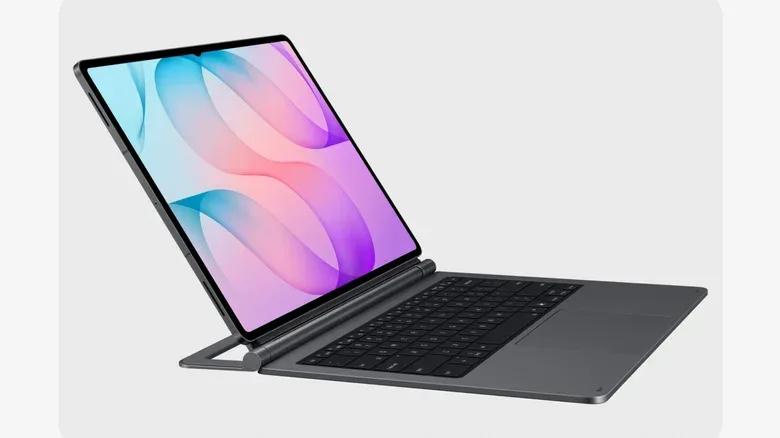
Samsung’s Galaxy Tab S12 Ultra is an unusually straightforward sequel to the Galaxy Tab S11 Ultra: it retains the same immense 14.6-inch screen, the same exceptionally thin chassis, the same battery capacity and charging ceiling, and even the same quoted weight. The headline changes are inside the slab rather than around it, led by a newer MediaTek processor, a redesigned cooling component and expanded spatial-audio support.
That makes the S12 Ultra a powerful Android tablet in absolute terms, but a difficult upgrade to frame against its immediate predecessor. Its starting configuration costs $1,400 with 256GB of storage and 12GB of RAM, or $200 more than the S11 Ultra’s launch price, while much of the experience on the two devices is expected to overlap.
The specification sheet: what remains unchanged
At first glance, there is effectively no generational redesign. Both the Galaxy Tab S12 Ultra and Galaxy Tab S11 Ultra measure 5.1mm thick and weigh 692 grams. Both have IP68 water- and dust-resistance ratings. IP68 is an ingress-protection classification: the “6” indicates dust protection, while the “8” refers to a level of water-resistance tested under specified conditions. It should not be read as a blanket guarantee that every poolside or underwater use case is risk-free, but it is a meaningful shared durability feature on paper.
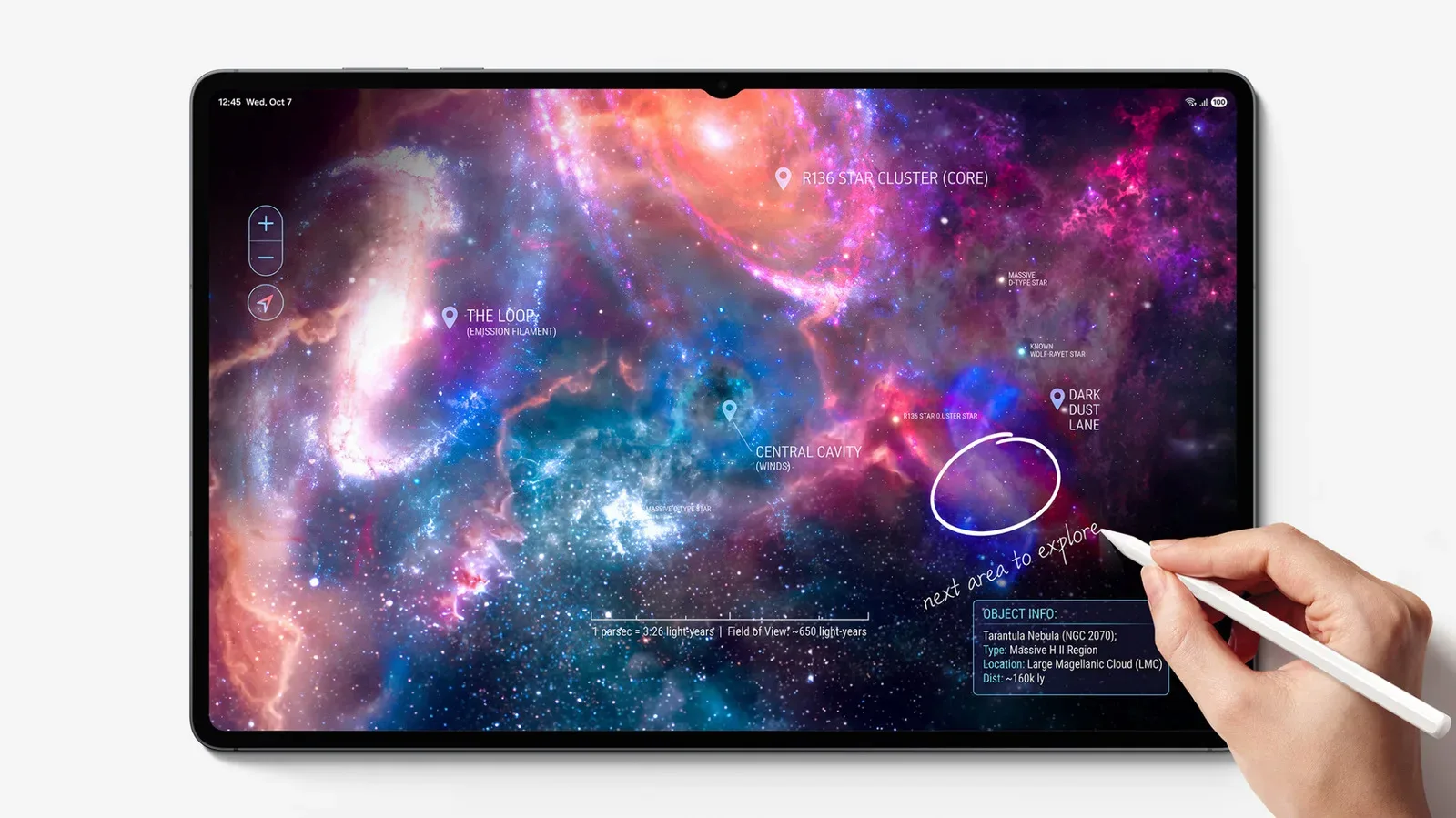
The display also carries over intact. Samsung uses a 14.6-inch Dynamic AMOLED 2X panel at 2,960 by 1,848 pixels, with a small teardrop cutout for a 12-megapixel ultra-wide front camera. Peak brightness is listed at 1,600 nits for HDR content and 1,000 nits in high-brightness mode, the same figures cited for the S11 Ultra.
Those details matter because the screen is central to the Ultra model’s appeal. A 14.6-inch panel is far beyond the compact-tablet category; it is geared toward big-screen video, split-screen work and other uses where physical canvas is more important than easy one-handed handling. AMOLED is a display technology in which pixels emit their own light, allowing very dark image areas without depending on a separate backlight. HDR, or high dynamic range, refers to video and imagery designed to show a broader contrast range between bright highlights and dark areas. The S12 Ultra does not advance these displayed figures over the S11 Ultra, but it also does not abandon a high-end screen formula.
Battery hardware is another holdover. The S12 Ultra has an 11,600mAh battery and supports up to 45W charging, matching the previous model. “mAh” means milliamp-hours, a measure of battery capacity rather than a direct promise of runtime; actual endurance depends on screen brightness, workloads, connectivity and other factors. Likewise, a 45W charging rating describes the maximum supported charging power, not necessarily the speed a user will see throughout every part of a charge.
The main change is the Dimensity 9500
The S12 Ultra moves from the MediaTek Dimensity 9300+ to the Dimensity 9500. Both chips use a 3nm process. In plain language, the process label refers to the manufacturing generation used for the silicon; it is not a literal description of every component’s size, and it cannot by itself tell a buyer exactly how much faster a device will feel. What matters more in this comparison is Samsung’s stated uplift: 19% higher CPU performance, 17% higher GPU performance and 61% higher NPU performance.
The CPU, or central processing unit, handles broad computing tasks and operating-system work. The GPU, or graphics processing unit, is particularly important for 3D rendering, visual effects and graphically demanding games. The NPU is a neural processing unit, specialized hardware intended for machine-learning and AI-related operations. The size of Samsung’s claimed NPU gain is considerably larger than its CPU and GPU claims, although the practical benefit depends on which features and apps actually use that hardware.
For game players, the GPU figure is likely the most intuitive number, but it should be treated carefully. A percentage performance claim does not establish a specific frame-rate improvement in a particular game. Results can vary based on the game’s engine, its Android version, graphics settings, resolution, thermal limits and the developer’s optimization. It does, however, point to a newer performance ceiling for workloads that can benefit from the updated silicon.
Samsung has also added a 3D vapor chamber for heat dissipation. A vapor chamber is a sealed cooling component that spreads heat away from a concentrated source such as a processor. It is designed to help control temperatures during sustained work. In this case, that could be relevant to lengthy gaming sessions, demanding multitasking or AI processing, but the supplied specifications do not establish how much cooler the tablet runs or whether sustained performance differs by a measurable amount from the S11 Ultra.
That distinction is important in an iterative release. A new chip and improved thermal design can be valuable even if the exterior is frozen, particularly to buyers coming from older hardware. Yet the stated CPU and GPU gains are relatively modest beside the price increase, and no new display, battery-capacity or charging specifications are present to broaden the upgrade story.
Four-channel spatial audio is a tangible media upgrade
The other notable S12 Ultra addition is four-channel spatial-audio support through its four-speaker array. The S11 Ultra supported two-channel spatial audio. Spatial audio broadly refers to processing and mixes intended to create a sense of direction and placement in sound, rather than presenting audio as a simple left-right stereo field. Four-channel support potentially gives the tablet more information to work with across its onboard speakers for compatible material.
It is a sensible improvement for a device whose size and screen specifications make it a natural fit for films, television and streaming video. Still, expectations should be set by the material: a spatial format cannot create a fully authored multichannel experience if the audio being played does not contain an appropriate mix. Speaker placement, listening position and the app’s playback support also influence what a listener hears.
The S12 Ultra’s unchanged 12-megapixel ultra-wide front camera occupies a small teardrop cutout in the display. Video calls remain a clear use for a screen this large, whether it is used at a desk or propped up elsewhere. There is no provided indication of a camera-specification upgrade over the S11 Ultra.
Software will narrow the distinction further
The new model will ship with One UI 9.0, Samsung’s Android interface. However, the S11 Ultra is expected to receive the same update. That means the new tablet gets the latest software out of the box, but the software version alone is not a durable reason for an S11 Ultra owner to trade up once both devices are on the same release.
AI is likely to be part of the marketing conversation around the new chip, especially given the stated NPU increase. But buyers should separate the silicon capability from the usefulness of individual AI features. An NPU can accelerate tasks designed to use it; it does not reveal, on its own, which tools are available, whether they work offline, or how much better they will be than on the prior model. That broader uncertainty also applies to other AI-focused device discussions, including recent developments involving AI upscaling on console hardware: the real impact rests on the specific feature and the software implementing it, not the phrase “AI” in isolation.
Who should consider the S12 Ultra?
The clearest audience is not necessarily the S11 Ultra owner. Anyone already using that model keeps the same screen resolution, brightness ratings, body dimensions, weight, battery capacity, charging limit, IP68 rating and eventual One UI 9.0 software. The S12 Ultra offers faster processor figures, a new vapor chamber and four-channel rather than two-channel spatial audio, but these improvements need to overcome a $1,400 starting price for a replacement to make sense.
The case is more plausible for somebody with an older Galaxy Tab Ultra. Samsung’s Ultra line dates back to the Galaxy Tab S8 Ultra, and the accumulated progression in performance across multiple generations is more meaningful than the narrow S11-to-S12 gap. Even then, the decision is about priorities. This is a 692-gram tablet with a 14.6-inch display: its scale is its signature advantage, but it is also an inherent trade-off compared with smaller tablets.
New buyers should regard the S12 Ultra as a premium large-format Android option rather than a broadly changed design. It combines an unusually large AMOLED display, a 12-megapixel ultra-wide front camera, four speakers, IP68 protection, 12GB of RAM in its base 256GB configuration and the Dimensity 9500 chip. The cost is equally part of the product definition. At $1,400 to start, the newer processor’s claimed gains and the audio update are being asked to justify not only an already flagship-level price, but a $200 step above the preceding model’s launch point.
The practical comparison
- Choose the S12 Ultra for: the newer Dimensity 9500, Samsung’s claimed 19% CPU and 17% GPU gains, the claimed 61% NPU gain, the 3D vapor chamber and four-channel spatial audio.
- Keep the S11 Ultra if: its performance already meets your needs. Its display, brightness ratings, chassis measurements, weight, battery capacity, 45W charging, IP68 rating and anticipated One UI 9.0 update align closely with the new model.
- Upgrade from a much older Ultra only after considering the price: the S12 Ultra may represent a larger cumulative jump from an S8 Ultra or S9 Ultra, but the starting cost remains $1,400.
- Do not treat AI hardware as an automatic answer: the stronger NPU is a specification advantage, while the real value depends on the specific applications and features a person uses.
The Galaxy Tab S12 Ultra is therefore less a new direction for Samsung’s biggest tablet than a refinement of an established one. Its most visible strengths—an enormous 14.6-inch AMOLED panel in a 5.1mm body—were already strengths of the S11 Ultra. The new processor, cooling hardware and audio capability make the S12 Ultra technically stronger, but the unchanged fundamentals and higher entry price leave the previous generation looking unusually current.