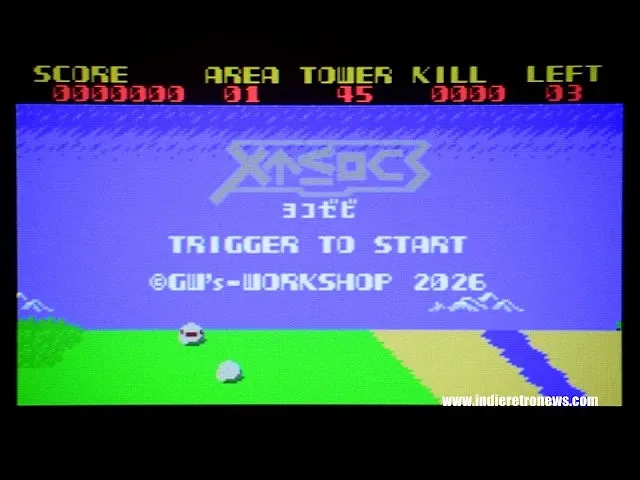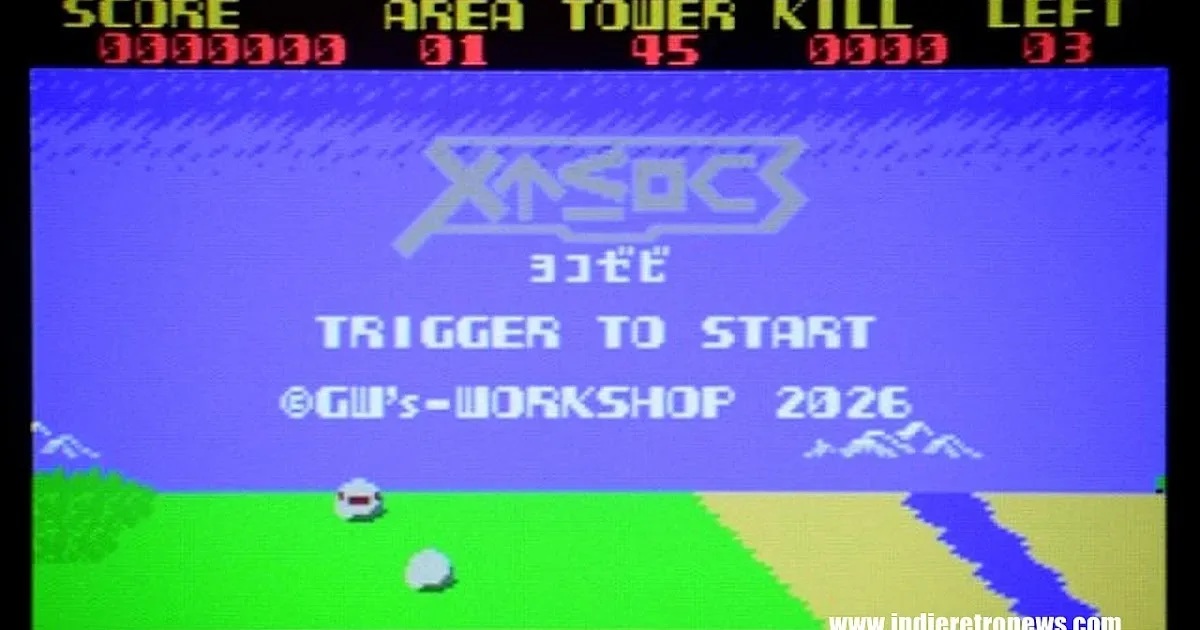
MSXdev26 is underway, and GW’s-Workshop has quickly placed a familiar kind of challenge in the flight path: YokoXevi, a new MSX1 side-scrolling shooter that sets out to marry arcade-era shooting fundamentals with a technically busy presentation.
The premise is pleasingly direct. Players pilot a spacecraft through hostile territory, firing forward at airborne threats while launching missiles downward at targets on the ground. Last long enough to clear the enemy forces and the route ends at a giant enemy mothership. It is a compact mission statement, but one that turns a simple shooter into a game about attention management: danger is not arriving from just one layer of the screen, and neither is the player’s response.
YokoXevi supports keyboard play as well as a traditional joystick or gamepad setup. That matters for a competition entry designed for the MSX1, where the relationship between responsive inputs, readable enemy patterns and an immediately understandable control scheme is central to the experience. The game’s concept does not depend on elaborate onboarding. The ship shoots ahead; its missiles address a different threat below. The job is to learn when each tool is needed and keep both parts of the battlefield in view.
A sideways shooter with an arcade reference point
The title gives a clear clue to the project’s design intent. “Yoko” means sideways in Japanese, and YokoXevi is explicitly conceived as a horizontal shoot ’em up, or shmup. That shorthand normally describes action games in which a player steers a craft, reads projectile patterns, eliminates enemies and survives escalating screen pressure. Here, the horizontal movement provides the structure, while the two-direction attack system gives the game its particular rhythm.
GW’s-Workshop drew inspiration from Xevious, the arcade classic associated with attacking both airborne and ground-based targets. YokoXevi is not presented as a simple reproduction of that template, however. Its stated aim is to take that split-targeting idea into a side-scrolling format and add modern twists within the constraints of MSX1 development.
The practical result is a design where firing alone is not enough. A player who concentrates entirely on approaching aerial enemies can leave ground defenses active; a player who spends too much time looking downward may fail to manage the threats advancing across the main flight path. That division is important because it asks for prioritization rather than only fast reactions. The game’s dual attacks turn enemy placement into a tactical question: which danger needs attention first, and can the other one safely wait?
What the two weapons ask of the player
The ship’s conventional shots travel forward to confront aerial attackers. Its downward missiles, by contrast, are meant to destroy ground targets. The distinction sounds obvious, but it creates a useful discipline for players: identify the type of threat before pressing the button.
In a shooter with a single universal attack, the usual decision is largely positional—move away from a threat, line up with an enemy, and fire. YokoXevi’s setup adds target classification. The player must follow the forward action while recognizing opportunities or risks in the terrain below. That can make the act of surviving feel less like simply clearing a lane and more like managing a small combat system.
For newcomers, the most sensible approach is likely to treat the forward gun as a defensive necessity and downward missiles as deliberate interventions. Airborne enemies are described as arriving in waves, which makes them an immediate concern. Ground targets demand their own response, though, and the missile system is the dedicated answer. The point is not to mash both attacks without thought; it is to establish a rhythm of watching the airspace, checking the ground layer and returning focus to ship positioning.
That is also why the end encounter is notable. A massive mothership is promised at the end of the journey, giving the run a clear destination beyond ordinary enemy waves. No specific boss mechanics have been detailed, so players should not assume a particular phase structure, weak point or pattern. What is established is the scale of the confrontation and its role as the game’s culminating obstacle.
Parallax, multiplexing and PSG: the technical vocabulary behind the pitch
YokoXevi’s visual and audio ambitions are a major part of the story. The game includes multiple parallax-scrolling backgrounds, multiplexed sprites and rich PSG audio samples. Those terms can sound like a specification sheet, but they also describe choices that can influence how a scrolling shooter feels.
Multiple parallax-scrolling backgrounds
Parallax scrolling is the use of background layers that move at different speeds. A nearer layer may sweep across the screen more quickly than a distant layer, creating an impression of depth as the player travels sideways. Multiple parallax backgrounds means the game is aiming for more than a single flat backdrop moving behind the ship.
For a horizontally scrolling shooter, depth is not merely cosmetic. It can strengthen the sense of motion and make a stage feel more like a place than a fixed playfield. The important caveat is that visual richness must remain legible. In a game where players must distinguish air enemies, ground targets and projectiles, backgrounds need to support the action rather than obscure it. YokoXevi’s feature list signals ambition; the real gameplay value is in how clearly the battlefield’s dangerous elements stand out against those moving layers.
Multiplexed sprites
Sprites are independently drawn visual objects used for things such as player ships, enemies and other active on-screen elements. Multiplexing, in this context, is a technique used to extend the apparent number of sprites displayed by reusing hardware sprite resources at different screen positions over the course of a frame.
That is especially relevant to a shooter, a genre that benefits from busy skies: enemy formations, player fire, hostile fire and animated hazards all compete for visual space. The inclusion of multiplexed sprites suggests an effort to make the screen feel active while working within the MSX1’s limits. It does not, by itself, tell us exactly how many objects YokoXevi places on screen or how any particular sequence performs. It does explain why the developer highlights the technique: it is one of the tools available for building a denser action scene on older hardware.
PSG audio samples
PSG stands for programmable sound generator, a form of sound hardware associated with electronic tones and effects. YokoXevi is described as using rich PSG audio samples, which points to an effort to make the game’s audio presentation feel substantial alongside its scrolling effects and sprite work.
Sound has a specific role in shooters beyond atmosphere. A clean firing sound can reinforce the difference between the standard shot and a ground-directed missile; an alert or impact effect can make critical action easier to recognize amid visual motion. No detailed soundtrack, sound list or audio behavior has been specified, so it would be premature to make claims about individual effects. Still, emphasizing PSG samples makes clear that audio is part of the project’s overall push to do more than present a bare-bones homage.
An MSX1 project with a clear competitive identity
YokoXevi arrives as an entry in the annual MSXdev competition, and GW’s-Workshop comes to this edition with a record of ranking near the top in prior competitions through its MSX1 shooters. That background provides useful context without guaranteeing how this entry will place. Competition results depend on the finished field, and YokoXevi should be judged on what it delivers rather than on a reputation alone.
Still, the continuity is meaningful. The developer is returning to a genre it knows while taking on a specific design problem: translate the air-and-ground combat logic associated with Xevious into a horizontal format, then give it a presentation built around layered movement, sprite techniques and PSG audio. It is a focused scope. Rather than chasing unrelated ideas, YokoXevi appears to concentrate its effort on the essentials of a scrolling shooter and on the technical details that can make those essentials look and sound more lively.
That approach fits the appeal of contemporary development for classic systems. A new release need not pretend that it comes from a different technological era, nor does it have to abandon the recognizable rules that made older arcade shooters enduringly readable. The interesting space is between the two: familiar controls and genre language, paired with techniques intended to stretch the presentation.
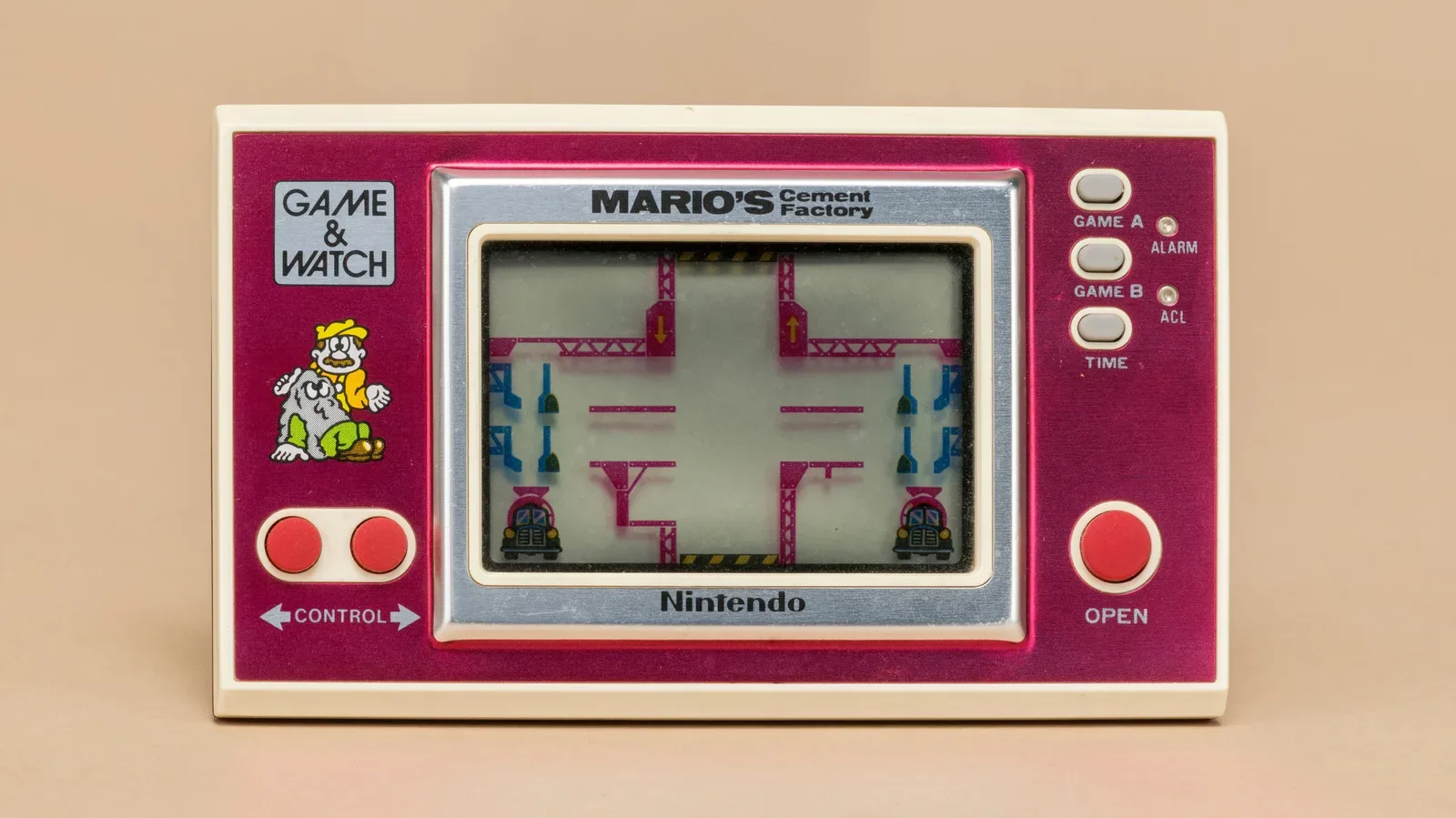
For a broader reminder of how older game hardware can produce distinctive design through apparent limits, see this look at Game & Watch’s unusual early hardware approach. YokoXevi belongs to a different system and genre, but the shared lesson is that limitations and creativity often arrive together.
What to watch for when taking flight
- Threat recognition: Learn to separate airborne targets from ground targets quickly, since each requires a different attack.
- Screen awareness: Keep attention on the forward lane without forgetting that downward missiles serve an equally important combat role.
- Input preference: The game accommodates keyboard controls and joystick/gamepad play, allowing players to choose the setup that best suits rapid directional movement and firing.
- Visual clarity: The layered scrolling and active sprite presentation are part of the appeal, but successful runs will depend on spotting hostile activity amid that motion.
- The final objective: The enemy mothership gives the journey an explicit end-point, so preserving survival through the route is not only about chasing a score.
YokoXevi’s promise is straightforward but well targeted: a compact MSX1 shooter with a classic arcade lineage, a two-part offensive toolkit and a visible desire to show what careful technical craft can do. For players who enjoy old-school shooters most when their rules are easy to grasp but difficult to execute under pressure, the combination of forward fire, ground missiles and a looming mothership should be a compelling reason to follow its MSXdev26 run.