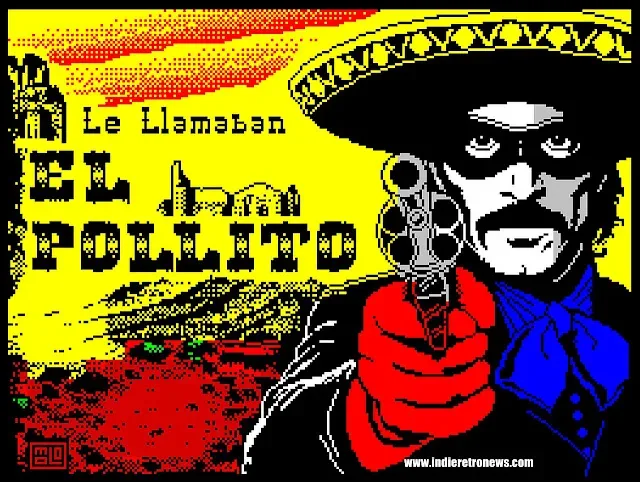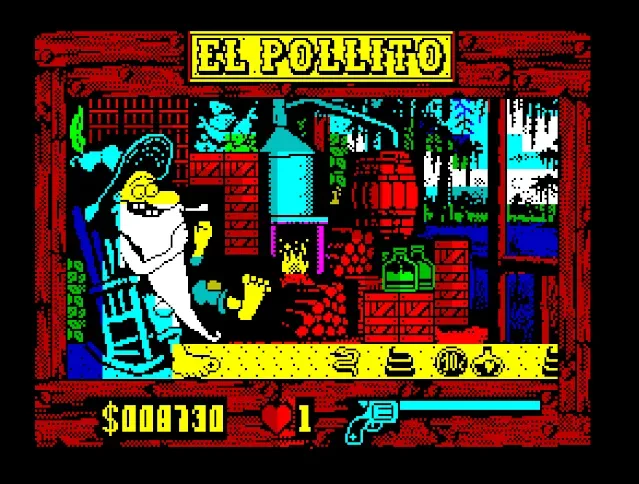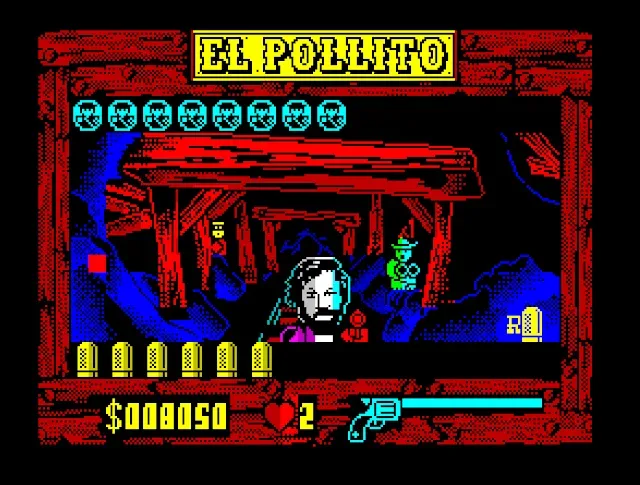
The ZX Spectrum’s frontier has gained an unlikely new gunslinger: a chicken with a rescue mission, a revolver-ready attitude and a very personal reason to ride into danger. Furillo Productions has introduced They Called Him El Pollito (The Legend of the Little Chicken), a shoot-’em-up set in the dusty, dangerous territory of Bernard Valley.
Its premise puts players in control of “The Chick,” a vigilante pursuing the kidnappers of Rosita, the valley’s schoolteacher and his romantic interest. The first name tied to the crime is Joe the Mad Miner, but the game’s setup suggests the apparent culprit may not be the person truly in control. A larger force is said to be operating behind the scenes, giving the otherwise playful poultry-led premise a classic Western-style mystery.
A feathered hero rides into Bernard Valley
The game frames Bernard Valley as a lawless badlands setting, and its Spaghetti Western influence is central rather than incidental. The Chick is not simply a mascot dropped into a generic action game; he is presented as a lone vigilante travelling through a frontier story built around a kidnapping, a suspect with a memorable moniker and an escalating conspiracy.
That structure gives the shoot-’em-up a clear narrative engine. Rosita’s abduction establishes the immediate objective, while the uncertainty surrounding Joe the Mad Miner provides room for the plot to extend beyond a straightforward chase. The supplied details do not identify the shadowy figure or explain the full chain of events, so players should not assume that naming the suspected kidnapper resolves the story.
“Spaghetti Western” generally describes Western fiction shaped by the heightened style and moral ambiguity associated with Italian-made Western films. In this case, the available information supports the thematic connection through the game’s badlands setting, gunslinger lead, abduction plot and villainous intrigue. It should not be read as a claim about specific film references, story beats or audiovisual techniques that have not been detailed.
What kind of game is El Pollito?
They Called Him El Pollito is described as a shoot-’em-up, a term commonly used for action games focused on shooting threats while navigating hostile spaces. The available description characterizes this one as a fast, arcade-oriented experience, but does not specify its perspective, stage count, control scheme, enemy patterns, weapon systems, lives, scoring rules or difficulty structure. Those are meaningful distinctions within the genre, so it is better to treat the game’s broader action identity as confirmed while leaving its exact mechanical format open.
What is clear is that Furillo Productions is positioning The Chick’s journey as an energetic rescue adventure rather than a slow, simulation-minded Western. The language around the project stresses challenge, combat and momentum. Bernard Valley’s fate is placed in the player’s hands, with the game directly urging its hero onward: “Now it’s all up to you, Chick! Go get them!”
For Spectrum players, that combination may be part of the appeal. The machine remains a home for new projects that work within its recognizable visual and technical language while pursuing new themes. Recent retro releases have also found room for genres far beyond traditional arcade action, as seen with a Commodore 64 platform-and-puzzle adventure built around prehistoric danger. El Pollito instead takes aim at brisk shooting action and a knowingly outlandish Western hero.
Related coverage includes They Called Him El Pollito Saddles Up for ZX Spectrum.
Customized creation tools behind the shoot-’em-up
The game was made with a heavily customized version of Jonathan Cauldwell’s SEUD, short for Shoot-Em-Up Designer. A game-creation tool gives developers a foundation for producing a particular kind of game, but customization matters: Furillo Productions did not simply use an untouched, off-the-shelf configuration. The project is described as relying on an extensively altered version of SEUD.
It is also paired with Furillo Productions’ proprietary “ambush module,” created for the Mojon Twins’ MK1 engine. An engine is the underlying technical framework used to organize game behavior and presentation. A module, in this context, is an added component intended to handle a particular function. The name “ambush module” strongly indicates a system associated with surprise encounters or pressure from enemies, but its precise behavior has not been explained. It would be speculation to claim exactly when enemies appear, how the system is triggered or what it changes during play.
The technical arrangement is nevertheless notable because it points to a hybrid approach. Customized SEUD tools supply the shoot-’em-up foundation, while the separate MK1-oriented module is brought in to support the game’s particular action ambitions. That is a useful reminder that retro development can involve adapting established tools and combining purpose-built systems, rather than treating a single engine or editor as a fixed creative limit.
Assets and authorship: what has been disclosed
Furillo Productions has also acknowledged the use of free asset libraries for some environmental elements, including rocks and serpents. An asset library is a collection of reusable art or other game materials that creators can incorporate into their projects. Reusing such elements can help a small team fill out a world efficiently, particularly for background or environmental details.
That disclosure should be understood narrowly. The stated examples concern environmental tiles, while the game’s core arcade play is described as original. A tile is a small visual unit repeated or arranged to construct an environment, such as terrain or decorative scenery. The information provided does not identify every asset, say which locations use them, or establish that all art in the game comes from those libraries. It does establish that Furillo Productions has been transparent about incorporating external free resources for certain scenery elements.
Why the setup stands out
A chicken vigilante rescuing a schoolteacher is intentionally broad, cartoonish material, yet the plot’s deeper-conspiracy angle gives it a little more dramatic scaffolding than its title alone implies. The contrast is likely the point: a tiny feathered protagonist is cast in the grand, dusty language of revenge tales and frontier heroics.
For players interested in contemporary ZX Spectrum software, the key promise is equally direct: a new shoot-’em-up with a distinct setting, a defined rescue premise and a development process that draws on customized vintage-oriented tools. The facts currently available leave major gameplay specifics to be discovered, but Bernard Valley’s mission is already easy to understand. Rosita needs rescuing, Joe the Mad Miner may be only part of the problem, and The Chick is heading into the badlands to find out.