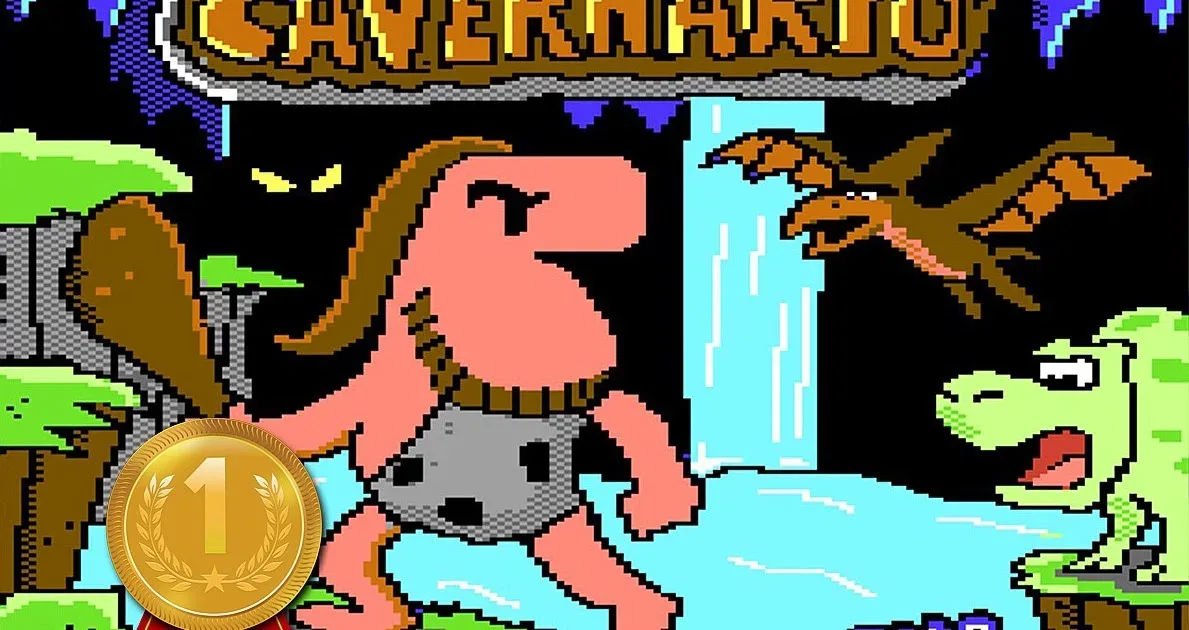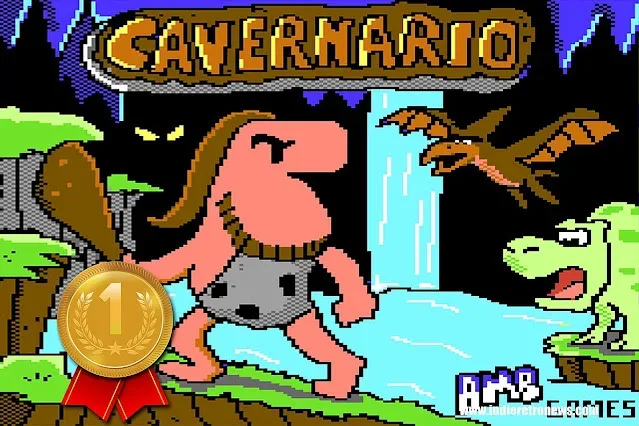
Caveman, also known as Cavernario, is a new Commodore 64 game from developer Bonnette2020 built around a direct, demanding premise: make your way through caverns, cross precarious platforms, gather the items needed to open the route ahead, and avoid the prehistoric creatures determined to make the expedition extremely short.
The game took first place in the Independent Video Games Category at FlashParty 2026, a demoparty held in Buenos Aires. That result puts a welcome spotlight on a project that marries an old-school arcade sensibility with a more deliberate layer of route-reading and puzzle-solving. It is not simply a case of moving from left to right while hazards happen nearby; the stated objective structure asks players to identify key items and unlock the next way forward.
For Commodore 64 players, that combination should be familiar in the best way. Fast reactions matter when a jump has a hostile creature or a bad landing waiting on the other side. But reflexes alone do not necessarily solve a room designed around progression items. Caveman’s caverns are framed as increasingly difficult action stages, where planning a safe path and executing it cleanly appear equally important.
A cave full of arcade pressure
Caveman draws on the spirit of 1980s arcade games through colorful visuals, fluid animation and immediate platforming danger. Its prehistoric setting gives the action an appropriately blunt logic: the caves are hazardous, the footing is unreliable, and the local wildlife is not interested in sharing the platforms.
The basic loop is clear from the game’s described structure:
- Navigate a sequence of cave levels.
- Jump across precarious platforms.
- Collect key items.
- Dodge hostile prehistoric creatures.
- Use the collected items to unlock the route onward.
That last step is important. An unlock condition is a gameplay requirement that must be met before a new route, exit or portion of a level can be accessed. In Caveman, key items are not described as mere score pickups. They are part of the player’s forward progress. This makes each cavern a problem with both a movement component and an objective component: getting somewhere is only useful if it helps secure what is needed to leave.
The supplied description also emphasizes a scaling challenge. In practical terms, scaling difficulty means later levels increase the demands placed on the player, whether through more dangerous platform layouts, trickier navigation, greater pressure from enemies, or more exacting combinations of those elements. The game is presented as a growing test of reflexes and strategy rather than a short sequence that teaches one idea and leaves it unchanged.
Why the platforming-and-puzzle mix matters
Platform games can ask for very different skills even when their controls look simple. A straightforward reaction test asks whether a player can time a jump or evade a moving threat. A puzzle-oriented platform challenge adds questions of order and position: which platform should be reached first, which item enables progress, and when is it safer to commit to a risky crossing?
Related coverage includes Caveman Brings Prehistoric Arcade Peril to Commodore 64.
Caveman’s stated design sits between those approaches. The player must jump and dodge in real time, yet items must be collected to unlock the path forward. That arrangement can make a familiar cave setting feel more purposeful. A platform is not only a place to land; it can be a staging point for reaching an item or avoiding an enemy while preserving a route through the level.
It also explains why the game’s increasing difficulty is framed around both strategy and reflexes. A run can fail because an input is mistimed, but it can also fail because the player chose a poor route through the available platforms. The difference is significant for anyone who enjoys retro games that reward repetition and observation. Learning is not limited to mastering a jump’s timing; it may also include understanding the order in which a cavern is best approached.
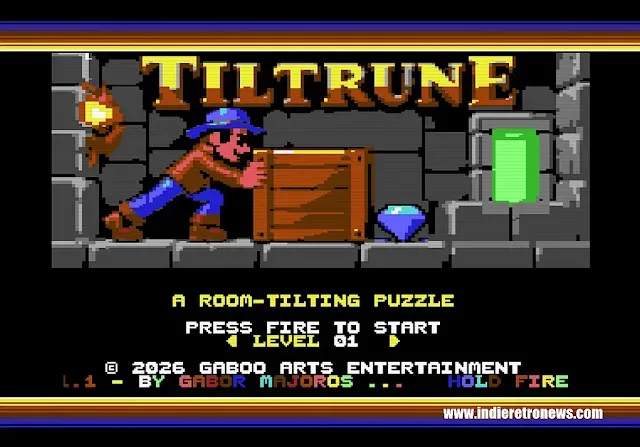
That focus on a compact, readable challenge is part of what makes new software for classic hardware interesting. The game is designed for the Commodore 64, but its goals are not restricted to nostalgia for the machine. It presents a contemporary creation using arcade language: visual motion, escalating stages, hazards and a sharp objective. For more current C64 activity, see our coverage of Tiltrune’s room-rotating puzzle challenge on Amiga and Commodore 64.
Modern tools, classic target hardware
Bonnette2020 programmed Caveman in C and compiled it with Oscar64. This is a notable technical detail, though it should not be mistaken for a claim that the game abandons the identity of C64 development. The target is still the Commodore 64; the toolchain is part of how its code was created.
C is a programming language widely used for systems and game development. A compiler converts code written in such a language into a form the target computer can run. Oscar64 is identified here as the modern toolchain used to compile Caveman. A toolchain is the collection of development tools that turns source code into a finished program, typically including a compiler and related build utilities.
That workflow is relevant because it illustrates how new games can be made for historic platforms with newer development methods. It does not tell us every technical detail of Caveman’s construction, nor does it automatically tell us how it plays. What it does establish is that the project uses C and Oscar64 while aiming squarely at Commodore 64 hardware and an arcade-informed design.
The distinction is useful when talking about retro games. “Retro” can describe the platform being supported, the visual and mechanical language of a game, or both. Caveman qualifies on each of the details provided: it is a C64 title, and it deliberately channels the look and momentum associated with 1980s arcade classics.
Recognition at FlashParty 2026
FlashParty 2026 recognized Caveman with first place in its Independent Video Games Category. The award gives the project a concrete early achievement beyond its premise and technical setup. Demoparties are gatherings associated with digital creative work, and the supplied result specifically places Caveman among independently judged video-game entries at the Buenos Aires event.
For a new game on a long-lived computer platform, that kind of recognition can be especially meaningful. It signals that the work has been noticed in a community where presentation, programming and the finished game itself can all attract attention. Caveman’s colorful graphics and fluid animation are specifically highlighted alongside its platforming and puzzle elements, suggesting that its appeal is intended to be both visual and mechanical.
Still, the strongest reason to pay attention is the clarity of the central challenge. Caveman does not need a complicated pitch to establish its identity. It is a cavern-running, item-gathering platform game in which obstacles and creatures close off the easy route, and each successive level is meant to press harder on player execution and decision-making.
The people behind Caveman
Bonnette2020 is credited as the game’s developer. Richard Bayliss is credited for music, while @1mariela8, @danasalvati, @milibonnette_ and @gonzalezj.ar are listed for extra support.
Music has an obvious role in an arcade-styled game even when the available details do not describe its sound or composition. The credit confirms Bayliss’ contribution, while the support acknowledgements underline that the project was not presented as an entirely solitary effort. Beyond that, it is best not to assume specific roles or contributions that have not been identified.
What is known is enough to set expectations: Caveman is a new C64 project from Bonnette2020, built in C using Oscar64, with music by Richard Bayliss. It has already earned a first-place finish at FlashParty 2026, and its caverns promise the particular kind of trouble that makes a compact arcade challenge memorable: one more platform, one more key item, and one prehistoric threat standing exactly where it should not.