Commodore 64 owners have a new reason to keep the lights low. The House on the Borderland, a first-person survival horror game by Michael Cox, places players in a home under siege and asks them to hold it together for three punishing nights.
The setup draws direct inspiration from William Hope Hodgson’s 1908 novel of the same name, but the game’s immediate concern is practical survival. The player must protect the house, their sister and their dog while swine-things attack. It is a compact premise with a deliberately uncomfortable question at its centre: when every resource is finite and every damaged wall matters, what can safely be spared?
That makes this less a story about conquering a haunted location than enduring one. The house is both refuge and responsibility, and surviving requires attention not only to monsters but also to the condition of the shelter itself.
Three nights, one starting stockpile
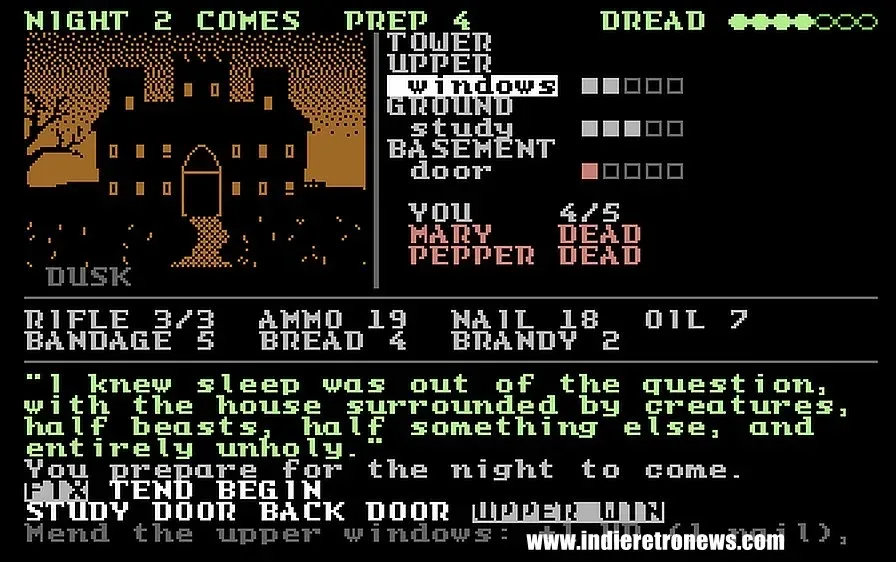
The game is structured around a cycle of night-time siege and daylight recovery. During the day, players can rest, repair fortifications and care for the wounded. Those actions are not merely downtime between encounters. They appear to be the foundation of a strategy that must last through the entire three-night ordeal.
There is no resupply. Everything available at the start must be rationed until the end. In survival-horror terms, resource management means deciding when an item or action is valuable enough to spend now rather than preserve for a more dangerous situation later. A defensive repair may prevent a current problem from escalating; rest may help preserve a character’s ability to continue; tending to injuries may carry its own urgency. With no new supplies arriving, each choice is connected to the nights still ahead.
That constraint gives the daytime phase a potentially severe edge. A player cannot simply treat daylight as a reset button. Repairing the home and looking after its occupants must be balanced against whatever limited materials remain. The central challenge is not only getting through an attack, but reaching the next night without turning the house into an even weaker target.
For a game built around just three nights, the limited duration is a feature rather than a limitation. It concentrates the pressure. There is a known finish line, but no implication that the final night will be forgiving. A short siege can make every deterioration feel meaningful because there is little room to recover from waste or poor planning.
Dread is a mechanical danger, not just atmosphere
The game’s distinctive system is its dread meter. Dread rises in response to darkness, eerie silence and structural damage. If it becomes too high, the player character’s perception warps and fear leaves them completely paralysed.
Related coverage includes The House on the Borderland Brings a Three-Night Horror Siege to C64.
A meter is simply an on-screen or game-tracked measure of a changing state. Here, it represents more than health or endurance. Dread turns the mood of the setting into a direct gameplay risk. Darkness is not just visual presentation. Silence is not just sound design. Damage to the building is not just an abstract durability number. Each can push the character toward incapacitation.
Paralysis is especially consequential in a siege scenario. The threat is not framed as a small penalty or a reduced stat; it is an inability to act at the moment action may be most necessary. That design links emotional pressure and tactical pressure tightly together. Letting the house deteriorate can make the surroundings more frightening, and the increased fear can in turn undermine the player’s ability to respond.
This also means repairs have a likely importance beyond simple defence. Mending fortifications may help resist the creatures physically, while also reducing one of the conditions that contributes to dread. The game’s systems therefore appear designed to reinforce the same theme from several directions: a protected home is safer materially and psychologically, while a broken home threatens both.
A first-person horror game for C64 hardware
The House on the Borderland is described as a first-person survival horror game for the Commodore 64. Its retro visuals, gameplay concept and detailed design are presented as original work. The project was also extensively play-tested on actual C64 hardware, an important detail for a game made for a platform with concrete technical limits rather than only an aesthetic association with the era.
“First-person” describes a perspective intended to place the player in the character’s viewpoint, rather than looking down on them from above or following them from behind. For horror, that framing can make the condition of the immediate environment especially important: a dark space, a quiet interval or visible structural damage is experienced as part of the player’s direct field of view.
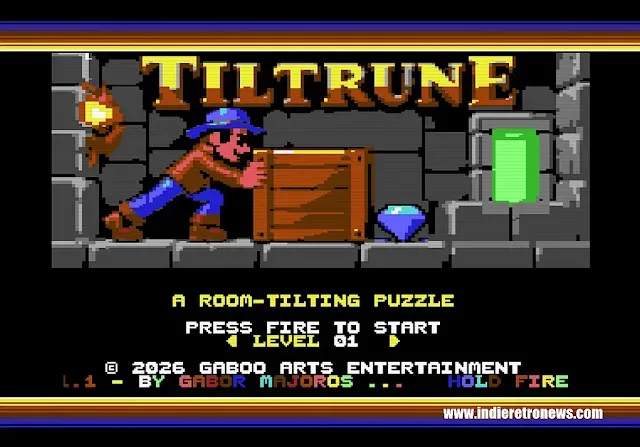
The C64 remains an active destination for new software, including projects that use the platform’s constraints as a design focus rather than a novelty. This release joins a continuing stream of new work for the machine; recently, Tiltrune brought a room-rotating puzzle challenge to both Amiga and Commodore 64. Cox’s game takes a markedly different route, using the format for a constrained horror siege built around pressure, upkeep and fear.
Clear disclosure around AI-assisted production
The game includes an explicit AI disclosure covering code and sound. Cox used Claude Code as assistance during development. The developer’s account distinguishes that assistance from the game’s original concept, design and graphics.
The sound work took a particularly unusual production path. The music was adapted over time, while the eerie sound effects began as AI-generated placeholders. Those placeholders were retained for the finished game because they worked effectively enough in the final design.
A placeholder is temporary material used while a project is being developed, often with the expectation that it will later be replaced. In this case, the temporary sound effects became part of the release. That does not change the stated disclosure, but it does give players useful context about the game’s audio: the sounds were initially created to fill a development need, then judged suitable for the finished horror atmosphere.
The disclosure is valuable because it identifies where AI assistance entered the project instead of leaving players to infer it from broad claims. It also makes an important distinction between tools used in production and the creative components identified as original: the game’s premise, design work and visual presentation.
What players should expect
The House on the Borderland is likely to appeal most to players who enjoy horror built around limits rather than abundance. Its stated ingredients point to a deliberately tense loop:
- Hold a threatened home against swine-things across three nights.
- Use daylight to rest, repair defences and tend to injuries.
- Make a starting supply last because no resupply is available.
- Prevent dread from reaching the point where fear paralyses the character.
- Manage the connection between a damaged shelter and an increasingly unstable sense of safety.
There is an appealing harshness to the structure. The player is not promised escalating firepower, a convenient shop or a new cache of supplies after a difficult encounter. Instead, the game frames survival as care under pressure: look after the house, look after the vulnerable people and animal inside it, and do not allow the atmosphere itself to take control.
For a C64 horror game, that combination of first-person perspective, finite supplies and a fear system gives The House on the Borderland a clear identity. Its monsters create the immediate danger, but its more enduring threat may be the gradual collapse of confidence, fortification and options over the course of three nights.