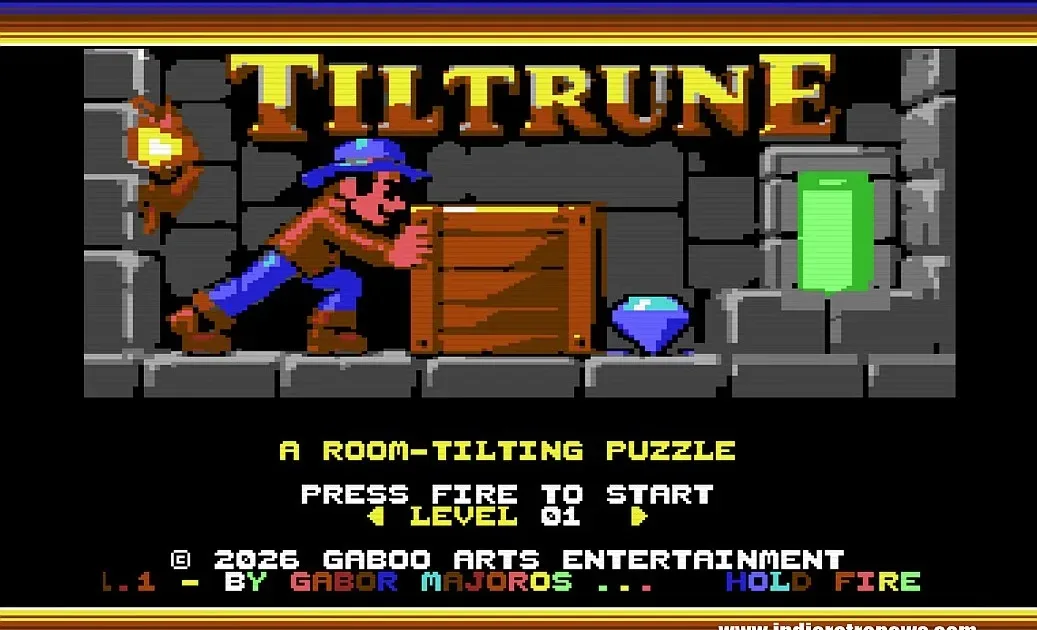
Tiltrune, a new puzzle game from Gaboo Arts Entertainment made with AI assistance, has arrived for both the Commodore 64 and Amiga. Its central idea is admirably direct: instead of merely moving a character through a fixed room, players rotate the entire room 90 degrees left or right. Gravity follows the new orientation, sending the explorer, crates and gems tumbling into altered positions.
That makes every chamber a small, shifting system rather than a static obstacle course. A vertical barrier can become a floor after a rotation; a previously safe ledge can turn into a dangerous drop; and a crate that looked inconvenient in one orientation may become essential protection in another. Tiltrune asks players to collect all gems in a room and then reach a green exit, but its puzzle-solving pressure comes from understanding what will move, where it will land and whether the new layout leaves a route forward.
A puzzle game where the room is the mechanism
Most room-based puzzle games present their architecture as an unchanging rulebook. Walls stay walls, pits stay pits and gravity consistently pulls toward the bottom of the screen. Tiltrune changes the last assumption. Turning the playfield changes which edge is “down,” so the room’s geometry takes on different meanings with each 90-degree shift.
That distinction matters. The rotation is not simply a visual trick or a camera effect. It is the action that causes the puzzle state to evolve. Crates fall, gems relocate and the explorer is subject to the same gravitational change. A player cannot treat an empty space as permanently harmless, because another rotation can transform it into the landing zone for falling debris or the route toward spikes.
In practical terms, Tiltrune’s rooms appear to require players to consider several connected questions before committing to a move:
- Which direction will gravity pull after the room turns?
- Where will the explorer land, and is that path safe?
- Will a crate block a route, support a fall or be destroyed by a bad position?
- Can every gem still be reached after the room has been rearranged?
- Does the new orientation create a viable path to the exit only after collection is complete?
That is the game’s key technical premise. In a gravity puzzle, a rotation is consequential because it applies to the whole room. Players are managing spatial relationships, rather than only navigating around objects one at a time. The result is a format where sequencing is likely to matter as much as recognizing a destination. Reaching a gem too early or shifting a crate at the wrong moment may leave the room in a configuration that cannot satisfy the remaining objective.
Crates are tools, while spikes and falls set the stakes
Tiltrune gives its crate-pushing a clear purpose beyond clearing passages. Crates can be placed to absorb dangerous falls. That means these objects can function as safety equipment as well as movable obstructions, potentially providing a landing surface when a later room turn sends the explorer downward.
Spikes add another hazard to account for, while falling debris makes careless rotations dangerous. Together, those elements frame the game as a puzzle experience where planning must include consequence management. Players are not only seeking the shortest route to the green exit; they must preserve safe positions and avoid a chain reaction caused by gravity.
Related coverage includes Tiltrune Brings Room-Rotating Puzzle Play to Amiga and C64.
The complete-gem requirement should further sharpen that tension. An exit route is not enough on its own if even one gem remains unreachable. Conversely, a room may look solved once every gem has been gathered, only for its final path to the exit to demand one more carefully staged rotation. Tiltrune’s structure makes the order of operations central: collect, reposition, rotate and escape without converting a solution into a dead end.
More than 80 rooms, five vaults and optional challenges
The game contains more than 80 main puzzle rooms distributed across five vaults. It also includes a special final chamber and bonus challenges that unlock after the main game. That is a meaningful amount of dedicated puzzle content for two classic computer platforms, especially because each room is built around a mechanic with many possible state changes.
Tiltrune also tracks performance through par targets, star ratings and broader statistics. A par target is a benchmark set for a stage, typically giving players a standard against which to measure an efficient solution. The supplied details do not define precisely how Tiltrune calculates par, so players should not assume it applies to a particular metric such as rotations or elapsed time. What is clear is that it provides an additional performance goal beyond simply completing a room.
Star ratings similarly turn a binary success-or-failure puzzle format into a system with room for refinement. A player who reaches the exit can then return to pursue a stronger result, while performance statistics offer a way to keep track of progress across the game. An animated tally at the end of a run brings those results together, and high scores can be saved to disk.
Disk-saved scores are particularly fitting for a game designed for the Commodore 64 and Amiga. The feature gives repeat runs continuity rather than treating each session as an isolated attempt. Since the game includes post-game bonus content and performance measures, that persistence supports both the campaign’s completion goals and its score-chasing side.
Undo and unlimited retries encourage experimentation
The potentially punishing side of a gravity-driven puzzle is clear: one rotation can cause several objects to fall, and the outcome may only become obvious after it is too late. Tiltrune addresses that with a 100-state undo buffer and unlimited retries.
An undo buffer is a stored history of prior game states that lets a player reverse actions. In Tiltrune, the 100-state capacity means players can roll back through a substantial chain of decisions rather than being limited to a single immediate mistake. The game’s unlimited retries provide another safeguard when an entire approach has gone wrong.
Those tools are not merely conveniences. They suit the game’s core design, which asks players to test the consequences of changing gravity across an entire chamber. An experiment can reveal a useful setup, a hidden danger or a route that was not apparent from the initial layout. With generous reversal options, failure can serve as information instead of becoming a major interruption.
For players, the practical implication is straightforward: methodical experimentation is supported. It should be reasonable to try a rotation to see how crates and gems settle, undo if the outcome is unhelpful, and then adjust the setup. Rather than requiring an answer to be fully mapped out before the first move, Tiltrune supplies the tools to investigate its rooms while still demanding that players understand why a particular sequence works.
The Amiga version retains the C64 game’s foundations
Tiltrune began as a Commodore 64 game and now has an Amiga version. The Amiga release retains the original rooms, rules and controls, preserving the puzzle design across the two platforms. Its presentation has been reworked with new graphics, animated title and reward screens, plus Amiga music and sound effects.
That approach separates the common game from the platform-specific presentation. Someone choosing between versions is not being asked to choose between different puzzle campaigns or control schemes based on the available details. The room set and underlying rules remain consistent, while the Amiga edition adds audiovisual changes tailored to that machine.
It also makes Tiltrune a notable release for players who still enjoy new software designed around vintage hardware. The Commodore 64 and Amiga versions share an immediately understandable idea, but one that can generate complex rooms: turn the world, live with the consequences of gravity, gather every gem and make it out through the green exit. For more retro-focused reading beyond these platforms, see our look at Game Boy Advance RPGs.
With over 80 main rooms, a final chamber, unlockable bonus challenges, performance goals and a large undo history, Tiltrune is structured to reward both careful first clears and more deliberate attempts at mastering individual puzzles. Its room rotation mechanic is simple to describe, but every turn can redefine what counts as an obstacle, a platform, a hazard or a solution.