A great Game Boy Advance RPG does more than shrink a console adventure onto a cartridge. It understands the handheld’s screen, controls and stop-and-start rhythm, then turns those limits into design opportunities. Some games use short encounters and compact maps; others build deep character systems that reward a few minutes of experimentation at a time.
This ranking considers how successfully each game adapts role-playing for portable play, weighing battle-system identity, progression depth, screen readability, session flexibility and historical importance. It includes traditional, tactical, action, monster-raising and hybrid RPGs. The order is an editorial selection, not a universal verdict, and the list discusses regional and edition limits where they matter.
10. Lunar Legend
Lunar Legend is a useful starting point because it shows both the promise and compromise of bringing a larger console RPG tradition to the Game Boy Advance. Its presentation is compact, its adventure is built for a cartridge and its progression remains recognizable as a classic party-based role-playing journey. Towns, dungeons, conversations and battles are arranged in a form that works naturally on a small screen rather than attempting to reproduce every presentation flourish associated with the series’ larger releases.
That compression gives Lunar Legend a direct rhythm. Its conventional structure makes it approachable for players who want equipment upgrades, level progression and a clear story without learning an unusually complicated battle system. The tradeoff is that the handheld edition does not offer the same audiovisual scale as the console versions it follows. It ranks tenth because its adaptation is competent more than radical, but that very restraint makes it a helpful example of how a portable RPG can preserve the genre’s basic shape while reducing its presentation demands.
The important edition distinction is that Lunar Legend is a Game Boy Advance adaptation, not a substitute for every other Lunar release. Players comparing versions should check which story, presentation and content differences apply to the specific edition rather than assuming the cartridge is identical.
- Best for players who want a traditional, story-led handheld RPG.
- Its strength is clarity and portability rather than experimental combat.
- Do not treat the GBA edition as interchangeable with later Lunar versions.
9. Riviera: The Promised Land
Riviera: The Promised Land takes a less familiar route to portable role-playing. Instead of centering its adventure on a conventional overworld, it organizes exploration through a more deliberate, menu-driven structure. Movement, item selection and environmental decisions become part of a compact decision loop, while battles ask the player to make careful choices about a limited group of available actions and equipment.
That structure suits the GBA particularly well. The game can deliver exploration, character development and combat without requiring a huge continuous map. Its unusual format also gives inventory decisions greater weight: selecting what to carry or use is not merely administrative, but part of understanding how the adventure’s encounters work. The result feels closer to a carefully arranged handheld campaign than a console journey simply reduced in size.
Riviera is not the best choice for someone seeking a large world map or unrestricted party management. Its appeal lies in the way it turns constraints into identity. Sting’s English product material identifies the Game Boy Advance version as a one-player RPG published in North America by Atlus USA, with a June 28 release date. Regional versions should not be assumed to have identical language or release details.
Riviera earns ninth place because its design is highly distinctive, though its narrow exploration structure can feel less immediately familiar than the games ranked above it.
- Best for players who enjoy menu-driven exploration and deliberate decisions.
- Its compact structure is an advantage for short sessions, but a limitation for open-world expectations.
- Check the regional edition before assuming language or release details.
8. Sword of Mana
Sword of Mana translates the Mana formula into a handheld action RPG with real-time combat, Ring Commands and a story route shaped partly by the chosen protagonist. That makes it fundamentally different from the menu-based RPGs elsewhere on this list. Attacks happen in the field, movement matters during encounters and equipment choices must be made without abandoning the flow of exploration.
The Ring Command interface is especially important to the adaptation. It places items, abilities and actions within a quick-access structure that suits the GBA’s limited buttons. Rather than pausing the adventure for a large console-style interface, the game turns command selection into a compact part of movement and combat. The result is a game that feels active even when its world and battle arenas are designed for a small screen.
Sword of Mana’s tradeoff is that action combat asks for more direct attention than a turn-based system. Players who prefer planning several turns ahead may find its rhythm less comfortable, while fans of action-adventure games can appreciate how naturally combat and exploration connect. Character selection also gives the adventure a different emphasis depending on the chosen route, increasing replay interest without requiring a completely separate ruleset.
It ranks eighth because it adapts Mana’s real-time identity convincingly, though it is not as mechanically deep or structurally surprising as the top entries.
- Best for players who want action combat with RPG progression.
- Ring Commands make item and ability access central to the handheld experience.
- Choose it for movement and immediacy, not for a purely menu-based battle system.
7. Final Fantasy V Advance
Final Fantasy V Advance is an enhanced handheld adaptation built around one of the strongest class systems in the series. Its job structure lets characters change roles, learn abilities and combine skills in ways that make party development feel like a series of small experiments. That flexibility is particularly effective on a portable system: a player can spend a short session testing a new class combination, then return later with a different plan for the next dungeon.
The game’s appeal is not simply having many jobs. It is the relationship between temporary roles and lasting abilities. Changing a character’s current job does not erase every previous decision, so experimentation can accumulate into a personalized party. This gives Final Fantasy V Advance a long tail of progression without requiring an enormous map or a constantly expanding cast.
The GBA version is an adaptation of an earlier console RPG, so its handheld achievement should be judged by what survives and what is adjusted rather than by pretending it was designed from nothing for the system. Its presentation is more constrained than a modern remake, but the job system remains remarkably legible through the GBA interface. Players who want a strongly character-driven story may prefer Final Fantasy VI Advance; players who enjoy building unusual parties will likely find V the richer sandbox.
It places seventh because its portable value comes primarily from deep, repeatable character customization rather than a uniquely handheld narrative structure.
- Best for players who enjoy jobs, abilities and party experimentation.
- The GBA edition should be discussed as an enhanced adaptation, not a wholly original handheld RPG.
- Choose it over Final Fantasy VI Advance if mechanical customization matters more than ensemble storytelling.
6. Fire Emblem: The Sacred Stones
Fire Emblem: The Sacred Stones brings tactical role-playing to the GBA through grid-based battles, character positioning and permanent consequences for defeated units. Its campaign structure gives it a distinct identity within the series, with a more flexible sense of progression than the stricter route through many Fire Emblem maps. That flexibility makes it a particularly approachable handheld strategy RPG without removing the importance of planning.
The GBA screen handles the essentials well. Maps are readable, unit roles are easy to distinguish and each turn breaks naturally into a short planning exercise. A player can inspect a threat, consider movement ranges and decide whether to advance, hold position or protect a vulnerable ally. These small decisions create the feeling of a large campaign while keeping the basic interaction simple enough for portable play.
Sacred Stones deserves separate consideration from Fire Emblem: The Blazing Blade. Both are tactical RPGs on the same system, but they should not be treated as interchangeable entries added merely to fill a list. Sacred Stones stands out here for its campaign flexibility, accessible progression and willingness to let the player develop units beyond the narrowest route through the story.
Its sixth-place position reflects how effectively it turns a demanding console strategy format into a readable handheld routine, even though some players may prefer the stricter challenge and campaign focus of other Fire Emblem games.
- Best for players who want tactical battles and character attachment.
- Its campaign structure gives it a different identity from The Blazing Blade.
- Remember that Fire Emblem’s permanent-loss rules can make casual experimentation costly.
5. Pokémon Emerald Version
Pokémon Emerald makes the role-playing genre portable by turning party building into a long-term collecting and training project. Its central loop is unusually flexible: players explore, recruit creatures, adjust moves and abilities, and then test those decisions in battles. The adventure is approachable as a conventional RPG, but its deeper systems continue after the main story has established a champion.
The Battle Frontier is central to Emerald’s handheld identity. It expands the game beyond a single campaign by offering more specialized tests of team construction and battle planning. That gives the cartridge a second life for players who enjoy optimization, experimentation and competitive-style decision-making without requiring the story adventure to become more complicated.
Emerald also belongs to a broader Game Boy Advance network of Pokémon releases. Nintendo’s product material identifies it as a Hoenn adventure with a Battle Frontier mode, while related Nintendo material documents the GBA Pokémon family’s links with Ruby, Sapphire, FireRed and LeafGreen through supported connection and transfer features. The exact feature set depends on the compatible games and hardware involved.
It ranks fifth because it makes progression unusually personal and durable. The limitation is that its role-playing structure is inseparable from creature collection, so players seeking a traditional fixed party may prefer one of the story-centered games above and below it.
- Best for players who enjoy collecting, team building and post-story challenges.
- The Battle Frontier gives Emerald a stronger long-term identity than a simple campaign-only RPG.
- Connection features depend on compatible games and supported hardware.
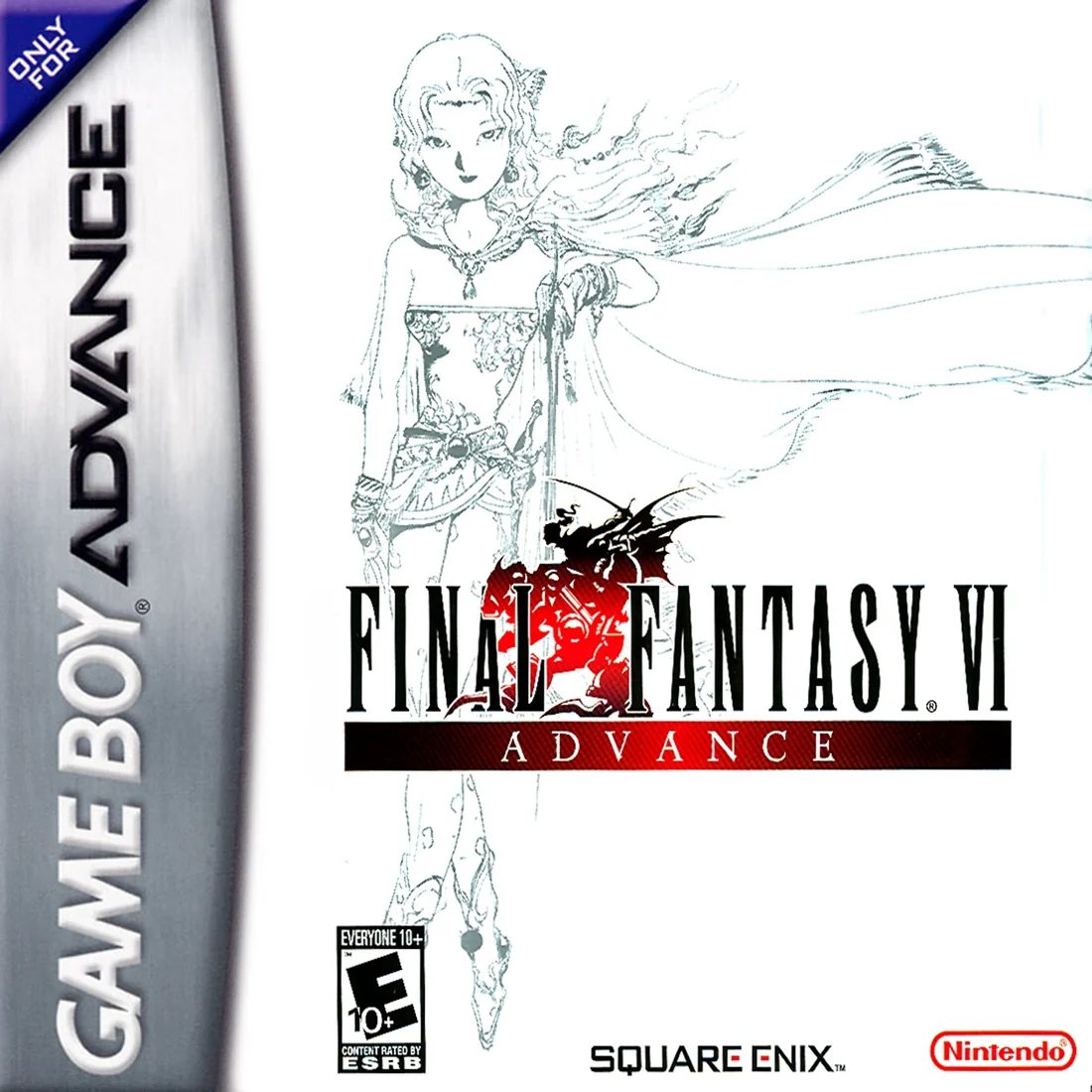
4. Final Fantasy VI Advance
Final Fantasy VI Advance demonstrates how much narrative and mechanical breadth a cartridge can carry. Its large ensemble, changing party arrangements and varied progression systems create the sense of a console-scale journey, yet the game remains structured around clear menus, compact encounters and save-friendly story segments. The handheld version therefore feels substantial without demanding that every session be a lengthy uninterrupted commitment.
Its greatest adaptation challenge is managing variety. Characters do not all express their abilities in the same way, and the adventure changes its emphasis as the story develops. That keeps party building from becoming a single repetitive routine. The GBA interface cannot reproduce every aspect of a larger presentation, but it preserves the game’s strongest quality: a role-playing adventure in which different characters and locations alter how the player thinks about progress.
Final Fantasy VI Advance is also valuable as an example of an enhanced adaptation. It is not an original GBA-only design, and its ranking depends on how convincingly its earlier console structure survives the transition. The answer is strongest in its menus, battles and character systems, while the smaller screen naturally reduces some of the visual scale.
It places fourth because it offers one of the richest traditional RPG experiences on the platform. It falls short of the top three only because its handheld identity is more adaptive than transformative.
- Best for players who want a large cast and a story-led RPG.
- Its many character systems reward trying different party arrangements.
- Treat the GBA release as an enhanced adaptation with edition-specific differences.
3. Mother 3
Mother 3 is one of the most distinctive RPGs released for the Game Boy Advance, combining a strong narrative voice with an unusual rhythm-based battle input. Players can add timed button presses to attacks, turning otherwise familiar command selection into something more active. The system gives ordinary encounters a musical and tactile dimension without abandoning turn-based planning.
The game also shows how a portable RPG can use contrast as a design tool. Its world shifts between humor, sadness, strangeness and danger, while its battle mechanics make the player pay attention to the timing of each action. That combination creates an identity that cannot be reduced to a conventional list of stats, equipment and elemental weaknesses.
There is an essential regional limitation. Mother 3 launched in Japan for Game Boy Advance on April 20, 2006, and Nintendo’s official product page documents that Japanese release. No official North American localization was released. Any discussion of the game must state that plainly rather than presenting it as a standard English-language GBA recommendation or directing readers toward unauthorized downloads or translations.
It ranks third because its writing, battle timing and tonal identity are unusually well matched to the system. Its regional barrier prevents it from being the easiest recommendation, but not from being one of the platform’s most imaginative RPGs.
- Best for readers who understand the Japanese-release limitation and can make an informed language decision.
- The rhythm-based battle system gives ordinary commands an active timing layer.
- Do not imply an official North American release or recommend unauthorized translations.
2. Golden Sun
Golden Sun is one of the clearest examples of a GBA RPG designed to feel larger than its hardware. Its battles use turn-based commands, but its identity extends beyond combat through Djinn, Psynergy abilities and environmental puzzles. Characters can use those abilities outside battle, so progression changes not only damage and defense but also how the player reads the world.
The Djinn system is especially effective for portable play. Collecting and assigning Djinn changes character classes and party capabilities, creating meaningful decisions that can be revisited as the adventure develops. The player is not merely filling an equipment screen; they are shaping the party’s roles and unlocking different solutions to combat and exploration problems.
Golden Sun also supports a connected-sequel structure. The Lost Age follows as a related GBA adventure, and Nintendo’s manuals document transfer options involving link cable or password methods. That feature gives the first game an unusual historical position: it can stand alone as a complete handheld RPG while also participating in a larger progression across cartridges.
Its puzzle design, class changes and readable presentation make it an exceptionally strong fit for the GBA. It ranks second because it expands the definition of portable RPG progression without making the interface difficult to understand. The top spot goes to a game whose combat itself is even more inseparable from handheld input.
- Best for players who want puzzles, party building and traditional turn-based battles together.
- Djinn affect classes, combat roles and exploration abilities.
- Transfer features with The Lost Age require the compatible release and connection method.
1. Mario & Luigi: Superstar Saga
Mario & Luigi: Superstar Saga is the strongest example of a Game Boy Advance RPG rethinking console-scale role-playing around handheld interaction. It has familiar RPG foundations—levels, equipment, towns, battles and a journey through a structured world—but its defining feature is timing. Attacks, dodges and Bros. actions ask the player to coordinate button inputs rather than simply select commands and wait.
That design makes both brothers feel active at all times. A well-timed input can increase an attack’s effect, while defensive timing can turn an enemy action into an opportunity. The system creates a direct connection between exploration, character control and role-playing progression. Instead of separating action from statistics, Superstar Saga lets the player’s attention influence how effectively those statistics are used.
The two-character structure also suits a small controller. Mario and Luigi have distinct actions, yet their abilities are designed to work together through cooperative button combinations. This creates puzzles and battle decisions that feel specifically built around the GBA’s controls rather than merely translated from a larger system. The humor and brisk pacing help the game remain inviting even when its mechanics become more demanding.
Nintendo identifies Mario & Luigi: Superstar Saga as a Game Boy Advance RPG released in 2003. It ranks first because it does not just fit an RPG onto a handheld; it makes the handheld’s buttons part of the genre’s central language. Players who want the most traditional, menu-led experience may prefer Final Fantasy VI Advance or Golden Sun, but those games do not integrate portable input as completely.
- Best for players who want an RPG where timing and button skill matter.
- Mario and Luigi’s cooperative actions make the GBA controls part of progression and combat.
- Choose a more traditional RPG if you prefer battles based entirely on menu decisions.
These ten games show that the Game Boy Advance did not need console-sized presentation to deliver console-scale role-playing ideas. It could compress a traditional adventure, turn class management into a portable experiment, make tactical maps readable, or transform every attack into a timing exercise.
The best choice depends on which part of the adaptation interests you most. Golden Sun and Final Fantasy V Advance reward system experimentation, Fire Emblem rewards careful planning, Pokémon Emerald rewards long-term team building, and Mario & Luigi makes the buttons themselves part of the role-playing design. Together, they explain why the GBA’s RPG library remains more varied than a simple list of ports or miniature console games suggests.