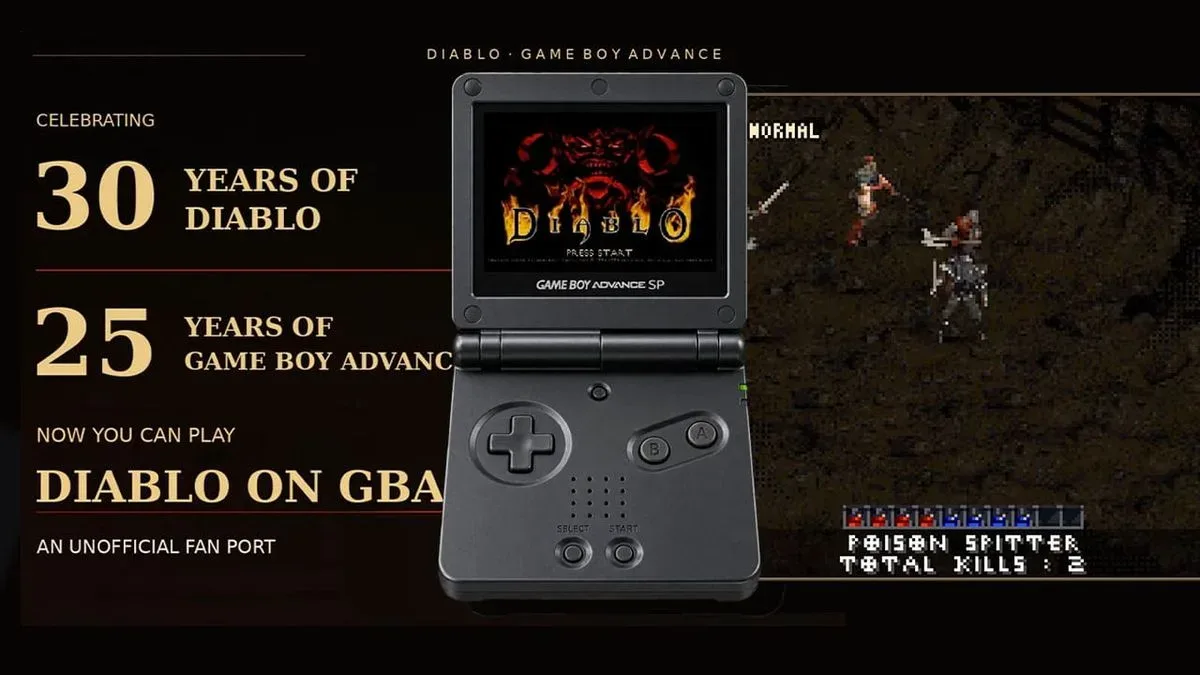
Diablo, the PC action RPG first released on December 31, 1996, is heading somewhere it never officially visited: the Game Boy Advance. An unofficial fan-made remake is being presented as a complete handheld adaptation of the original game, built around the distinctly early-2000s promise that a whole dungeon crawl can travel in a pocket.
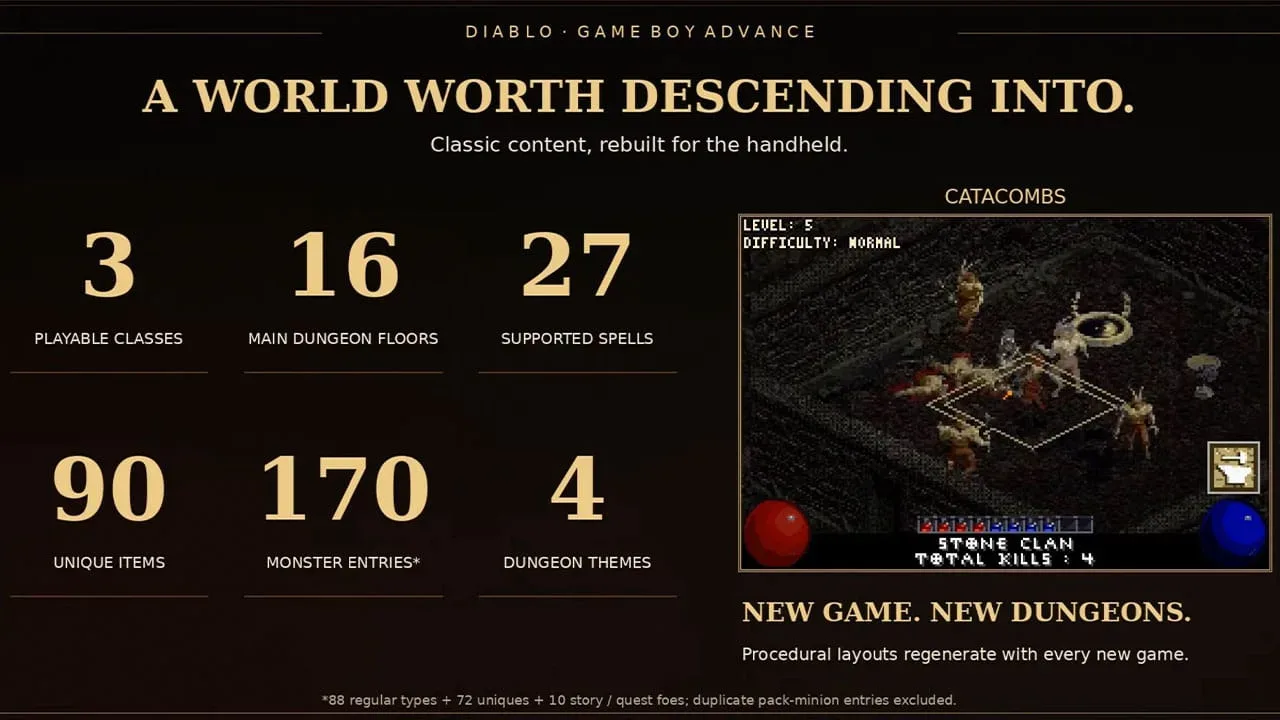
The project’s concise pitch is “hell fits in your pocket,” but the reported feature list is more substantial than that slogan suggests. It includes 16 dungeon floors, three playable classes, four dungeon themes, 27 supported spells, 90 unique items and a bestiary with 150 monster entries. Most eye-catching of all, it supports up to four players through the GBA link cable.
That combination matters because it frames the project as more than a visual novelty or a stripped-down reinterpretation. The stated goal is to carry Diablo’s core structure onto Nintendo’s handheld while reworking its character sheets, quest logs, spell access and menus for a much smaller screen and a much more limited control layout.
A PC dungeon crawler squeezed into a handheld format
The original Diablo predates the Game Boy Advance by several years. Diablo arrived in 1996, while the GBA followed in 2001. That order is worth noting when discussing the new version: this is not a period release that has resurfaced, nor is it a contemporary commercial conversion. It is an unofficial project revisiting an older PC game through hardware that was itself already a later system.
Calling the project a remake is more precise than calling it a simple port. A port generally describes software moved from one platform to another, while retaining its underlying design as directly as the target hardware allows. A remake, by contrast, implies that assets, systems or interface elements have been rebuilt for the destination. Here, the reported redesign of menus and player-facing screens is central to the effort.
Diablo’s gameplay depends on a constant flow of information: character statistics, equipment, quests, spells and collected loot all need to be readable and usable. On a PC, those tasks benefit from a larger display and a broad set of inputs. On a Game Boy Advance, the same functions have to be organized around a compact handheld display and a small set of buttons. The project reportedly addresses that challenge with reworked character sheets, quick spell slots, quest logs and menus.
A quick spell slot is particularly important in this context. It refers to an assigned shortcut for casting or selecting a spell without repeatedly navigating through a larger menu. In a fast-moving action RPG, reducing menu friction can be as important as preserving the number of available abilities. The remake is said to support 27 spells, so a sensible way to access them is essential to making that feature list practical rather than merely decorative.
What players can expect in the dungeon
The adaptation reportedly covers 16 floors spread across four familiar dungeon environments: the Cathedral, Catacombs, Caves and Hell. Those themes establish a progression from religious ruins to deeper and increasingly hostile spaces, preserving the original game’s descent-oriented structure in compact form.
Related coverage includes Diablo Gets an Unofficial Game Boy Advance Port With Four-Player Co-Op.
The game also offers three classes. The available information does not identify those classes or detail their mechanics, so it would be premature to assume exactly how each has been implemented. Still, the inclusion of three character choices is a meaningful sign that the remake is attempting to preserve different approaches to combat and spell use rather than reducing the adventure to a single fixed hero.
Its reported bestiary contains 150 monster entries. A bestiary is an in-game reference catalogue for enemies, generally used to organize information on the creatures encountered during play. Alongside the stated 90 unique items, that figure points to an adaptation concerned with Diablo’s repeatable loot-and-combat loop as well as its dungeon path.
Unique items are named or specially defined pieces of gear distinguished from ordinary equipment. Their presence is a notable fit for Diablo’s format: finding and evaluating equipment is part of the game’s appeal, and a portable version needs that reward structure to feel like more than a series of abbreviated fights. The supplied information does not explain item properties, drop behaviour or progression balance, so those implementation details remain unclear.
Four-player link-cable co-op is the standout feature
The most ambitious reported feature is local multiplayer for up to four players using the GBA link cable. A link cable is a physical accessory that connects compatible Game Boy systems for direct local communication. Before online play became the standard expectation, it was a defining piece of handheld multiplayer: participants needed to be together, each with the needed hardware, rather than simply joining a remote lobby.
For a game associated with adventuring through hostile spaces and building a party, four-player support changes the appeal of the GBA adaptation considerably. Rather than treating the handheld as a solitary compromise, the project makes room for a group setup built around connected consoles. It is a very different proposition from passing a phone around or opening a multiplayer app, and one that suits the physical, social nature of the GBA era.
There is also a fallback for people without a link cable. The port reportedly allows a party to be filled out with three CPU-controlled companions. CPU, short for central processing unit, is commonly used in games to describe computer-controlled teammates or opponents. This option means a lone player can still travel with a full four-member group, though the supplied details do not describe companion behavior, commands or difficulty tuning.
Link-cable co-op does not automatically make a project easy to use in practice. Four-player sessions require compatible hardware, a cable arrangement and other people willing to bring their systems. But for enthusiasts who already own Game Boy Advance hardware, the requirement is also part of the attraction. It turns multiplayer into a deliberately local event instead of an invisible network service.
Graphics, constraints and the appeal of a faithful fit
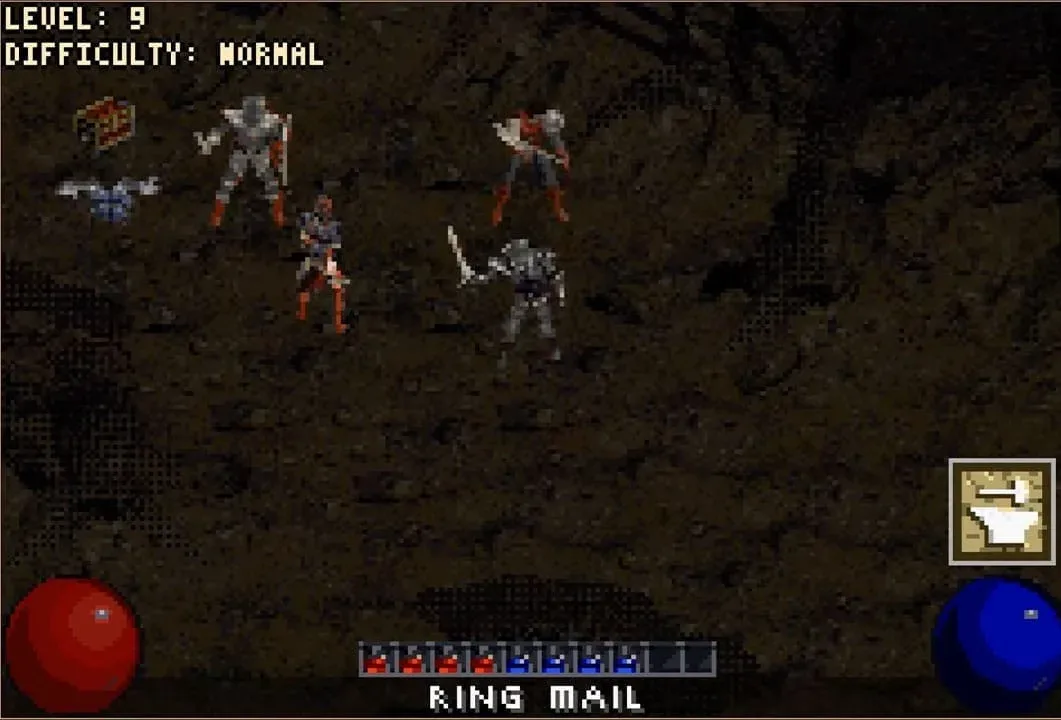
Visually, the remake is said to stay relatively close to the PC game, while naturally losing some clarity because the Game Boy Advance cannot match the capabilities of the original PC presentation. That is a useful distinction. The project is not being positioned as a dramatically reimagined “demake” with a wholly different identity; it is trying to make the older game recognizable within the GBA’s technical limits.
A demake usually reinterprets a game for substantially older or less capable technology, often by making deliberate stylistic and mechanical changes. This adaptation occupies a more unusual space. The GBA is younger than Diablo, but it remains a handheld with far tighter limitations than the PC environment for which Diablo was made. That leaves the project balancing recognizable visual language against necessary compromises in interface and display detail.
That work is exactly where fan adaptations can become interesting. It is easy to summarize a conversion as a list of screens, floors and feature counts. It is harder to make inventory management, spell selection, quest tracking and party play feel coherent on a small portable system. The reported interface redesigns suggest the developers understand that the handheld version must be shaped around the device, not simply compressed onto it.
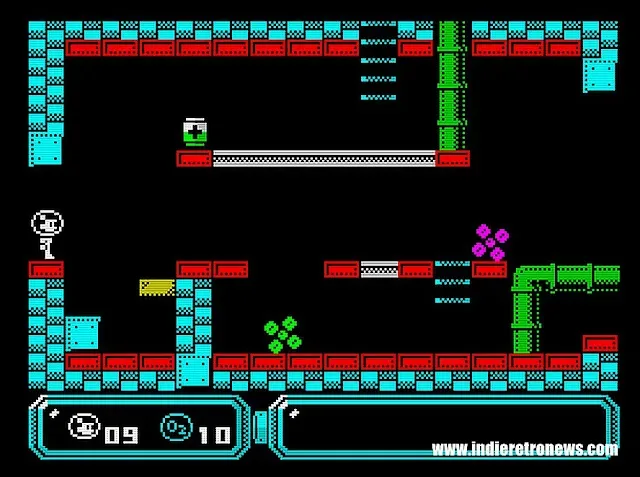
Recent retro projects continue to show that old hardware remains a platform for new ideas. For another example of a modern game targeting legacy technology, Outpost’s ZX Spectrum 48K release illustrates how developers can build around the particular limits and character of a classic machine rather than treating them as a reason not to create.
Practical details remain limited
The currently available information identifies the project as unofficial and refers to a ROM Converter linked through its accompanying video for people who want to run it on a GBA. A ROM is a software image used by hardware or compatible devices to run a game. Beyond that reference, the supplied details do not establish supported hardware methods, setup steps, file requirements or whether the project is designed for original consoles, modified systems or other means of play.
That uncertainty is important for interested players. The feature list establishes the intended scope of the remake, but it does not answer every practical question surrounding access or configuration. Likewise, no performance claims, release timetable, compatibility list or development roadmap are provided here.
What is clear is the scale of the ambition: Diablo’s 16-floor descent, four environment types, spellcasting, items, monster catalogue, party system and local multiplayer are all being brought together for a handheld released in 2001. For fans of both Diablo and Game Boy Advance hardware, the prospect is less about replacing the PC original than seeing how much of its dungeon-crawling identity can survive—and function—on a portable machine.