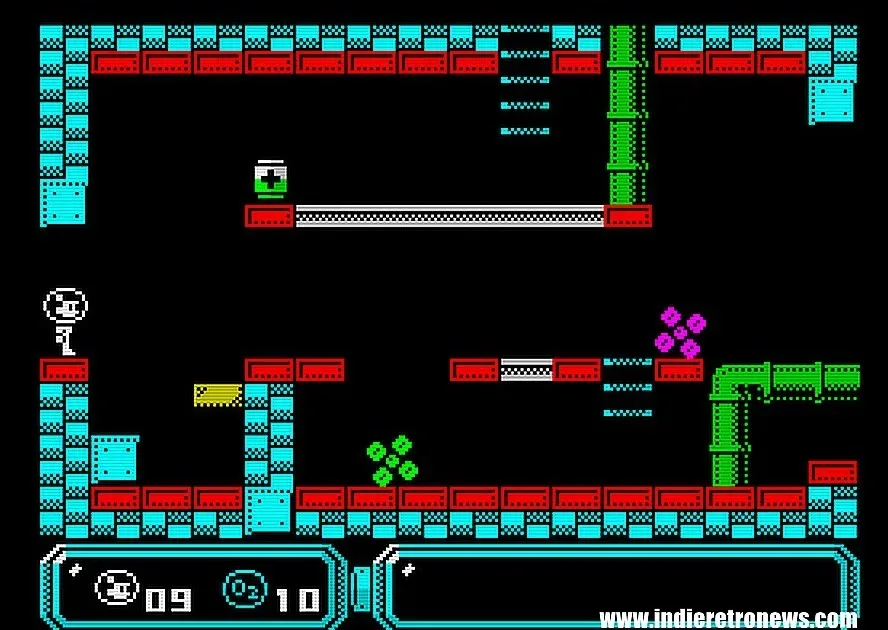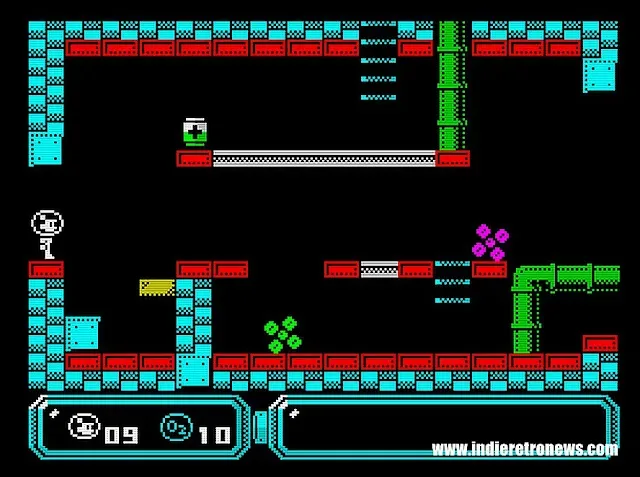
There is a very particular kind of panic that begins with waking up in a medical pod after a spaceship crash. In Outpost, that bad start gets worse quickly: the seemingly deserted mining facility is home to aggressive alien creatures, and the route off the hostile planet runs through its dangerous interior.
Developed for the classic ZX Spectrum 48K, Outpost is a new platform-adventure from Juan J. Martínez. Its basic objective is cleanly stated but likely demanding in practice: explore the mining outpost, stay alive amid its inhabitants, locate the route to escape, and leave the planet. The structure behind that objective is a 90-screen map with eight crucial items. Those items open hidden portions of the outpost and, ultimately, make escape possible.
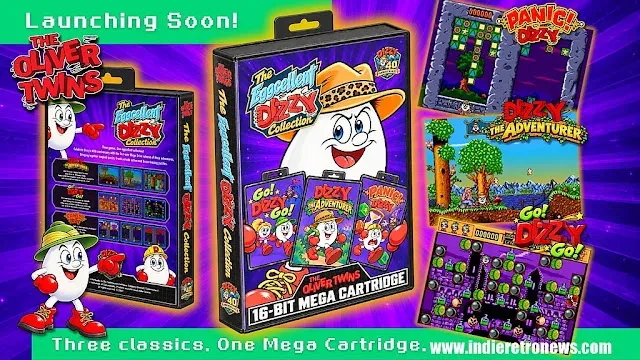
The result is being framed as a meeting point between the approachable adventure-platforming associated with the Oliver Twins’ Dizzy series and the progressive exploration of a Metroidvania. That combination matters because it describes more than a visual or tonal throwback. It points to a game built around learning a place, recognizing barriers, and making meaningful use of objects found elsewhere in that place.
A mining outpost built for exploration
Outpost begins after the player character’s ship has crash-landed. They awaken in a medical pod inside a mining outpost that appears vacant at first. The illusion does not last: aliens populate the base, turning an already unfamiliar sci-fi environment into a hazardous platforming space.
The mining setting serves the game’s design premise well. An outpost can naturally be divided into discrete rooms, corridors and facilities, making its 90-screen structure feel like a connected location rather than a sequence of unrelated levels. Each screen can be a small platforming challenge, but the larger challenge is understanding how those spaces relate to one another and which newly acquired object changes what is possible.
That is where Outpost’s eight key items become central. They are not described as optional pickups or score items. They are necessary objects tied to hidden sections of the map and to the player’s eventual way home. In other words, their function is progression: collecting the right item gives access to a previously inaccessible part of the outpost.
That loop gives exploration a purpose beyond simply seeing every screen. A player may encounter a route they cannot yet use, continue searching through the areas currently available, recover an important object, then return with a new way forward. The source material does not specify what any individual item does, nor how the eight are ordered, so the exact nature of those obstacles remains unknown. What is clear is that Outpost uses items to connect discovery with advancement.
What “Metroidvania” means here
Metroidvania is a broad term for exploration-driven action games in which progress is typically controlled by abilities, tools or other unlocks. Rather than presenting one irreversible path from start to finish, these games often encourage revisiting earlier places once the player has acquired something that removes a barrier.
Related coverage includes Outpost Targets ZX Spectrum 48K With Dizzy-Inspired Exploration.
For Outpost, the useful takeaway is not an assumption that it reproduces every convention associated with that label. The confirmed details are more specific: there are 90 screens, eight essential items, and hidden map sections opened by those items. That is enough to establish an item-gated exploration structure. It does not, on its own, confirm combat systems, an experience system, a map interface, boss encounters, multiple endings, or any particular movement upgrades.
Keeping that distinction in mind is especially important with a 48K game. “Metroidvania” can describe the logic of exploration without suggesting the scale or technical presentation of a contemporary game. Outpost’s take is centered on compact screens, platforming hazards, enemies and a handful of pivotal objects. The interest lies in how carefully those pieces can be arranged within a single hostile base.
Dizzy’s influence points to adventure-platforming
The Dizzy comparison adds another useful clue. The Oliver Twins’ series is invoked for its nostalgic adventure-platforming character, an approach that pairs navigation challenges with the search for and use of objects. Outpost is not stated to be a Dizzy sequel, licensed release or remake; it is a new game inspired by that style.
In this context, the influence helps explain why the item hunt is such a prominent part of the premise. Outpost is not described merely as a platformer where players travel through 90 screens while avoiding danger. The eight objects are essential to uncovering new areas and escaping the planet, making the game’s world navigation and objective-solving inseparable.
The sci-fi setting also distinguishes the game’s identity from the fantasy-adventure associations many players may have with Dizzy. Outpost replaces that kind of storybook framework with a crashed ship, a medical pod, a mining installation and aliens. The emotional direction is correspondingly more uneasy: the player begins stranded, isolated and immediately vulnerable.
Made for the Spectrum 48K, including its sound
Martínez handled Outpost’s development alone, taking responsibility for the coding, graphics and audio. That is a meaningful detail for a game designed for the ZX Spectrum 48K, because each of those disciplines shapes how the finished experience communicates its world. The code governs movement and screen-to-screen logic; graphics establish readable environments and threats; sound provides feedback and atmosphere. In a platform-adventure where players are navigating hazards while tracking progress through an unfamiliar installation, clarity across all three is valuable.
The audio uses authentic 1-bit beeper music and sound effects. “1-bit” here refers to a very limited form of sound output: instead of the richer, multi-voice audio associated with dedicated sound chips or modern systems, the beeper works with simple on/off-style signals. The constraint produces a recognizable Spectrum character and asks composers to create music and effects within a narrow technical palette.
That choice is more than a retro flourish. The game is explicitly for the ZX Spectrum 48K, so using beeper audio ties its atmosphere to the hardware tradition it is addressing. The alien threats, platforming action and abandoned-outpost premise will be accompanied by sound designed around that machine’s distinctive limitations rather than treated as an afterthought.
The practical appeal of a 90-screen quest
Ninety screens sounds substantial, but it does not necessarily mean a sprawling game in the modern open-world sense. The more useful way to read the number is as a promise of a sizable connected play space for a screen-based platform adventure. The crucial design question is how those screens are used: which ones test timing, which ones conceal or protect progress items, and which ones become newly useful once a barrier has been removed.
Because only eight items are identified as crucial, they may act as clear milestones through the journey. That can create a focused rhythm: explore, survive, acquire, reassess the outpost, and push into the next locked-off section. It also gives every item narrative weight. They are tools in the broader attempt to turn a crash landing into an escape.
There are deliberate unknowns around Outpost. No release timing, distribution method, price, control scheme or platform support beyond the ZX Spectrum 48K has been provided. There is also no detailed breakdown of the aliens, the names of the items, or the exact layout of the 90 screens. Those gaps make it sensible to focus on what has been established: a complete, self-contained sci-fi platform-adventure premise with a defined exploration structure and authentic machine-specific audio.
Why projects like Outpost matter
New games for older platforms demonstrate that retro hardware remains a creative destination, not solely a museum piece. The appeal is not only nostalgia. Working within a recognizable set of limitations can encourage precise design decisions: compact rooms, legible threats, deliberate item placement and audio that makes a virtue of limited means.
Outpost fits that continuing interest in fresh software made around classic systems and their distinct identities. The wider retro scene can also produce unexpected technical projects, as seen in a community showcase of World of Warcraft running on Dreamcast. Outpost takes a different route: rather than adapting a massive existing game, it is an original adventure designed around the ZX Spectrum 48K itself.
For players drawn to classic screen-by-screen platformers, Outpost’s appeal is easy to identify. It offers a hostile alien outpost to chart, 90 screens to negotiate, eight vital objects to recover and a single urgent goal: find a way back home alive. Its combination of Dizzy-inspired adventure sensibilities, item-gated exploration and Spectrum beeper sound gives the project a defined character without needing to overstate what has not yet been detailed.