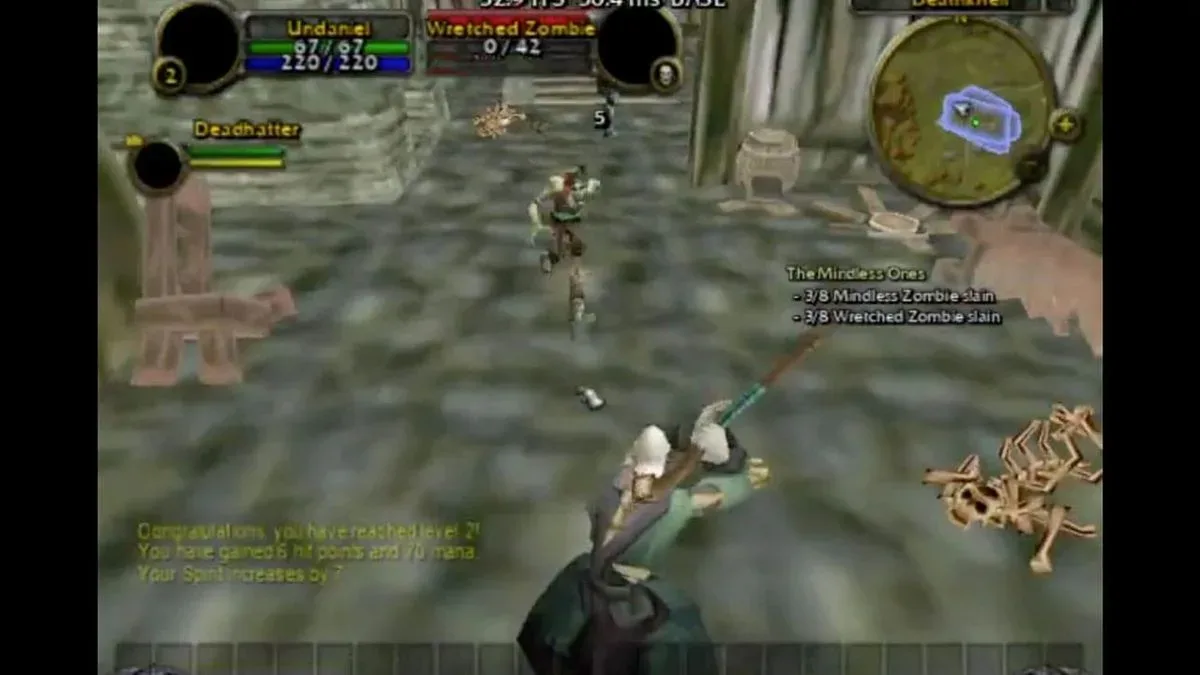
World of Warcraft on a Sega Dreamcast sounds like the sort of sentence produced when a bargain-bin keyboard has been left alone with a time machine. Yet footage shared by Dreamcast developer Falco Girgis shows the MMO running on the console and participating in online play.
The showcase is significant less because it turns the Dreamcast into a new official home for Blizzard’s long-running online game—this is plainly a community effort, not an official release—and more because it demonstrates an ambitious attempt to make a PC-era online game operate on hardware with a very different original purpose. The footage includes gameplay across multiple areas and segments featuring user @cypress577422 playing with another person.
Girgis says the game engine has been made to fit across two discs. He also says all character classes and abilities are working in the build shown. Those are substantial claims for a console better known for its own library and for an era when online console play was still a much more unusual proposition. The available footage is a useful demonstration, but it is not the same thing as a comprehensive compatibility report. Players interested in the project should treat its scope, access and remaining limitations as details to verify as development continues.
The shared video post offers the clearest look at the project in motion: not merely a menu or loading screen, but a running game with online activity. For retro hardware enthusiasts, that distinction matters. Getting software to boot is one hurdle; maintaining playable behaviour, networking and the web of class abilities that an MMO depends on is a much larger one.
For more context, explore Your PC’s Tiny CMOS Battery Can Turn Every Boot Into a Fresh Start Nobody Asked For.
What the Dreamcast build reportedly includes
The project is described as a version built around the original, or “vanilla,” World of Warcraft style of player-versus-player systems, with several additions tailored specifically to this Dreamcast implementation. Girgis has outlined the following elements:
- All classes and abilities working, as claimed by the developer.
- A complete engine build distributed across two discs.
- Online support through the Dreamcast Broadband Adapter.
- Custom pets, mounts, quests and recipes.
- Arenas supporting teams of up to three players, drawing from later expansions while operating alongside vanilla PvP systems.
- Double experience gains when leveling until level 20, after which experience returns to the normal rate.
That list describes something more specific than a straight preservation-minded recreation. Custom quests, recipes, pets and mounts indicate that the server-side experience has been adjusted for this version. The early-level double-XP rule is another deliberate design decision rather than an inherent property of classic World of Warcraft.
In MMO terms, XP, short for experience points, is the progression value earned to advance a character’s level. A 2x XP rate means progression through the earliest levels is accelerated. Setting that rule to end at level 20 suggests an effort to speed up a player’s initial journey while preserving a more regular progression pace after that point. It also illustrates why this project should not be understood simply as a historical PC build transferred unchanged to Dreamcast discs.
Related coverage includes World of Warcraft Is Running on Dreamcast in a New Community Port Showcase.
What is not in the reported build
Girgis has also been clear that the project does not encompass every accessible piece of content. GM Island is not included, nor is other content that can be accessed in the broader game environment.
“GM” commonly means game master: a role associated with administrative and support tools in online games. GM Island is therefore separate from the ordinary player-facing adventure most people associate with leveling, dungeons and PvP. Its omission does not erase the technical achievement of the demonstration, but it is a reminder that “complete engine” and “every piece of accessible content” are not interchangeable claims.
That distinction is especially useful when assessing fan ports. A project can have a functional core—character control, areas, combat systems, classes and networked play—while still omitting locations, tools or edge-case content. The footage and development notes support the former; they also openly identify a boundary around the latter.
Why broadband support is central to the idea
World of Warcraft is an online game, so a port is only meaningful if it can communicate with other players and the service infrastructure supporting the experience. The Dreamcast build is said to support Sega’s Broadband Adapter, enabling online play through that accessory.
A broadband adapter is hardware that provides a network connection suitable for data communication. In this context, it is not a cosmetic optional extra: it is the route that makes the port’s multiplayer component possible. The shared footage’s online segments are consequently the most important part of the showcase. They move the project beyond the interesting-but-limited novelty of a locally running game and toward the central premise of an MMO: a shared world occupied by other people.
There is still a practical line worth drawing. Broadband Adapter support does not, by itself, establish who can access the project, how a player would configure it, what server environment is required, or whether every scenario performs identically. None of those specifics are established here. What has been shown is that online play is part of the demonstrated goal, rather than a theoretical feature listed for some distant future build.
A port that is also a custom ruleset
The arena note is one of the more revealing details. The reported inclusion of up-to-3v3 arena play from future expansions alongside vanilla PvP systems mixes material from different points in World of Warcraft’s history. Rather than presenting one untouched era, the project appears to be creating a particular Dreamcast-friendly blend.
For players, that can matter as much as the platform itself. PvP means player versus player, covering competitive combat between users rather than encounters controlled by the game. Arenas are a structured competitive format, and 3v3 refers to teams of three players facing one another. Their presence alongside earlier-style systems gives this version its own identity and potentially its own balance considerations.
Likewise, special quests and recipes create a version with content beyond a simple platform conversion. A recipe generally refers to an instruction used to create an in-game item through a crafting system. New recipes, like custom mounts or pets, offer reasons for characters to pursue material that is specific to this implementation.
That approach is a sensible fit for a fan project, where technical preservation and new design ideas can overlap. It does, however, mean prospective players should frame their expectations correctly. This is not presented as a replacement for every official incarnation of World of Warcraft. It is a community-built version shaped by the constraints and opportunities of Dreamcast hardware.
Dreamcast modders keep finding ambitious targets
This World of Warcraft demonstration arrives amid a broader run of high-profile Dreamcast community porting work. Recent examples cited around the scene include Grand Theft Auto III and Star Fox 64, while Nintendo 64 games such as Mario Kart, Diddy Kong Racing and DOOM 64 have also been brought into the conversation.
Those projects are not all technically equivalent. A single-player action game, a racing game and an online MMO present different problems, and one successful port does not automatically predict another. But together they show why the Dreamcast remains an active platform for modern hobbyist development: people are still willing to examine its capabilities, make unusual software fit, and build hardware or control solutions where the original design falls short.
The controller question is particularly relevant to games with PC roots. The Dreamcast’s standard controller did not arrive with dual thumbsticks, a layout now familiar across many console games. A game designed around different inputs may require adaptation, whether through altered control schemes or community hardware work. The World of Warcraft footage demonstrates operation, but it does not settle the broader question of how every player may prefer to control the game.
What the showcase actually proves—and what it does not
It is easy for a remarkable retro-hardware video to attract either exaggerated praise or reflexive suspicion. The balanced reading is simpler. The footage is evidence that a Dreamcast World of Warcraft project has been shown running, with online play visible. Girgis has provided a detailed set of claims about the two-disc engine, functioning classes and abilities, Broadband Adapter support, and custom content.
At the same time, the project’s creator acknowledges omitted content, and the available material does not establish an exhaustive feature matrix, universal performance standard or public availability plan. Those are not reasons to dismiss the work. They are the normal limits of what a short showcase can demonstrate.
Even with those limits, the port is an impressive expression of what keeps retro development scenes lively. The Dreamcast’s commercial life may belong to the past, but its community is still making it do unexpected things—up to and including sending characters into an online fantasy world that once seemed tied to a very different kind of machine.